At a glance
Kafbat UI and AKHQ are scored here on the same five criteria, 50 points in all: Kafbat UI 38 out of 50, AKHQ 37 out of 50. Kafbat UI takes its best score on Cost as teams grow (10 out of 10) and its lowest on Support and maintenance (5 out of 10). Cost a year, modelled: 8,640 US dollars, no licence fee. AKHQ takes its best score on Cost as teams grow (10 out of 10) and its lowest on Support and maintenance (5 out of 10). Cost a year, modelled: 8,640 US dollars, no licence fee.
AKHQ vs Kafbat UI, compared
Kpow meets 7 of 8 requirements on this page.
Key takeaway
AKHQ and Kafbat UI are both free, Apache 2.0, self-hosted and uncapped, so the choice is not about price. AKHQ is the more deployed and production-tested of the two, and its open problems are operational: two memory reports open since 2022 and 2025, and OIDC as its tracker’s most active failure surface. Kafbat UI has the finer access model, with permissions scoped to eight resource types, though its audit level defaults to ALTER_ONLY, so reads go unrecorded. Kpow by Factor House is the licensed, self-managed alternative, and it is not open source.
Kpow live demo
Test the trade-offs in a live Kafka UI
You have compared AKHQ vs Kafbat UI. Open a live Kpow environment to test the everyday workflows a shared Kafka platform needs.
Built for platform and data teams managing shared Kafka clusters.
Try the Kpow demoWhat is AKHQ?
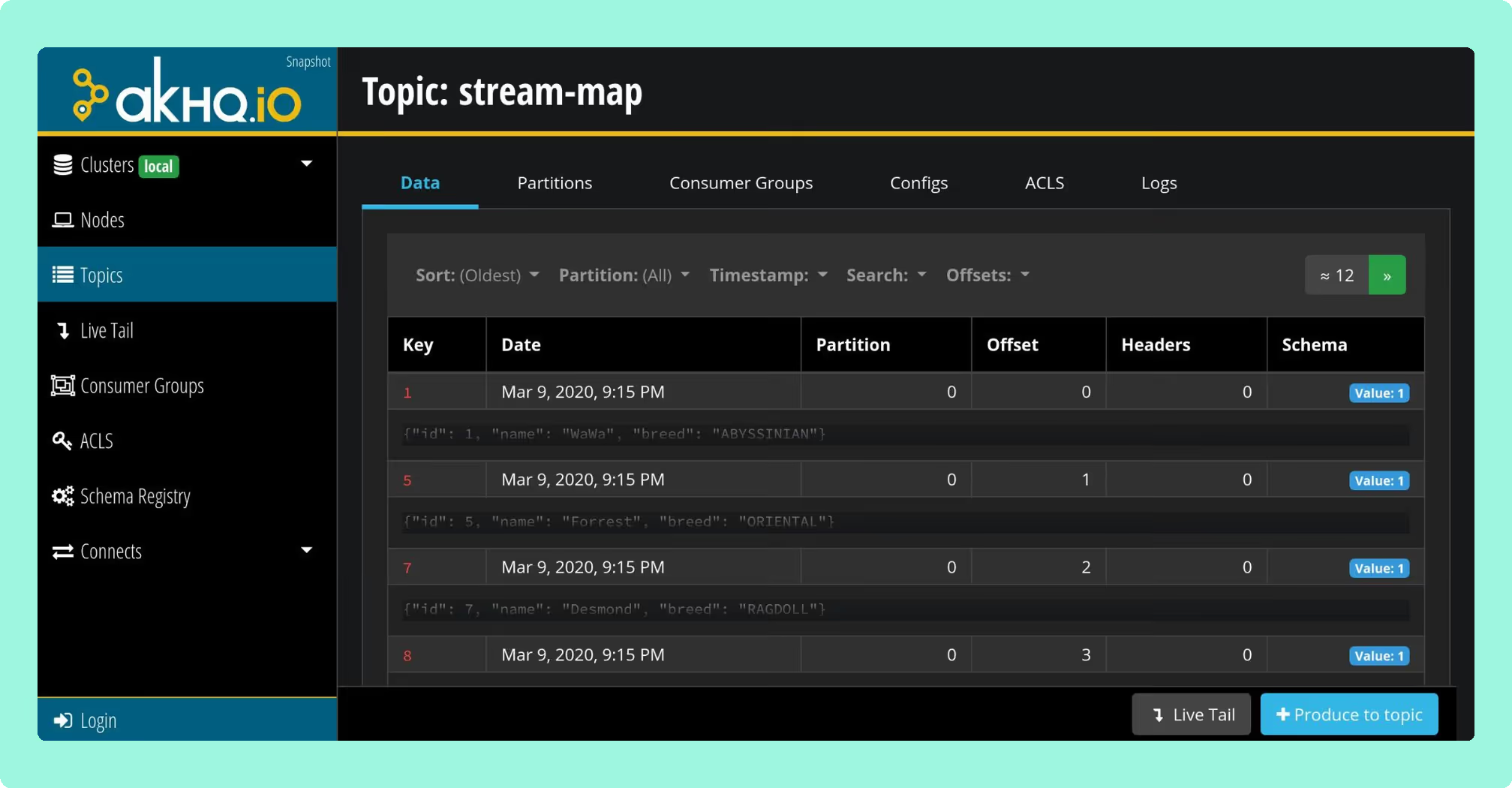
AKHQ is an open-source Kafka management UI under Apache 2.0, formerly KafkaHQ, self-hosted and built on Micronaut. One deployment reaches one cluster or many, covering topic browsing, live tailing, producing, consumer groups, Schema Registry, Kafka Connect, ACL management and role-based access with LDAP and OIDC. There is no commercial edition, no hosted service and no paid support tier.
- Releases: 0.28.0 on 6 August 2026, after 0.27.1 in May and 0.27.0 in March.
- Maintainership: concentrated, at 441 commits from the lead maintainer and 82 from the next human contributor.
- Adoption: the README names BMW Group, Klarna, Best Buy, Decathlon and Michelin among others.
- Contributions: Michelin built resource-level RBAC on the default authorisation model and contributed it back.
What is Kafbat UI?
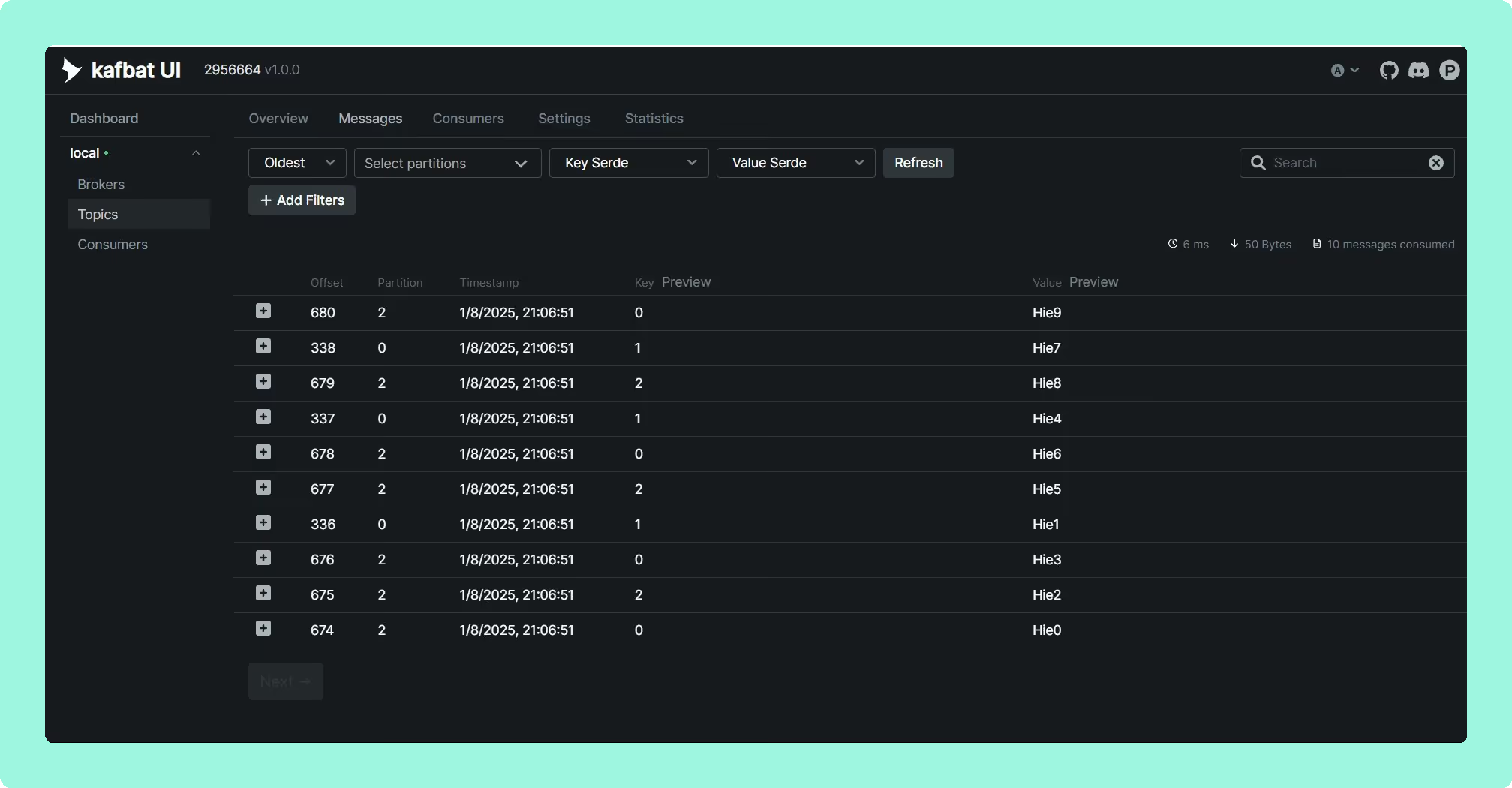
Kafbat UI is a free, Apache 2.0 web dashboard for observing and managing Kafka clusters, deployed as a container rather than installed per engineer. It is the maintained continuation of the Provectus kafka-ui project, carried forward by contributors who were there from that project’s inception. Kafbat sells services around the software instead of a paid edition of it.
The fork history is why the two names collide in search. Provectus kafka-ui shipped its last release, v0.7.2, in April 2024 and took its last commit that July. Kafbat is where the work went. The dormant repository carries 12,200 stars against Kafbat’s 2,642, so the first result many engineers reach is the abandoned one, and the old image is still being pulled by teams who believe they are running the current project.
What is the official 2026 pricing of AKHQ and Kafbat UI?
Both are Apache 2.0, and neither has a paid tier, a seat cap, a cluster cap, a registration step or a feature withheld for a commercial edition. The real cost on both sides is operator time. What money can buy is where they differ: Kafbat sells professional services around the open-source product, quoted rather than listed and also sold through AWS Marketplace, covering architecture review, custom UI implementation, performance and scaling, security and compliance, and 24/7 support. AKHQ has nothing to buy, so the escalation path ends inside your own team.
What the deployment costs to run is close to identical. Both are stateless containers with no external database, both are configured in YAML or through environment variables, and both are reproducible in source control alongside the cluster list. Kafbat publishes a Helm chart whose example values are 200m of CPU and a 512Mi memory limit against a 256Mi request, which is a starting point rather than an answer at scale.
Where does each one run out?
Both are scored out of 50, as five criteria marked out of 10, and each criterion carries the same weight as the others. Nothing sits behind a multiplier, so a total is the sum of its five marks and a reader can recompute it. The five are cost as teams grow, deployment footprint, support and maintenance, access control and audit, and multi-cluster reach, because those are the questions a Kafka interface is actually measured against after the first month: a second cluster, an access review with a date on it, an upgrade nobody owns, and a bill that moves when the team does. The widest gap between the two marks is on access control and audit, where AKHQ marks 5 and Kafbat UI marks 6. The marks come from the same matrix used on every comparison on this site, so a tool scores the same here as it does anywhere else, and the reason behind each mark is in the card below, under Why these scores.
The dependency figures in the cards below were read on 24 September 2026 from each project’s published release artefact and matched against the NVD and GitHub advisory databases, so they move whenever a release or an advisory lands. Every jar AKHQ ships resolves to a Maven coordinate, while only 150 of Kafbat UI’s 266 do, so Kafbat UI’s figure is a floor rather than a total and the two counts do not rank each other. Kpow is self-hosted as well. What a licence buys here is not a different deployment model, it is a company under contract to ship the patched build.
 Rank 1
 Kafbat UI
38 out of 50 Total
- Cost a year, modelled
- 8,640 US dollars, no licence fee
- Latest release
- v1.5.0, 20 April 2026
- Support
- GitHub issues, or paid services
- Cost as teams grow
- 10 out of 10
- Deployment footprint
- 8 out of 10
- Support and maintenance
- 5 out of 10
- Access control and audit
- 6 out of 10
- Multi-cluster reach
- 9 out of 10
Why these scores for Kafbat UI
- Cost as teams grow 10 out of 10
- The compare figure gives free, Apache 2.0, with no seat cap and no cluster cap on the software. This page’s modelled cost of ownership is about 8,640 US dollars a year at 6 engineer-hours a month and 120 US dollars an hour; the 10 is for the bill not moving as the team grows, not for total cost.
- Deployment footprint 8 out of 10
- This page gives a stateless container with a published Helm chart whose example values are 200m of CPU and a 512Mi memory limit. It is docked because the config wizard’s writes are lost on restart without a volume.
- Support and maintenance 5 out of 10
- The compare figure has professional services quoted rather than listed, and also sold through AWS Marketplace, but no SLA and no tagged release since 20 April 2026.
- Access control and audit 6 out of 10
- The compare figure gives permissions scoped to eight resource types with regular-expression subjects, server-side REMOVE, REPLACE and MASK policies, and a built-in audit trail; it beats AKHQ here by one.
- Multi-cluster reach 9 out of 10
- This page gives clusters declared in YAML, uncapped, the same reach as AKHQ.
This page's cost estimate: no licence fee, and about 6 engineer-hours a month to run the container, set the audit level to ALL, raise the audit topic’s partition count and declare clusters in YAML rather than the wizard, at 120 US dollars an hour, is about 8,640 US dollars a year.
Kafbat’s audit trail is the better of the two on paper, and its defaults undo half of it. The level switch defaults to ALTER_ONLY, so who changed something is captured and who read a payload is not, until an operator sets ALL.
Audit topic: must not be compacted, because records carry no key, and its partition count defaults to 1.
Masking: covers what the Messages page displays, per cluster and pattern-driven, so coverage depends on the patterns written.
Releases: five tags across 2025, then v1.5.0 on 20 April 2026 and none since, against commits still landing in August 2026.
Dynamic config: the wizard writes inside the container and overwrites the file in full each submission, so UI changes are lost on restart without a volume.
Staying patched: v1.5.0 shipped in April 2026 and nothing has shipped since. In the 157 days after it, at least 20 high or critical advisories were published against libraries that release bundles, including a critical in netty. Only 150 of its 266 bundled jars resolve to a Maven coordinate, so that is a floor rather than a total, and the state of the release itself is unmeasured. Kafbat does publish a security policy, which AKHQ and Kafdrop do not.
Compare Kpow vs Kafbat UIKafbat UI vs KafdropKafbat UI review
 Rank 2
 AKHQ
37 out of 50 Total
- Cost a year, modelled
- 8,640 US dollars, no licence fee
- Latest release
- 0.28.0, 6 August 2026
- Support
- GitHub issues, no SLA
- Cost as teams grow
- 10 out of 10
- Deployment footprint
- 8 out of 10
- Support and maintenance
- 5 out of 10
- Access control and audit
- 5 out of 10
- Multi-cluster reach
- 9 out of 10
Why these scores for AKHQ
- Cost as teams grow 10 out of 10
- The compare figure gives free, Apache 2.0, no paid tier and no commercial support, level with Kafbat UI on price. This page’s modelled cost of ownership is about 8,640 US dollars a year at 6 engineer-hours a month and 120 US dollars an hour; the 10 is for the bill not moving as the team grows, not for total cost.
- Deployment footprint 8 out of 10
- This page gives a stateless container with no external database, configured in YAML and reproducible in source control, the same shape as Kafbat UI.
- Support and maintenance 5 out of 10
- The compare figure gives GitHub issues and no SLA, three releases in the eight months to August 2026, and 441 commits from one maintainer.
- Access control and audit 5 out of 10
- The compare figure gives groups over LDAP, OIDC and HTTP basic with claim mapping, but masking is one filter per topic in global YAML and audit is opt-in.
- Multi-cluster reach 9 out of 10
- On this page, one deployment reaches one cluster or many, including on-premise, factory and MSK IAM clusters.
This page's cost estimate: no licence fee, and about 6 engineer-hours a month to size the JVM, watch the two open memory reports and keep OIDC working, at 120 US dollars an hour, is about 8,640 US dollars a year.
AKHQ has both masking and audit logging, and both are shallower than the feature names suggest. Masking takes four modes and lives in the application YAML, keyed on topic and field path, so what is hidden does not vary by who is looking. Only one filter per topic is supported, which breaks where RecordNameStrategy puts several record types on one topic.
Audit: opt-in, sunk to a Kafka topic the operator nominates, with no audit view in the product. 0.28.0 widened it to produce, delete and empty topic.
Memory: a report open since July 2022 and last touched in March 2025, and a second from May 2025 with no response.
OIDC: the most active failure surface in the tracker, with new reports still arriving in August 2026.
Metrics: port 28081 reports AKHQ’s own health. The request for Kafka JMX collection has been open since September 2021.
Staying patched: release 0.28.0, cut on 6 August 2026, bundles 270 libraries and 18 of them carry a high or critical advisory. Sixteen of the eighteen were already public, with fixed versions already on Maven Central, on the day it shipped, and five of those are netty CVEs Kpow had already remediated in release 96.2 three weeks earlier: CVE-2026-44249, CVE-2026-45416, CVE-2026-45674, CVE-2026-47691 and CVE-2026-50010. The oldest has been open 108 days. Every jar AKHQ ships resolves to a coordinate, so this is a complete count rather than a floor, and each identifier can be checked at nvd.nist.gov. A shipped vulnerable library is exposure and remediation latency, not a working attack.
Which should you pick?
Kafbat UI scores higher here, 38 against 37, on the finer access model: permissions scoped across eight resource types, against AKHQ’s masking filters written once into the application YAML. AKHQ is the more deployed and production-tested of the two. Neither has a support commitment behind it, so a regulated team that needs RBAC, audit and a vendor under contract to ship the patched build should choose Kpow by Factor House.
Pick AKHQ if:
- the deployment record matters more than the interface
- the estate includes on-premise or factory clusters, or MSK IAM authentication
- a GitOps configuration model is already in place
- an adoption list has to survive an architecture review
Pick Kafbat UI if:
- the access model is the project, at eight resource types with regular-expression subjects
- the audit trail has to be built in rather than bolted on
- an agent needs a documented route in through the MCP server behind
mcp.enabled
On Kafbat, set the audit level to ALL on day one, raise the audit topic’s partition count before the deployment gets busy, and declare clusters in YAML rather than through the configuration wizard. The choice is not really between two feature sets, because those converge. It is between a project whose problems are in the tracker with nobody paid to close them, and a project whose code is healthy and whose release cadence is the thing being bet on. Both are ranked against the rest of the free field in the best free Kafka UI tools, and the audit question they split on is compared across the field in Kafka audit logging tools.
Kpow: masking that doesn’t wait on someone to remember
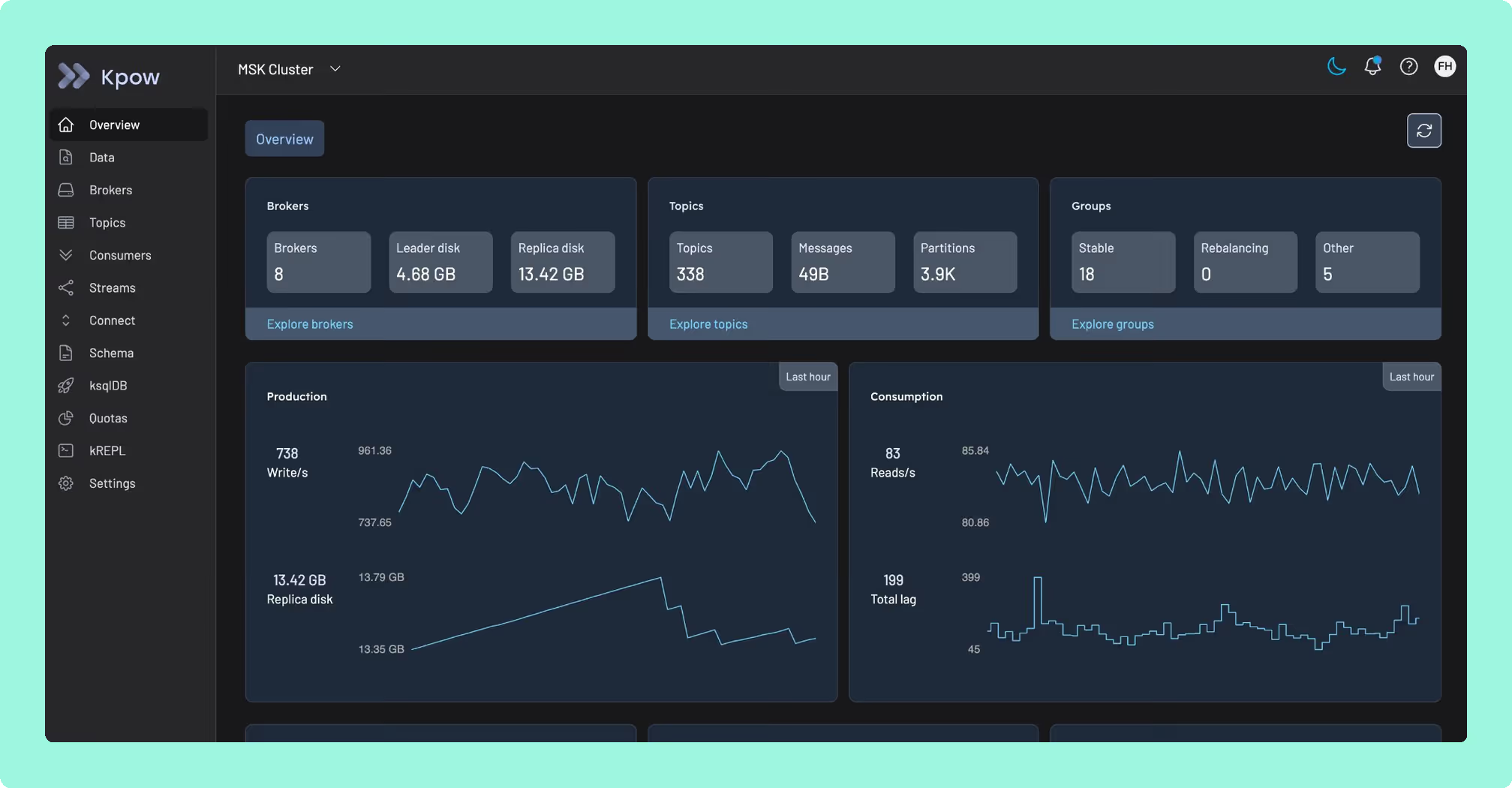
AKHQ and Kafbat UI both hand governance to whoever remembers to configure it. AKHQ’s masking lives in global application YAML with one filter per topic, so what’s hidden doesn’t vary by who’s looking, and Kafbat’s audit level defaults to ALTER_ONLY, so reads go unrecorded until an operator sets it to ALL. Kpow by Factor House ships server-side masking built in, so it doesn’t depend on a default nobody changed. It’s self-managed tooling for the cluster you already have, licensed per cluster from 4,500 US dollars a year with 100 users included, so what you pay doesn’t move when the team does: one stateless JVM container, no external database, and up to 12 clusters from one instance.
Governance shouldn’t depend on who’s staffing it this quarter. Trying Kpow against a cluster you already run shows what it looks like built in instead of remembered.
Product demo · 2 min
Apache Kafka data masking & PII protection: Kpow demo
Chad Harris walks through data masking in Kpow: last-four, full, and email-domain masking rules applied during data inspection, and the data policy playground for testing redaction rules like show-first and hashing before rolling them out.
How these tools were scored
Every option is scored from 0 to 10 on each criterion, from the evidence and sources this page cites, and the reason for each score is on its card. Each criterion counts once, for a total out of 50. The options are listed by total.
Sources
- Apache Kafka documentation on authorization
- Apache Kafka documentation on log compaction
- Apache Kafka documentation on monitoring