At a glance
Kpow and AKHQ are scored here on the same five criteria, 50 points in all: Kpow 44 out of 50, AKHQ 37 out of 50. Kpow takes its best score on Access control and audit (10 out of 10) and its lowest on Cost as teams grow (7 out of 10). Cost a year: $7,380 on one cluster: $4,500 published plus $2,880. AKHQ takes its best score on Cost as teams grow (10 out of 10) and its lowest on Support and maintenance (5 out of 10). Cost a year: $0 licence, $8,640 in operator time (this page's estimate).
Kpow vs AKHQ, compared
Kpow meets 6 of 7 requirements on this page. One row is not a yes or no question.
Key takeaway
Kpow by Factor House and AKHQ read the same cluster and cover the same topics, consumer groups, schemas and access control, so the decision comes down to what you pay in. AKHQ takes operator time: masking is global YAML rather than role-aware policy, its audit trail is an opt-in Kafka topic rather than a built-in view, and there is no paid tier and no support contract to call at 03:00. Kpow takes a per-cluster licence instead, as one stateless container with a published price.
Kpow live demo
See Kpow in a working Kafka environment
You have seen how Kpow compares on paper. Open the live demo to test the workflows your platform team will depend on during an incident.
Built for platform and data teams managing shared Kafka clusters.
Try the Kpow demoWhat is AKHQ?
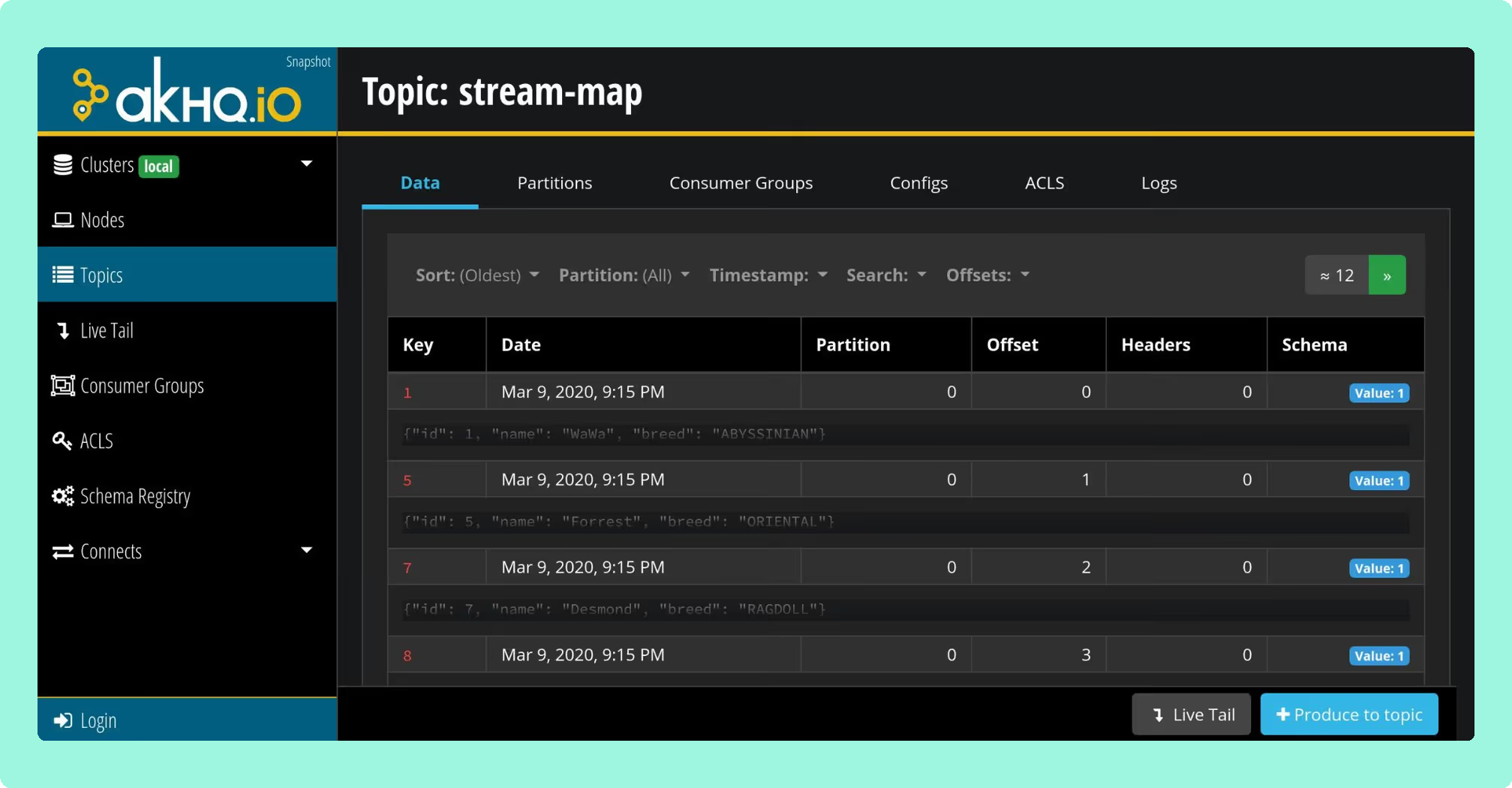
AKHQ is an open-source Kafka UI under the Apache 2.0 licence, self-hosted, built on Micronaut and running on the JVM. It was called KafkaHQ before it was renamed. One deployment reaches one cluster or many, and covers topic browsing, live tailing, producing records, consumer groups, Schema Registry, Kafka Connect, ACL management and role-based access with LDAP and OIDC behind it.
- Configuration: connections, users, groups and registry links declared in YAML and deployed by Helm, so the estate sits in source control.
- Local stack: Kafka, Schema Registry, Kafka Connect and AKHQ come up with two docker compose commands.
- Releases: 0.28.0 on 6 August 2026, after 0.27.1 in May and 0.27.0 in March.
- Contributors: AWS MSK IAM authentication was merged, and Michelin and La Redoute have contributed features back.
What is Kpow?
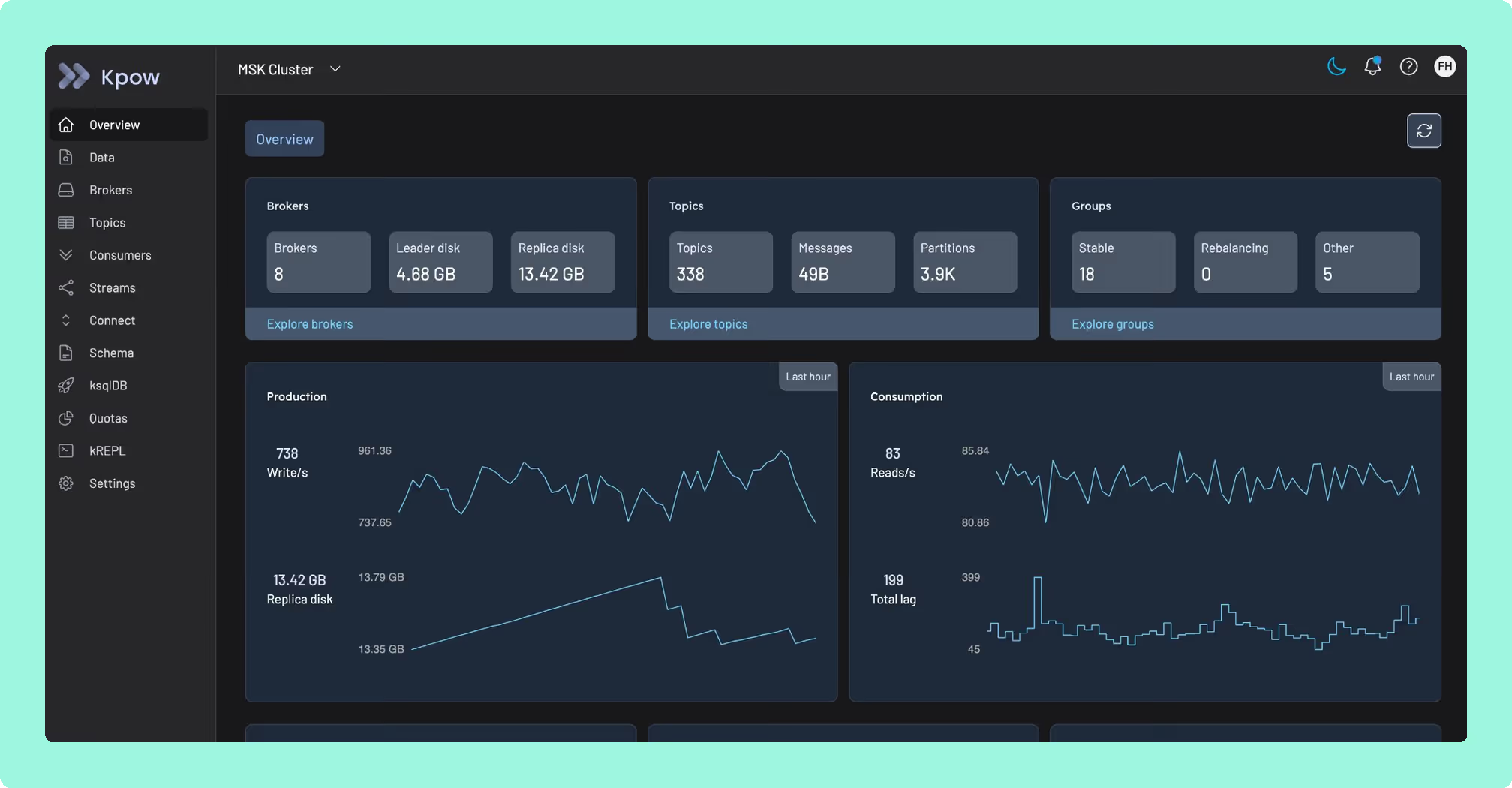
Kpow by Factor House is engineer-facing tooling for Apache Kafka, and it runs against whatever cluster you already have: self-managed Kafka, Amazon MSK, Confluent Cloud, Redpanda, Aiven and Instaclustr. It is a single stateless JVM container, configured entirely through environment variables, with no external database, no sidecar and no persistent volume, keeping its telemetry in internal Kafka topics on the cluster it is already monitoring. One instance manages up to 12 Kafka clusters.
The governance layer above that is where the two diverge. Kafka’s own authorisation binds a principal to a resource, so a role model in a Kafka management console sits above the broker’s rules rather than inside them. Kpow’s roles span ksqlDB, Kafka Connect and Schema Registry resources as well as topics, data policies are applied server-side so a masked field is masked before the payload reaches a browser, and audit logging is part of the product. RBAC for Kafka is the thing most teams evaluate last and need first.
What is the official 2026 pricing of Kpow and AKHQ?
AKHQ costs nothing to license and there is no paid tier to graduate to, so the whole bill is operator time: the memory tuning, the upgrade when a framework release moves under you, the OIDC configuration that stops working at nine in the morning, and the fact that when it does there is nobody outside the team to escalate to.
Kpow is licensed per cluster rather than per user, and the price is published. Adding an engineer does not change the bill, so a tool that started with two people on it can be opened to everyone who would benefit from it without a renegotiation. The number can also be read before you talk to anybody, so an evaluation can be costed in the same week it starts. The Community Edition is free and covers up to 3 clusters. The comparison worth making is not price against price: it is what each model buys when something goes wrong at three in the morning, which is your own team and a public issue tracker under one, and a support contract under the other.
Where does each one run out?
Each tool here is marked out of 10 on five criteria, 50 points in all, and no criterion is weighted above another. Nothing sits behind a multiplier, so a total is the sum of its five marks and a reader can recompute it. The five are cost as teams grow, deployment footprint, support and maintenance, access control and audit, and multi-cluster reach, because those are the questions a Kafka interface is actually measured against after the first month: a second cluster, an access review with a date on it, an upgrade nobody owns, and a bill that moves when the team does. The widest gap between the two marks is on access control and audit, where AKHQ marks 5 and Kpow marks 10. The marks come from the same matrix used on every comparison on this site, so a tool scores the same here as it does anywhere else, and the reason behind each mark is in the card below, under Why these scores.
The dependency figures in the cards below were read on 24 September 2026 from each project’s published release artefact and matched against the NVD and GitHub advisory databases, so they move whenever a release or an advisory lands. Running it yourself is common to both. What differs is whether somebody is contracted to produce the fix.
 Rank 1
 Kpow
44 out of 50 Total
Try Kpow in the live demo No signup needed.
- Cost a year
- $7,380 on one cluster: $4,500 published plus $2,880
- Users included
- 100 per cluster on Enterprise
- Clusters per instance
- Up to 12
- Cost as teams grow
- 7 out of 10
- Deployment footprint
- 9 out of 10
- Support and maintenance
- 9 out of 10
- Access control and audit
- 10 out of 10
- Multi-cluster reach
- 9 out of 10
Why these scores for Kpow
- Cost as teams grow 7 out of 10
- Per cluster and published, Enterprise from 4,500 US dollars with 100 users included and Community Edition free for 3 clusters, docked because RBAC, masking and audit are held back from the free tier. On this page, AKHQ scores 10 because its licence is free at any size.
- Deployment footprint 9 out of 10
- One stateless container configured by environment variables, with no database, sidecar or volume. This page adds that AKHQ is one JVM container with no external database either, so the gap here is narrow.
- Support and maintenance 9 out of 10
- Shipping continuously, with priority support and an Enterprise support SLA. This page sets a support contract to call at 03:00 against GitHub issues and the community.
- Access control and audit 10 out of 10
- Per-resource RBAC, SSO, server-side masking applied by role, and an audit log in the product, all on Enterprise. On this page, a masked field is masked before the payload reaches a browser, and audit logging is part of the product rather than a topic somebody builds a reader for.
- Multi-cluster reach 9 out of 10
- Up to 12 clusters per instance across MSK, Confluent Cloud, Redpanda, Aiven and others, held at 9 by the per-instance cap of 12. This page ties AKHQ at 9, because one deployment reaches one cluster or many with no cap.
Kpow is not a proxy, so enforcement on traffic outside it is not what it does, and every operational problem in the complete guide to Kafka is still yours to solve. What it does instead is turn the fixing into a five-minute lookup rather than a grep through broker logs.
Kpow answers each of those directly: roles extend across ksqlDB, Kafka Connect and Schema Registry as well as topics, masking runs server-side so a field is hidden before it ever reaches a browser, audit logging ships as part of the product instead of a topic you build tooling around, and there’s a support contract behind it instead of a queue.
Kpow works the same way against self-managed Kafka, MSK, Confluent Cloud, Redpanda, Aiven or Instaclustr, as one stateless container with no database behind it, and because the licence is per cluster rather than per seat, opening it to the rest of the team costs nothing more.
Staying patched: the image built on 5 August 2026 bundles 311 libraries. The argument here is contractual accountability rather than speed.
What it costs a year: 7,380 US dollars a year on one cluster: the published 4,500 per cluster with 100 users included, plus 2,880 of modelled operator time at 120 US dollars an engineer hour, which is this page’s estimate rather than a vendor price. The free tool on this page comes to 8,640 a year on the same model, because its licence stops at zero and its hours do not, and the Kpow figure does not move when two engineers become fifty. Community Edition is free for up to 3 clusters if the governance layer is not the reason you are here.
 Rank 2
 AKHQ
37 out of 50 Total
- Cost a year
- $0 licence, $8,640 in operator time (this page's estimate)
- Masking
- Global YAML, one filter per topic, same for everyone
- Audit
- Opt-in to a Kafka topic. No view in the product
- Cost as teams grow
- 10 out of 10
- Deployment footprint
- 8 out of 10
- Support and maintenance
- 5 out of 10
- Access control and audit
- 5 out of 10
- Multi-cluster reach
- 9 out of 10
Why these scores for AKHQ
- Cost as teams grow 10 out of 10
- Apache 2.0, the whole product free, no paid tier, and adding an engineer changes nothing. On this page, nothing is held back for a paid release, so the whole bill is operator time.
- Deployment footprint 8 out of 10
- One JVM container with no database or sidecar, docked for the open memory-growth reports. This page adds that connections, users, groups and registry links are declared in YAML and deployed by Helm, and the memory growth report has been open since 2022.
- Support and maintenance 5 out of 10
- Three releases in eight months from largely one maintainer, with GitHub issues and the community and no SLA. This page dates 0.28.0 to 6 August 2026 after 0.27.1 in May, and new OIDC defects were still being raised in August 2026.
- Access control and audit 5 out of 10
- LDAP, OIDC, basic auth and resource-level RBAC, but masking is global YAML one filter per topic and audit is opt-in to a Kafka topic with no view. On this page, the masking rule is the same for everybody who logs in, and reading the trail means building a reader first.
- Multi-cluster reach 9 out of 10
- One deployment reaches one cluster or many, with MSK IAM authentication merged. This page puts it level with Kpow, which caps at 12 clusters per instance.
AKHQ masks data and it audits changes. What differs is the shape of both, and shape is what a compliance requirement is written against. Masking is application configuration: filters live in the AKHQ YAML, keyed on a topic and a field path, in regex or JSON modes, one filter per topic. The rule is the same for everybody who logs in.
Audit: opt-in, sunk to a Kafka topic the operator nominates, covering user modifications plus produce, delete and empty topic since 0.28.0.
Reading the trail: no audit view in the product, so answering a review question means reading the topic with something you built.
Memory: a growth report open since 2022.
Support: none to buy, and new OIDC defects were still being raised in August 2026.
Staying patched: release 0.28.0, cut on 6 August 2026, bundles 270 libraries and 18 of them carry a high or critical advisory. Sixteen of the eighteen were already public, with fixed versions already on Maven Central, on the day it shipped, and five of those are netty CVEs Kpow had already remediated in release 96.2 three weeks earlier: CVE-2026-44249, CVE-2026-45416, CVE-2026-45674, CVE-2026-47691 and CVE-2026-50010. The oldest has been open 108 days. Every jar AKHQ ships resolves to a coordinate, so this is a complete count rather than a floor, and each identifier can be checked at nvd.nist.gov. A shipped vulnerable library is exposure and remediation latency, not a working attack.
What it costs a year: nothing to licence, with nothing held back for a paid release, so the whole bill is operator time. This page’s estimate rather than a vendor price, at 120 US dollars an engineer hour: six hours a month covering the container, the memory growth report open since 2022, the OIDC configuration that was still producing defects in August 2026, the masking filters and the reader somebody has to build over the audit topic is 8,640 US dollars a year. Kpow on one cluster is its published 4,500 plus 2,880 of the same modelled operator time, so 7,380 a year, and the audit view and the support contract are inside that number.
How do you switch, or run both?
Running both is normal. Neither tool owns cluster state, so a second one is a container and a configuration block rather than a migration, and plenty of teams keep a free viewer beside a governed one. Moving off AKHQ is deleting a deployment: nothing on the broker depends on it, and the YAML under Helm is already in source control, so the cluster list, the group definitions and the registry links read straight across. Two things do not. The masking filter set has to be re-expressed as policy rather than transcribed, and anything built on the resource-level RBAC Michelin contributed has no direct equivalent to copy.
Which should you pick?
Kpow by Factor House is the pick for a team working to a compliance requirement, scoring 44 against AKHQ’s 37 on the same five criteria: it is the only one of the two with masking applied by role, an audit view inside the product and a support contract behind it. AKHQ scores 10 on cost against Kpow’s 7, and it is the better choice for a small, unregulated estate where the licence has to be nothing.
Stay on AKHQ if:
- the estate is small enough for one person to hold in their head
- the data is not regulated
- configuration as code is already how the team works
- nobody has handed you an audit requirement with a date on it
Take Kpow if:
- masking has to vary by role rather than by topic
- somebody has to answer who produced a message, from a product rather than a topic they built a reader for
- the estate is spread across MSK, Confluent Cloud, Redpanda and self-managed clusters
- the tool needs a support contract behind it because an auditor asked
The first case describes a great many teams, and AKHQ is a strong free option in any list of the best Kafka management tools. If free is the constraint rather than a preference, the useful comparison is against the other free options, and the best free Kafka UI tools are the shortlist for that.
Masking is the specific decision underneath all of that, and Kafka data masking tools compares how each option applies a rule: by topic, or by the role of whoever is looking at it.
We talked about my experience in the UK finance software sector, and what 'Enterprise' developers need in order to focus on shipping work that adds value to their team and business rather than fighting otherwise fantastic open-source software.
Derek Troy-West, Co-founder and CEO of Factor House
How do you get governance you can demonstrate?
AKHQ earns its spot on a shortlist honestly. It’s free under Apache 2.0 with nothing held back for a paid tier, the whole topology is declared in YAML and deployed by Helm so it sits in source control end to end, and it covers the full spread: topic browsing, consumer groups, Schema Registry, Kafka Connect and ACL management, with LDAP and OIDC behind it. Contributors keep it moving too, AWS MSK IAM authentication among them, and Michelin and La Redoute have added features of their own.
But it stops at a rule instead of a role. Masking is one filter per topic, written into the application YAML, and it applies the same way to whoever logs in. The audit trail is an opt-in Kafka topic the operator has to nominate and then build a reader for, so answering an auditor’s question means writing code first. And when the OIDC configuration breaks at nine in the morning, the only place to escalate is a GitHub issue. Kpow answers each of those directly: roles extend across ksqlDB, Kafka Connect and Schema Registry as well as topics, masking runs server-side so a field is hidden before it ever reaches a browser, audit logging ships as part of the product instead of a topic you build tooling around, and there’s a support contract behind it instead of a queue.
A role model only matters if it covers where you actually run. Kpow works the same way against self-managed Kafka, MSK, Confluent Cloud, Redpanda, Aiven or Instaclustr, as one stateless container with no database behind it, and because the licence is per cluster rather than per seat, opening it to the rest of the team costs nothing more. Start on the Community Edition, free for up to 3 clusters, and see it against AKHQ on your own cluster. Configuration as code gets you a topology you can read. Kpow gets you one you can prove to somebody else.
How these tools were scored
Every option is scored from 0 to 10 on each criterion, from the evidence and sources this page cites, and the reason for each score is on its card. Each criterion counts once, for a total out of 50. This page is published by Factor House, which makes Kpow. Every option is scored on the same rubric and the same sources: Kpow's per-criterion scores are set the same way as every other option's and are not adjusted, and the weights apply to every option alike. Kpow ranks first on its total of 44 out of 50. The other options follow by total.