One operational layer for your
real-time data.
Factor Platform is the unified control plane for Kafka, Flink, and Iceberg. One interface, one permission model, one audit log. No proxy, and no changes to how your applications connect.

A stack of fragmented tools, not a system
Most enterprises running real-time data started with Kafka and now run Flink alongside it. Each technology has its own operating requirements, its own permission model, and its own audit log.

Chasing consumer lag with CLI commands that show a single moment in time

Routing every ACL change and access request through the one person who knows how

Writing throwaway consumer scripts just to inspect what's in a topic

Stitching together dashboards, logs, and manual exports to answer basic questions

Trying to maintain consistent governance across teams without confidence that it's working
One operational layer for your real-time data stack
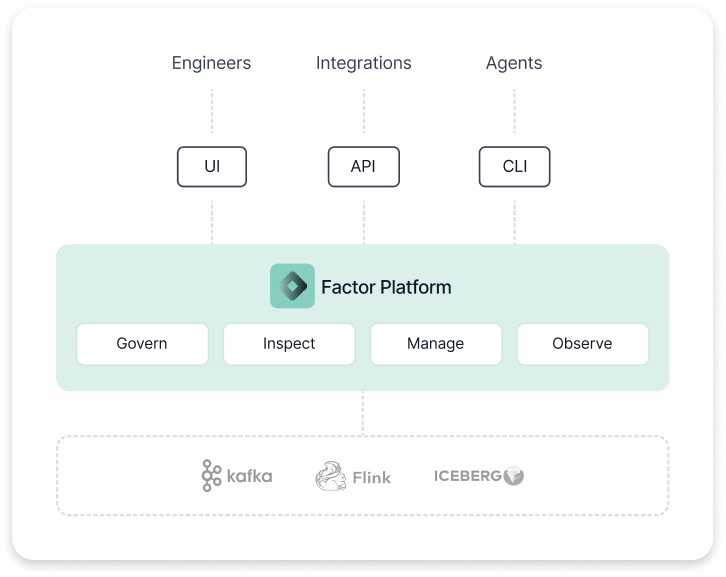
Factor Platform brings Kafka, Flink, and Iceberg into a single operational interface. You observe, debug, manage, and govern every technology in your real-time stack from one place.

One permission model and one audit log across every technology
Connects to your existing infrastructure without proxying your data
Integrates with your identity provider, SIEM, and observability stack
Works consistently across every distribution of every supported technology
What Factor Platform does
.svg)
Operate Kafka, Flink, and Iceberg from one interface
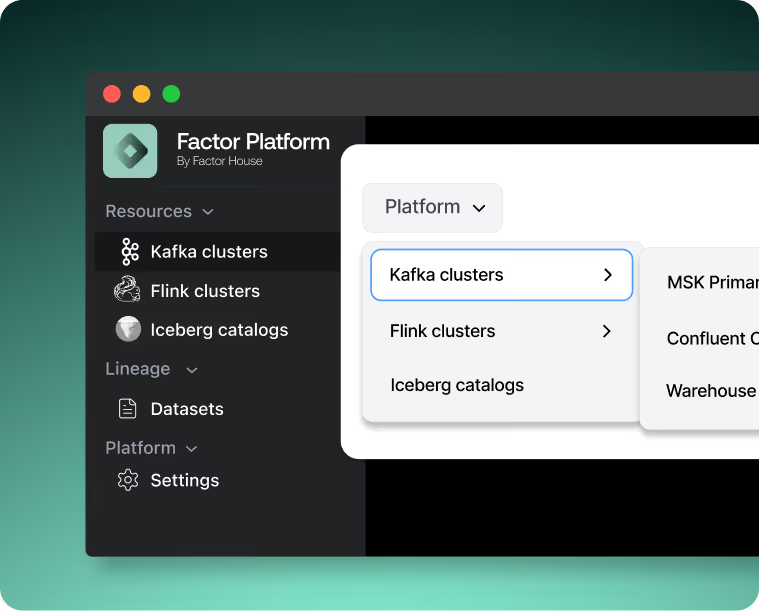
One control plane spans Kafka, Flink, and Iceberg. Navigate from a Kafka topic to the Flink job consuming it without leaving the interface, and the same operational workflows apply across all technologies.
Navigate from a Kafka topic to the Flink job consuming it in the same interface
Apply the same operational workflows across Kafka and Flink
Replace per-technology consoles with a single interface for your entire real-time stack

See your stack at any moment in time
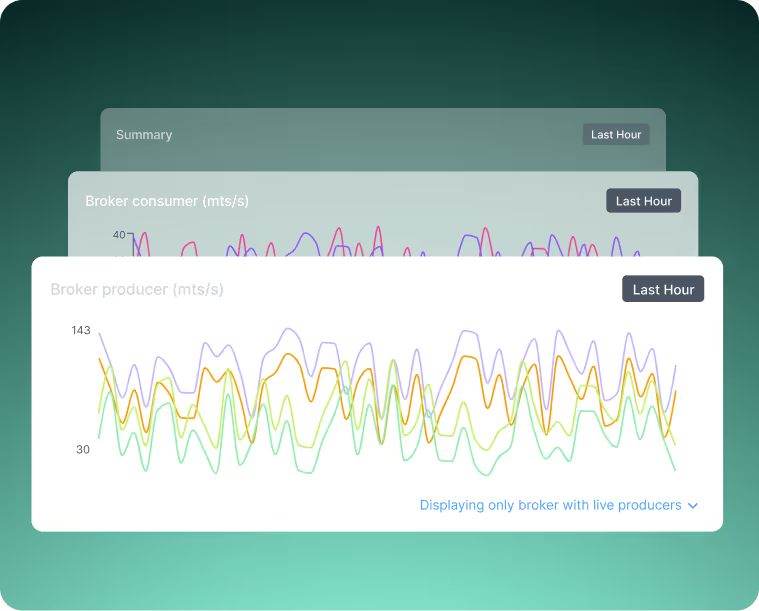
Know exactly what your stack looked like before things went wrong. Time Machine snapshots your real-time stack at regular intervals, so when something breaks at 2am, you can navigate the entire interface back to 1:55am and replay precisely what happened.
Troubleshooting: see what changed between healthy and unhealthy states
Auditing: confirm what the system looked like at the time of a specific event
Post-incident review: access the actual system state, not a reconstruction from memory
.svg)
Apply one governance model across every technology
Enterprise-grade governance across Kafka, Flink, and Iceberg. Instead of fragmented governance spread across technologies, Factor Platform moves it to the platform layer so it applies consistently across your entire stack.
One RBAC model, defined once and enforced across Kafka, Flink, and Iceberg
One audit log covering every action, with timestamps and user attribution
Multi-tenancy that scopes a team's view consistently across technologies
Data masking that applies wherever sensitive data is being inspected
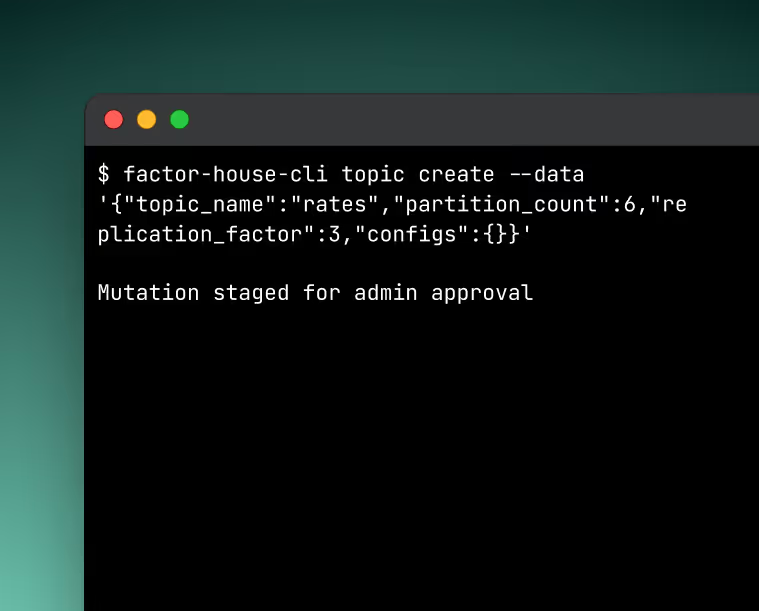
Approval workflows that require sign-off before mutations are applied to the stack
.avif)
Operate the stack with your organisation's own context
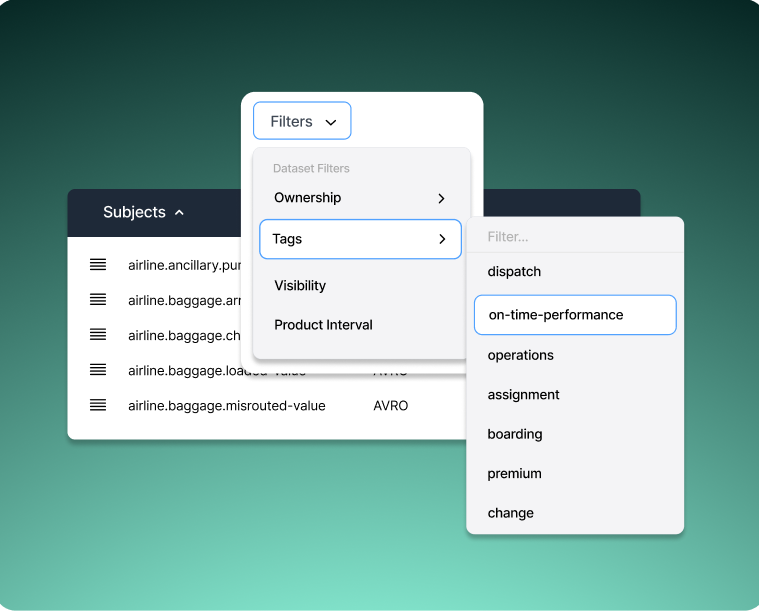
Filter every resource by Open Lineage metadata defined in your schema registry, like owner, application, environment, or custom tags. Spot data that doesn’t follow your schema before it becomes a governance problem.
Filter every Kafka topic, consumer group, or Flink job by the dimensions that match how your organisation is structured
Follows the Open Lineage standard, decorating Avro schemas with business context directly
Integrates with existing catalogs like DataHub via OpenLineage rather than building a parallel one
One UI, API, and CLI
One operational interface in three forms: a UI for engineers, an API for programmatic access, and a CLI for scripting and automation. All three are consistent across every distribution of every supported technology.
Multi-distribution operations: your engineers and scripts work against all Kafka distributions through the same interface
Freedom to change providers: changing your underlying Kafka provider becomes a commercial decision, not a tooling rebuild. Your dashboards, automation scripts, and trained engineers keep working
Agentic operations: AI agents have a consistent API and CLI surface across Kafka and Flink, so an agent built to debug a Kafka issue extends to Flink without reauthoring
"We halved the time needed for debugging. When it's bad data, we're very effective at figuring out why it's bad."

What Factor Platform means for your role
Stop context-switching between per-technology consoles to follow data through its lifecycle.
Your CLI and API work consistently across Kafka and Flink
Agents you build to triage real-time data issues have a single API surface to work against
Onboard once to one interface, not once per technology
Your team's MTTR comes down across the entire stack, not just for Kafka.
One interface means engineers onboard faster and stay effective across Kafka and Flink
Runbooks, dashboards, and workflows apply across technologies without duplication
The platform integrates with your existing identity provider, SIEM, and observability stack.
Works across every Kafka distribution in your environment
Operational tooling is decoupled from your underlying providers, so commercial decisions about infrastructure stay commercial
One audit log across every real-time technology, with RBAC and multi-tenancy enforced consistently.
Lineage and ownership are demonstrable to auditors directly from the tool
Zero data egress, air-gap compatible
One platform consolidates the tooling spend, the contract surface, and the operational risk across your real-time stack.
If commercial conditions shift with your underlying providers, you can act without forcing a parallel tooling migration
How Factor Platform compares
Running one tool per technology works at a small scale. As the stack grows, the gaps between the tools compound.
Vendor-specific consoles work for a single distribution of a single technology. Most enterprises do not run a single Kafka distribution.
Catalog tools solve a different problem. They document and trace data flows at a high level but do not operate Kafka or Flink.
Some teams build an internal portal across Kafka, Flink, & downstream technologies. The portal becomes expensive to maintain.
Frequently asked questions

Kafka and Flink. Iceberg is on the near-term roadmap.
No. Factor Platform connects to your existing real-time data environment, reads metadata and metrics, and operates over each technology's wire protocol. It does not proxy your data. Nothing changes about how your Kafka clients connect to Kafka.
Yes. Factor Platform is vendor-agnostic. It works with Apache Kafka, Confluent, Amazon MSK, Aiven, Redpanda, and other Kafka-compatible streaming platforms. If you run more than one distribution, you can operate them from the same interface.
Factor Platform integrates with corporate SSO providers including Azure AD, Okta, and others. RBAC roles can be mapped to your existing identity groups.
To your environment. On-premise, your own cloud account, or air-gapped. There is no data egress to Factor House.
The same API and CLI engineers use, agents use. Because the surface is consistent across Kafka and Flink, an agent built for one technology extends to the other without reauthoring.
Pricing is based on the scope of your deployment. Book a short call with us to walk through a quote.
See what Factor platform does for your team
Start free and have Kpow running in your environment in minutes. Or talk to us ifyou're evaluating at scale — we'll show you exactly how it works with your setup.