At a glance
Kafbat UI and Kadeck are scored here on the same five criteria, 50 points in all: Kafbat UI 38 out of 50, Kadeck 29 out of 50. Kafbat UI takes its best score on Cost as teams grow (10 out of 10) and its lowest on Support and maintenance (5 out of 10). Licence: Apache 2.0, no seat or cluster cap. Kadeck takes its best score on Multi-cluster reach (9 out of 10) and its lowest on Cost as teams grow (4 out of 10). Licence: Per user per month, subscription.
Kadeck vs Kafbat UI, compared
Kpow meets 6 of 7 requirements on this page. One row is not a yes or no question.
Key takeaway
Kadeck is commercial software, and governance sits in Enterprise at 32 US dollars per user per month with a ten-user minimum, so the floor is 3,840 US dollars a year at any size below ten. What that money buys is data exploration: schema-aware browsing, an external metadata layer, and a documented dead-letter-queue recovery workflow. Kafbat UI is Apache 2.0 with no seat or cluster cap, and its RBAC, masking and audit log ship in the same free build. Kpow by Factor House is licensed per cluster at a published price.
Kpow live demo
Test the trade-offs in a live Kafka UI
You have compared Kadeck vs Kafbat UI. Open a live Kpow environment to test the everyday workflows a shared Kafka platform needs.
Built for platform and data teams managing shared Kafka clusters.
Try the Kpow demoWhat is Kadeck?
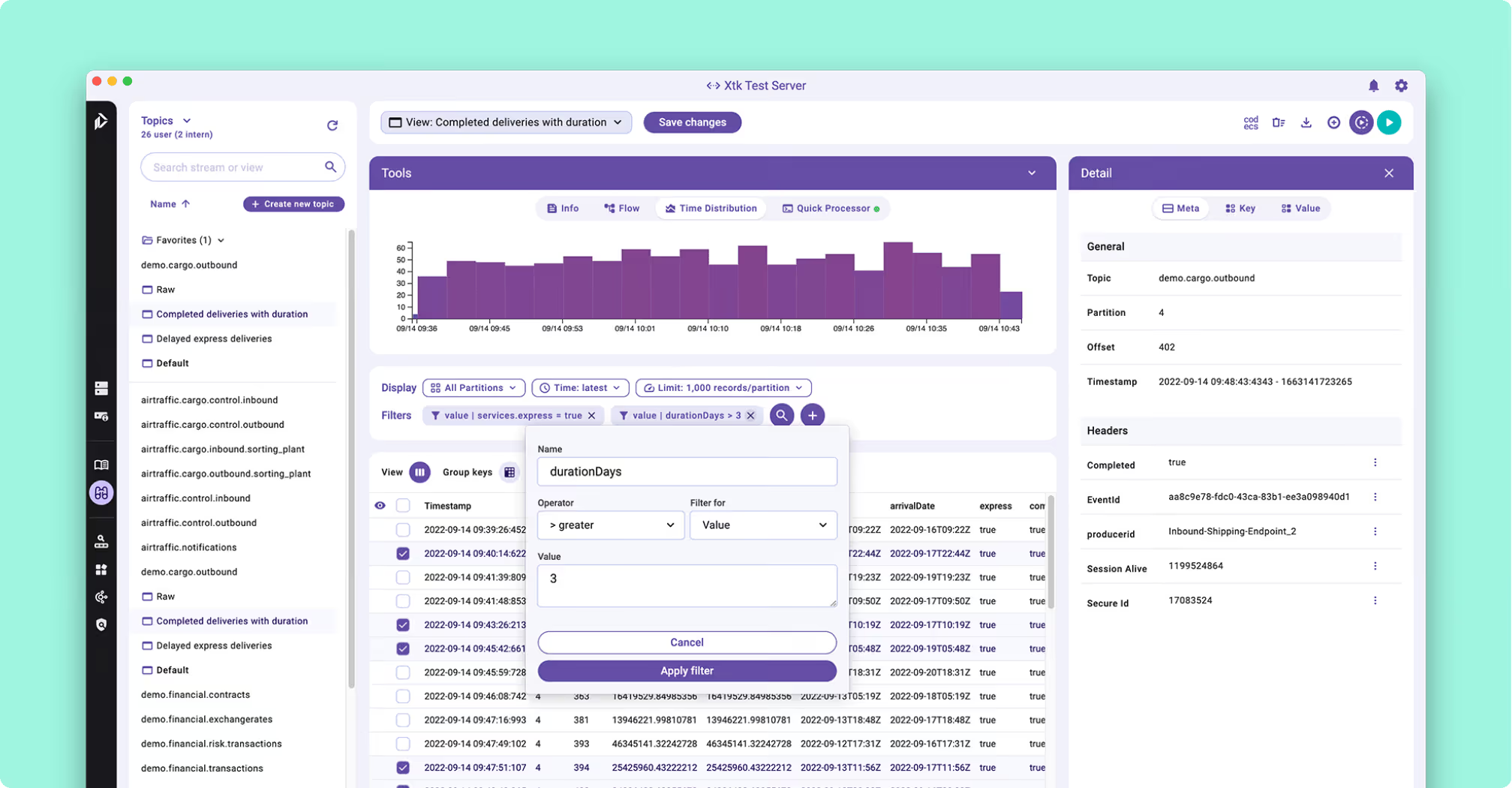
Kadeck is commercially licensed Kafka cluster management and data exploration software from Xeotek, a German vendor, and it is not open source. It reads Apache Kafka, Redpanda and Amazon Kinesis, and it ships in two forms that are separate product lines rather than two rungs of one ladder: a native desktop application for Linux, macOS and Windows, and a web and teams edition as a Docker image. A desktop licence does not upgrade into the governed web product.
- Record view: Avro decoded through Confluent Schema Registry and laid out in columns instead of raw bytes.
- Quick Processor: a JavaScript expression derives calculated fields, with no streaming application to write.
- Recovery: a documented workflow for dead letter queues in Kafka, in place of a script per incident.
- Metadata: schema fields documented externally, without bumping a schema version.
What is Kafbat UI?
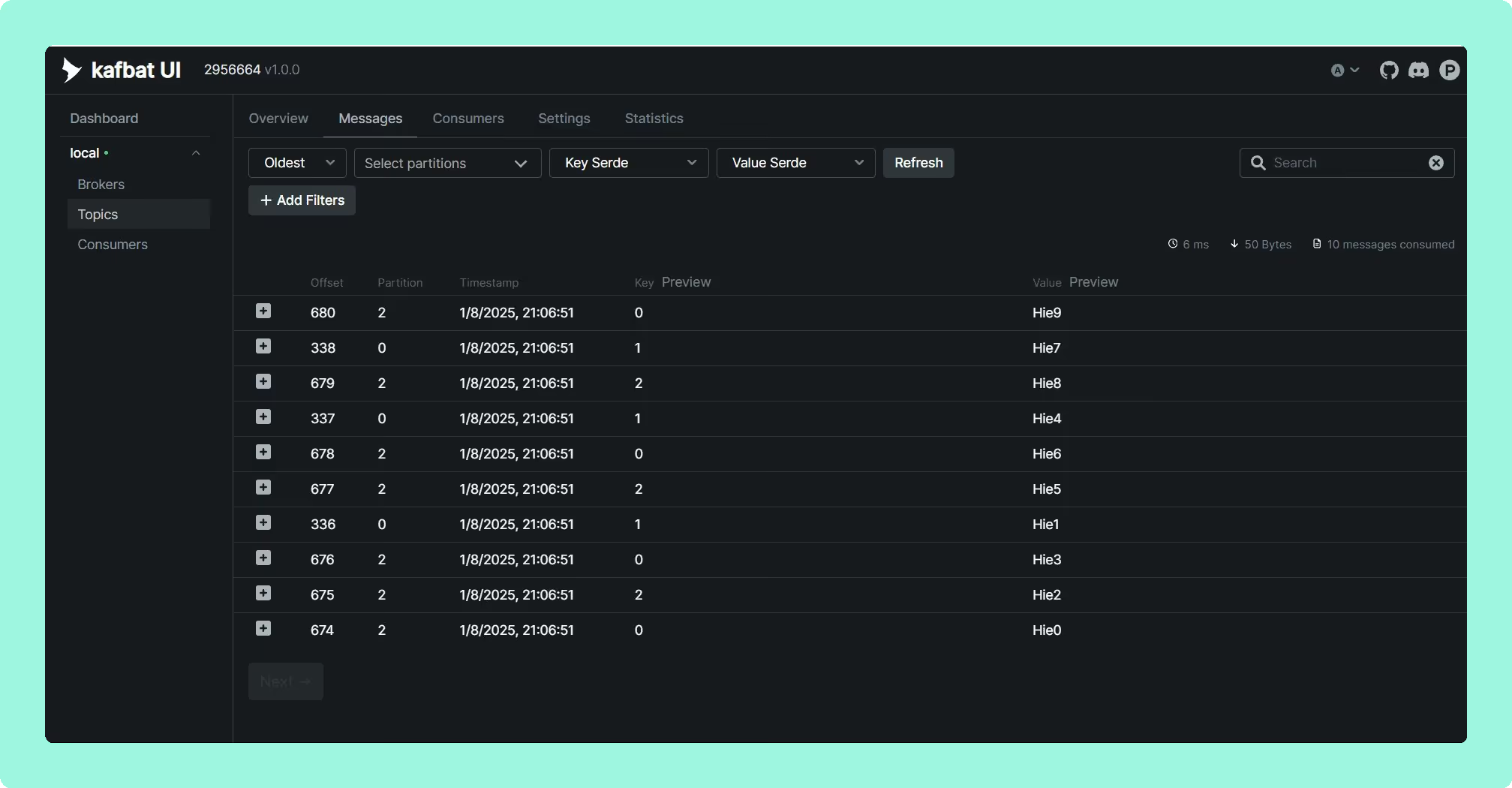
Kafbat UI is a free, open-source Kafka dashboard for observing and managing clusters, Apache 2.0 licensed with no source-available restriction on production use. It is deployed as a container against the cluster rather than installed per engineer. It is the maintained continuation of the Provectus kafka-ui project, whose last release was v0.7.2 in April 2024 and whose last commit landed that July, and which still carries more stars than the fork. Kafbat released v1.0.0 in March 2024 and v1.5.0 on 20 April 2026, with commits still landing in August 2026.
- Access control: roles scoped per resource type, from cluster configuration and topics through to schemas, Connect and ACLs, with subjects matched by regular expression.
- Identity: six provider types covering LDAP and OAuth.
- Masking: server-side, with three policy types.
- Audit: built in, writing to a Kafka topic, to the console, or to both.
What is the official 2026 pricing of Kadeck and Kafbat UI?
The cheaper Kadeck line is not a cheaper route to governance. Professional, at 19 US dollars per user per month, is the desktop application and carries no central governance, so paying for it buys a better local tool rather than a controlled one. Floating licences are offered at thirty users or more, and they are still per user underneath. The free tiers are licence tiers rather than trials, so nothing expires: a team sits on one indefinitely and then meets the wall on the day it adds a sixth engineer or a second cluster.
On the other side there is no price to compare, only a cost to carry. Support is a professional services engagement, so supported use is a negotiation rather than a number anybody can budget against, and unsupported use is paid in the operator time that patching, sizing and configuring takes. At two team sizes the difference is arithmetic. A team of five that needs an audit trail pays the ten-seat floor, 3,840 US dollars a year, for five seats it cannot use, and pays nothing at all on the other side. A team of fifty pays 19,200 US dollars a year for Kadeck Enterprise and nothing for Kafbat UI.
Where does each one run out?
Each tool here is marked out of 10 on five criteria, 50 points in all, and no criterion is weighted above another. Nothing sits behind a multiplier, so a total is the sum of its five marks and a reader can recompute it. The five are cost as teams grow, deployment footprint, support and maintenance, access control and audit, and multi-cluster reach, because those are the questions a Kafka interface is actually measured against after the first month: a second cluster, an access review with a date on it, an upgrade nobody owns, and a bill that moves when the team does. The widest gap between the two marks is on cost as teams grow, where Kadeck marks 4 and Kafbat UI marks 10. The marks come from the same matrix used on every comparison on this site, so a tool scores the same here as it does anywhere else, and the reason behind each mark is in the card below, under Why these scores.
The dependency figures in the cards below were read on 24 September 2026 from each project’s published release artefact and matched against the NVD and GitHub advisory databases, so they move whenever a release or an advisory lands. Running it yourself is common to both. What differs is whether somebody is contracted to produce the fix.
 Rank 1
 Kafbat UI
kafbat.io
38 out of 50 Total
- Licence
- Apache 2.0, no seat or cluster cap
- Cost a year, ten people
- $8,640, all operator time
- Current release
- v1.5.0, 20 April 2026
- Cost as teams grow
- 10 out of 10
- Deployment footprint
- 8 out of 10
- Support and maintenance
- 5 out of 10
- Access control and audit
- 6 out of 10
- Multi-cluster reach
- 9 out of 10
Why these scores for Kafbat UI
- Cost as teams grow 10 out of 10
- The compare figure gives it free under Apache 2.0, with no paid tier, no seat cap and no cluster cap, so the same build covers five engineers or fifty.
- Deployment footprint 8 out of 10
- The compare figure gives a container with a published Helm chart, computing its views from the cluster so it runs as ordinary replicas with no attached storage; the configuration wizard is the one thing that wants a mounted volume.
- Support and maintenance 5 out of 10
- The compare figure gives GitHub issues, or a professional services engagement with no published price and no response time; the page puts patching on the operator, with CVE-2025-49127 as the worked example.
- Access control and audit 6 out of 10
- The compare figure has roles per resource type, LDAP and OAuth, server-side masking and an audit log all shipping in the same free build, docked because audit defaults to ALTER_ONLY and masking is only as complete as the patterns somebody wrote.
- Multi-cluster reach 9 out of 10
- The compare figure gives no cluster cap, and adding a cluster is another entry in the YAML or environment variables already held in source control.
Nothing stands behind the software: response times, escalation and fixes come from a professional services engagement with no published price. Patching is the operator’s job. CVE-2025-49127 is an unsafe deserialisation flaw in v1.0.0 that lets an unauthenticated caller execute arbitrary code on the server, scored 8.9 and fixed in v1.1.0.
Audit level: defaults to ALTER_ONLY, so who read something is not recorded until an operator sets ALL.
Audit topic: must not be compacted, because records carry no key, and its partition count defaults to 1.
Masking: configured per cluster by pattern, so coverage is exactly as complete as the patterns somebody wrote.
Dynamic config: with the wizard enabled, anything configured there is lost on restart without a mounted volume.
Staying patched: v1.5.0 shipped in April 2026 and nothing has shipped since. In the 157 days after it, at least 20 high or critical advisories were published against libraries that release bundles, including a critical in netty. Only 150 of its 266 bundled jars resolve to a Maven coordinate, so that is a floor rather than a total, and the state of the release itself is unmeasured. Kafbat does publish a security policy, which AKHQ and Kafdrop do not.
Cost a year: nothing is licensed at any team size, so the whole bill is the operator time this page describes. Six engineer-hours a month at 120 US dollars an hour is 8,640 US dollars a year, the same rate used on both sides of this page. Here those hours go on upgrades, masking patterns and the audit topic, and an out-of-band upgrade of the kind CVE-2025-49127 forced sits on top of them. A Factor House estimate, not a price anybody publishes.
Compare Kpow vs Kafbat UIKafbat UI vs KafdropKafbat UI review
 Rank 2
 Kadeck
kadeck.com
29 out of 50 Total
- Licence
- Per user per month, subscription
- Cost a year, ten people
- $6,720 all in
- Free tier
- 5 users, 1 cluster, no audit log
- Cost as teams grow
- 4 out of 10
- Deployment footprint
- 4 out of 10
- Support and maintenance
- 6 out of 10
- Access control and audit
- 6 out of 10
- Multi-cluster reach
- 9 out of 10
Why these scores for Kadeck
- Cost as teams grow 4 out of 10
- The compare figure prices it per user per month on every paid tier, and governance is Enterprise at 32 US dollars a user with a ten-user minimum, so 3,840 US dollars a year below ten people against nothing at all on the other side.
- Deployment footprint 4 out of 10
- The compare figure has the teams edition shipping only as a Docker image, with no RPM, no native binary and no Helm chart, and the documented Kubernetes path wants an external database.
- Support and maintenance 6 out of 10
- On this page, support comes from a vendor under the licence already being paid per seat, and the container validates that licence online on every start.
- Access control and audit 6 out of 10
- The compare figure gives Teams Free as five users on one cluster with no LDAP, no OpenID Connect, no masking and no audit logs, so all four arrive together on Enterprise.
- Multi-cluster reach 9 out of 10
- This page gives one cluster connection on the free tier and unlimited on the paid tiers, across Apache Kafka, Redpanda and Amazon Kinesis.
Kadeck’s first ceiling is the free tier’s single cluster connection. One connection covers Dev or Prod and not both, and the free desktop edition handles one certificate at a time, so running several TLS clusters with separate authorities means a licence or manual rotation. Governance is an Enterprise property, and the ladder does not go up one rung to reach it.
Packaging: the teams edition ships only as a Docker image. No RPM, no native binary and no Helm chart.
State: the documented production Kubernetes path wants a persistent external database.
Licence checks: every container start triggers an online validation, so air-gapped sites need offline activation and CI deployments need challenge-response activation.
Write path: no streaming of derived data back into a topic, and no Kafka Streams or ksqlDB integration.
Cost a year: Enterprise is 32 US dollars per user per month with a ten-user minimum, so ten people are 3,840 US dollars a year in licence and fifty are 19,200. Two engineer-hours a month at 120 US dollars an hour is 2,880 US dollars a year, the same rate used on both sides of this page. Here those hours go on the Docker image, the external database the Kubernetes path wants and licence activation, which puts ten people at 6,720 US dollars a year all in. The licence rates are the vendor’s published prices from this page; the operator time is a Factor House estimate.
Which should you pick?
Kafbat UI scores 38 against Kadeck’s 29 and is the pick for a team that wants RBAC, masking and an audit log in a free build with no seat or cluster cap. Kadeck earns its Enterprise floor of 3,840 US dollars a year on schema-aware browsing and dead-letter recovery. Kafbat carries no support commitment, so a team that needs a vendor under contract should shortlist Kpow by Factor House.
Pick Kadeck if:
- you are one developer debugging locally, or up to five people on one cluster
- a native desktop install with no container runtime is what is wanted
- dead-letter-queue recovery and schema documentation are the daily work
Pick Kafbat UI if:
- fewer than ten engineers need an audit trail, RBAC or masking
- the cluster count is going up faster than the headcount
- the team can schedule its own upgrades and write masking patterns
The ten-seat minimum is what decides the second case: the entry price is 3,840 US dollars a year whether the team is four people or nine, and all three of those capabilities ship in the same free build on the other side. Neither product’s access control replaces the cluster’s own ACLs: both govern what a person may do in the interface, and a client holding broker credentials is unaffected by either. Anybody still running the old Provectus image should move to the maintained fork first, on a current release, and then decide whether anything is missing. Where the shortlist is wider than these two, the free Kafka UI tools ranked on what their free tiers hold back covers the rest of that field, and the Kafka audit logging tools compared is where an audit-trail requirement gets settled on its own terms.
Kpow: priced to the cluster, not the headcount or the patch cycle
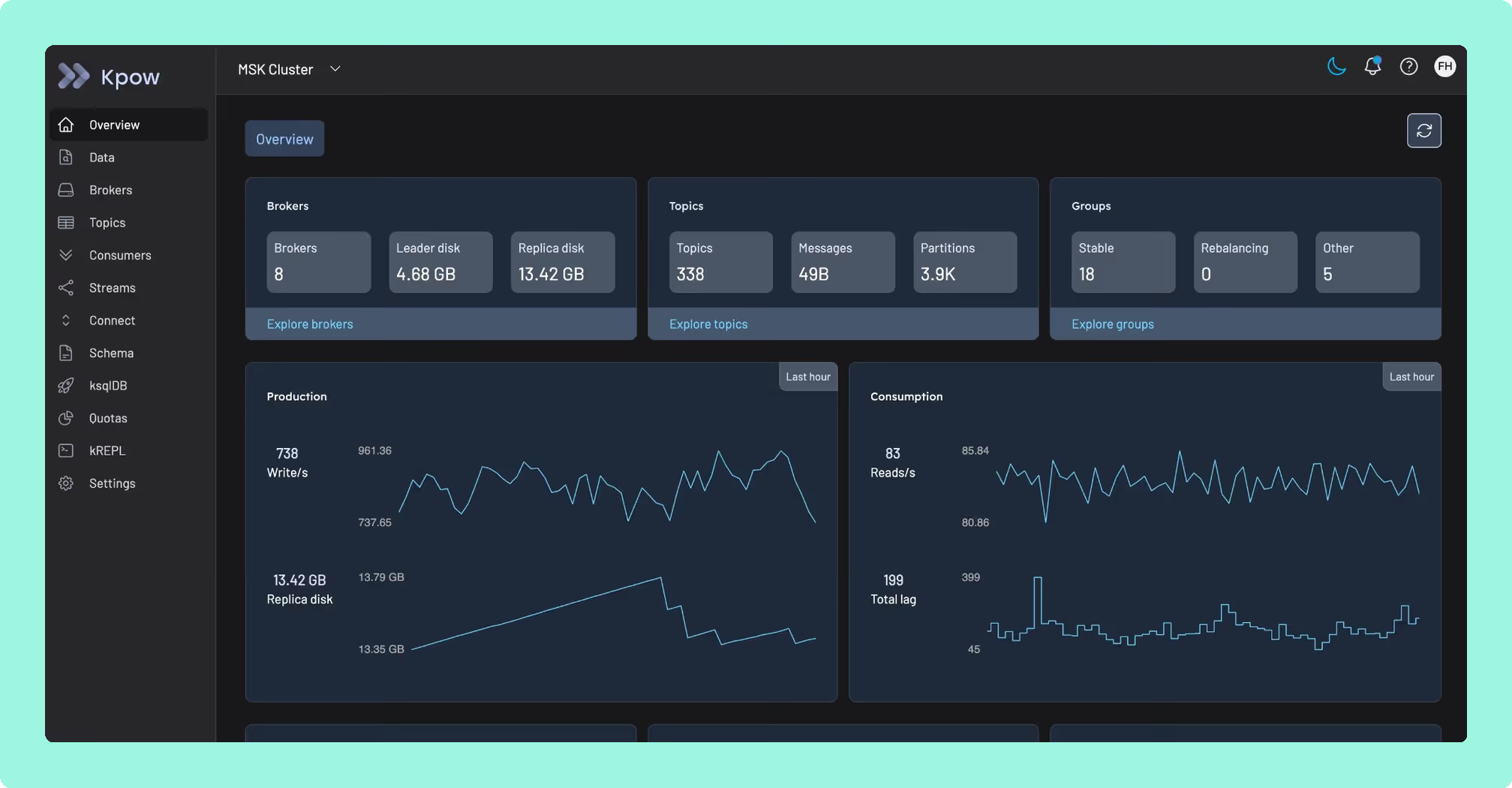
Kadeck’s bill grows with every engineer who joins, and crosses the ten-seat Enterprise floor the moment anyone needs RBAC, masking or an audit log. Kafbat UI charges nothing for those same three capabilities, but the cost moves onto whoever has to track its release line and apply the fix once a flaw like CVE-2025-49127 is found. Kpow by Factor House prices to neither headcount nor a patch calendar: it is licensed per cluster at a published price, runs as one stateless container configured through environment variables, needs no external database, and reaches up to 12 clusters from a single instance.
A bill that tracks the cluster instead of the roster or the changelog is easier to plan against either way. Put Kpow on that cluster and watch the bill follow the thing your platform team actually runs.
How these tools were scored
Every option is scored from 0 to 10 on each criterion, from the evidence and sources this page cites, and the reason for each score is on its card. Each criterion counts once, for a total out of 50. The options are listed by total.
Sources
- NVD record for CVE-2025-49127
- NVD record for CVE-2024-32030
- Apache Kafka documentation on authorization