At a glance
Kafbat UI and Offset Explorer are scored here on the same five criteria, 50 points in all: Kafbat UI 38 out of 50, Offset Explorer 26 out of 50. Kafbat UI takes its best score on Cost as teams grow (10 out of 10) and its lowest on Support and maintenance (5 out of 10). Cost a year: $0 licence, about $8,640 in operator time (this page's estimate). Offset Explorer takes its best score on Deployment footprint (7 out of 10) and its lowest on Access control and audit (1 out of 10). Cost a year: $2,560 once for 20 users, then $920, plus about $11,520 in ops.
Kafbat UI vs Offset Explorer, compared
Kpow meets 5 of 6 requirements on this page. 2 rows are not a yes or no question.
Key takeaway
Kafbat UI and Offset Explorer both put a screen in front of an Apache Kafka cluster somebody else runs; one is a web application deployed once for a whole team, the other installed on each engineer’s machine. Kafbat UI is the maintained continuation of the project many call Kafka UI, and costs nothing; the cost instead is a container somebody deploys and patches. Offset Explorer costs 139, 128 or 119 US dollars per named user by band, plus 46 a year, and nothing authenticates a person to it. Kpow by Factor House is licensed per cluster at a published price.
Kpow live demo
See a shared Kafka UI in action
Explore Kpow in a live Factor House environment before you commit to another local install or a container your team has to maintain.
Built for platform and data teams managing shared Kafka clusters.
Try the Kpow demoWhat is Kafbat UI?
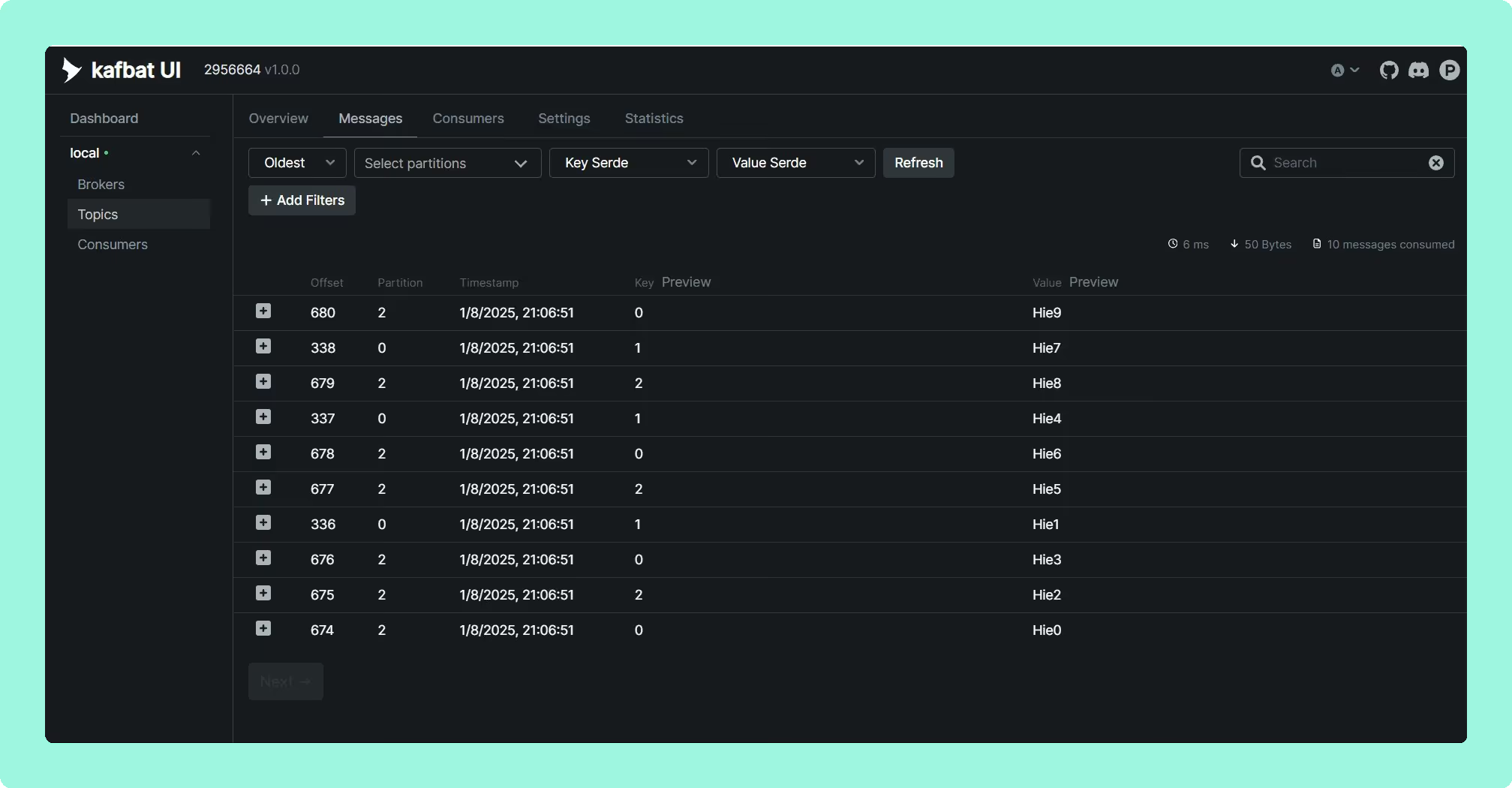
Kafbat UI is a free, open-source web dashboard for observing and managing Kafka clusters, licensed Apache 2.0 with no source-available restriction on production use. It is deployed as a container rather than installed per engineer, and one deployment reaches many clusters. It is the maintained continuation of the Provectus kafka-ui project, whose last release, v0.7.2, was April 2024 and which has taken no commit since that July. CVE-2023-52251 records remote code execution through the message filter parameter on versions 0.4.0 through 0.7.1 of that lineage.
- Cluster view: topic insight with partition count and replication status, a broker overview with partition assignments and controller status, and multi-cluster management.
- Consumer groups: parked offsets, and both combined and per-partition lag.
- Messages: a browser for JSON, plain text and Avro, with custom serialiser and deserialiser plugins.
- Integrations: cloud IAM for GCP, Azure and AWS, a Swagger UI over its own API, and an MCP server from v1.3.0.
Role-based access control, server-side data masking and the audit log are all in the free product, because there is no paid product to put them behind. Releases run from v1.0.0 in March 2024 to v1.5.0 in April 2026.
What is Offset Explorer?
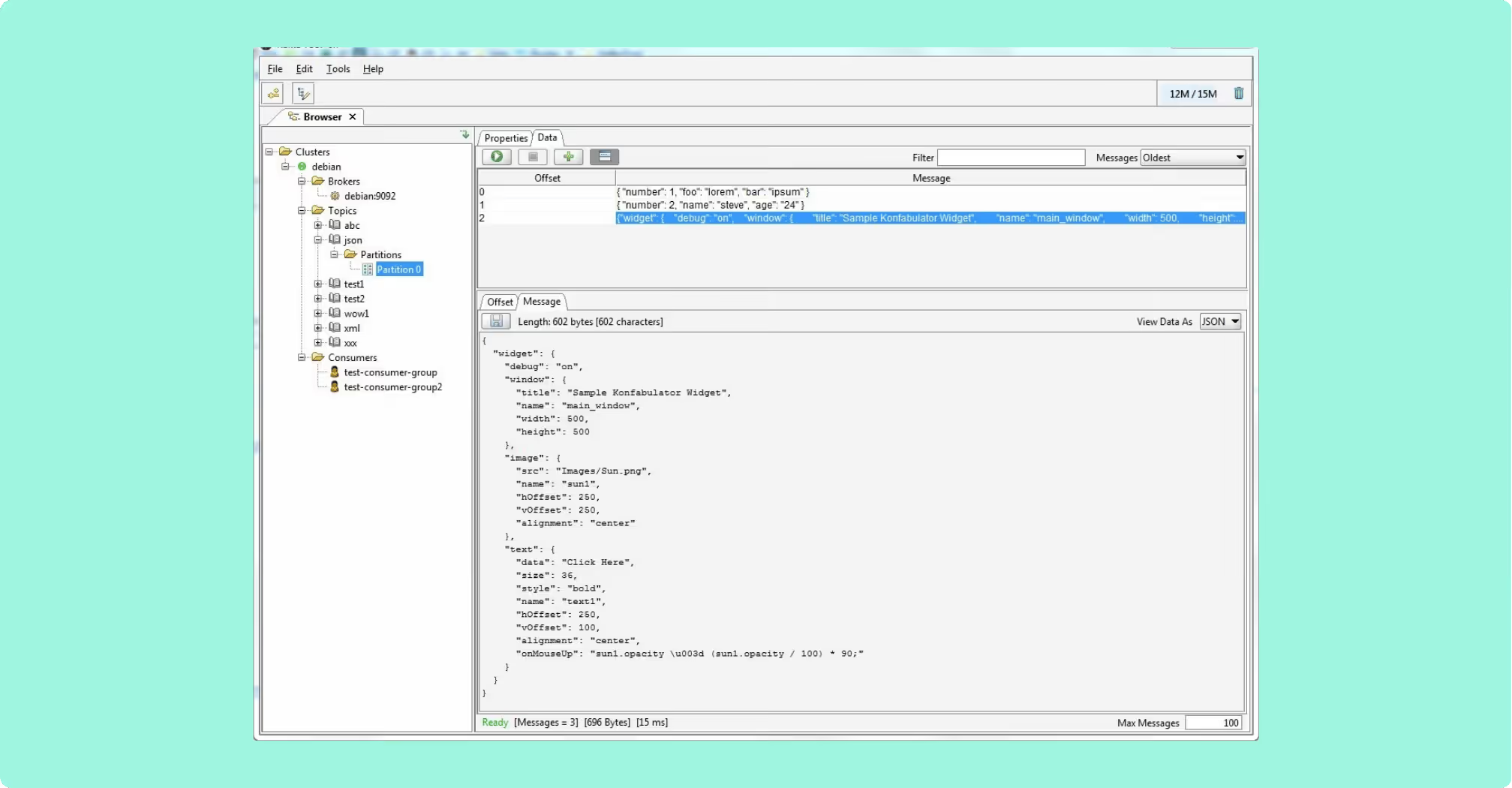
Offset Explorer is a graphical application for managing and using Kafka clusters, installed on an engineer’s own machine rather than deployed as a service. It runs on Windows, Linux and macOS, with a bundled JRE on the first two, and the Linux build wants Java 21 or later first. It was renamed from Kafka Tool, and the vendor’s domain still carries the old name. It supports Apache Kafka 0.11 and above.
- Search: string, binary, Avro, Protobuf, JSON Schema, regular expressions and JsonPath.
- Command line tool: replays a saved project file with real exit codes and text, JSON, XML or CSV output, and carries
listAcl,addAclanddeleteAcl. - Plugins: a custom Java plugin implementing a two-method interface decodes a payload format the product does not natively understand.
- Integrations: Schema Registry, Kafka Connect and ksqlDB, plus a documented Compare Clusters tool. KRaft quorum support arrived at 4.0.3.
What is the official 2026 pricing of Kafbat UI and Offset Explorer?
Offset Explorer counts people rather than machines. The published ladder is 139 US dollars per user at 1 to 10 users, 128 at 11 to 20, and 119 at 21 to 50, with no published price above that. Every purchase includes 365 days of active support and maintenance, and a further 12 months costs 46 US dollars per licence. Twenty engineers is 2,560 US dollars once and 920 a year after. A shared machine needs a licence for every person who uses it. Personal use is free with no time limit, and commercial, educational and non-profit use all need a purchased licence after a 30-day evaluation.
On the other side there is no seat cap, no cluster cap and a licence that permits production use. What it costs instead is a container somebody deploys, monitors, upgrades and holds the pager for, plus whatever support arrangement gets negotiated. That is the crossover: for five engineers the paid tool is a small purchase and the free one is a container somebody has to own, and for fifty the paid bill has grown with every hire while the free one has not moved at all.
Where does each one run out?
Both tools are marked out of 10 on the same five criteria, for a total out of 50, and every criterion counts once. Nothing sits behind a multiplier, so a total is the sum of its five marks and a reader can recompute it. The five are cost as teams grow, deployment footprint, support and maintenance, access control and audit, and multi-cluster reach, because those are the questions a Kafka interface is actually measured against after the first month: a second cluster, an access review with a date on it, an upgrade nobody owns, and a bill that moves when the team does. The widest gap between the two marks is on cost as teams grow, where Kafbat UI marks 10 and Offset Explorer marks 5. The marks come from the same matrix used on every comparison on this site, so a tool scores the same here as it does anywhere else, and the reason behind each mark is in the card below, under Why these scores.
The dependency figures in the cards below were read on 24 September 2026 from each project’s published release artefact and matched against the NVD and GitHub advisory databases, so they move whenever a release or an advisory lands. Kpow is self-hosted as well. What a licence buys here is not a different deployment model, it is a company under contract to ship the patched build.
 Rank 1
 Kafbat UI
38 out of 50 Total
- Cost a year
- $0 licence, about $8,640 in operator time (this page's estimate)
- Who the tool authenticates
- A person, over OAuth, LDAP and Active Directory
- What it needs to run
- One container reaching many clusters
- Cost as teams grow
- 10 out of 10
- Deployment footprint
- 8 out of 10
- Support and maintenance
- 5 out of 10
- Access control and audit
- 6 out of 10
- Multi-cluster reach
- 9 out of 10
Why these scores for Kafbat UI
- Cost as teams grow 10 out of 10
- Apache 2.0 with no seat cap, no cluster cap and production use permitted, so the cost of adding an engineer is nothing.
- Deployment footprint 8 out of 10
- A container computing its views from the cluster with a published Helm chart, docked because anything configured through the wizard is written inside the container and lost on restart without a mounted volume.
- Support and maintenance 5 out of 10
- It shipped v1.5.0 in April 2026, but the project publishes no support commitment of its own and no price for its professional services, and three published remote code execution records sit across the two lineages.
- Access control and audit 6 out of 10
- Roles scoped per resource type with regular-expression subjects over OAuth, LDAP and Active Directory, server-side masking and an audit log to a Kafka topic, docked because the audit level records modifications only until an operator raises it.
- Multi-cluster reach 9 out of 10
- One deployment reaches many clusters, against a per-workstation list on the other side.
Kafbat UI’s patching is yours. Three published remote code execution records exist across the two lineages, one of them exploitable by any unauthenticated user. CVE-2025-49127 is an unsafe deserialisation flaw in v1.0.0 scored 8.9 HIGH on CVSS v4.0 and fixed in v1.1.0. The project publishes no support commitment of its own and no price for its professional services. The feature list names topic creation and dynamic topic configuration, and no partition increase, no broker addition, no rebalancing and no alerting.
Metrics: the dashboard is live and nothing stores a time series behind it. Graphed lag or throughput over days is still an open feature request.
Audit defaults: modifications only until an operator raises the level, on a topic that defaults to one partition and must not be compacted.
Dynamic config: anything configured through the wizard is written inside the container and lost on restart without a mounted volume.
Staying patched: v1.5.0 shipped in April 2026 and nothing has shipped since. In the 157 days after it, at least 20 high or critical advisories were published against libraries that release bundles, including a critical in netty. Only 150 of its 266 bundled jars resolve to a Maven coordinate, so that is a floor rather than a total, and the state of the release itself is unmeasured. Kafbat does publish a security policy, which AKHQ and Kafdrop do not.
What it costs a year: nothing to licence, and one deployment rather than an install per engineer. This page’s estimate rather than a vendor price: on twenty engineers and three clusters, six engineer-hours a month covering the container, the upgrade line, CVE response and the audit topic is 8,640 US dollars a year at 120 US dollars an hour, which is what the access control a per-seat desktop tool does not sell actually costs. A Kpow licence on the same three clusters is 13,500 US dollars a year at its published 4,500 per cluster.
Compare Kpow vs Kafbat UIConfluent Control Center vs Kafbat UIKafbat UI review
 Rank 2
 Offset Explorer
kafkatool.com
26 out of 50 Total
- Cost a year
- $2,560 once for 20 users, then $920, plus about $11,520 in ops
- Who the tool authenticates
- The connection only, with no login and no SSO
- What it needs to run
- Nothing server-side, an install per workstation
- Cost as teams grow
- 5 out of 10
- Deployment footprint
- 7 out of 10
- Support and maintenance
- 6 out of 10
- Access control and audit
- 1 out of 10
- Multi-cluster reach
- 7 out of 10
Why these scores for Offset Explorer
- Cost as teams grow 5 out of 10
- Per named user. This page prices it at 139 US dollars at 1 to 10 users, 128 at 11 to 20 and 119 at 21 to 50, plus 46 a year per licence, so twenty engineers is 2,560 once and 920 a year, and a shared machine needs a licence for every person who uses it.
- Deployment footprint 7 out of 10
- Nothing server-side, with a bundled JRE on the Windows and macOS builds and Java 21 or later wanted by the Linux build, docked because configuration is per workstation and passed around as files.
- Support and maintenance 6 out of 10
- It includes 365 days of active support and maintenance at purchase, then 46 US dollars per licence a year covering upgrades with email and phone support.
- Access control and audit 1 out of 10
- The documented authentication is client to broker only, so there is no login, no single sign-on and no OIDC against the product itself, and no user identity for a role model or an audit trail to key on. Neither masking nor audit is in the product.
- Multi-cluster reach 7 out of 10
- Kafka 0.11 and above, Event Hubs, MSK and Confluent Cloud all reachable, docked because each workstation holds its own list and nothing keeps two people in step.
Nothing authenticates a person to Offset Explorer. The documented authentication is client to broker only: SASL over plaintext or SSL, SSL with a truststore and optional client certificates, and OAUTHBEARER. There is no login, no single sign-on and no OIDC against the product itself, so there is no user identity for a role model or an audit trail to key on. Authorisation is a cluster concern a client surfaces rather than owns, so the tool can add and remove ACLs from a shell and still know nobody’s name.
Shared record: no shared deployment to operate, nothing server-side to log, and no single place to see what an engineer did.
Configuration: per workstation, exported and imported as files, so nothing keeps two people in step.
Plugins: a jar copied into the installation directory, effective after a restart, so a decoder lands one workstation at a time. KRaft appears once in the vendor’s change history and never in the documentation set.
What it costs a year: 2,560 US dollars once for twenty engineers in the 11 to 20 band, then 920 a year, which is the smallest licence line on this page. What it does not buy is a shared deployment, and that is where this page’s estimate rather than a vendor price comes in: eight engineer-hours a month keeping twenty workstations, their connection files and their decoder plugins in step is 11,520 US dollars a year at 120 US dollars an hour, so about 12,440 a year all in after the first. A Kpow licence on the same three clusters is 13,500 US dollars a year at its published 4,500 per cluster, and the gap buys an audit trail, which this tool does not have at any price.
Compare Kpow vs Offset ExplorerKafdrop vs Offset ExplorerLenses vs Offset ExplorerKafka Tool download
Which should you pick?
Kafbat UI scores 38 against Offset Explorer’s 26 and is the pick where one deployment serves a whole team, because Offset Explorer installs on each engineer’s machine and authenticates nothing about the person. Offset Explorer suits an individual at 139 US dollars per named user. Kafbat’s cost is a container somebody patches, so a team that wants that owned under contract should shortlist Kpow by Factor House.
Pick Kafbat UI if:
- more than a handful of people need to see the cluster
- somebody will eventually ask who has access to which topics
- payload fields have to be obscured before they reach a screen
- the cost of adding an engineer matters
Pick Offset Explorer if:
- the tool is for a small number of engineers who already hold cluster credentials
- the work is deep inspection of awkward payloads rather than delegated access
- nobody is going to ask who looked at what
- a support contract included in the first year is worth more than a container nobody wants
The question underneath both is who the tool is for. Five people who all hold broker credentials anyway make either one work, and the choice comes down to payload handling and whether anybody wants to run a container. Fifty people, most of whom should never touch a broker, make access control the thing being bought, and one of these gives it away while the other does not sell it at all.
Kafka RBAC tools ranks what can hold a role model over a shared cluster, and the top Kafka UI tools for engineering teams widens the shortlist past a container and a desktop install.
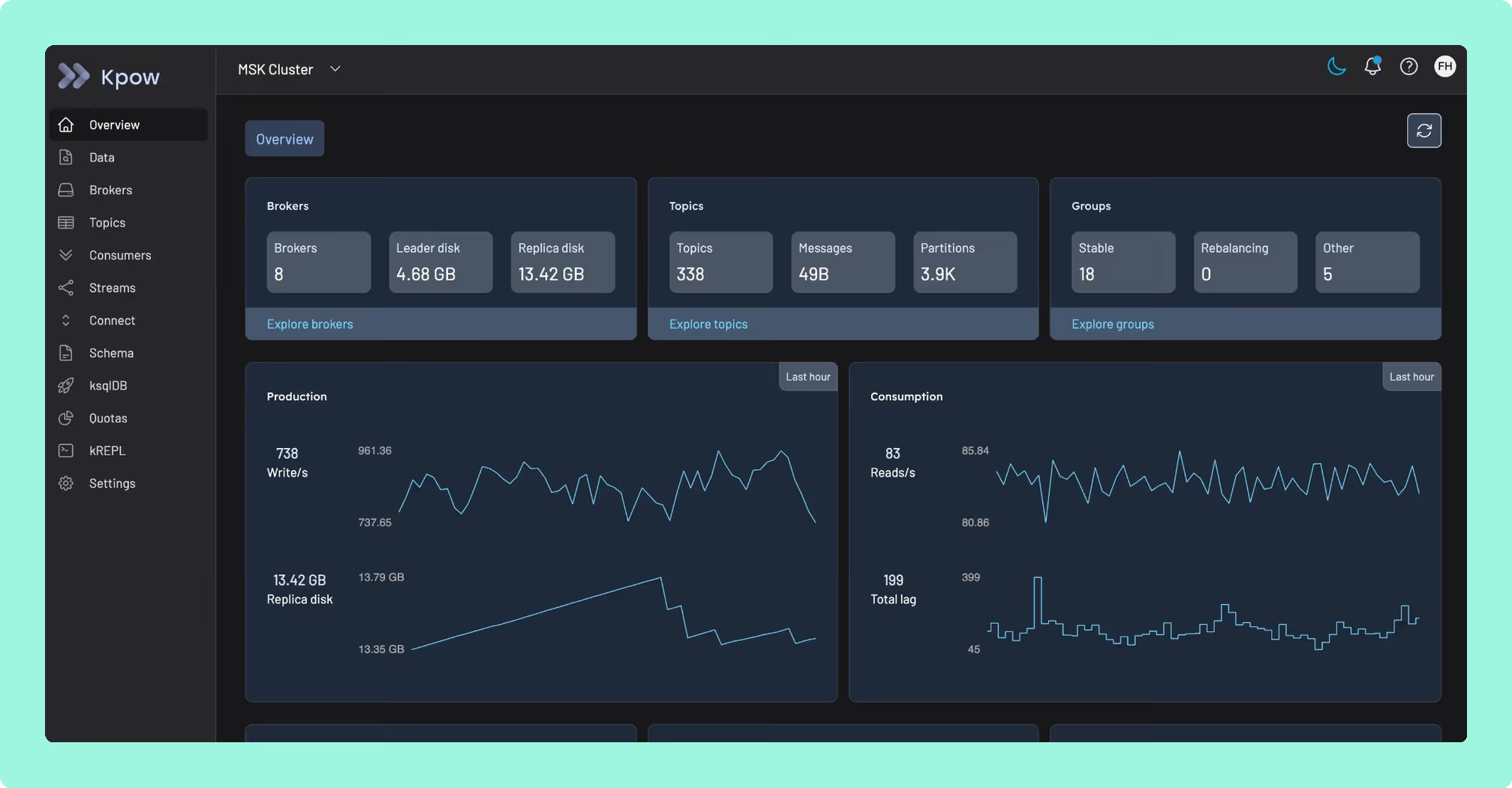
Kpow: one price per cluster, not per seat
Neither of these prices the actual unit of a Kafka deployment, the cluster. Kafbat UI is free to license, but three published remote-code-execution CVEs sit across its two lineages and the project makes no support commitment, so patching, deploying and holding the pager for the container stays with whoever runs it. Offset Explorer prices per named user instead, 139, 128 or 119 US dollars by band, so the bill climbs at every hire whether or not that hire touches a second cluster. Kpow by Factor House is licensed per cluster at a published price, so an extra engineer changes nothing on the invoice. It runs as a single stateless JVM container configured through environment variables, with no external database, no sidecar and no persistent volume.
Both bills above skip the unit that is actually scaling: the cluster itself. That per-cluster price is worth checking on Kpow’s own page before either alternative’s bill catches up with headcount.
How these tools were scored
Every option is scored from 0 to 10 on each criterion, from the evidence and sources this page cites, and the reason for each score is on its card. Each criterion counts once, for a total out of 50. The options are listed by total.
Sources
- Apache Kafka documentation on authorization
- NVD record for CVE-2025-49127
- NVD record for CVE-2023-52251
- NVD record for CVE-2024-32030