At a glance
Kafbat UI and Confluent Control Center are scored here on the same five criteria, 50 points in all: Kafbat UI 38 out of 50, Confluent Control Center 20 out of 50. Kafbat UI takes its best score on Cost as teams grow (10 out of 10) and its lowest on Support and maintenance (5 out of 10). Cost a year (modelled): $0 licence, plus $8,640 in ops time. Confluent Control Center takes its best score on Access control and audit (7 out of 10) and its lowest on Cost as teams grow (2 out of 10). Cost a year (modelled): Licence not published, plus $2,880 in ops time.
Confluent Control Center vs Kafbat UI, compared
Kpow meets 7 of 8 requirements on this page.
Key takeaway
Control Center is a component of Confluent Platform and needs the proprietary Metrics Reporter in the broker classpath, so it cannot watch Amazon MSK, Redpanda or Aiven. It holds two things no free tool matches: its Kafka Streams topology view and its ksqlDB development workflow. Kafbat UI is Apache 2.0 with no seat or cluster cap, though it records changes but not reads until an operator sets the audit level to ALL, and no support commitment stands behind it. Kpow by Factor House is licensed per cluster at a published price.
Kpow live demo
Test the trade-offs in a live Kafka UI
You have compared Confluent Control Center vs Kafbat UI. Open a live Kpow environment to test the everyday workflows a shared Kafka platform needs.
Built for platform and data teams managing shared Kafka clusters.
Try the Kpow demoWhat is Confluent Control Center?
Control Center is the web management and monitoring interface bundled with Confluent Platform, Confluent’s commercial Kafka distribution. It is closed source, licensed as part of that distribution, and not sold on its own. One dashboard covers brokers, topics, consumer groups, Kafka Connect workers, Schema Registry, ksqlDB and Kafka Streams topologies. It requires the proprietary Confluent Metrics Reporter in the broker classpath, which is a file somebody has to put on the brokers rather than a policy a support ticket can relax.
Confluent Control Center
confluent.io
20 out of 50 Total
- Cost a year (modelled)
- Licence not published, plus $2,880 in ops time
- Needs on the broker
- The proprietary Confluent Metrics Reporter
- Its own node
- 4 cores, 8 GB, 200 GB to 100,000 replicas
- Cost as teams grow
- 2 out of 10
- Deployment footprint
- 2 out of 10
- Support and maintenance
- 6 out of 10
- Access control and audit
- 7 out of 10
- Multi-cluster reach
- 3 out of 10
Why these scores for Confluent Control Center
- Cost as teams grow 2 out of 10
- This page has it bundled inside a Confluent Platform enterprise licence, not sold separately, with no price published, and Control Center, multi-tenancy support and encryption each carry cost. Cost of ownership modelled at $2,880 a year in ops time on top of an unpublished platform licence (this page’s estimate, 2 engineer-hours a month at $120 an hour).
- Deployment footprint 2 out of 10
- This page gives it its own node separate from the brokers and Java 17, with next-generation sizing of 4 cores, 8 GB of RAM and 200 GB of storage up to 100,000 replicas, plus the proprietary Metrics Reporter in the broker classpath.
- Support and maintenance 6 out of 10
- This page gives a vendor under an enterprise licence, with quarterly patch updates for the current version only and no public issue tracker.
- Access control and audit 7 out of 10
- This page gives RBAC with audit logging for authentication and authorisation events, OIDC the only protocol on Confluent Platform with SAML unsupported for self-managed, and no masking described.
- Multi-cluster reach 3 out of 10
- This page gives Confluent Platform and nothing else, because the Metrics Reporter cannot go on brokers whose classpath you do not control.
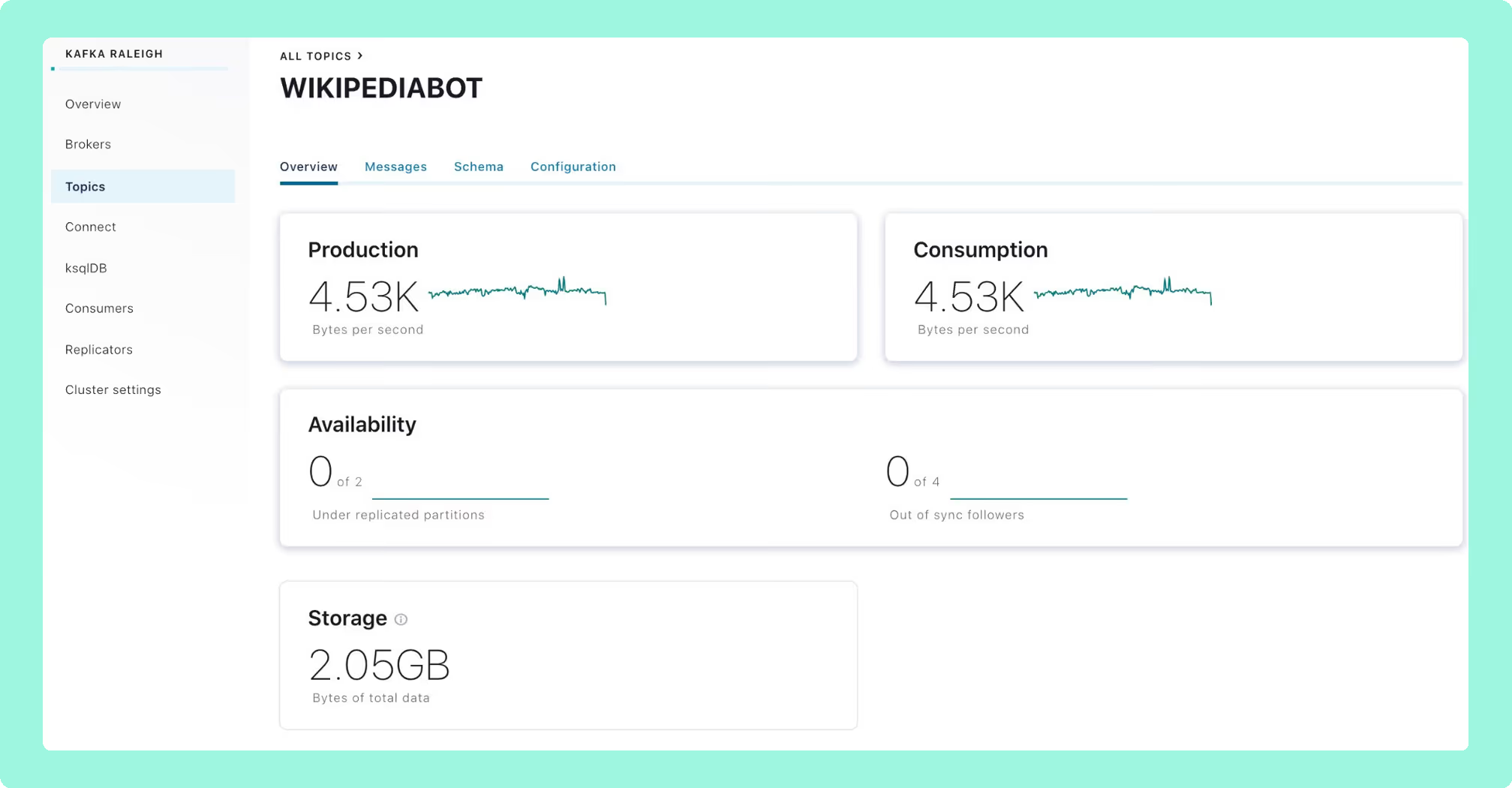
Legacy architecture: shipped with Confluent Platform 7.x and earlier, running metrics through a Kafka Streams pipeline.
Next generation: Prometheus-based, generally available with Confluent Platform 8.0 in May 2025.
Current line: 2.6.x, with Java 17 as a minimum, deployed on its own node separate from the brokers.
Ownership: IBM completed its acquisition of Confluent in March 2026.
Single sign-on: SAML is not supported for self-managed deployments, and OIDC is the only protocol on Confluent Platform.
RBAC: in an RBAC-enabled environment you cannot send metrics only, because full management has to be enabled.
Legacy interceptors: roughly 50 internal topics added to broker metadata.
Upgrades: legacy to next generation is a migration. Historical metrics do not carry over, and 7 to 15 days in parallel is recommended.
Cost of ownership (modelled): Confluent does not publish a price for Control Center, so there is no licence line to quote. What can be counted is the running cost: a dedicated node to size and patch, a reporter to keep on every broker, and a legacy to next generation migration run in parallel for 7 to 15 days. At 2 engineer-hours a month at $120 an hour that is $2,880 a year before the platform licence itself, against a published Kpow licence of $4,500 per cluster a year for up to 100 users.
Compare Kpow vs Confluent Control CenterAKHQ vs Confluent Control CenterConfluent Control Center review
What is Kafbat UI?
Kafbat UI is a free, open-source web dashboard for observing and managing Kafka clusters, deployed as a single container for the whole team. It is Apache 2.0, with no source-available restriction on production use, and it addresses a cluster the way any Kafka client does, through bootstrap-servers and ordinary client properties.
 Rank 1
 Kafbat UI
kafbat.io
38 out of 50 Total
- Cost a year (modelled)
- $0 licence, plus $8,640 in ops time
- Latest release
- v1.5.0, 20 April 2026
- Helm example values
- 200m of CPU, 512Mi memory limit
- Cost as teams grow
- 10 out of 10
- Deployment footprint
- 8 out of 10
- Support and maintenance
- 5 out of 10
- Access control and audit
- 6 out of 10
- Multi-cluster reach
- 9 out of 10
Why these scores for Kafbat UI
- Cost as teams grow 10 out of 10
- This page has it free under Apache 2.0, with no paid tier and no seat or cluster cap on the software, so a team of five and a team of fifty pay the same. Cost of ownership modelled at $8,640 a year (this page’s estimate, 6 engineer-hours a month at $120 an hour) on a $0 licence.
- Deployment footprint 8 out of 10
- This page gives a container, with the published Helm chart’s example values at 200m of CPU and a 512Mi memory limit, tied to no cluster size, held below 10 because anything configured through the UI is lost on restart without a mounted volume.
- Support and maintenance 5 out of 10
- This page gives v1.5.0 in April 2026 and none since, against commits still arriving in August 2026, with GitHub issues or a professional services engagement quoted rather than listed.
- Access control and audit 6 out of 10
- This page gives RBAC scoped per resource type with regular-expression role subjects, OAuth and LDAP identity providers, and server-side masking with three policy types; the audit level defaults to ALTER_ONLY, so who read a payload is not captured until an operator sets ALL.
- Multi-cluster reach 9 out of 10
- This page gives self-managed Kafka and managed services including Amazon MSK, Azure Event Hubs and Google Cloud, with cloud IAM integration.
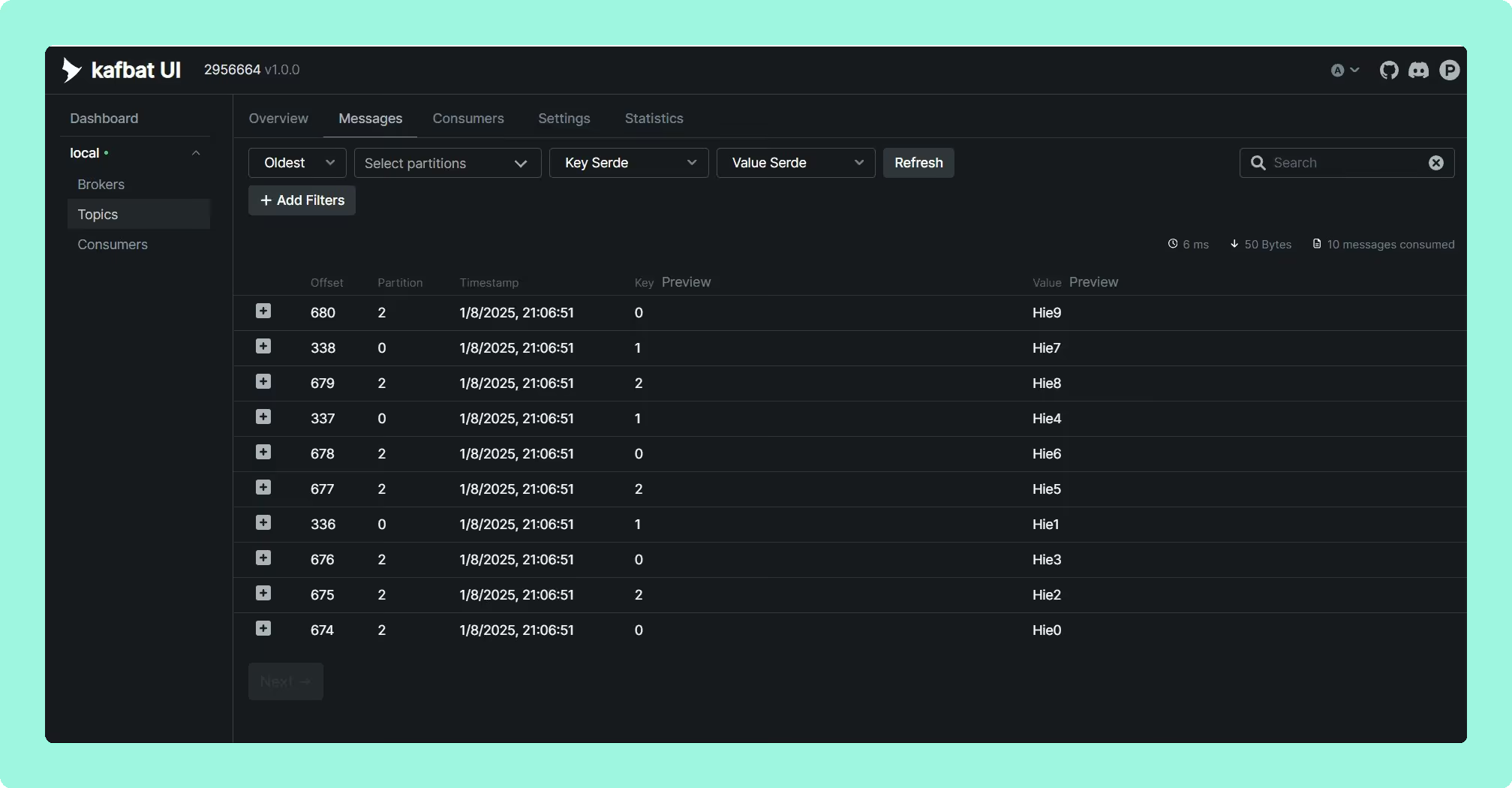
The naming is what most readers get wrong, and it matters because you may have typed the old name. Kafbat UI is the maintained continuation of the Provectus kafka-ui project, carried forward by contributors who were there from that project’s inception. The predecessor is dormant: its last release, v0.7.2, landed in April 2024 and its last commit that July. It still carries roughly five times Kafbat’s stars, which is why search keeps pointing at the abandoned repository. Kafbat itself has kept releasing, with v1.0.0 in March 2024 and v1.5.0 on 20 April 2026, and the company sells professional services rather than a paid edition.
Audit level: defaults to ALTER_ONLY, so who read a payload is not captured until an operator sets ALL.
Audit topic: must not be compacted, because records carry no key, and its partition count defaults to 1.
Masking: covers what the Messages page displays, per cluster and pattern-driven.
Dynamic config: with DYNAMIC_CONFIG_ENABLED set, anything configured through the UI is lost on restart without a mounted volume.
Staying patched: v1.5.0 shipped in April 2026 and nothing has shipped since. In the 157 days after it, at least 20 high or critical advisories were published against libraries that release bundles, including a critical in netty. Only 150 of its 266 bundled jars resolve to a Maven coordinate, so that is a floor rather than a total, and the state of the release itself is unmeasured. Kafbat does publish a security policy, which AKHQ and Kafdrop do not.
Cost of ownership (modelled): The software is $0, so the bill is time. Running a shared Kafka UI, keeping it current, wiring the identity providers and mounting a volume so UI configuration survives a restart is 6 engineer-hours a month on this page’s estimate, which at $120 an hour is $8,640 a year, with no support contract behind it. A published Kpow licence is $4,500 per cluster a year for up to 100 users.
What is the official 2026 pricing of Confluent Control Center and Kafbat UI?
Control Center has no price of its own, because it is not sold on its own. The unit is a Confluent Platform licence, so what you buy when you want this interface is a distribution, and it cannot be bought for a cluster somebody else runs. Beyond the base licence, Control Center, multi-tenancy support and encryption each carry cost.
Kafbat’s software costs nothing, with no seat cap and no cluster cap. The money is in services: architecture review, custom UI implementation, performance and scaling support, security and compliance work, and 24/7 enterprise support, each quoted on request. No support commitment stands behind the software itself. Neither of these bills by the seat, so headcount is the wrong axis to compare them on: a team of five and a team of fifty pay the same on both sides. One bill moves with the platform contract and the topology underneath it, and the other does not move at all, with the operator’s own time as the second half of what it costs.
Where does each one run out?
Both tools are marked out of 10 on the same five criteria, for a total out of 50, and every criterion counts once. Nothing sits behind a multiplier, so a total is the sum of its five marks and a reader can recompute it. The five are cost as teams grow, deployment footprint, support and maintenance, access control and audit, and multi-cluster reach, because those are the questions a Kafka interface is actually measured against after the first month: a second cluster, an access review with a date on it, an upgrade nobody owns, and a bill that moves when the team does. The widest gap between the two marks is on cost as teams grow, where Confluent Control Center marks 2 and Kafbat UI marks 10. The marks come from the same matrix used on every comparison on this site, so a tool scores the same here as it does anywhere else, and the reason behind each mark is in the card below, under Why these scores.
The dependency figures in the cards below were read on 24 September 2026 from each project’s published release artefact and matched against the NVD and GitHub advisory databases, so they move whenever a release or an advisory lands. Kpow is self-hosted as well. What a licence buys here is not a different deployment model, it is a company under contract to ship the patched build.
Control Center’s limits are structural before they are operational. It cannot monitor Amazon MSK, Redpanda or Aiven at all, and MSK’s native IAM authentication is not supported, so a mixed estate needs a second tool for everything that is not Confluent Platform.
Kafbat’s exposure is organisational rather than technical, and the release cadence is where it shows: five tags across 2025, then v1.5.0 in April 2026 and none since, against commits still arriving in August 2026. Response times, escalation and fixes come from a services engagement.
Which should you pick?
Kafbat UI scores 38 against Control Center’s 20 and is the pick for any cluster outside Confluent Platform, because Control Center’s proprietary reporter cannot be installed on Amazon MSK, Redpanda or Aiven. Control Center holds the ksqlDB and Kafka Streams views no free tool matches. Kafbat records changes but not reads by default and carries no support commitment, so a regulated team should shortlist Kpow by Factor House.
Keep Control Center if:
- you are on Confluent Platform and Kafka Streams topologies are part of how the team works
- ksqlDB development integration is a requirement
Take Kafbat UI if:
- the cluster is MSK, Redpanda, Aiven or plain Apache Kafka
- Control Center is being used as a topic and consumer-group console rather than for topologies
- the licence rather than a feature gap is what is driving the move
If the cluster is not Confluent Platform, the choice is already made and no feature comparison will change it, because the Metrics Reporter cannot go on brokers whose classpath you do not control. Replacing Control Center with an open-source Kafka UI where topologies matter loses a view no free tool restores, so the work in front of you is replacing a capability rather than an interface. On the audit question both have a trail, and what each records is decided differently: Control Center logs authentication and authorisation events, and Kafbat records modifications until somebody sets the level to ALL, which belongs in the deployment manifest rather than in somebody’s memory. If the shortlist is wider than these two, the field is scored in full on the best free Kafka UI tools and on the best Kafka management tools.
Kpow: the reach a distribution’s own console doesn’t have
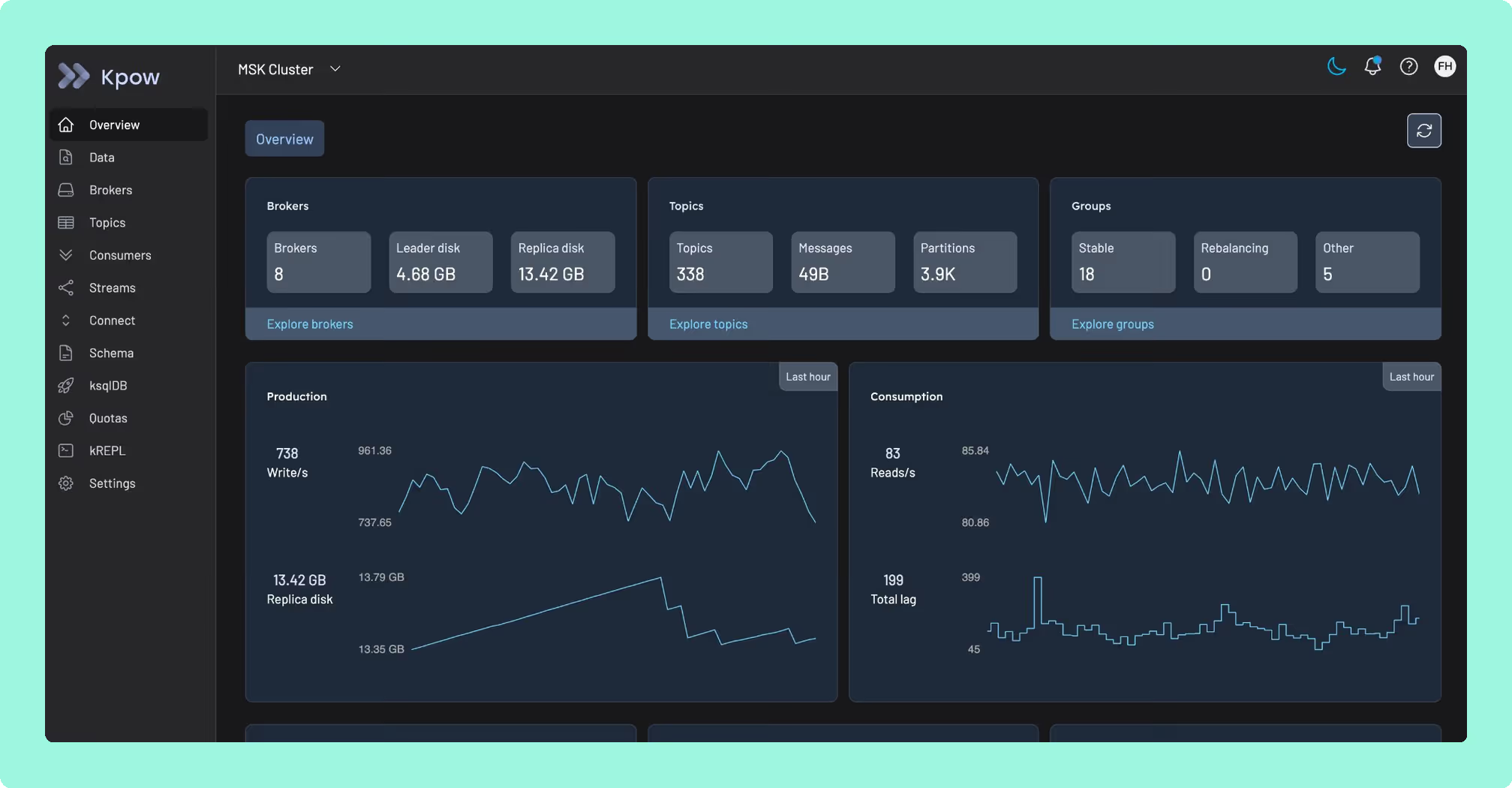
Control Center and Kafbat UI share the same blind spot from opposite directions. Control Center only ever watches Confluent Platform, because the proprietary Metrics Reporter it needs cannot go on brokers you don’t control, so it cannot monitor Amazon MSK, Redpanda or Aiven at all. Kafbat UI reaches any of those other clusters, but no support commitment stands behind the software itself, only a services engagement quoted on request. Kpow by Factor House is self-managed tooling that runs on top of the cluster you already have, hosting no broker and licensed per cluster at a published price. One stateless JVM container reaches self-managed Kafka, MSK, Confluent Cloud, Redpanda, Aiven and Instaclustr, covering ground a distribution’s own console can’t follow.
One interface across a topology that outgrew its distribution is worth seeing directly. Point Kpow at whichever of those clusters you run.
How these tools were scored
Every option is scored from 0 to 10 on each criterion, from the evidence and sources this page cites, and the reason for each score is on its card. Each criterion counts once, for a total out of 50. The options are listed by total.