At a glance
Kpow and Confluent Control Center are scored here on the same five criteria, 50 points in all: Kpow 44 out of 50, Confluent Control Center 20 out of 50. Kpow takes its best score on Access control and audit (10 out of 10) and its lowest on Cost as teams grow (7 out of 10). Cost a year: $13,500 licence for 3 clusters, plus $2,880 in ops. Confluent Control Center takes its best score on Access control and audit (7 out of 10) and its lowest on Cost as teams grow (2 out of 10). Cost a year: Bundled, no published price, plus about $2,880 in ops.
Kpow vs Confluent Control Center, compared
Kpow meets 5 of 7 requirements on this page. One row is not a yes or no question.
Key takeaway
Control Center requires the proprietary Confluent Metrics Reporter in the broker classpath, which is why it cannot be pointed at Amazon MSK, Redpanda or Aiven at all. It is not sold separately and no price is published, because the unit is a Confluent Platform licence. Two generations are in active deployment, and legacy 7.x and the Prometheus-based release in Confluent Platform 8.0 are different evaluations. Native ksqlDB development is Control Center’s alone. Kpow by Factor House is licensed per cluster, and the price is published.
Kpow live demo
See Kpow in a working Kafka environment
You have seen how Kpow compares on paper. Open the live demo to test the workflows your platform team will depend on during an incident.
Built for platform and data teams managing shared Kafka clusters.
Try the Kpow demoWhat is Confluent Control Center?
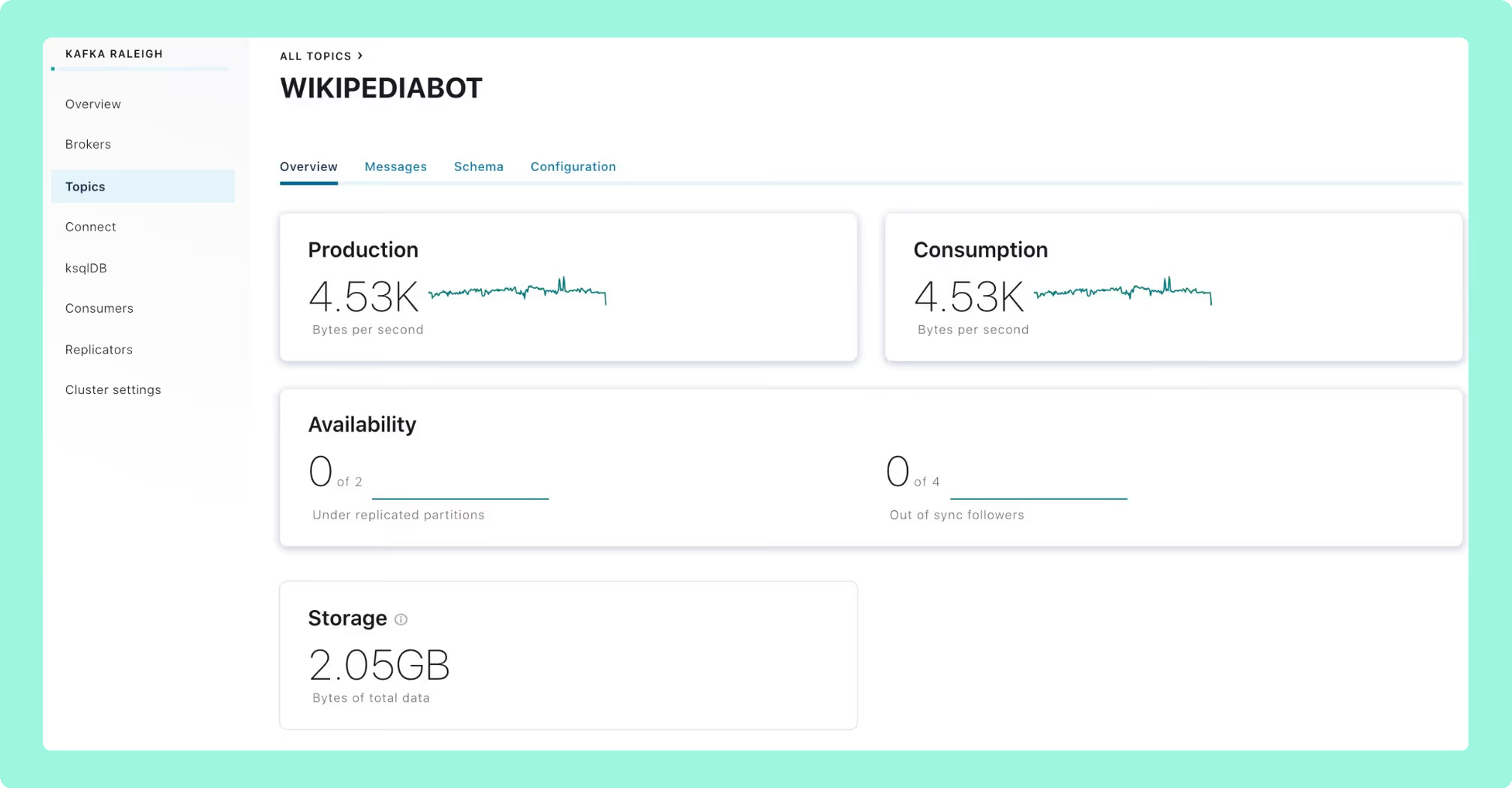
Control Center is the web management and monitoring interface bundled with Confluent Platform, Confluent’s commercial Kafka distribution. It is closed source, covered by an enterprise licence, and not available on its own. It gives one dashboard over brokers, topics, consumer groups, Kafka Connect workers, Schema Registry, ksqlDB and Kafka Streams topologies across Confluent-managed clusters.
- Legacy architecture: shipped with 7.x and earlier, moving metrics through a Kafka Streams pipeline.
- Next generation: Prometheus-based, generally available with Confluent Platform 8.0 in May 2025.
- What changed: startup fell from 15 to 50 minutes to roughly one, and supported partition scale rose from 120,000 to 400,000.
- Prerequisite: the Confluent Metrics Reporter JAR is broker-side, so Control Center cannot be pointed at Amazon MSK, Redpanda or Aiven.
Inside a Confluent deployment the payoff is real: a panoramic view across every component of the platform, Schema Registry integration, and native ksqlDB development tooling that no open-source interface matches. IBM completed its acquisition of Confluent in March 2026.
What is Kpow?
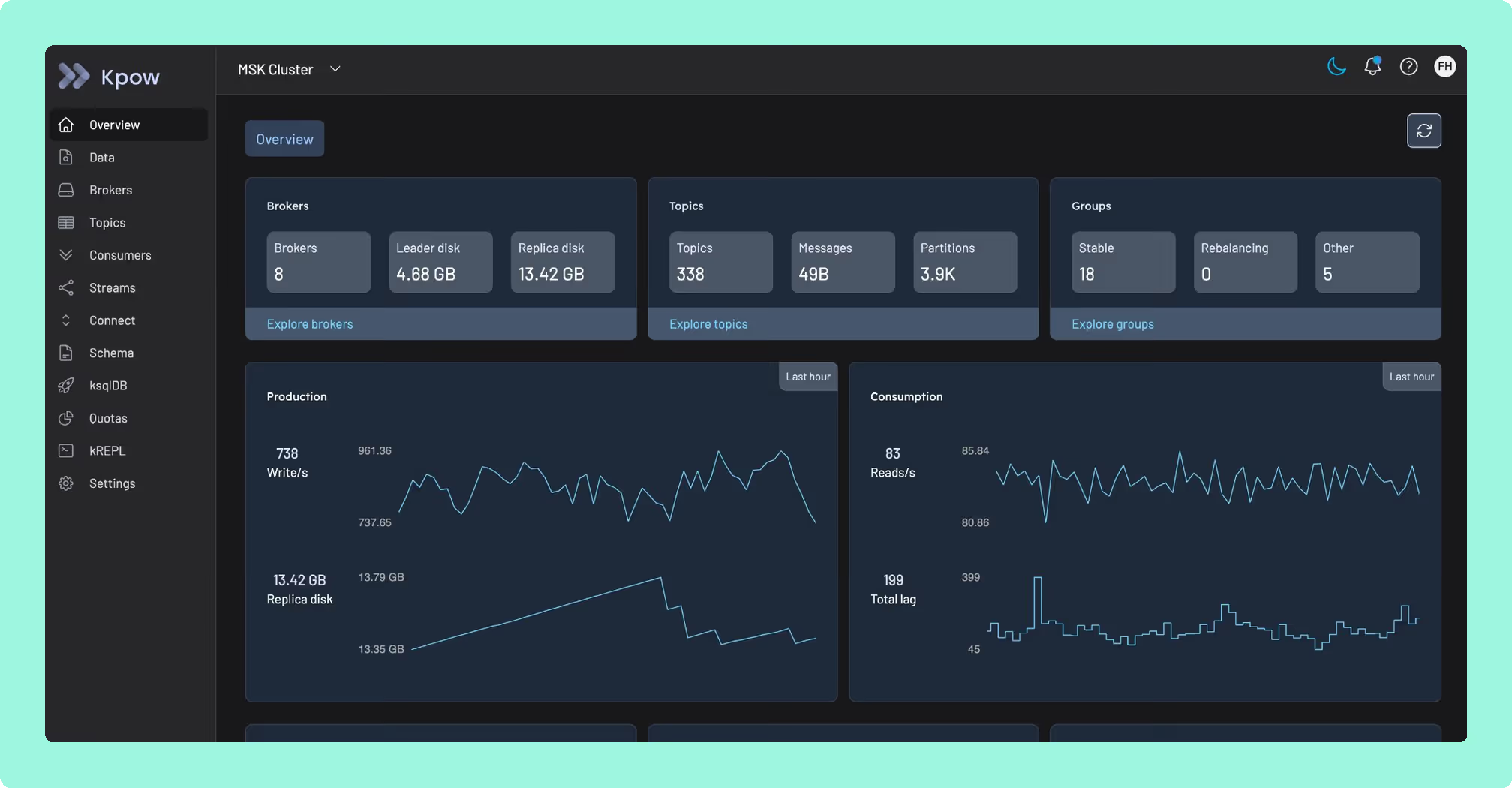
Kpow by Factor House is engineer-facing tooling for Apache Kafka. It runs against whatever cluster you already have: self-managed Kafka, Amazon MSK, Confluent Cloud, Redpanda, Aiven and Instaclustr. It is a single stateless JVM container, configured entirely through environment variables, with no external database, no sidecar and no persistent volume, keeping its telemetry in internal Kafka topics on the cluster it is already monitoring. One instance manages up to 12 Kafka clusters.
What is the official 2026 pricing of Kpow and Confluent Control Center?
The two prices are not the same kind of object. Kpow is licensed per cluster and the price is published: Enterprise starts at 4,500 US dollars per cluster and includes 100 users, and the Community Edition is free for up to 3 clusters and 10 users. Control Center is not sold separately and carries no published price, because the unit is a Confluent Platform licence rather than a cluster or a seat. Beyond the base licence, Control Center, multi-tenancy support and encryption each carry additional cost.
Under a per-cluster price, adding an engineer changes nothing up to the included user count, and adding a cluster is a number you can read before speaking to anybody. Under a platform licence, you cannot buy the tool for a cluster somebody else runs, and you cannot buy it at all without taking the distribution with it: the operations surface is an entitlement of the licence, and it lapses when the licence does. The practical test is which of your two numbers is growing faster, and which you can forecast.
Where does each one run out?
Both are scored out of 50, as five criteria marked out of 10, and each criterion carries the same weight as the others. Nothing sits behind a multiplier, so a total is the sum of its five marks and a reader can recompute it. The five are cost as teams grow, deployment footprint, support and maintenance, access control and audit, and multi-cluster reach, because those are the questions a Kafka interface is actually measured against after the first month: a second cluster, an access review with a date on it, an upgrade nobody owns, and a bill that moves when the team does. The widest gap between the two marks is on deployment footprint, where Kpow marks 9 and Confluent Control Center marks 2. The marks come from the same matrix used on every comparison on this site, so a tool scores the same here as it does anywhere else, and the reason behind each mark is in the card below, under Why these scores.
 Rank 1
 Kpow
44 out of 50 Total
Try Kpow in the live demo No signup needed.
- Cost a year
- $13,500 licence for 3 clusters, plus $2,880 in ops
- Which clusters it can watch
- Self-managed, MSK, Confluent Cloud, Redpanda, Aiven
- Upgrade path
- A container swap. Nothing outside the cluster holds state
- Cost as teams grow
- 7 out of 10
- Deployment footprint
- 9 out of 10
- Support and maintenance
- 9 out of 10
- Access control and audit
- 10 out of 10
- Multi-cluster reach
- 9 out of 10
Why these scores for Kpow
- Cost as teams grow 7 out of 10
- Published per cluster, Enterprise from $4,500 with 100 users, Community Edition free for 3 clusters and 10 users with RBAC, masking and audit held back. On this page, adding a cluster is a number you can read before speaking to anybody.
- Deployment footprint 9 out of 10
- One stateless container, environment variables, no database, sidecar or volume. This page adds that nothing is loaded into the broker, so there is no prerequisite to negotiate with whoever owns the cluster.
- Support and maintenance 9 out of 10
- Email support and an Enterprise support SLA, shipping continuously. On this page, moving to a new release is a container swap, because nothing outside the cluster holds state.
- Access control and audit 10 out of 10
- RBAC, SSO, server-side masking applied by role, and an audit log of user actions, with LDAP, SAML and OpenID. This page records that SAML ships on Enterprise rather than being Confluent Cloud only.
- Multi-cluster reach 9 out of 10
- Up to 12 clusters per instance across MSK, Confluent, Redpanda, Aiven and others, held at 9 by the per-instance cap. This page sets six kinds of cluster against one distribution.
Nothing is loaded into the broker. That is the part that decides this comparison: there is no prerequisite to negotiate with whoever owns the cluster, and no distribution can rule the tool out.
Kpow is not a proxy: nothing sits between your producers and your brokers, so a requirement for encryption enforced below the application describes a proxy architecture, and that is a different purchase. Native ksqlDB development is Control Center’s own turf; Kpow answers the same question a different way, visualising live Kafka Streams topologies in the Workflows UI instead.
What it costs a year: published, plus the cost of running it, and both halves are on the page before anybody is contacted. Enterprise is 4,500 US dollars per cluster a year with 100 users included, so dev, staging and production are 13,500, and this page’s estimate for one stateless container is two engineer-hours a month at 120 US dollars an hour, 2,880 a year, which is 16,380 all in. There is no published number on the other side to set against it. Nothing goes on the brokers here and nothing is sized, so a cluster somebody else runs comes under the same 16,380 without a distribution coming with it.
Compare Kpow vs Kafbat UIKpow vs CMAK
Confluent Control Center
confluent.io
20 out of 50 Total
- Cost a year
- Bundled, no published price, plus about $2,880 in ops
- Which clusters it can watch
- Confluent Platform only. A broker-side JAR is required
- Upgrade path
- Legacy to next generation is a migration, 7 to 15 days parallel
- Cost as teams grow
- 2 out of 10
- Deployment footprint
- 2 out of 10
- Support and maintenance
- 6 out of 10
- Access control and audit
- 7 out of 10
- Multi-cluster reach
- 3 out of 10
Why these scores for Confluent Control Center
- Cost as teams grow 2 out of 10
- Bundled into a Confluent Platform licence, no published price, and no free tier beyond a time-limited evaluation. On this page, Control Center, multi-tenancy support and encryption each carry additional cost on top of the base licence.
- Deployment footprint 2 out of 10
- Dedicated nodes at 4 cores, 8 GB and 200 GB up to 100,000 replicas, plus the Metrics Reporter JAR on the brokers. This page gives 8 cores, 16 GB and 300 GB above that, and legacy interceptors add roughly 50 internal topics to broker metadata.
- Support and maintenance 6 out of 10
- A vendor under enterprise contract, with quarterly patches for the current version only and no public issue tracker. On this page, legacy to next generation is a migration rather than an upgrade, with 7 to 15 days in parallel recommended.
- Access control and audit 7 out of 10
- RBAC with audit logging for authentication and authorisation events, OIDC only on self-managed, no SAML and no masking described. This page adds that a SAML-only identity provider is one more thing to settle before the licence.
- Multi-cluster reach 3 out of 10
- Confluent Platform only, because the reporter JAR cannot go on MSK, Redpanda or Aiven. This page records that on a mixed topology whatever watches MSK or Redpanda is a second tool with a second set of dashboards and alerts.
Control Center’s limits are structural rather than a bug list. The distribution boundary is the first: on a mixed estate the tool covers the Confluent part and nothing else, so whatever watches MSK or Redpanda is a second tool with a second set of dashboards and alerts.
Single sign-on: documented against OIDC on self-managed deployments, so a SAML-only identity provider is one more thing to settle before the licence.
Legacy interceptors: roughly 50 internal topics added to broker metadata.
Footprint: 4 cores, 8 GB of RAM and 200 GB of storage for clusters up to 100,000 replicas, and 8 cores, 16 GB and 300 GB above that.
Alerting: many teams route production alerting through Prometheus and Grafana and keep Control Center for ad-hoc debugging.
What it costs a year: not a number you can read. It is not sold separately, so the licence is a Confluent Platform licence with no published price, and Control Center, multi-tenancy support and encryption each carry additional cost on top of it. For the running cost alone, this page’s estimate rather than a vendor price: two engineer-hours a month at 120 US dollars an hour, 2,880 a year, covering the sized nodes above, the Metrics Reporter JAR on every broker and the 7 to 15 days of parallel running a generation change asks for. Everything that decides this bill sits in the part with no published number.
Compare Confluent Control Center reviewAKHQ vs Confluent Control CenterConfluent Control Center vs Kadeck
How do you switch, or run both?
Leaving Control Center is broker-side work rather than a user-interface swap. Everything that made it work sits on the brokers: the Metrics Reporter JAR, and on the legacy architecture the interceptors as well, and removing those also removes roughly 50 internal topics from broker metadata. Staying is not free either: upgrading legacy Control Center to the next generation is a migration rather than an upgrade, historical metrics do not carry over, and running the two in parallel for 7 to 15 days is the recommended path. Running both tools is also fine, because neither owns cluster state. A South Korean e-commerce marketplace made this move when it dropped the Confluent commercial licence, and names consumer lag and topic offset visibility as what it could not lose.
Which should you pick?
Kpow by Factor House is the pick for any estate that is not entirely Confluent Platform, scoring 44 against Control Center’s 20, because Control Center needs Confluent’s proprietary Metrics Reporter on every broker and cannot be pointed at Amazon MSK, Redpanda or Aiven. Control Center is the better choice for a team already committed to that licence and doing daily ksqlDB development, which Kpow does not offer.
Stay on Control Center if:
- you are entirely inside Confluent Platform and intend to stay there
- ksqlDB development is part of your daily workflow
- the licence is already committed and the tool bundled into it
Take Kpow if:
- the estate is mixed across MSK, Confluent Cloud, Redpanda, Aiven and self-managed Kafka
- a published price is needed to budget against before contacting anybody
- you are moving to community Kafka and need the operations surface back
- broker-side prerequisites are slow to get approved where you work
Where audit logging, data masking and air-gapped deployment are requirements rather than preferences, a broker-side prerequisite is the first thing that has to clear, and that is not a question about dashboards. Kafka monitoring that survives a change of distribution is the whole of the difference.
On a topology that is not all one distribution the shortlist widens, and the best Kafka monitoring tools covers what watches the clusters Control Center cannot see, while Kafka multi-cluster tools ranks how many of them one deployment reaches.
The IBM-Confluent acquisition has enterprises rethinking their streaming tooling dependencies, particularly in regulated industries with strong data sovereignty requirements.
Kylie Troy-West, Co-founder and COO of Factor House
How do you get an operations surface that outlives the distribution?
Confluent Control Center earns its place inside a Confluent deployment. It gives one dashboard over brokers, topics, consumer groups, Kafka Connect workers, Schema Registry, ksqlDB and Kafka Streams topologies across every Confluent-managed cluster, and the Confluent Platform 8.0 generation cut startup time from as long as 50 minutes to roughly one while lifting supported partition scale from 120,000 to 400,000. Native ksqlDB development tooling is a real strength no open-source interface matches.
But that panoramic view stops at the distribution boundary. Control Center needs the Confluent Metrics Reporter JAR in the broker classpath, so it cannot be pointed at Amazon MSK, Redpanda or Aiven at all. Single sign-on is documented against OIDC on self-managed deployments only, so a SAML-only identity provider is one more thing to settle before the licence. And the deployment itself is sized rather than light: 4 cores, 8 GB of RAM and 200 GB of storage for clusters up to 100,000 replicas, rising to 8 cores, 16 GB and 300 GB above that. Kpow answers each of those directly: nothing is loaded into the broker, so self-managed Kafka, MSK, Confluent Cloud, Redpanda, Aiven and Instaclustr are all reachable with no prerequisite to negotiate; LDAP, SAML and OpenID all ship on Enterprise, so the identity provider isn’t a gate; and it runs as one stateless container configured through environment variables, with no external database, sidecar or persistent volume to size in the first place.
It also settles on a number before Control Center does. Kpow Enterprise starts at 4,500 US dollars per cluster with 100 users included, published rather than bundled into a platform licence, and moving to a new release is a container swap rather than the 7 to 15 days of parallel running Control Center’s own generation change asks for. Start on Kpow and see how it holds up against the distribution you are on now. Control Center answers for the distribution you have today. Kpow answers for whichever one you run next.
How these tools were scored
Every option is scored from 0 to 10 on each criterion, from the evidence and sources this page cites, and the reason for each score is on its card. Each criterion counts once, for a total out of 50. This page is published by Factor House, which makes Kpow. Every option is scored on the same rubric and the same sources: Kpow's per-criterion scores are set the same way as every other option's and are not adjusted, and the weights apply to every option alike. Kpow ranks first on its total of 44 out of 50. The other options follow by total.