At a glance
AKHQ and Confluent Control Center are scored here on the same five criteria, 50 points in all: AKHQ 37 out of 50, Confluent Control Center 20 out of 50. AKHQ takes its best score on Cost as teams grow (10 out of 10) and its lowest on Support and maintenance (5 out of 10). Cost a year, modelled: 8,640 US dollars, no licence fee. Confluent Control Center takes its best score on Access control and audit (7 out of 10) and its lowest on Cost as teams grow (2 out of 10). Cost a year, modelled: 2,880 US dollars above the licence.
AKHQ vs Confluent Control Center, compared
Kpow meets 5 of 7 requirements on this page. One row is not a yes or no question.
Key takeaway
AKHQ is free under Apache 2.0, with no paid tier and no commercial support, and it runs against any Kafka a JVM can reach. Control Center is not sold on its own: it ships bundled with Confluent Platform under an enterprise licence, price unpublished, and needs the proprietary Metrics Reporter JAR in the broker classpath, so it cannot watch Amazon MSK, Redpanda or Aiven. AKHQ’s masking and audit are global YAML rather than role-aware policy. Kpow by Factor House is licensed per cluster from 4,500 US dollars a year, with 100 users included.
Kpow live demo
Test the trade-offs in a live Kafka UI
You have compared AKHQ vs Confluent Control Center. Open a live Kpow environment to test the everyday workflows a shared Kafka platform needs.
Built for platform and data teams managing shared Kafka clusters.
Try the Kpow demoWhat is AKHQ?
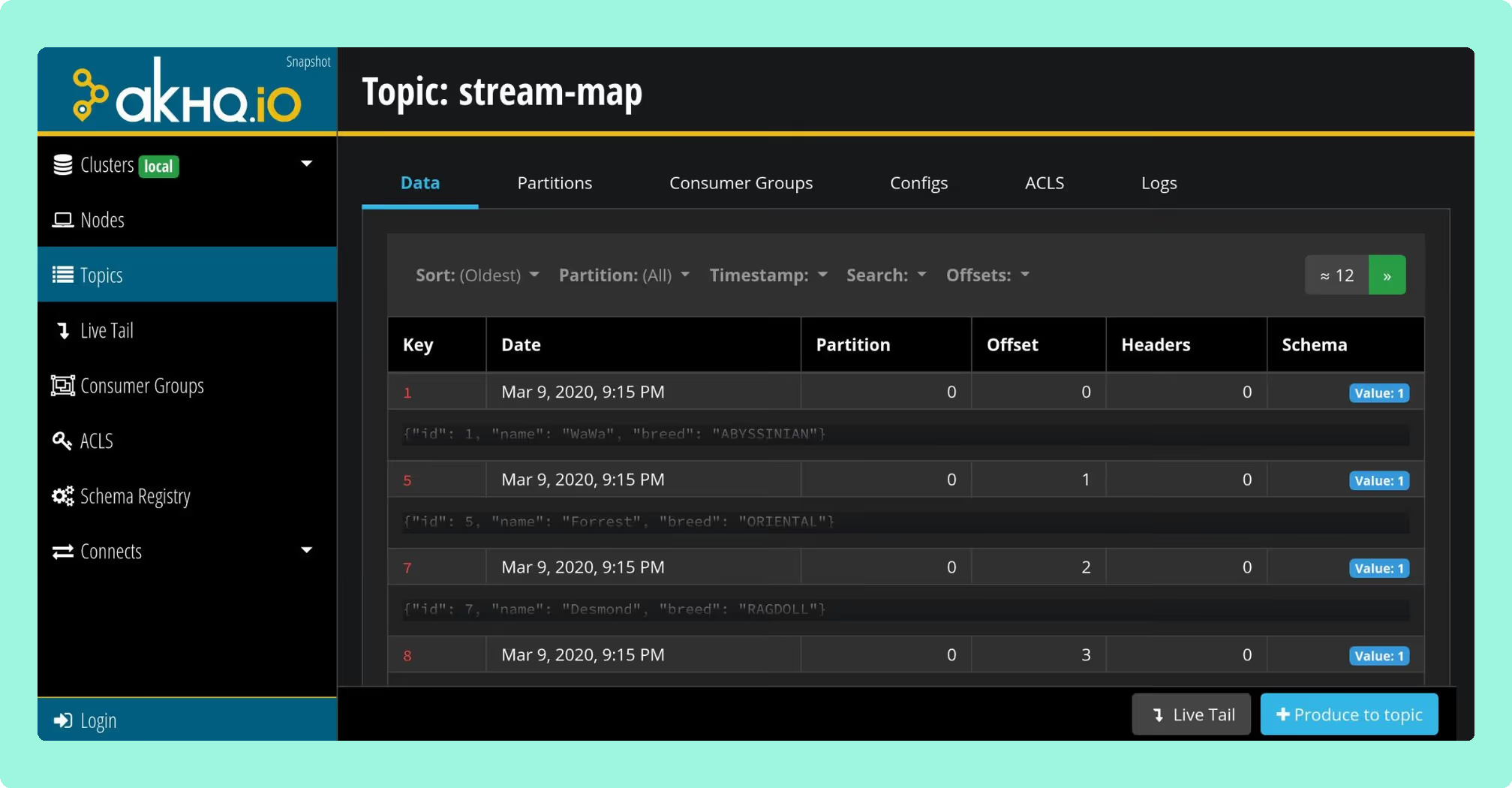
AKHQ is an open-source Kafka management UI under Apache 2.0, formerly KafkaHQ, self-hosted and built on Micronaut. One deployment reaches one cluster or many, and it runs against whatever the JVM can reach, self-managed clusters included. AWS MSK IAM authentication was contributed and merged.
- topic browsing, live tailing, producing, and consumer groups
- Schema Registry, Kafka Connect and ACL management
- role-based access with LDAP and OIDC
- connections, users, groups and registry links defined in YAML and deployed by Helm
There is no commercial edition, no hosted service and no paid support tier, and no feature is held back from the open release. Version 0.28.0 shipped in August 2026, after 0.27.1 in May and 0.27.0 in March. The commit record is concentrated: the lead maintainer has 441 commits and the next human contributor has 82.
What is Confluent Control Center?
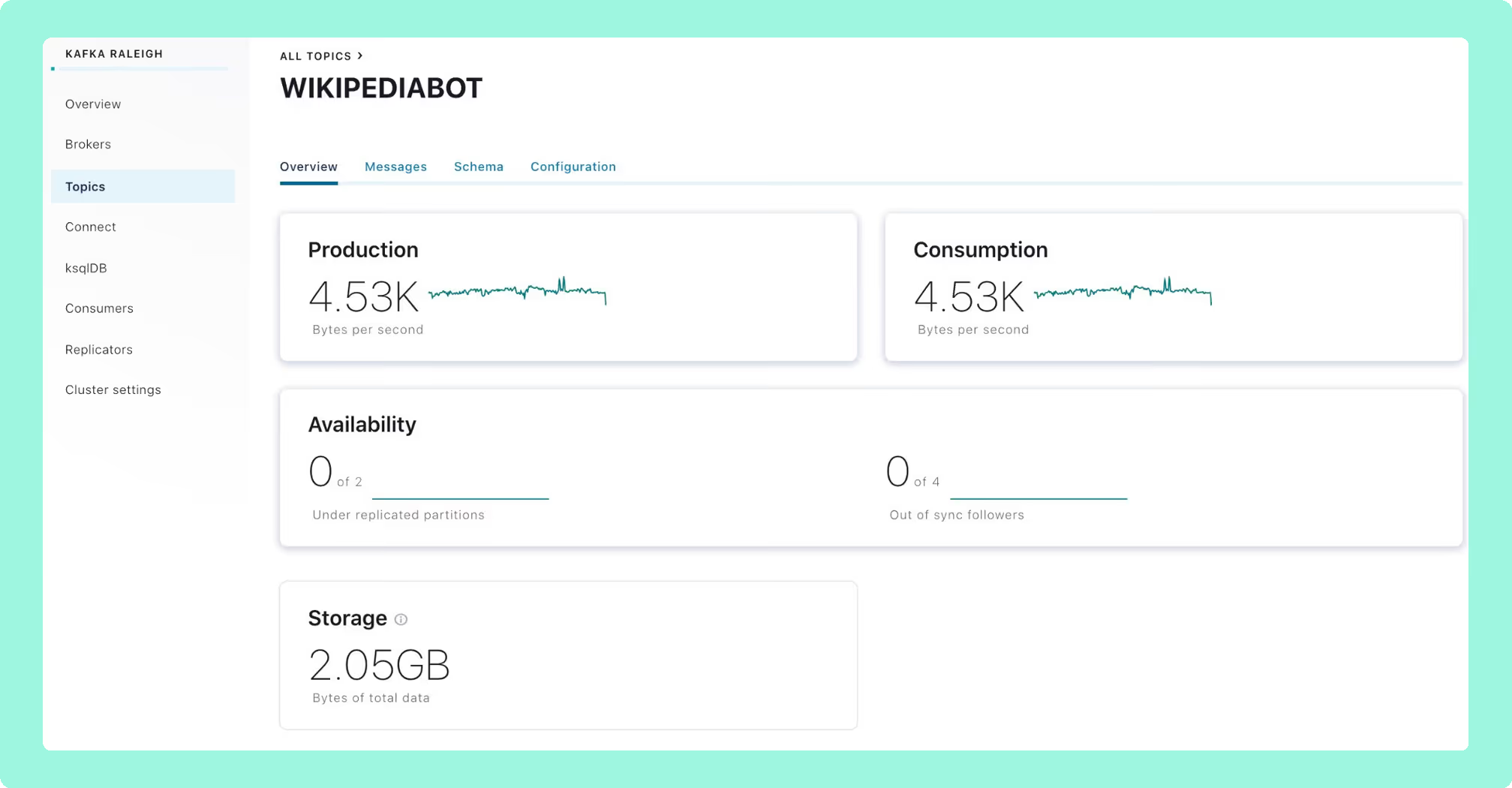
Control Center is the web management and monitoring interface bundled with Confluent Platform, Confluent’s commercial Kafka distribution. It is closed source and licensed as part of that distribution. Since Confluent Platform 8.0 the package ships from its own repository, but it is still not licensed or sold on its own. One dashboard covers brokers, topics, consumer groups, Kafka Connect workers, Schema Registry, ksqlDB and Kafka Streams topologies across Confluent-managed clusters.
Control Center requires the proprietary Confluent Metrics Reporter JAR in the broker classpath. That JAR cannot be installed on Amazon MSK, on Redpanda or on Aiven, so Control Center cannot watch any of them. It is a file that has to be on the brokers, not a licensing preference a support ticket might relax.
- Legacy architecture: shipped with Confluent Platform 7.x and earlier, running its metrics through a Kafka Streams pipeline.
- Next generation: Prometheus-based, generally available with Confluent Platform 8.0 in May 2025, now on the 2.6.x line with Java 17 as a minimum.
- What changed: startup fell from 15 to 50 minutes to roughly one, and supported partition scale rose from 120,000 to 400,000.
What is the official 2026 pricing of AKHQ and Confluent Control Center?
AKHQ costs nothing to license, and its whole cost is operator time. Somebody sizes the JVM, somebody reads the issue tracker before an upgrade, and somebody answers for it when it stops. There is no SLA, because there is nobody to escalate to, and no heap or sizing guidance is published at any cluster size.
Control Center has no price of its own. It is not sold separately and not priced separately: the unit is the Confluent Platform licence, so what you buy when you want this UI is a distribution. Control Center, multi-tenancy support and encryption each carry cost beyond the base licence, and additional charges apply for scaling. A developer licence gives the full feature set free and indefinitely on a single broker per cluster; add a second broker and it becomes a 30-day trial, with no way back. The Enterprise licence covers quarterly patch updates for the current version only, and the Platinum tier is not available for this product.
Where does each one run out?
Each tool here is marked out of 10 on five criteria, 50 points in all, and no criterion is weighted above another. Nothing sits behind a multiplier, so a total is the sum of its five marks and a reader can recompute it. The five are cost as teams grow, deployment footprint, support and maintenance, access control and audit, and multi-cluster reach, because those are the questions a Kafka interface is actually measured against after the first month: a second cluster, an access review with a date on it, an upgrade nobody owns, and a bill that moves when the team does. The widest gap between the two marks is on cost as teams grow, where AKHQ marks 10 and Confluent Control Center marks 2. The marks come from the same matrix used on every comparison on this site, so a tool scores the same here as it does anywhere else, and the reason behind each mark is in the card below, under Why these scores.
The dependency figures in the cards below were read on 24 September 2026 from each project’s published release artefact and matched against the NVD and GitHub advisory databases, so they move whenever a release or an advisory lands. Self-hosting is not the risk on this page. Both run in your own infrastructure. The question is who rebuilds the image when a dependency advisory lands.
 Rank 1
 AKHQ
37 out of 50 Total
- Cost a year, modelled
- 8,640 US dollars, no licence fee
- Connects to
- Any Kafka a JVM can reach
- Support
- GitHub issues, no SLA
- Cost as teams grow
- 10 out of 10
- Deployment footprint
- 8 out of 10
- Support and maintenance
- 5 out of 10
- Access control and audit
- 5 out of 10
- Multi-cluster reach
- 9 out of 10
Why these scores for AKHQ
- Cost as teams grow 10 out of 10
- The compare figure has it free under Apache 2.0, with no paid tier and no feature held back, so headcount does not change the bill. This page’s modelled cost of ownership is about 8,640 US dollars a year at 6 engineer-hours a month and 120 US dollars an hour; the 10 is for the bill not moving as the team grows, not for total cost.
- Deployment footprint 8 out of 10
- The compare figure gives one JVM container, with no external database and no sidecar, against Control Center’s dedicated sized host.
- Support and maintenance 5 out of 10
- The compare figure gives GitHub issues, no SLA and no commercial tier, but the project is still shipping.
- Access control and audit 5 out of 10
- The compare figure gives LDAP and OIDC, with masking and audit as global YAML and the audit trail written to a Kafka topic with no view in the product.
- Multi-cluster reach 9 out of 10
- The compare figure reaches any Kafka a JVM can reach, self-managed, MSK, Confluent, Redpanda or Aiven, from one deployment.
This page's cost estimate: no licence fee, and about 6 engineer-hours a month to size a JVM for which no sizing guidance is published and to answer for it with no SLA, at 120 US dollars an hour, is about 8,640 US dollars a year.
AKHQ’s governance is present but shallow. Its role-based access sits above the broker’s own ACLs rather than replacing them, so Kafka still decides what a principal may do and the UI decides who may ask.
Masking: four modes, configured globally in application YAML and keyed on topic and field path, so what is hidden does not vary by who is looking.
Audit: opt-in, written to a Kafka topic the operator nominates, with no audit view in the product.
Monitoring: the health, metrics and Prometheus endpoints on port 28081 describe the AKHQ process, not the brokers. No JMX visualisation and no alerting.
Open defects: constantly increasing memory reported since July 2022, and OIDC failures still arriving in August 2026.
Staying patched: release 0.28.0, cut on 6 August 2026, bundles 270 libraries and 18 of them carry a high or critical advisory. Sixteen of the eighteen were already public, with fixed versions already on Maven Central, on the day it shipped, and five of those are netty CVEs Kpow had already remediated in release 96.2 three weeks earlier: CVE-2026-44249, CVE-2026-45416, CVE-2026-45674, CVE-2026-47691 and CVE-2026-50010. The oldest has been open 108 days. Every jar AKHQ ships resolves to a coordinate, so this is a complete count rather than a floor, and each identifier can be checked at nvd.nist.gov. A shipped vulnerable library is exposure and remediation latency, not a working attack.
Confluent Control Center
confluent.io
20 out of 50 Total
- Cost a year, modelled
- 2,880 US dollars above the licence
- Connects to
- Confluent Platform only
- Needs to run
- 4 cores, 8 GB RAM, 200 GB storage
- Cost as teams grow
- 2 out of 10
- Deployment footprint
- 2 out of 10
- Support and maintenance
- 6 out of 10
- Access control and audit
- 7 out of 10
- Multi-cluster reach
- 3 out of 10
Why these scores for Confluent Control Center
- Cost as teams grow 2 out of 10
- The compare figure has it not sold separately, with no price published, and Control Center, multi-tenancy and encryption each carrying cost above the base platform licence. No price is published, and this page’s modelled carry on top of the platform licence is about 2,880 US dollars a year at 2 engineer-hours a month and 120 US dollars an hour.
- Deployment footprint 2 out of 10
- The compare figure gives 4 cores, 8 GB of RAM and 200 GB of storage for clusters up to 100,000 replicas, plus the Metrics Reporter JAR in the broker classpath.
- Support and maintenance 6 out of 10
- The compare figure puts Confluent under an enterprise contract, but with quarterly patches for the current version only, no Platinum tier and no public issue tracker.
- Access control and audit 7 out of 10
- The compare figure gives RBAC across Confluent-managed clusters with audit logging, capped at 10,000 rules per cluster, and OIDC only with no SAML self-managed.
- Multi-cluster reach 3 out of 10
- The compare figure has it on Confluent Platform only. The Metrics Reporter JAR cannot be installed on MSK, Redpanda or Aiven.
This page's cost estimate: Confluent publishes no price for Control Center, so the licence itself is unknown. On top of it, the dedicated host, the legacy to next-generation migration and a second tool for every cluster that is not Confluent Platform come to about 2 engineer-hours a month at 120 US dollars an hour, or about 2,880 US dollars a year.
Control Center’s limits are structural before they are operational. It cannot monitor Amazon MSK, Redpanda or Aiven at all, and MSK’s native IAM authentication is unsupported, so a mixed estate needs a second tool for everything that is not Confluent Platform.
SSO: SAML is not supported for self-managed deployments, and OIDC is the only SSO protocol on Confluent Platform.
RBAC: capped at 10,000 rules per cluster, and metrics cannot be sent without enabling full management.
GitOps: changes apply directly to cluster state rather than through a Git-managed manifest, so a team either treats it as read-only in production or accepts drift.
Upgrades: legacy to next generation is a migration. Historical metrics do not carry over, and Confluent recommends 7 to 15 days running both in parallel.
Legacy interceptors also add roughly 50 internal topics to broker metadata, and Kafka Streams can enter a rebalancing loop on startup that leaves the UI on a loading spinner for 20 to 30 minutes. There is no public issue tracker, so there is no way to watch for a fix.
Compare Kpow vs Confluent Control CenterConfluent Control Center vs Kafbat UIConfluent Control Center review
Which should you pick?
AKHQ is the pick for a team on Amazon MSK, Redpanda or Aiven, because Confluent Control Center needs Confluent’s proprietary Metrics Reporter on every broker and cannot watch those clusters at all. Control Center earns its place only inside a committed Confluent Platform licence. For role-aware masking, an audit view and a published per-cluster price on any distribution, shortlist Kpow by Factor House.
Pick AKHQ if:
- the cluster is anything other than Confluent Platform
- the tool is for engineers who already hold cluster access
- the value is day-to-day debugging rather than delegated self-service
- the team will own a JVM service and read a Micronaut stack trace
Pick Control Center if:
- you are already on Confluent Platform and paying for it
- Kafka Streams topology visualisation is a hard requirement
- native ksqlDB development is a hard requirement
Those last two are worth stating on their own terms: no open-source Kafka UI provides a comparable native view of either, and it is the one capability the licence genuinely buys. Underneath, though, the two are not competing for the same slot. One is a UI you add to a cluster you already have. The other is a UI you get by buying a distribution. If the real question is which console to run against a set of clusters that is not all Confluent Platform, the best Kafka management tools and Kafka multi-cluster management tools rank the field both of these sit in.
Kpow: a tool, not a distribution decision
AKHQ is free, but you own the running of it end to end, and Control Center arrives bundled with a distribution and cannot watch anything outside it: its proprietary Metrics Reporter JAR has to sit in the broker classpath, so it never sees Amazon MSK, Redpanda or Aiven, whatever the licence costs. Kpow by Factor House is a third shape: a tool you point at a cluster you already run, rather than a console you operate yourself or a distribution you buy. It does not run the broker, host it or replace it, which is what lets one stateless container reach self-managed Kafka, MSK, Confluent Cloud, Redpanda, Aiven and Instaclustr from the same instance. It is licensed per cluster from 4,500 US dollars a year, with 100 users included.
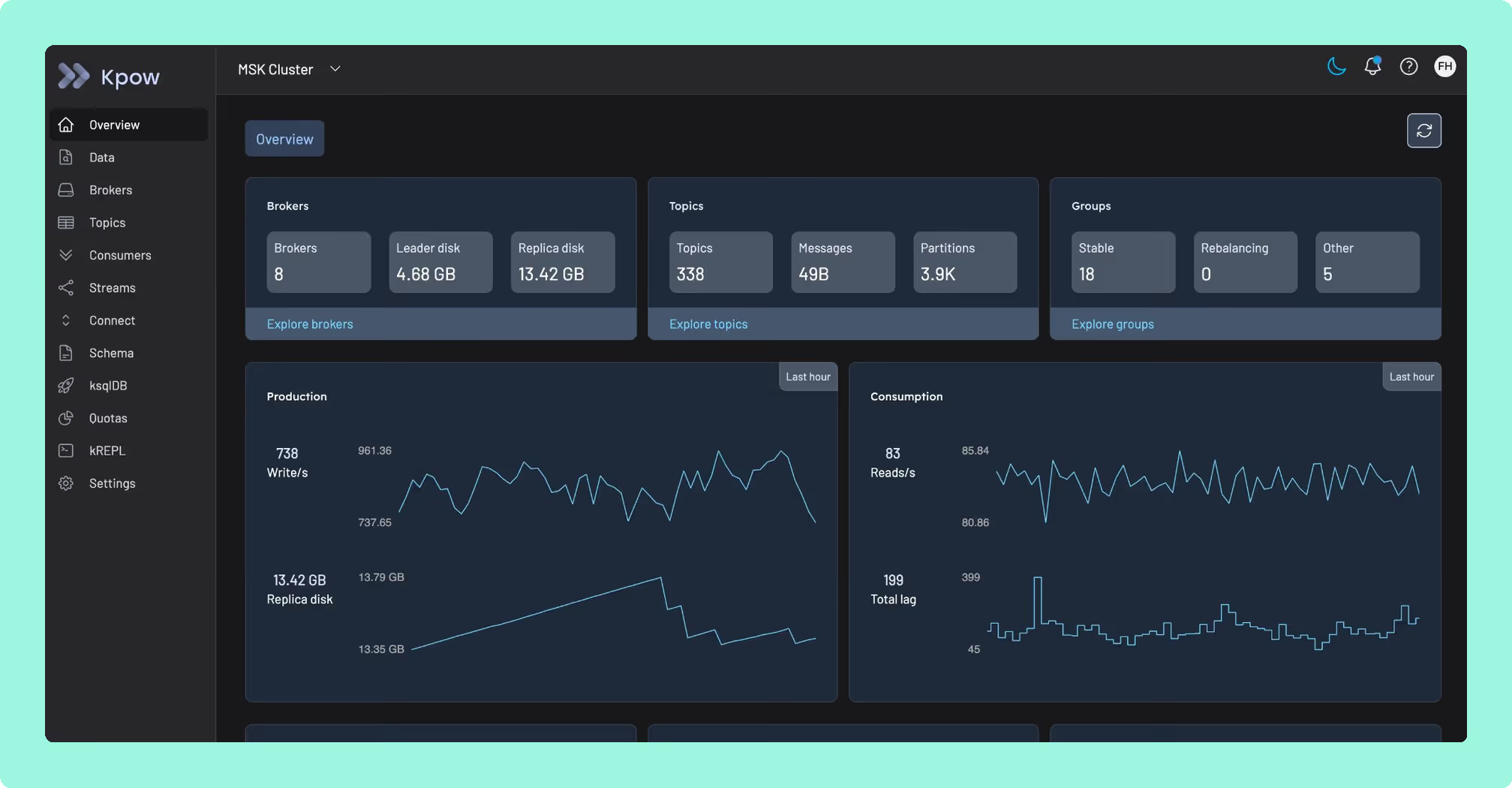
The distribution and the monitoring tool don’t have to be one purchase. Pointing Kpow at a cluster you already run is the fastest way to see the two questions come apart.
How these tools were scored
Every option is scored from 0 to 10 on each criterion, from the evidence and sources this page cites, and the reason for each score is on its card. Each criterion counts once, for a total out of 50. The options are listed by total.