At a glance
Lenses and Kafdrop are scored here on the same five criteria, 50 points in all: Lenses 26 out of 50, Kafdrop 23 out of 50. Lenses takes its best score on Access control and audit (7 out of 10) and its lowest on Deployment footprint (2 out of 10). Cost a year: $4,000 Team licence to 15 users on one cluster, plus $2,880 operator time (this page's estimate). Kafdrop takes its best score on Cost as teams grow (10 out of 10) and its lowest on Access control and audit (0 out of 10). Cost a year: $0 licence, $11,520 in operator time (this page's estimate).
Kafdrop vs Lenses.io, compared
Kpow meets 6 of 7 requirements on this page. One row is not a yes or no question.
Key takeaway
Kafdrop and Lenses both put a web interface over a Kafka cluster somebody else runs, and the feature lists are not what separates them. Kafdrop is free under Apache 2.0 with no paid tier and no authentication inside the product, and a request for one closed as not planned, so protecting it means a proxy in front. Lenses is a commercial data platform: a central HQ node needing PostgreSQL plus an Agent database per cluster, with DevX Team from 4,000 US dollars a year for 15 users. Kpow by Factor House is licensed per cluster at a published price.
Kpow live demo
Test the trade-offs in a live Kafka UI
You have compared Kafdrop vs Lenses.io. Open a live Kpow environment to test the everyday workflows a shared Kafka platform needs.
Built for platform and data teams managing shared Kafka clusters.
Try the Kpow demoWhat is Kafdrop?
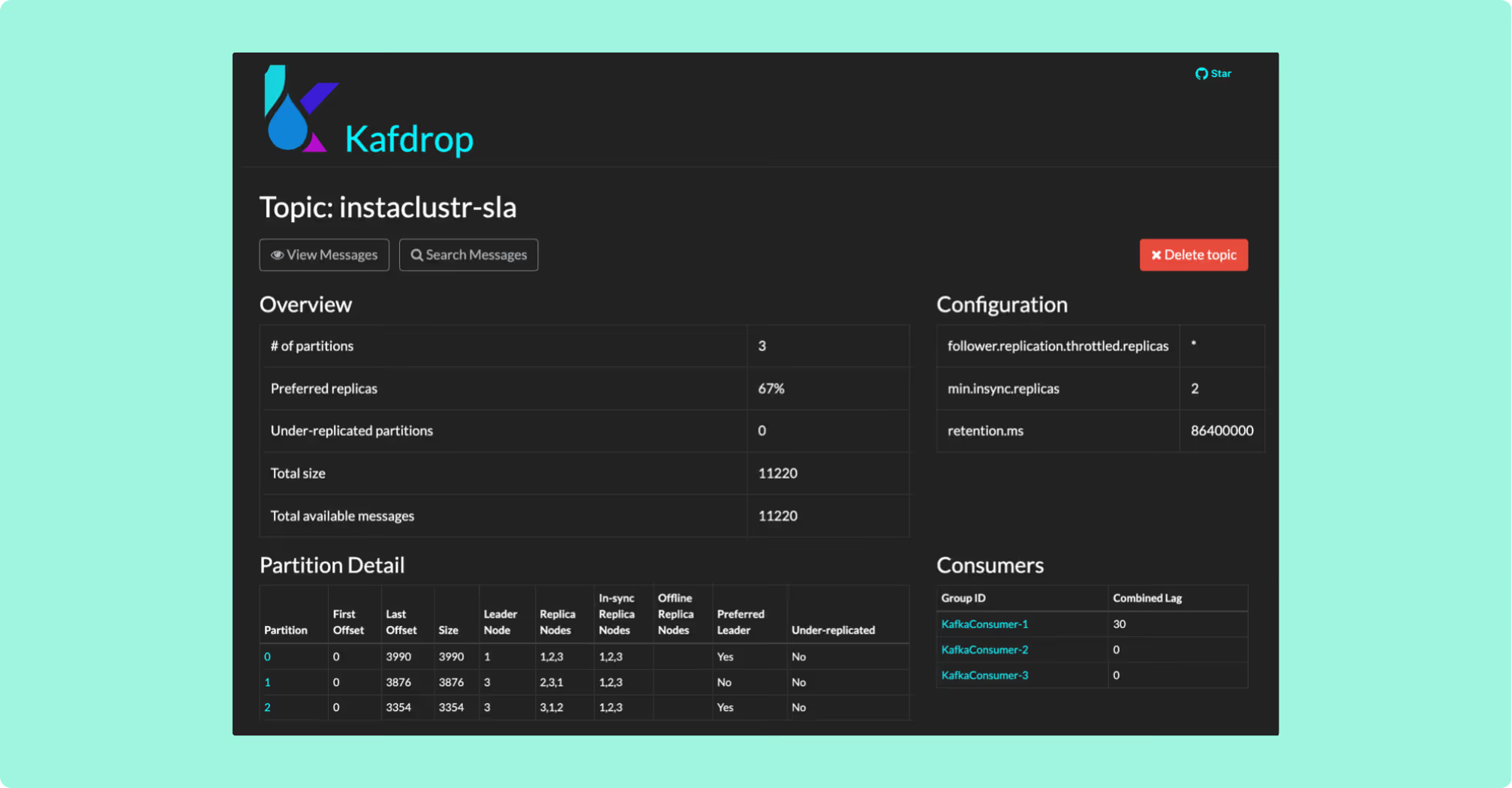
Kafdrop is an open-source Kafka UI built on Spring Boot and licensed Apache 2.0, hosted at obsidiandynamics/kafdrop. It runs as a stateless Java process talking standard broker protocols with no backend datastore, which is why it is the Docker Compose default in so many tutorials. It wants Java 17 or newer and Kafka 0.11.0 or newer, and takes Schema Registry as its one optional integration.
- view brokers and topics
- browse messages in JSON, plain text, Avro and Protobuf
- view consumer groups with combined and per-partition lag
- create topics, view ACLs, and reach Azure Event Hubs
Apache Kafka 4.0 supports KRaft only, and ZooKeeper mode has been removed. Kafdrop has needed no ZooKeeper connection since 3.10.0 and reads everything through the admin API, but three reports of the topic view failing against a KRaft cluster were each closed as not planned, the last in April 2025. Commits land continuously through August 2026, while the newest tagged release is 4.2.0 of July 2025.
What is Lenses?
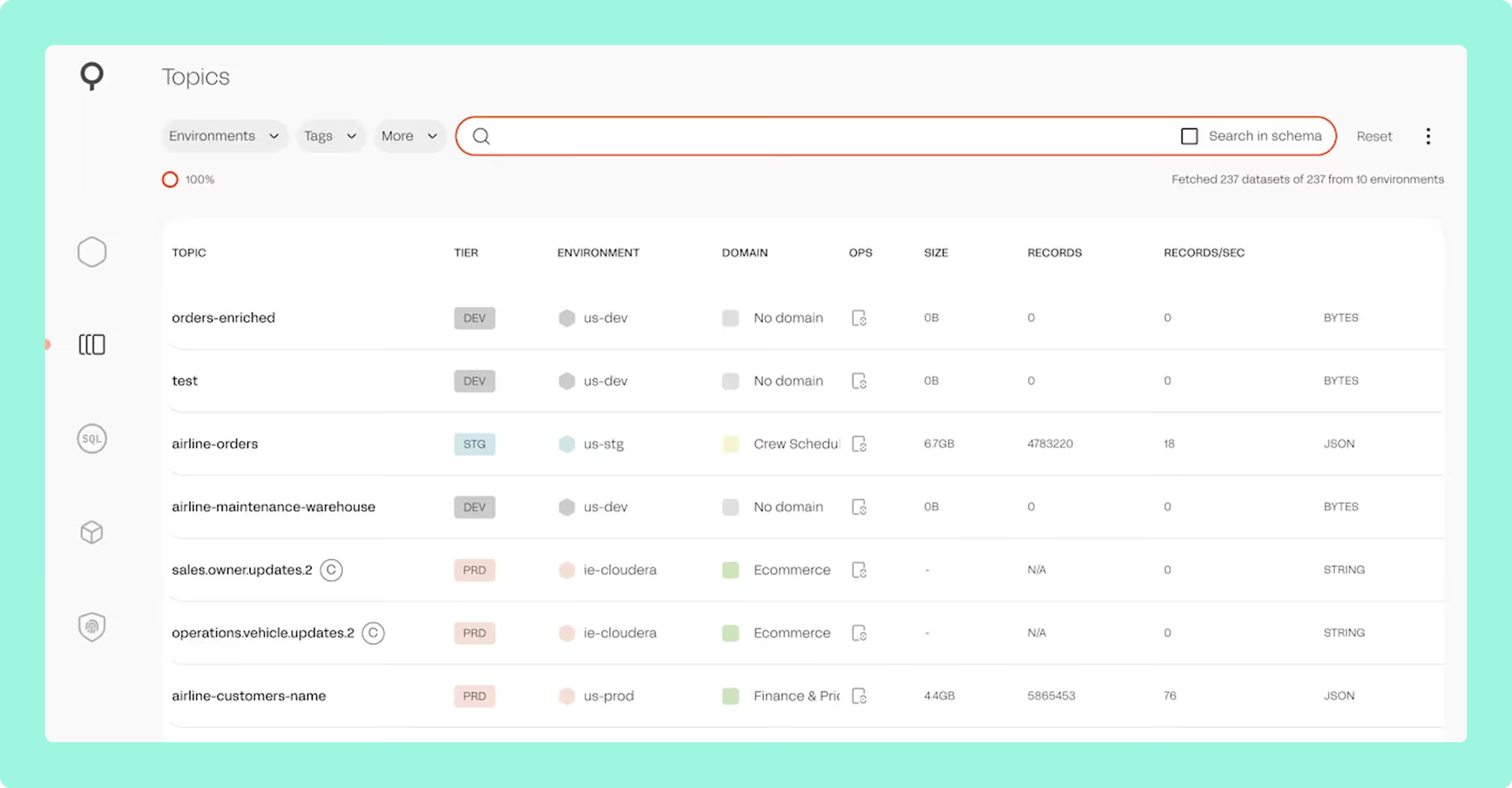
Lenses is a commercial Kafka governance and data exploration platform that sits on top of clusters somebody else runs. It is a Kafka client rather than a proxy, so nothing of it sits in the data path, and it is owned by Celonis. A central Lenses HQ node sits alongside a lightweight Agent per cluster, and an Agent connects to one Kafka cluster at a time. KRaft clusters need no modification, because the Agent connects as an ordinary Kafka client. 6.2.6 shipped in August 2026.
- SQL Studio: a SQL interface for querying topics without writing consumer code.
- Topology and lineage: one view across producers, topics, connectors and consumers.
- SQL Processors: Kubernetes-native stream processing built on Kafka Streams.
- Roles: built-in Admin, Operator and Security Admin, with deletes and offset writes restricted to Admin.
What is the official 2026 pricing of Kafdrop and Lenses?
Kafdrop costs nothing to license: one tier, Apache 2.0, no commercial edition, no subscription and nobody to buy support from. The whole cost is operator time, and there is no SLA to escalate to.
Lenses is priced in two ladders. On the DevX side, Community is free for up to five users with Basic Auth only, no SSO and no RBAC. DevX Team starts at 4,000 US dollars a year for up to 15 users and adds SSO, SAML, RBAC and Team Support. Multi-Kafka Enterprise is custom priced. The step from Community to Team is a user-count step as well as a capability step, five to fifteen. Replication is metered separately: K2K Community is free with a maximum of five topic partitions per job, and K2K Enterprise starts at 1,000 US dollars a month with five clusters included and 200 dollars a month for each cluster after. At five engineers both are free and the question is what each exposes you to. At fifty, Kafdrop is still zero and Lenses is past both published user caps.
Where does each one run out?
The scoring is the same on both sides: five criteria, 10 points each, 50 in all, with every criterion counting once. Nothing sits behind a multiplier, so a total is the sum of its five marks and a reader can recompute it. The five are cost as teams grow, deployment footprint, support and maintenance, access control and audit, and multi-cluster reach, because those are the questions a Kafka interface is actually measured against after the first month: a second cluster, an access review with a date on it, an upgrade nobody owns, and a bill that moves when the team does. The widest gap between the two marks is on deployment footprint, where Kafdrop marks 10 and Lenses marks 2. The marks come from the same matrix used on every comparison on this site, so a tool scores the same here as it does anywhere else, and the reason behind each mark is in the card below, under Why these scores.
The dependency figures in the cards below were read on 24 September 2026 from each project’s published release artefact and matched against the NVD and GitHub advisory databases, so they move whenever a release or an advisory lands. Running it yourself is common to both. What differs is whether somebody is contracted to produce the fix.
 Rank 1
 Lenses
lenses.io
26 out of 50 Total
- Cost a year
- $4,000 Team licence to 15 users on one cluster, plus $2,880 operator time (this page's estimate)
- What has to be deployed
- One HQ on PostgreSQL, an Agent and a database per cluster
- Newest release
- 6.2.6, August 2026
- Cost as teams grow
- 4 out of 10
- Deployment footprint
- 2 out of 10
- Support and maintenance
- 6 out of 10
- Access control and audit
- 7 out of 10
- Multi-cluster reach
- 7 out of 10
Why these scores for Lenses
- Cost as teams grow 4 out of 10
- DevX Team from 4,000 US dollars a year for 15 users with custom pricing above that, and Community capped at five users with basic auth, no SSO and no RBAC. This page meters replication again on its own ladder, K2K Enterprise from 1,000 US dollars a month with 200 for each cluster past five.
- Deployment footprint 2 out of 10
- A central HQ on PostgreSQL plus one Agent and one Agent database for every cluster, on the free tier too. This page adds that on the 6.2 chart line HQ sets replicas to a literal 1, the values file exposes no autoscaling or PodDisruptionBudget, and the default update strategy is Recreate.
- Support and maintenance 6 out of 10
- A vendor under contract with Team Support from Team upwards, docked because HQ has no high availability. This page records 6.2.6 shipping in August 2026, against an issue tracker and nothing else on the other side.
- Access control and audit 7 out of 10
- SSO, SAML and RBAC from Team with built-in Admin, Operator and Security Admin roles and in-product audit, docked because masking is global by field name. On this page, data policies match on field name across every registered dataset with no escape even for an admin.
- Multi-cluster reach 7 out of 10
- One Agent per cluster under a single HQ, with federated multi-Kafka only at the custom-priced top tier. This page puts any Kafka distribution in reach, but another cluster is another Agent and another database.
Lenses HQ is a single point in the current architecture. On the 6.2 chart line, HQ sets replicas: 1 as a literal, and the values file exposes no replica count, no autoscaling, no PodDisruptionBudget and no topology spread constraints, while it does expose an affinity block. The default update strategy is Recreate, so an upgrade terminates the running HQ before starting its replacement.
Databases: PostgreSQL is the only supported store for HQ, each Agent needs one of its own, and Community carries the same dependency.
Masking: data policies match on field name across every registered dataset and are global, with no escape even for an admin.
Permissions: 6.2.5 split UpdateTopicDetails into two actions, so custom roles granting the old one need re-granting by hand.
Portability: SQL Processors are proprietary, so anything built on them is a re-implementation if the team leaves.
What it costs a year: 4,000 US dollars for DevX Team up to 15 users on a single cluster, and custom pricing at the sixteenth, so twenty engineers is a quote rather than a number. Add this page’s estimate rather than a vendor price, at 120 US dollars an engineer hour: two hours a month to run a commercial product is 2,880 a year, so 6,880 for fifteen users on one cluster, and on top of that sit the PostgreSQL databases this page describes, one for HQ and one for every Agent. Kpow on one cluster is its published 4,500 plus 2,880 of the same modelled operator time, so 7,380 a year with 100 users included and no database to keep alive.
23 out of 50 Total
- Cost a year
- $0 licence, $11,520 in operator time (this page's estimate)
- Access control
- None in the product, an NGINX proxy in front
- Clusters per deployment
- One
- Cost as teams grow
- 10 out of 10
- Deployment footprint
- 10 out of 10
- Support and maintenance
- 2 out of 10
- Access control and audit
- 0 out of 10
- Multi-cluster reach
- 1 out of 10
Why these scores for Kafdrop
- Cost as teams grow 10 out of 10
- Apache 2.0, the whole product, no seat or cluster cap. This page gives one tier, no commercial edition, no subscription and nobody to buy support from.
- Deployment footprint 10 out of 10
- The lightest of these tools, one stateless Java process with no database, sidecar or volume. On this page, that statelessness is why it is the Docker Compose default in so many tutorials, against a central HQ node and an Agent database per cluster on the other side.
- Support and maintenance 2 out of 10
- Newest tagged release 4.2.0 of July 2025, KRaft failure reports closed as not planned, GitHub issues only. This page records that commits land continuously through August 2026 and reach no published image.
- Access control and audit 0 out of 10
- No authentication, no RBAC, no SSO, an NGINX basic-auth workaround and write operations exposed. On this page, the feature request was opened in January 2026 and closed as not planned in February, and the read-only pull request has sat since November 2020.
- Multi-cluster reach 1 out of 10
- It runs one cluster per deployment with no multi-cluster management, against one Agent per cluster under a single HQ on the other side.
Kafdrop has no authentication and no access control of any kind. The README says so plainly and documents an NGINX basic-auth workaround, and the feature request was opened in January 2026 and closed as not planned in February, so the absence is a settled scope statement.
Write operations: exposed alongside the read ones, with no read-only mode. The pull request adding one has sat since November 2020.
Reach: one cluster per deployment, no message search by key or value, and the deserialisation format set per topic by hand.
Scale: roughly 1,010 topics and 2,000 partitions took over 30 minutes to load, with 5,566 consumer groups the dominant cost.
ACLs: Kafka’s default authorizer holds them in cluster metadata, so a tool that displays them is not a tool that governs who may use it.
Staying patched: 4.3.0 shipped on 31 August 2026 bundling Tomcat 11.0.22, which had carried three critical advisories since 25 August, six days earlier. One of them, CVE-2026-65905, scores 9.8 and is an authentication bypass, and all three are still in the current release. Three releases have shipped in two years. Only 66 of its 118 bundled jars resolve to a Maven coordinate, so those counts are floors rather than totals.
What it costs a year: nothing to licence, and the access decision moves out to whatever you put in front of it. This page’s estimate rather than a vendor price, at 120 US dollars an engineer hour: eight hours a month to run it, keep it current and maintain the NGINX basic-auth proxy the README documents in place of a login is 11,520 US dollars a year. Kpow on one cluster is its published 4,500 plus 2,880 of the same modelled operator time, so 7,380 a year with 100 users included, and the roles sit inside the product rather than in a proxy in front of it.
Which should you pick?
Lenses scores 26 against Kafdrop’s 23 and is the pick wherever access control is a requirement, because Kafdrop has no authentication in the product and a request for one closed as not planned. Kafdrop stays the lightest free viewer. Lenses is a control plane with PostgreSQL behind HQ and an agent database per cluster, so a team that wants neither should shortlist Kpow by Factor House.
Pick Kafdrop if:
- the tool is for engineers who already hold cluster credentials
- the value is looking at a message on a bad afternoon rather than delegated self-service
- the estate is one cluster
- the deployment already sits behind something that can authenticate for it
Pick Lenses if:
- people who are not Kafka engineers have to read a topic without writing consumer code
- SSO, SAML and role-based access have become a contract term
- one picture across producers, topics, connectors and consumers is the actual project
The question underneath both is what you are metering. Kafdrop takes its cost out of your engineers and leaves the access question to whatever sits in front of it. Lenses meters users, and then meters clusters again on the replication ladder. Anyone choosing between the two is really choosing whether the access model belongs inside the tool or in a proxy in front of it, and that decision is far harder to reverse than the purchase.
Where that model has to live inside the tool, Kafka RBAC tools sets out what each option can actually enforce without a proxy in the way, and the best free Kafka UI tools shows where the free end of the field draws its line.
Kpow: role-based access with nothing extra to run
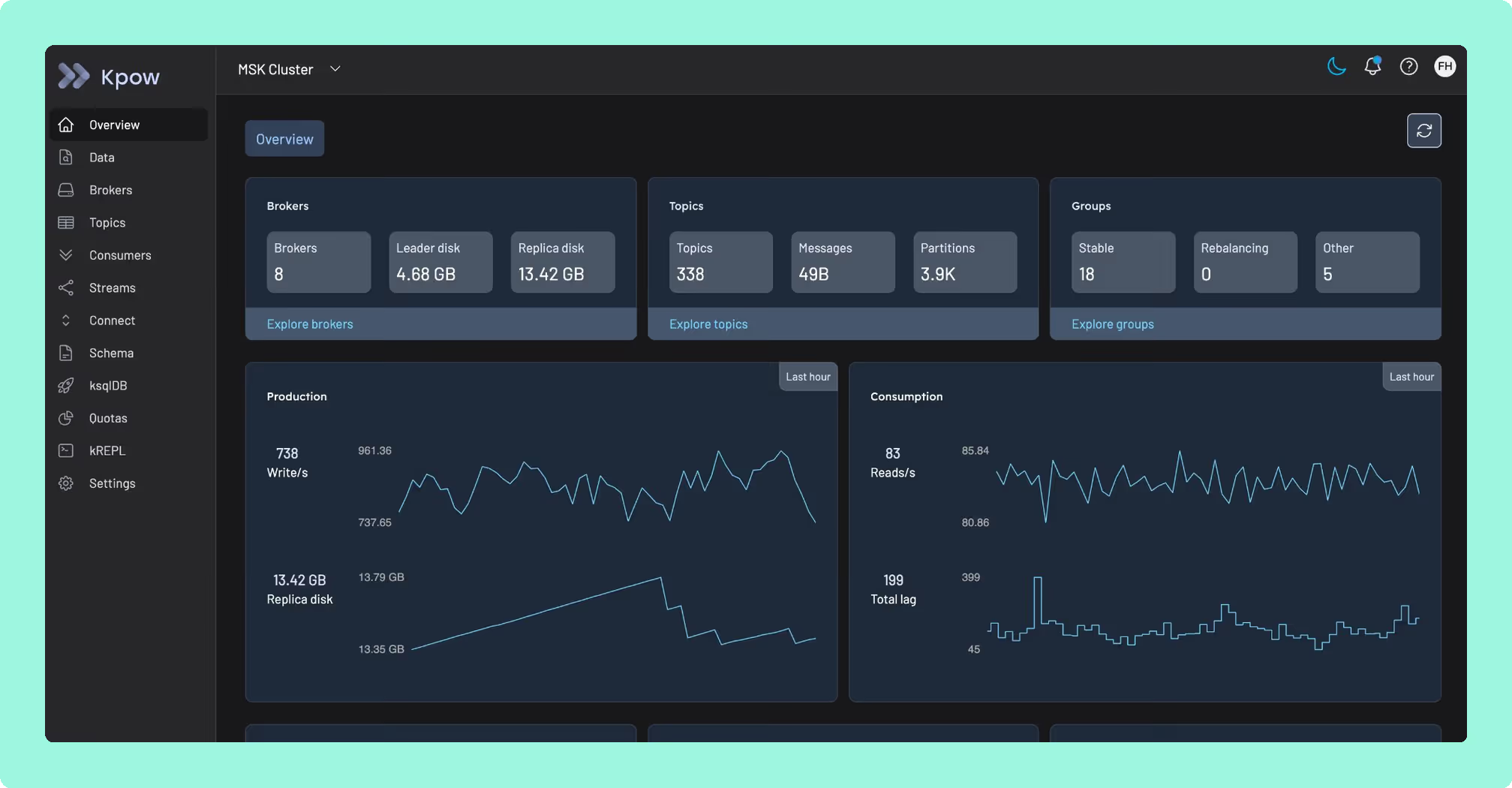
Kafdrop and Lenses both put the access decision somewhere other than inside a straightforward deployment. Kafdrop ships no authentication of its own, so keeping it safe means a proxy in front, and the feature request for a login was closed as not planned. Lenses puts access control inside the product, but only from DevX Team upward, and reaching that tier means standing up a central HQ node on PostgreSQL plus an Agent and an Agent database for every Kafka cluster. Kpow by Factor House keeps the access model role-based inside the product without either of those extra pieces: one stateless JVM container, no external database, reaching up to 12 clusters from a single instance. It is licensed per cluster at a published price, so the bill does not move when five engineers become fifty.
Neither Kafdrop nor Lenses prices the cluster itself, and neither settles access inside a plain deployment either. Role-based access with no proxy and no Postgres install is set out in full on Kpow’s product page, before Lenses’ step from Community to Team changes the bill instead.
How these tools were scored
Every option is scored from 0 to 10 on each criterion, from the evidence and sources this page cites, and the reason for each score is on its card. Each criterion counts once, for a total out of 50. The options are listed by total.
Sources
- Apache Kafka 4.0 upgrade documentation
- Apache Kafka documentation on authorization and ACLs