At a glance
Redpanda Console and CMAK are scored here on the same five criteria, 50 points in all: Redpanda Console 29 out of 50, CMAK 20 out of 50. Redpanda Console takes its best score on Deployment footprint (8 out of 10) and its lowest on Multi-cluster reach (2 out of 10). Cost a year, modelled: $0 licence, $15,840 for four clusters. CMAK takes its best score on Cost as teams grow (10 out of 10) and its lowest on Support and maintenance (1 out of 10). Cost a year, modelled: $0 licence, $18,720 to run.
CMAK vs Redpanda Console, compared
Kpow meets 5 of 7 requirements on this page. One row is not a yes or no question.
Key takeaway
CMAK needs a ZooKeeper ensemble, and Kafka 4.0 has none, so a KRaft cutover ends it on the day rather than degrading it. Redpanda Console gates four capabilities (including Reassign Partitions, the operation CMAK is most praised for) behind an enterprise licence whose price is not published, and it needs one deployment per cluster, where CMAK registers many in one instance. Its message viewer is the strongest of any free tool. Kpow by Factor House is licensed per cluster at a published price.
Kpow live demo
Test the trade-offs in a live Kafka UI
You have compared CMAK vs Redpanda Console. Open a live Kpow environment to test the everyday workflows a shared Kafka platform needs.
Built for platform and data teams managing shared Kafka clusters.
Try the Kpow demoWhat is CMAK?
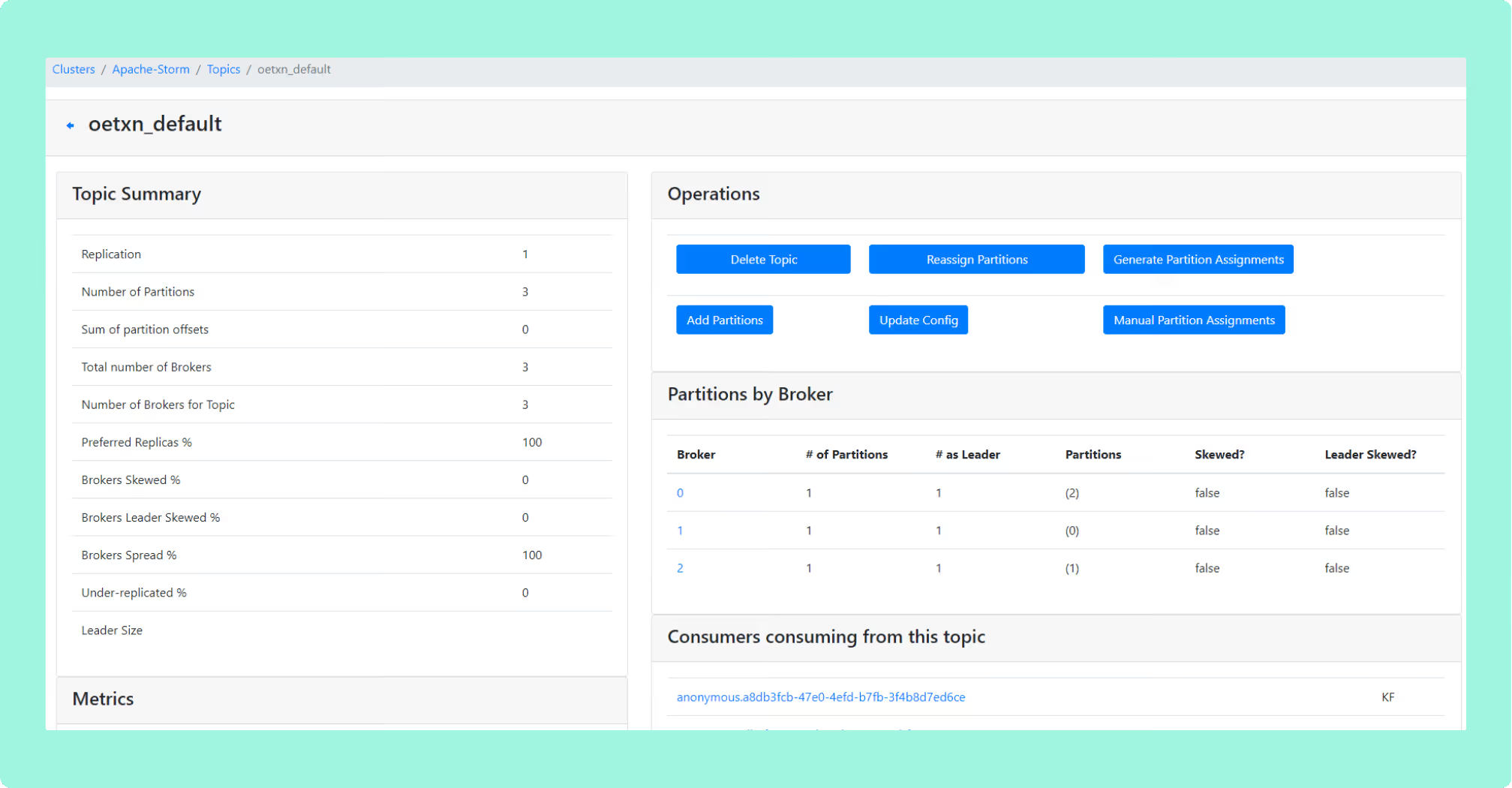
CMAK is Cluster Manager for Apache Kafka, originally Kafka Manager, built at Yahoo and released under Apache 2.0. It is a Scala application on the Play framework, and it needs a direct connection to a ZooKeeper ensemble to function at all. Its scope is Kafka cluster management rather than data-plane work, and there is no commercial distribution, no hosted offering and no paid support tier.
- several registered clusters from a single view
- creating and modifying topics, and managing partitions
- partition reassignment and preferred-replica election
- optional JMX polling at broker and topic level
The credit is real: reassignment and preferred-replica election are what it is most consistently praised for, and its visual taxonomy of brokers, partitions and replicas maps closely enough to Kafka’s own model that the tool still teaches somebody what a cluster is doing. Nothing has shipped since April 2022.
What is Redpanda Console?
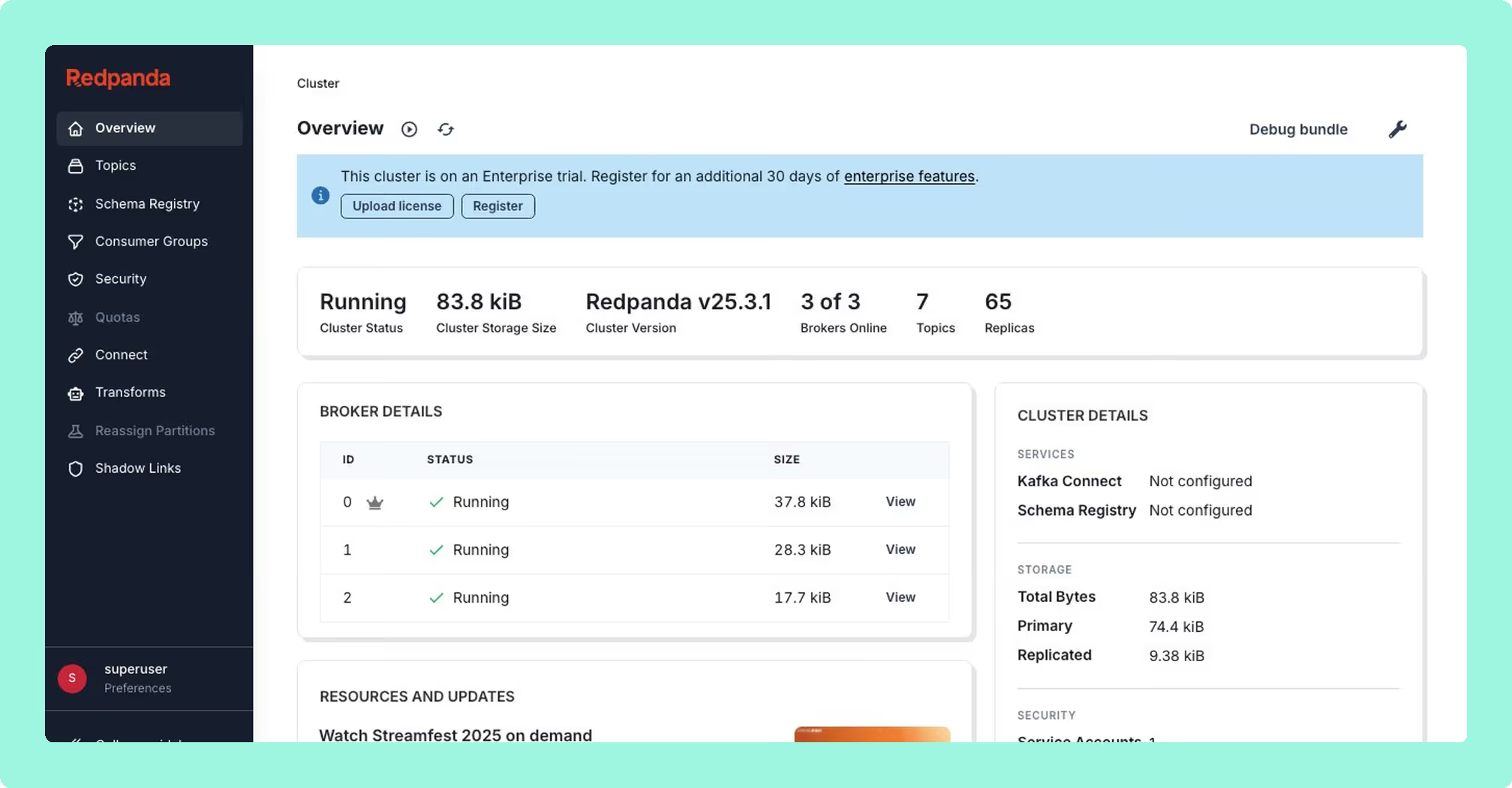
Redpanda Console is an open-source web interface for inspecting and managing Kafka-compatible clusters, built on Go and React and distributed as a Docker image and a Helm chart. It began as Kowl, by CloudHut, and Redpanda acquired it in April 2022. Against a Redpanda cluster it reads the Redpanda admin API for extra capability, and it also serves vanilla Apache Kafka, Amazon MSK and Confluent Platform. v3.11.0 shipped in August 2026.
- Deserialisation: Avro, Protobuf, JSON, XML, CBOR, MessagePack and binary hex, with Protobuf working from local descriptor maps and no registry.
- Filtering: JavaScript message filters, and time-travel offset management.
- Observer Mode: browses a topic without joining a consumer group, so inspection triggers no rebalance and moves nobody’s offsets.
What is the official 2026 pricing of CMAK and Redpanda Console?
CMAK’s licence cost is zero and always was. Its whole cost is what it takes to keep an unmaintained Scala application running: build it from source with sbt, or take a community Docker image, except that both community deployment paths are archived and read-only. There is no support tier to buy, and 522 issues stand open with nobody triaging them.
Console’s community build is free under the Business Source License, indefinitely, covering the message viewer, topic and consumer group management, Kafka Connect management and Schema Registry browsing. What it does not cover is the operations and access half: OIDC and OAuth 2.0 single sign-on, authorization, debug bundle generation and Reassign Partitions all require an enterprise licence whose price is not published. That is a Redpanda Enterprise platform licence rather than a Console product, so a team on vanilla Apache Kafka or Amazon MSK is buying from a broker vendor whose broker it does not run. Fifty people across development, staging and production is three Consoles, because there is no broker-tier multi-cluster, plus a purchase order for the login and the reassignment screen.
Where does each one run out?
Both are scored out of 50, as five criteria marked out of 10, and each criterion carries the same weight as the others. Nothing sits behind a multiplier, so a total is the sum of its five marks and a reader can recompute it. The five are cost as teams grow, deployment footprint, support and maintenance, access control and audit, and multi-cluster reach, because those are the questions a Kafka interface is actually measured against after the first month: a second cluster, an access review with a date on it, an upgrade nobody owns, and a bill that moves when the team does. The widest gap between the two marks is on support and maintenance, where CMAK marks 1 and Redpanda Console marks 7. The marks come from the same matrix used on every comparison on this site, so a tool scores the same here as it does anywhere else, and the reason behind each mark is in the card below, under Why these scores.
The dependency figures in the cards below were read on 24 September 2026 from each project’s published release artefact and matched against the NVD and GitHub advisory databases, so they move whenever a release or an advisory lands. Kpow is self-hosted as well. What a licence buys here is not a different deployment model, it is a company under contract to ship the patched build.
 Rank 1
 Redpanda Console
redpanda.com
29 out of 50 Total
- Cost a year, modelled
- $0 licence, $15,840 for four clusters
- Enterprise price
- Not published
- Clusters
- One Console per cluster
- Cost as teams grow
- 6 out of 10
- Deployment footprint
- 8 out of 10
- Support and maintenance
- 7 out of 10
- Access control and audit
- 6 out of 10
- Multi-cluster reach
- 2 out of 10
Why these scores for Redpanda Console
- Cost as teams grow 6 out of 10
- This page’s table gives the community build free under the Business Source License, but single sign-on, authorization and Reassign Partitions need an enterprise licence with no published price; four Consoles for four clusters is $15,840 a year on this page’s estimate, against $18,000 for Kpow Enterprise.
- Deployment footprint 8 out of 10
- This page gives a Docker image and a Helm chart holding no state, though ListMessages carries a hardcoded 35-second timeout and one offline broker fails all consumer group queries.
- Support and maintenance 7 out of 10
- This page’s table gives v3.11.0 in August 2026, with three further releases in the two months before it, against a vendor tracker.
- Access control and audit 6 out of 10
- On this page, OIDC and OAuth 2.0 single sign-on and authorization are both enterprise-licensed, so the free build has neither, and audit sits in the Redpanda platform rather than in Console.
- Multi-cluster reach 2 out of 10
- This page’s table gives one Console per cluster, asked for in September 2021 and again in April 2022, and the later request is still open.
Cost a year, modelled: the community build is $0 under the Business Source License, and the enterprise licence carrying single sign-on, authorization and Reassign Partitions has no published price at all. Four clusters is four Consoles, because there is no broker-tier multi-cluster, and this page’s estimate of running them is $15,840 a year: six engineer-hours a month at $120 an hour across the four deployments, which is $8,640, plus a one-off sixty hours at $120 to put access control and reassignment somewhere else, which is $7,200. Those hours are this page’s estimate rather than a vendor figure. Kpow Enterprise is $4,500 per cluster a year for up to 100 users, so the same four clusters are $18,000, reached from one instance rather than four.
Console has no broker-tier multi-cluster, so development, staging and production is three deployments, three configuration files and three upgrade paths. It was asked for in September 2021 and again in April 2022, and the later request is still open. Reassignment is an AdminClient operation, settled in the replica reassignment API proposal, so an interface either exposes it or it does not, and here it is licensed.
Monitoring: no built-in broker metrics, no alerting and no historical trends, so Kafka broker monitoring is a separate Prometheus and Grafana stack.
Write path: no producing a message from the interface, and no request quotas.
Timeouts: 35 seconds on ListMessages, and 5 and 6 seconds on DescribeConfigs, DescribeLogDirs and Metadata, all hardcoded.
Degradation: with one broker offline in a multi-node cluster, all consumer group queries fail.
Compare Kpow vs Redpanda ConsoleAKHQ vs Redpanda ConsoleRedpanda Console review
CMAK
github.com/yahoo/CMAK
20 out of 50 Total
- Cost a year, modelled
- $0 licence, $18,720 to run
- Needs
- A ZooKeeper ensemble, so not Kafka 4.0
- Last release
- 3.0.0.6, 29 April 2022
- Cost as teams grow
- 10 out of 10
- Deployment footprint
- 3 out of 10
- Support and maintenance
- 1 out of 10
- Access control and audit
- 2 out of 10
- Multi-cluster reach
- 4 out of 10
Why these scores for CMAK
- Cost as teams grow 10 out of 10
- This page’s table gives Apache 2.0 in one self-hosted tier, and no paid edition, hosted offering or support contract has ever existed; this page’s estimate of running it at fifty engineers on four clusters is $18,720 a year, against $18,000 for Kpow Enterprise on the same four.
- Deployment footprint 3 out of 10
- This page has it built from source with sbt or taken from a community Docker image, except that both community deployment paths are archived and read-only, and long-running instances hang after 20 to 30 days from thread-pool exhaustion.
- Support and maintenance 1 out of 10
- This page’s table gives the last release on 29 April 2022, the last commit in December 2022, 522 open issues, and both community deployment paths archived.
- Access control and audit 2 out of 10
- This page gives LDAP basic auth and coarse global feature flags, with no SAML, no OIDC, no per-topic granularity and no audit log.
- Multi-cluster reach 4 out of 10
- This page’s table gives many clusters registered in one instance, but only where a ZooKeeper ensemble is reachable, so nothing on Kafka 4.0 and little that is managed.
Cost a year, modelled: the licence is $0 under Apache 2.0, and at fifty engineers on four clusters this page’s estimate of running it is $18,720 a year: eight engineer-hours a month at $120 an hour to build it from source and keep an unmaintained application alive, which is $11,520, plus a one-off sixty hours at $120 to put an audit trail and per-topic access control somewhere else, which is $7,200. Those rates and hours are this page’s estimate rather than a published price, and they assume all four clusters still run ZooKeeper, because CMAK cannot reach a KRaft one. Kpow Enterprise is $4,500 per cluster a year for up to 100 users, so the same four clusters are $18,000.
CMAK’s hard ZooKeeper dependency is now a date rather than a design preference. Kafka 4.0, released 18 March 2025, operates entirely without ZooKeeper, and the KRaft production readiness proposal is where that removal was settled. A KRaft cutover stops CMAK working on the day rather than degrading it, and managed services reached the same place earlier.
Data plane: no message browsing at all.
Freshness: reads come from an internal cache rather than live broker APIs.
Access control: LDAP basic auth and coarse global feature flags, with no SAML, no OIDC, no per-topic granularity and no audit log.
Longevity: long-running instances hang after 20 to 30 days from thread-pool exhaustion, reported in 2018 and never addressed.
Staying patched: the last release is from April 2022 and nothing has been committed since August 2023. It bundles ZooKeeper 3.5.7, carrying an authorization bypass that scores 9.1 and has been public since October 2023, 1,079 days. No release is coming to carry a fix. 109 of its 112 bundled jars resolve to a Maven coordinate, so its counts are floors rather than totals.
Which should you pick?
Redpanda Console scores 29 against CMAK’s 20 and is the pick for a KRaft cluster, because CMAK needs a ZooKeeper ensemble Kafka 4.0 does not have. Console gates partition reassignment, RBAC and SSO behind a Redpanda Enterprise licence and reaches one cluster per deployment. A team that wants those without a broker vendor’s licence should shortlist Kpow by Factor House, published per cluster and reaching up to 12.
Keep CMAK if:
- the cluster is on ZooKeeper and staying there for now
- the daily work is partition reassignment and preferred-replica election
- nobody outside operations logs in
Pick Redpanda Console if:
- the daily work is reading payloads rather than moving partitions
- Protobuf without a registry removes a real step from incident work
- inspection currently disturbs consumer groups
- either the access model can stay open, or the enterprise licence will actually be bought
CMAK’s date belongs to Kafka rather than to the tool, and deferring the decision does not turn it back into a choice. Where Console is chosen, Kafka monitoring has to already live in a Prometheus and Grafana stack, because Console was never going to cover it. The question underneath both is which half the team cannot do without: one of these is a manager that cannot view, and the other is a viewer that manages up to a licence line. Kafka partition rebalancing tools sets the reassignment half against every other option, and the best free Kafka UI tools covers what each free tier actually reaches.
Kpow: manage and view, without a licence line in between
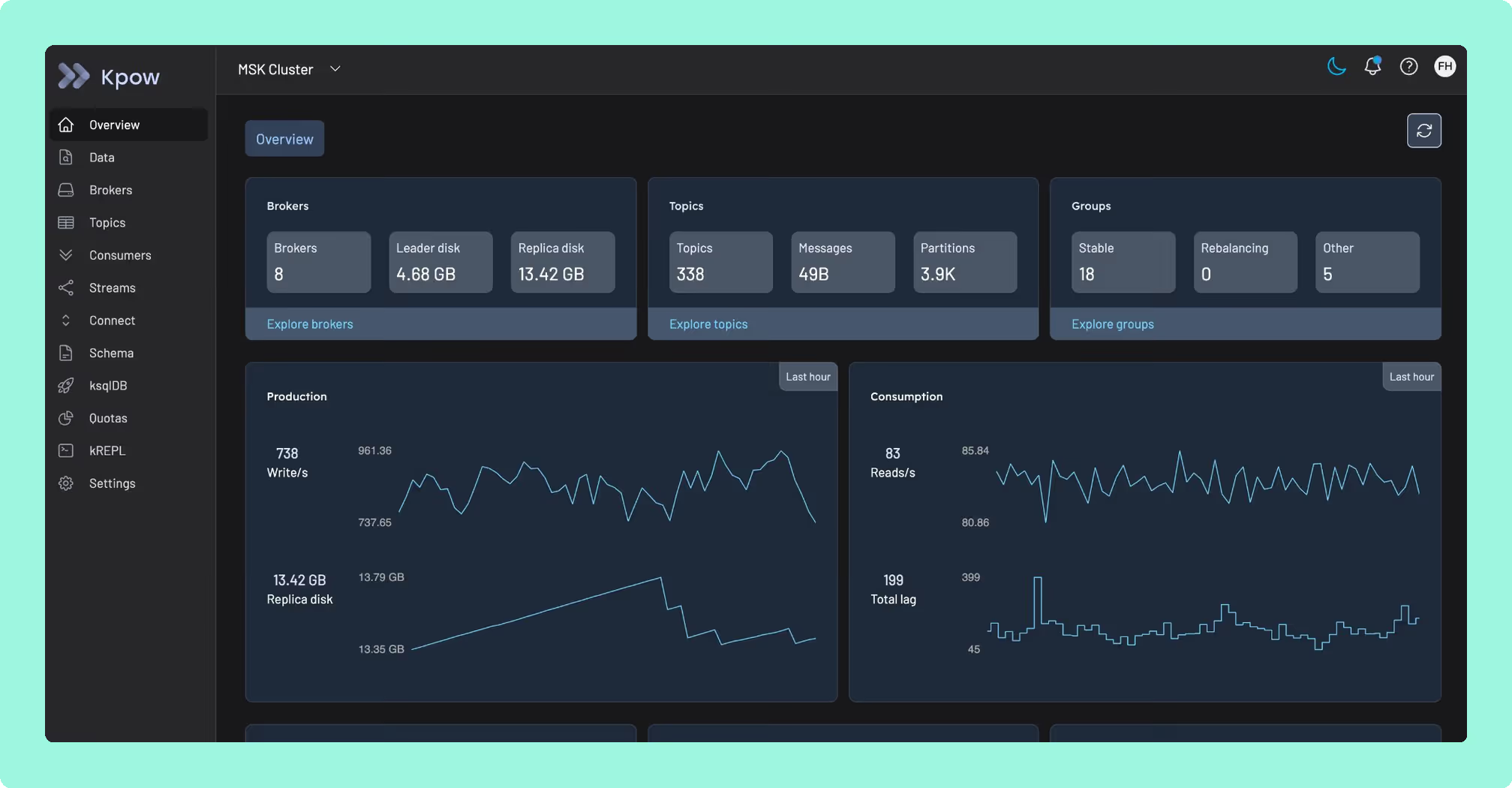
Both of these do half the job and gate the other half somewhere else. CMAK does reassignment and preferred-replica election, the operation it is most consistently praised for, but it has never browsed a message and it cannot reach a KRaft cluster at all. Redpanda Console browses messages in seven formats and reads the Redpanda admin API, but Reassign Partitions, the equivalent management operation, sits behind an enterprise licence whose price is not published. Kpow by Factor House does both from one stateless container, configured entirely through environment variables, with no external database, sidecar or persistent volume, managing up to 12 clusters from a single instance. It is licensed per cluster at a published price, so adding an engineer never moves the number.
A manager that cannot view and a viewer that manages up to a licence line are both half a tool. Kpow publishes the price for the other half.
How these tools were scored
Every option is scored from 0 to 10 on each criterion, from the evidence and sources this page cites, and the reason for each score is on its card. Each criterion counts once, for a total out of 50. The options are listed by total.
Sources
- KIP-833: Mark KRaft as Production Ready
- KIP-455: Create an Administrative API for Replica Reassignment