At a glance
Kafbat UI and Conduktor are scored here on the same five criteria, 50 points in all: Kafbat UI 38 out of 50, Conduktor 36 out of 50. Kafbat UI takes its best score on Cost as teams grow (10 out of 10) and its lowest on Support and maintenance (5 out of 10). Cost a year, modelled: $0 licence, $15,840 to run. Conduktor takes its best score on Access control and audit (10 out of 10) and its lowest on Deployment footprint (3 out of 10). Cost a year, 50 seats: $60,000 on Team Edition.
Conduktor vs Kafbat UI, compared
Kpow meets 5 of 7 requirements on this page. One row is not a yes or no question.
Key takeaway
Both ship a current free tier, and they cap on opposite things: Conduktor Console Community stops at 50 users and 3 clusters, and Kafbat UI caps on nothing at all. Team Edition is 1,200 US dollars per seat per year, and Kafbat has no paid edition to move to. Console requires PostgreSQL 13 or later with a role holding ALL PRIVILEGES, where Kafbat holds no database and writes its audit trail into a Kafka topic. Kpow by Factor House is licensed per cluster at a published price.
Kpow live demo
Test the trade-offs in a live Kafka UI
You have compared Conduktor vs Kafbat UI. Open a live Kpow environment to test the everyday workflows a shared Kafka platform needs.
Built for platform and data teams managing shared Kafka clusters.
Try the Kpow demoWhat is Conduktor?
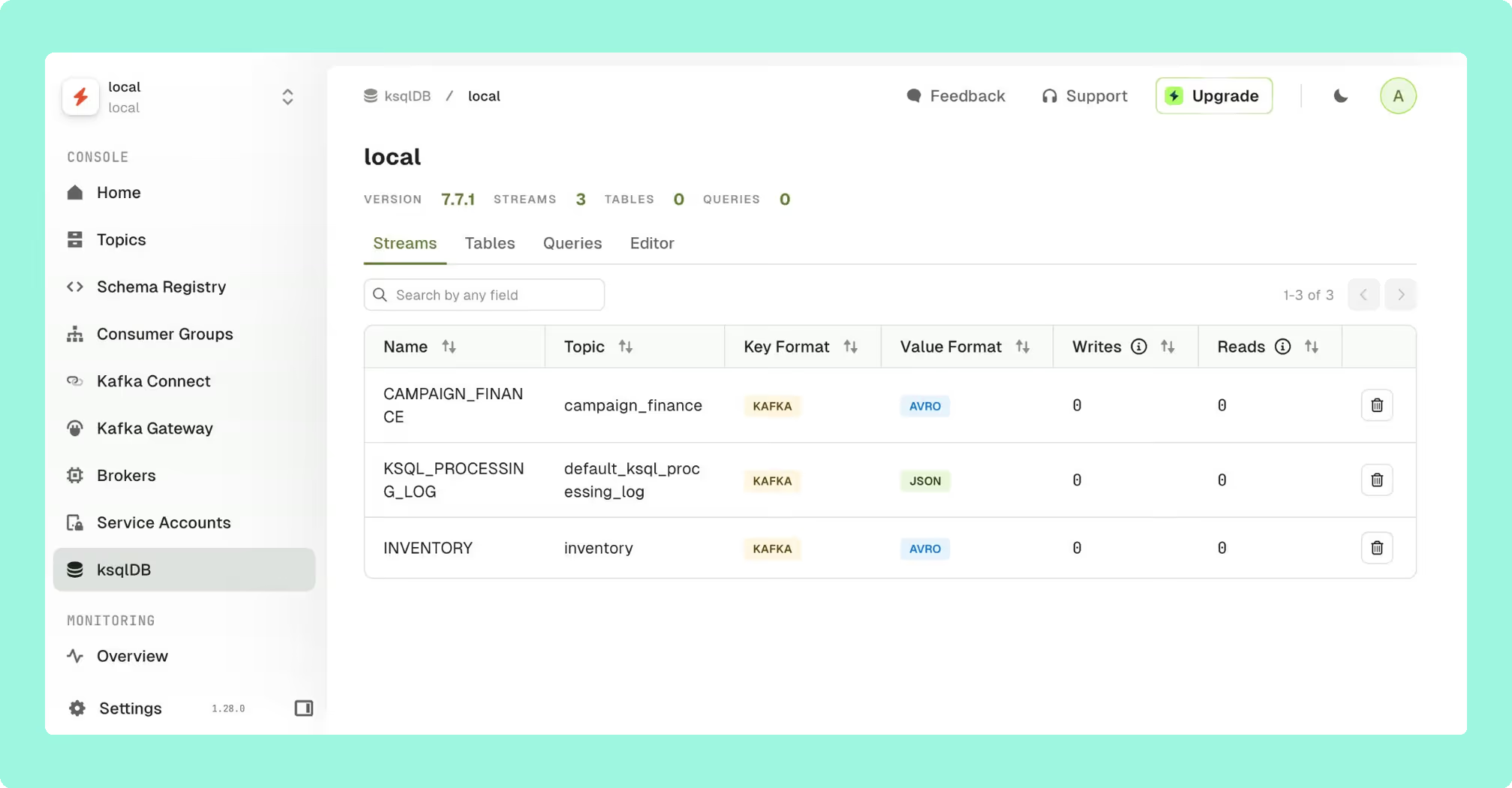
Conduktor is a commercial Kafka management and governance platform, sold as three separately licensed products. Console is a web interface over topics, schemas, connectors, consumer groups and access control across clusters. Gateway is a proxy between clients and brokers that enforces encryption, data masking, quota policy and multi-tenancy at the wire level. A Schema Registry Proxy carries its own tier.
Gateway is what makes this a different category of product rather than a smarter dashboard: field-level encryption with no client change, virtual topic filtering with no stream processor behind it, and a backend cluster failover applications never notice. It is also the only thing on either side of this comparison that sits in live client traffic. The company has been SOC2 Type II certified since 2023, and group-level RBAC, topic policies, unlimited audit logs and data masking all land in Team Edition rather than Enterprise, so the governance layer starts at a published price.
What is Kafbat UI?
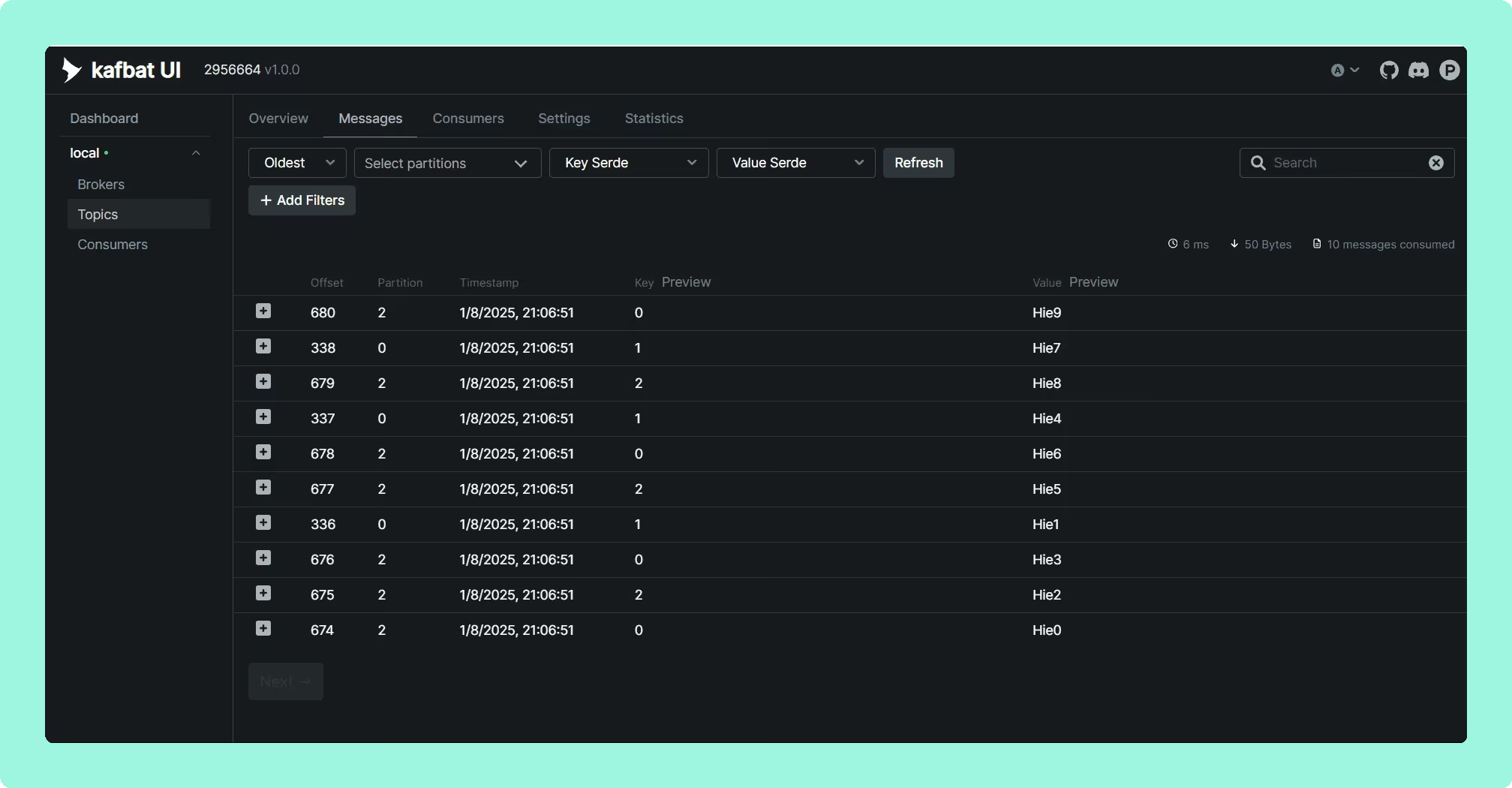
Kafbat UI is a free, Apache 2.0, self-hosted web dashboard for observing and managing Kafka clusters, deployed as a container. There is no paid edition, no seat cap, no cluster cap and no source-available restriction on production use. It is the maintained continuation of the Provectus kafka-ui project, whose last release was v0.7.2 in April 2024 and whose last commit landed that July. Kafbat has shipped v1.0.0 through v1.5.0, the most recent on 20 April 2026.
- Access control: permissions across cluster configuration, topics, consumer groups, schemas, Connect, connectors, ksqlDB and ACLs, with subjects matched by regular expression.
- Masking: three server-side policy types, applied per cluster.
- Audit: a log built into the product.
- Commercials: professional services around the open-source product, rather than a paid edition.
The predecessor repository is not archived, carries no pause notice and points at no successor, and it holds roughly five times the audience of the fork: 12,272 stars against 2,642. A search for Kafka UI lands on the dormant one.
What is the official 2026 pricing of Conduktor and Kafbat UI?
Both are free to start, and the two free tiers are not the same shape. Console Community is free at 50 users and 3 clusters, and single sign-on at no cost is unusual in this category. Kafbat UI is free at any number of users on any number of clusters, with nothing held back from the open release.
The difference appears at the fifty-first user or the fourth cluster. That is where Conduktor moves to Console Team Edition at 1,200 US dollars per seat per year, or 125 US dollars per seat per month billed monthly. Kafbat’s answer at fifty seats is the same container. The best free Kafka UI tools sets that free tier against every other free option. Past Console the ladder stops being published: Gateway Enterprise is licensed per cluster with a three-cluster minimum, and three of the five purchasable tiers are contact-only. The free side has a price too. Kafbat publishes no support commitment in the software and no price for any of its professional services, so the cost of supported use is a negotiation rather than a number.
Where does each one run out?
The scoring is the same on both sides: five criteria, 10 points each, 50 in all, with every criterion counting once. Nothing sits behind a multiplier, so a total is the sum of its five marks and a reader can recompute it. The five are cost as teams grow, deployment footprint, support and maintenance, access control and audit, and multi-cluster reach, because those are the questions a Kafka interface is actually measured against after the first month: a second cluster, an access review with a date on it, an upgrade nobody owns, and a bill that moves when the team does. The widest gap between the two marks is on cost as teams grow, where Conduktor marks 5 and Kafbat UI marks 10. The marks come from the same matrix used on every comparison on this site, so a tool scores the same here as it does anywhere else, and the reason behind each mark is in the card below, under Why these scores.
The dependency figures in the cards below were read on 24 September 2026 from each project’s published release artefact and matched against the NVD and GitHub advisory databases, so they move whenever a release or an advisory lands. Kpow is self-hosted as well. What a licence buys here is not a different deployment model, it is a company under contract to ship the patched build.
 Rank 1
 Kafbat UI
kafbat.io
38 out of 50 Total
- Cost a year, modelled
- $0 licence, $15,840 to run
- Free tier
- No seat cap, no cluster cap
- Runs on
- One container, no database
- Cost as teams grow
- 10 out of 10
- Deployment footprint
- 8 out of 10
- Support and maintenance
- 5 out of 10
- Access control and audit
- 6 out of 10
- Multi-cluster reach
- 9 out of 10
Why these scores for Kafbat UI
- Cost as teams grow 10 out of 10
- This page’s table gives it free under Apache 2.0 with no seat cap and no cluster cap, so the licence is $0; this page’s estimate of running it is $15,840 a year, against $18,000 for Kpow Enterprise on four clusters.
- Deployment footprint 8 out of 10
- This page’s table gives no external dependencies, with views computed from the cluster and the audit trail written to a Kafka topic on it, docked because the setup wizard overwrites its config file in full, so UI changes are lost on restart without a volume.
- Support and maintenance 5 out of 10
- This page gives GitHub issues, or a services engagement with no published price, and four months with no tag by the end of August 2026 against five tags in 2025.
- Access control and audit 6 out of 10
- This page gives permissions across cluster configuration, topics, consumer groups, schemas, Connect, ksqlDB and ACLs, three server-side masking policy types and a built-in audit log, but the audit level defaults to modifications only and masking protects what the Messages page displays.
- Multi-cluster reach 9 out of 10
- This page’s table makes adding a cluster another entry in the configuration, with no cap.
Cost a year, modelled: the licence is $0 under Apache 2.0 at any seat or cluster count, and this page’s estimate of running it is $15,840 a year: six engineer-hours a month at $120 an hour on the container, the configuration volume and the four-month release gap, which is $8,640, plus a one-off sixty hours at $120 to make the audit topic queryable, because the trail is written to Kafka with no view in the product, which is $7,200. Those hours are this page’s estimate rather than a published price. Kpow Enterprise is $4,500 per cluster a year for up to 100 users, so the same four clusters are $18,000, with support attached rather than a services engagement carrying no published price.
Kafbat’s audit trail is where its governance claim gets tested, and the defaults are the small print. The level switch defaults to recording modifications only, so who read something is not captured until an operator raises it.
Audit topic: defaults to a single partition, and must not be compacted, because records carry no key.
Masking: documented as protecting what the Messages page displays, which is a presentation control.
Releases: four months with no tag by the end of August 2026, against five tags in 2025, while commits kept landing.
Dynamic config: the setup wizard writes inside the container and overwrites the file in full, so UI changes are lost on restart without a volume.
Staying patched: v1.5.0 shipped in April 2026 and nothing has shipped since. In the 157 days after it, at least 20 high or critical advisories were published against libraries that release bundles, including a critical in netty. Only 150 of its 266 bundled jars resolve to a Maven coordinate, so that is a floor rather than a total, and the state of the release itself is unmeasured. Kafbat does publish a security policy, which AKHQ and Kafdrop do not.
 Rank 2
 Conduktor
conduktor.io
36 out of 50 Total
- Cost a year, 50 seats
- $60,000 on Team Edition
- Free tier
- Community: 50 users, 3 clusters
- Runs on
- PostgreSQL 13+, plus Gateway proxy
- Cost as teams grow
- 5 out of 10
- Deployment footprint
- 3 out of 10
- Support and maintenance
- 9 out of 10
- Access control and audit
- 10 out of 10
- Multi-cluster reach
- 9 out of 10
Why these scores for Conduktor
- Cost as teams grow 5 out of 10
- This page’s table prices it per seat, $1,200 per seat per year on Team Edition once past the 50 users in Community, so fifty engineers is $60,000 a year; Kpow Enterprise is $18,000 for four clusters.
- Deployment footprint 3 out of 10
- On this page, PostgreSQL 13 or later is not optional, the role needs ALL PRIVILEGES on that database, and Gateway sits in the data path.
- Support and maintenance 9 out of 10
- This page’s table gives a vendor under contract, SOC2 Type II since 2023, with support attached to the plan.
- Access control and audit 10 out of 10
- This page’s table gives more than 70 audit event types, each carrying user identity, IP address, timestamp, topic and partition, with SSO by OIDC or LDAP free on Community.
- Multi-cluster reach 9 out of 10
- On this page, Console Community covers 3 clusters and Team Edition is where unlimited clusters start, across distributions.
Cost a year: Console Team Edition is $1,200 per seat per year, the vendor’s own published price, so fifty engineers is $60,000 a year before Gateway, which is licensed separately per cluster with a three-cluster minimum and no published price. On top of the seats, this page’s estimate of running Console is two engineer-hours a month at $120 an hour, about $2,880 a year. Kpow Enterprise is $4,500 per cluster a year for up to 100 users, so the same four clusters are $18,000, and that number does not move when the fifty-first engineer needs a login.
Console requires a PostgreSQL database to hold its own state, version 13 or later, and it is not optional. On RDS the constraint is tighter: only engine versions 14.8 and later, or 15.3 and later, will work. The connection role has to hold ALL PRIVILEGES on that database, because Console creates, updates and deletes its own schemas and tables, so a least-privilege role is not an option.
Resources: 2 CPU and 3 GB of RAM for Console, plus 2 CPU and 4 GB for Gateway.
Latency: Gateway is a proxy in the data path that can slightly increase end-to-end latency, and it is a single point of failure in live traffic.
Azure: Event Hubs is reachable over Kafka protocol compatibility, but Azure’s native Schema Registry is not integrated.
Directory: Active Directory needs a specific LDAP search filter, or the default configuration returns an invalid user error.
Compare Conduktor vs KadeckConduktor vs Confluent Control CenterConduktor review
Which should you pick?
Kafbat UI scores higher here, 38 against 36, because it caps on nothing at all where Conduktor Console Community stops at 50 users and 3 clusters. Conduktor is the pick where topic policies and group-level RBAC have to be enforced centrally, at 1,200 US dollars per seat a year. A team that needs that governance without a per-seat bill or a PostgreSQL to run should shortlist Kpow by Factor House.
Pick Conduktor if:
- the team is 50 people or fewer on 3 clusters or fewer
- a regulator or a customer contract makes the audit trail non-negotiable
- encryption or masking has to be enforced below the application
- topic creation is being handed to product teams inside policy guardrails
Pick Kafbat UI if:
- the cluster count is going up faster than the headcount
- the team can own a container and read an issue tracker
- the governance you need is who may act inside the tool, not policy on the wire
- the cluster inventory and access model belong in source control
One thing is worth checking before either decision. Both expose a Model Context Protocol endpoint onto a production cluster: Kafbat shipped an MCP server in v1.3.0 in July 2025, and Conduktor lists MCP workflows on its free Console card. Kafbat’s MCP documentation covers the enable flag, the SSE endpoint and two client setups, and describes no interaction between that endpoint and its role-based access model. A tool’s own permissions are not the same thing as the cluster’s own authorisation model, and an agent endpoint is a new subject on both. The best Kafka MCP servers compares both endpoints with the other options on permissions, audit and approval.
Kpow: priced per cluster, not per seat or a quote you have to ask for
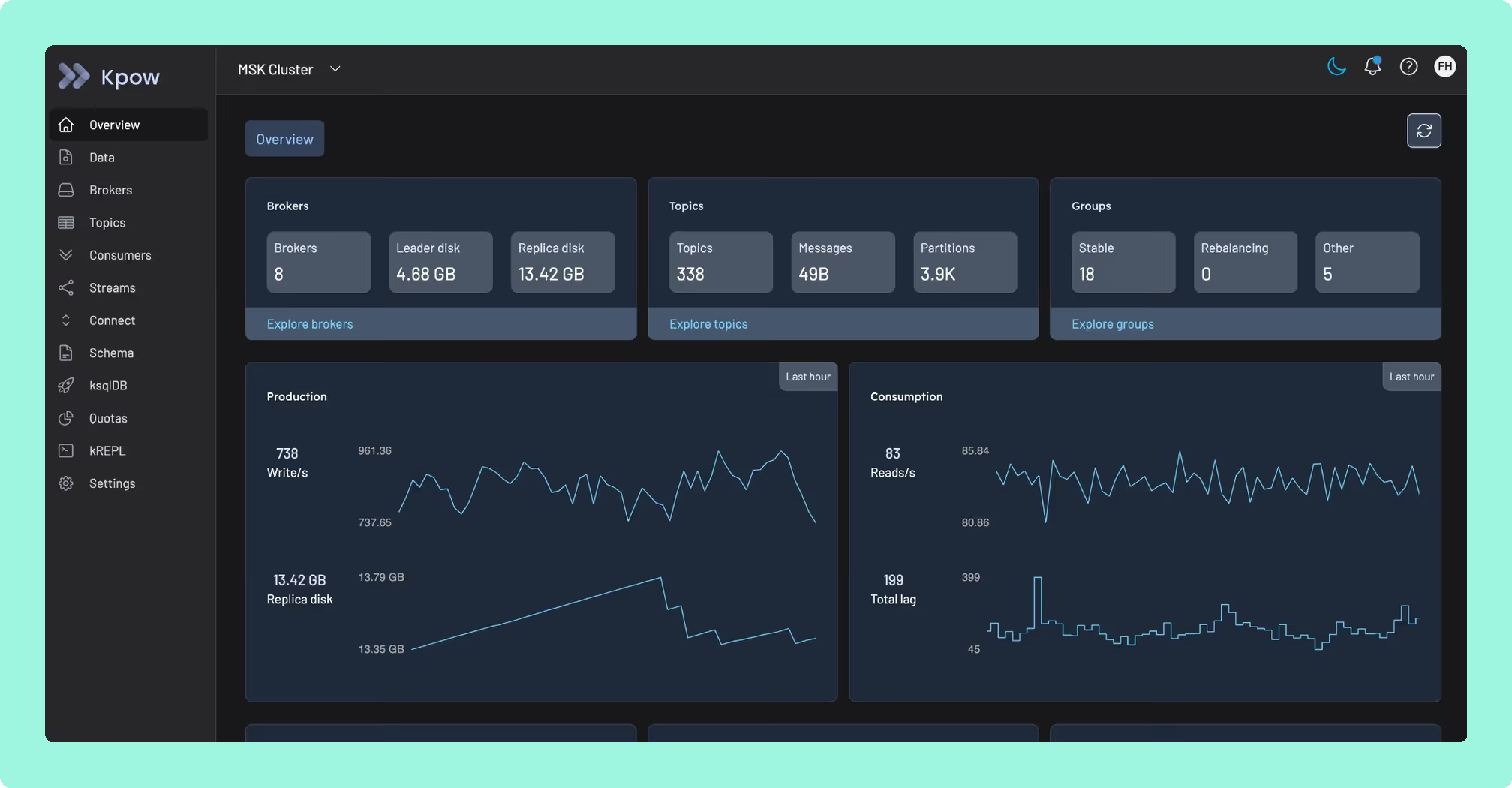
Conduktor and Kafbat UI both leave the real number unanswered until something else happens. Conduktor’s Team Edition is 1,200 US dollars per seat per year, so the bill moves the moment a fifty-first engineer needs a login, whatever the cluster count is doing. Kafbat UI’s software costs nothing at any seat or cluster count, but the moment support is needed the price becomes a services engagement with no number published anywhere, so the free side carries a cost too. Kpow by Factor House is licensed per cluster at a published price instead: one stateless container with no external database and no persistent volume, reaching up to 12 clusters from a single instance, and sitting beside the cluster rather than inside its data path.
A price you can look up before you commit to it is worth comparing against one you can’t. See what Kpow actually charges for the clusters you run, not the people who log in.
How these tools were scored
Every option is scored from 0 to 10 on each criterion, from the evidence and sources this page cites, and the reason for each score is on its card. Each criterion counts once, for a total out of 50. The options are listed by total.
Sources
- Apache Kafka documentation on authorization
- Apache Kafka documentation on log compaction