At a glance
Conduktor scores 74 out of 90 on this page's five weighted criteria: it takes its best score on Access control and audit (10 out of 10) and its lowest on Deployment footprint (3 out of 10). The rubric is weighted: Support and maintenance counts three times, Access control and audit counts three times, and Cost as teams grow, Deployment footprint and Multi-cluster reach count once. Free tier: Community: 3 clusters, 50 users. The other options, in the order this page lists them: Kpow 82, AKHQ / Kafbat 57, Lenses 52, Confluent Control Center 46, AxonOps 42, each out of 90. Kpow takes its best score on Access control and audit (10 out of 10) and its lowest on Cost as teams grow (7 out of 10).
Key takeaways
- Conduktor is a commercial Kafka governance platform built around RBAC, self-service topic workflows, and a proxy (Gateway) that enforces encryption and policy at the wire level without modifying producer or consumer code.
- Its strongest use cases are multi-team enterprise environments where governance, compliance (PCI DSS, HIPAA, GDPR), and self-service are priorities.
- Per-seat pricing ($1,200/seat/year on the Team Edition) becomes a significant line item for teams above 20-30 users; at 100 users across three clusters, estimated list price reaches $80,000-$150,000 per year.
- The free Community tier has changed across releases: version 1.43 reduced the number of allowed servers and users, and Reddit threads from 2022 describe a free tier that could not connect to SSL-enabled or multi-broker clusters. As published in August 2026, Console Community is free and self-hosted for up to 3 clusters and 50 users, with SSO by OIDC or LDAP, while group-level RBAC, data masking and unlimited audit logs start on the paid Team Edition. Community sentiment on Reddit consistently describes the free tier as no longer viable for startup or staging environments. [r/apachekafka, multiple threads, 2023-2026; Conduktor pricing page, August 2026]
- Known gaps include the absence of distributed tracing, no integration with Azure’s native Schema Registry, and an operational overhead introduced by the Gateway proxy (an extra network hop that can slightly increase end-to-end latency, a required PostgreSQL 13+ dependency, and a single point of failure to manage for high availability).
- Kpow is worth evaluating if per-cluster pricing, a stateless deployment model, proven stability on large partitioned clusters, or a WCAG 2.1 AA compliant UI matters to your team.
Kpow live demo
Test the operational trade-offs in a live Kafka UI
A Conduktor review is only the start of an evaluation. Open Kpow and try the shared workflows your platform team will need every day.
Explore data inspection, consumer operations, and governed access in one environment.
Try the Kpow demoWhat is Conduktor?
Conduktor is a commercial Kafka management and governance platform. It has two main components: Console, a React-based web UI for managing topics, schemas, connectors, consumer groups, and access controls across multiple clusters; and Gateway, a Kafka proxy that sits between clients and brokers to enforce encryption, data masking, quota policies, and multi-tenancy rules at the wire level without requiring application changes.
The product was originally distributed as a JavaFX desktop application. In 2023, Conduktor shifted its focus to Console (its centrally deployed web platform) and deprecated both the desktop application (end of life at end of 2025) and its Testing product. Conduktor achieved SOC2 Type II certification in 2023 and has grown its enterprise feature set (LDAP, RBAC, audit logging, and schema registry integrations) in response to requirements from regulated-industry customers.
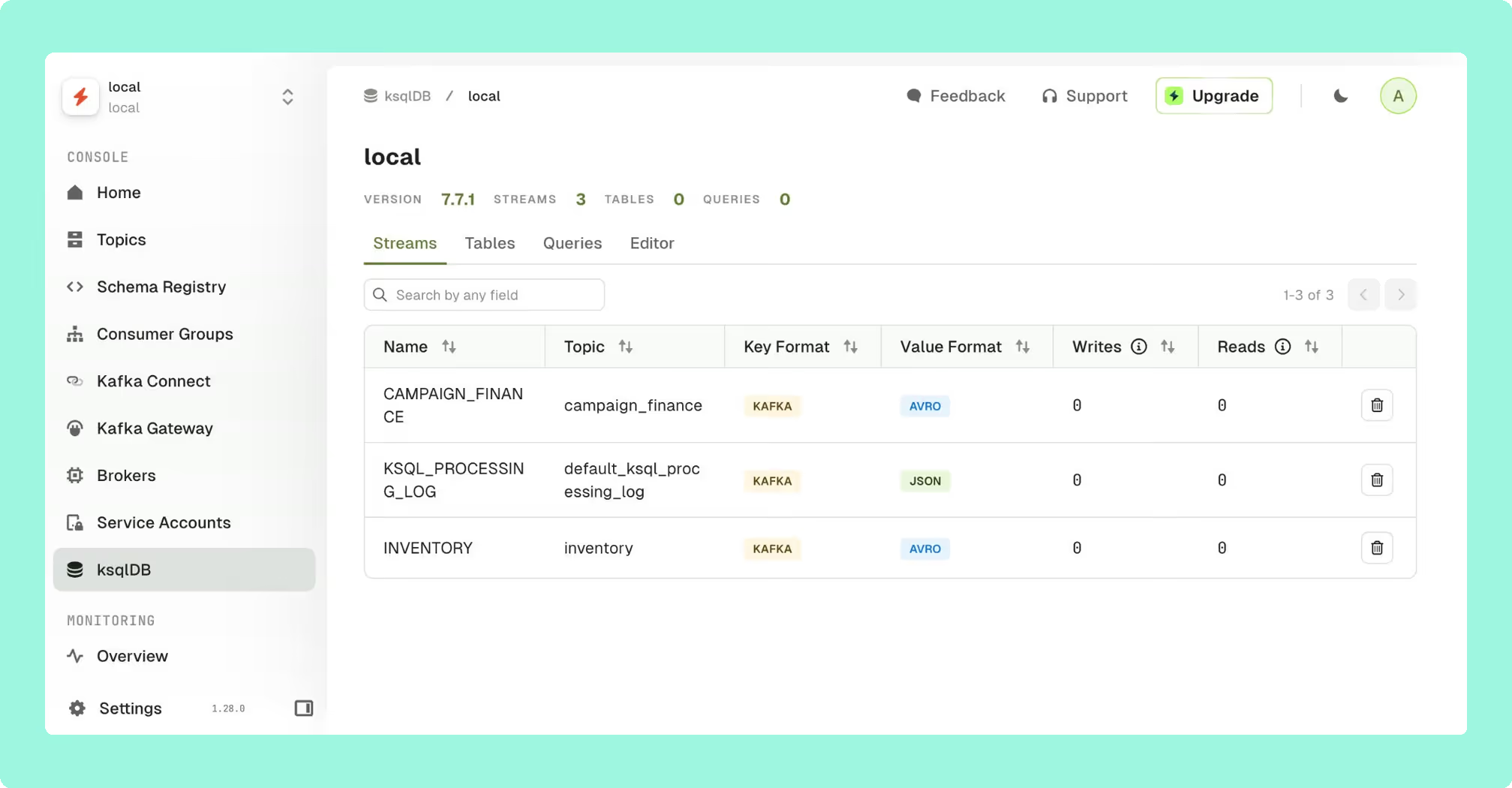
Conduktor review
Functionalities
Conduktor’s core functionality covers the expected surface area for enterprise Kafka management: topic creation and management, consumer group inspection, schema registry integration (Confluent-compatible and AWS Glue), Kafka Connect management with a UI wizard for connector deployment, ksqlDB integration, and multi-cluster support.
The Gateway is the more differentiated component. It enables field-level encryption, data masking, and policy enforcement at the wire level. Key management integrates with AWS KMS, Azure Key Vault, GCP Cloud KMS, HashiCorp Vault, and Fortanix. The Topic as a Service feature, which lets teams self-serve topic creation within defined policy guardrails, received what Conduktor’s CTO described as “overwhelming praise” at Kafka Summit London 2024. [Stéphane Derosiaux, Medium/Conduktor, April 2024]
The Gateway also provides capabilities that extend beyond basic governance. In disaster recovery scenarios, the proxy architecture allows platform teams to failover backend cluster connections dynamically without requiring any client-side reconfiguration or application restarts, a meaningful operational advantage for multi-region deployments. [r/apachekafka, “DR for Kafka Cluster,” January 2025] The Gateway additionally supports virtual topic filtering, which executes server-side filtering logic without spinning up dedicated stream processors or creating physical duplicate topics. Practitioners evaluating this approach on Reddit noted it reduces network bandwidth and client-side processing load compared to a Kafka Streams or Flink implementation for the same problem. [r/apachekafka, “Is there any way to perform server-side filtering?”, August 2024]
Chad Harris’s take: Kong started out as an API gateway and is moving into an everything gateway. Its Event Gateway competes with Conduktor’s gateway, with virtual topics and clusters at the Kafka client layer, and I expect to see Kong pop up more in the Kafka landscape. Then in May 2026 Kroxylicious, the open-source Kafka proxy, added multi-topic and multi-cluster routing. I think that will massively simplify cluster migrations and exceed the features and utility of Conduktor Gateway.
There are two documented functional gaps. First, Conduktor has no native distributed tracing capability, which prevents it from being considered a complete observability platform. [Damaso Sanoja, Redpanda blog, March 2023] Second, while Azure Event Hubs is accessible via Kafka protocol compatibility, Azure’s native Schema Registry is not integrated: teams using Azure Event Hubs cannot access schema features within Conduktor Console. [Farbod Ahmadian, DataChef blog, November 2024]
One operational nuance: when Console’s internal index is incomplete or stale, it falls back to querying the Kafka cluster directly, which can result in slow page loads. [Conduktor support documentation, undated] The monitoring graph also averages brief metric spikes across large time windows, making short-lived spikes invisible at wider zoom levels. [Conduktor documentation, undated]
The Conduktor Testing product was deprecated in 2023 despite customer adoption, and the Terraform provider’s experimental generic resource is explicitly not recommended for production use.
Deployment and operations
Conduktor Console requires PostgreSQL 13+ as an external dependency; this is not optional. Minimum resource requirements are 2 CPU and 3 GB RAM for Console, plus 2 CPU and 4 GB RAM for Gateway if you are running the proxy component. A Kubernetes/Helm path is documented and functional. Docker deployment is supported; the image was reduced from 1.66 GB to 800 MB in 2023 as part of a documented effort to simplify onboarding. [Conduktor retrospective, 2023]
The retirement of the native desktop client has been a consistent source of friction for solo developers and small teams. Under the desktop model, installation required a standard ZIP extraction or an MSI installer. The Console model requires installing WSL2, configuring Docker on a Linux subsystem, downloading a specific compose file, placing it in a precisely named folder to avoid container configuration errors, and running container operations from the command line. Community commentary characterises this as an unreasonable setup burden for a tool whose primary use case, inspecting a local topic, does not require a centrally deployed web application. [r/apachekafka, “Open source clone of Conduktor Desktop,” May 2026] The consensus among practitioners on Reddit is that the Console architecture is well-suited to multi-tenant teams deploying to a shared server with Okta and RBAC, but it represents a meaningful barrier to entry for individual developers. This friction has driven some users toward native desktop alternatives and lightweight open-source web UIs that carry no containerisation dependency. [r/apachekafka, “I built a free, open-source desktop Kafka client,” 2025]
The Gateway is a proxy, and Kai Waehner’s Kafka Proxy Demystified notes that a proxy “adds an extra network hop between clients and brokers, which can slightly increase end-to-end latency”. The proxy also becomes a potential single point of failure and requires HA deployment planning. [Kai Waehner, personal blog, October 2025]
Conduktor Cloud (their SaaS offering) failed to gain meaningful traction. In their 2023 retrospective, they attributed this to customers preferring on-premise deployments for security and privacy reasons, and to the absence of VPC peering and local agent support. Active Directory integration requires a specific workaround, setting the LDAP search filter to (sAMAccountName={0}), when the default configuration returns an “invalid user” error.
Connecting Conduktor to a Strimzi-managed Kafka Connect cluster requires exposing the Connect REST service and disabling KafkaConnector resources. Practitioners have reported HTTP 500 errors and permission denied errors when attempting this integration without the workaround. [fathimaSheikh and mozarik, GitHub/Strimzi Discussions #8543, May-June 2023]
Access control and security
RBAC is Conduktor’s most consistently cited strength. The Console logs every user action (including produce, consume, and admin requests) across 70+ event types with user identity, IP address, timestamp, topic, and partition. [Conduktor documentation, undated]
SSO via OIDC and LDAP is available on all tiers including Community. The AxonOps comparison says SAML 2.0 requires the Enterprise plan, but Conduktor’s own SSO documentation describes only LDAP and OIDC, so treat SAML as unconfirmed. One independent comparison notes LDAP integration as “limited” relative to OIDC. [Hayato Shimizu, AxonOps blog, December 2025]
The Gateway’s field-level encryption and data masking operate at the wire level, meaning producers and consumers do not need to be modified. Key management integrates with AWS KMS, Azure Key Vault, GCP Cloud KMS, HashiCorp Vault, and Fortanix. The Gateway can additionally function as a secure intermediary for managed services like Confluent Cloud, allowing organisations to enforce custom security policies and access controls on top of a cloud-hosted cluster without modifying client applications. [r/apachekafka, “Is anyone using Confluent Cloud on a private dedicated network?”, 2023] [Conduktor documentation and product pages, undated]
The Gateway’s proxy architecture has drawn architectural commentary from competitors: a Lenses employee raised concerns that placing a component between clients and brokers “may add complexity and risk.” [Marios, Lenses Community Forum, January 2026] This is a trade-off worth evaluating.
User interface
Console uses a React-based interface. Practitioners describing it on Product Hunt have called the search function fast and praised the overall UX. [Mark Shannon, Johan Netzler, Product Hunt, ~2023].
Community feedback on Reddit is consistent with this assessment on the UX itself: a senior engineer described their personal experience as “highly positive due to its excellent user experience.” The same thread noted that their organisation abandoned the tool because of licensing fees rather than any functional dissatisfaction, a pattern that appears repeatedly across practitioner forums. [r/apachekafka, “The best Kafka Management tool,” 2025] The UI is widely regarded as Conduktor’s strongest attribute; the points of contention are almost entirely commercial and architectural rather than functional.
One independent reviewer notes that the “desktop app heritage shows in architecture,” though this appears to be a reference to product lineage rather than a specific UI deficiency. [Hayato Shimizu, AxonOps blog, December 2025]
The one documented UI limitation is the monitoring graph behaviour noted above: brief spikes averaged across a wide time window render as zero, making them invisible without narrowing the time range. [Conduktor documentation, undated]
Ecosystem
Conduktor integrates with AWS MSK (including IAM authentication, eliminating long-lived API key exposure), Confluent Platform and Cloud, Redpanda, Aiven, and Strimzi. Confluent-compatible and AWS Glue Schema Registries are both supported. ksqlDB and Kafka Connect management are included in the Console UI. A formal partnership integration with Redpanda positions Conduktor as a governance and management layer on top of Redpanda clusters. [Stéphane Derosiaux, Medium/Conduktor, undated]
The Azure gap is documented and specific: Azure Event Hubs is reachable via Kafka protocol compatibility, but Azure’s native Schema Registry is not integrated. [Farbod Ahmadian, DataChef blog, November 2024] Apache Flink support was not documented in any source reviewed for this article.
A Terraform provider is available for GitOps workflows. The experimental generic resource within that provider is not recommended for production. [Conduktor documentation, undated]
Customer support
Enterprise tier customers receive a dedicated Solutions Engineering team.
Community tier users receive public documentation, a community Slack, and best-effort email support. Conduktor switched from Intercom to Zendesk for customer support tooling in 2023, which they described as resulting in a “significant improvement in Quality of Service.” [Conduktor retrospective, 2023]
No named negative reviews of Conduktor’s support quality were found on any third-party review platform at time of research. G2, Capterra, PeerSpot, GetApp, and SourceForge each had zero verified user reviews at the time of writing.
Best for
Conduktor suits organisations running Kafka at multi-team scale where governance, compliance, and self-service are primary requirements. The documented customer base skews toward regulated industries (financial services, logistics, and healthcare) where field-level encryption, audit logging across 70+ event types, and compliance certifications (SOC2 Type II) are prerequisites rather than nice-to-haves.
Teams using AWS MSK who want IAM-native authentication and a governed self-service layer without building it in-house are a strong fit. Platform engineering teams managing Kafka access requests across 20 or more teams will find the Topic as a Service and ownership model design specifically relevant.
It is less well-suited to small teams or startups. Community feedback on Reddit is consistent on this point: the free tier restrictions added in version 1.43 (fewer allowed servers and users), and a Community tier that now stops at 3 clusters and 50 users, make it impractical for staging environment access during early development. [r/apachekafka, “The best Kafka Management tool,” 2025; Conduktor pricing page, August 2026] Teams at that size are usually choosing between free tiers rather than between contracts, and the comparison of the best free Kafka UI tools sets Conduktor Console Community against Kpow, Lenses, Kadeck, AKHQ and Kafbat UI on what each one actually gives away. Other scenarios where alternatives deserve a closer look: teams primarily on Azure Event Hubs who need schema registry integration, organisations requiring a stateless deployment model, or use cases that require distributed tracing.
Conduktor pricing
Conduktor operates a per-seat pricing model for its commercial tiers. A Community tier is available at no cost for teams getting started or running smaller deployments.
Pricing tiers
The Team Edition is priced at $1,200 per seat per year, or $125 per seat per month billed monthly. [Conduktor pricing page, August 2026] For an organisation with 100 users across three clusters, estimated list price ranges from $80,000 to $150,000 per year. Enterprise pricing is negotiated directly and includes the dedicated Solutions Engineering team, SAML 2.0 SSO, and additional compliance features. Exact Enterprise pricing is not published.
Per-seat pricing means that cost scales with headcount rather than with infrastructure. If your teams are growing faster than your cluster count, this is worth modelling explicitly before committing.
Free tier limitations
The Community tier has changed over successive releases. Version 1.43 reduced the number of allowed servers and users on the free plan, and a 2022 Reddit thread describes a free tier that would not connect to clusters configured with SSL/TLS or with more than one broker node. Community practitioners have described this as the point at which the free tier became unviable for startup use. [r/apachekafka, “The best Kafka Management tool,” 2025; r/apachekafka, “Free tools to connect to multi-broker/SSL-enabled clusters,” 2022]
The ladder Conduktor published in August 2026 caps Community by cluster and user count instead: Console Community is free and self-hosted for up to 3 clusters and 50 users, with full Kafka operations, API and CLI access, and SSO by OIDC or LDAP. Group-level RBAC, topic policies, data masking, unlimited audit logs and unlimited clusters start on Team Edition. [Conduktor pricing page, August 2026]
In a public Reddit thread, Conduktor representatives characterised their licensing as “highly affordable” and attributed hesitation to confusion around volume discounts and floating licence options. [r/apachekafka, “Suggestions for UI for AWS managed Kafka?”, 2023] That framing is worth noting, but it does not address the free tier’s cluster and user caps, or the governance features held back for Team Edition.
Free trial
Conduktor offers free sandboxes that allow evaluation without local Docker setup. A Community tier is available for teams that want to self-host without a commercial licence, subject to the tier restrictions noted above.
Conduktor competitors and alternatives
Conduktor occupies a reasonably well-defined segment, enterprise Kafka governance with a proxy component, but it competes across several dimensions with both open-source tools and commercial alternatives. Open-source tools like AKHQ and Kafbat are viable for teams where developer experience is the primary requirement and governance is handled separately. Commercial tools like Lenses and Kpow offer different trade-offs on pricing model, deployment architecture, and feature emphasis. If governance is not the thing you are buying for, the guide to the best Kafka management tools ranks the same field on day-to-day topic, consumer group and connector work instead.
| Rank | Best for | Tool | Type | Key functionalities | Deployment and ops | Access control | User interface | Pricing |
|---|---|---|---|---|---|---|---|---|
| 1 | Kafka operations and developer experience at cluster scale | Kpow (Factor House) | Commercial | Topic, consumer group, schema, connector management; advanced RBAC; audit log; stable on clusters with up to 200k partitions | Stateless; no external database dependency; Docker, Helm, JAR | Advanced RBAC | WCAG 2.1 AA compliant, with a published VPAT | Per-cluster pricing |
| 2 | Lightweight developer UI for single-team or small-scale use | AKHQ / Kafbat | OSS | Topic, consumer group, schema management; basic ACL management; free SSL and multi-broker access | Self-hosted; low resource overhead; no external dependencies | ACL-based; limited RBAC | Web UI | Free (open-source) |
| 3 | Developer-focused data exploration and stream processing | Lenses | Commercial | Data exploration, SQL on streams, topology view, connector management | Self-hosted and SaaS | RBAC | Web UI | Tiered by capability and user count; Team from $4,000/year for up to 15 users |
| 4 | Kafka operations visibility and JMX-based monitoring | AxonOps | Commercial (with OSS tier) | Monitoring, alerting, backup and restore, topic management | Self-hosted; Cassandra backend | Role-based | Web UI | Free tier; commercial tiers available |
| 5 | Full Confluent Platform users | Confluent Control Center | Commercial (bundled) | Full Confluent Platform integration; ksqlDB, Kafka Connect, Schema Registry | Bundled with Confluent Platform; requires Confluent deployment | Confluent RBAC | Web UI | Included with Confluent Platform licence |
| 6 | Multi-team enterprise governance and compliance | Conduktor | Commercial | RBAC, Topic as a Service, Gateway proxy (encryption, masking, virtual topic filtering, DR failover), schema registry, Kafka Connect, ksqlDB | Self-hosted (requires PostgreSQL 13+); Kubernetes/Helm supported; SaaS limited | RBAC; OIDC/LDAP (all tiers); SAML 2.0 (Enterprise only) | React-based Console; NPS 80 at Kafka Summit 2024; widely praised by community | Per-seat ($1,200/seat/year, or $125/seat/month); Community tier free for up to 3 clusters and 50 users |
For a full comparison of Kafka UI and management tools in 2026, see Top Kafka UI tools in 2026: a practical comparison for engineering teams.
 Rank 1
 Kpow
82 out of 90 Total
Try Kpow in the live demo No signup needed.
- Runs on
- One stateless container, no database
- Enterprise
- $4,500 per cluster per year
- At 100 users, 3 clusters
- About $16,380 a year, licence and run time
- Cost as teams grow
- 7 out of 10
- Deployment footprint
- 9 out of 10
- Support and maintenance ×3 weight, this criterion counts 3 times toward the total
- 9 out of 10
- Access control and audit ×3 weight, this criterion counts 3 times toward the total
- 10 out of 10
- Multi-cluster reach
- 9 out of 10
Why these scores for Kpow
- Cost as teams grow 7 out of 10
- Licensing is per cluster, and the Kpow pricing page gives $4,500 a year with 100 users included, with Community Edition free for 3 clusters and 10 users but RBAC and data masking held back for Enterprise. This page’s cost model at three clusters adds the published $13,500 licence to 2 engineer-hours a month at $120 to run one stateless container, which is $2,880, so about $16,380 a year.
- Deployment footprint 9 out of 10
- It is stateless with no external database, and it runs as one container via Docker, Kubernetes or JAR with no proxy layer. Kafdrop is named lighter elsewhere on the site.
- Support and maintenance 9 out of 10
- The Kpow features page records an Enterprise support SLA, and the Kpow vs CMAK comparison has it shipping continuously, with priority support on Enterprise and community Slack on Community Edition.
- Access control and audit 10 out of 10
- Advanced RBAC and an audit log are what this page’s table gives it, and the Kpow vs Kafdrop comparison adds SSO, server-side masking applied by role and an in-product audit log, all on Enterprise, which ties Conduktor.
- Multi-cluster reach 9 out of 10
- One instance reaches up to 12 clusters across MSK, Confluent, Redpanda and self-managed Kafka, according to the Kpow multi-cluster page, and the per-instance cap keeps it level with Conduktor, not above.
Best for. Kafka operations and developer experience at cluster scale
Cost at 100 users on 3 clusters. Three clusters at the published $4,500 per cluster per year is $13,500 a year, and 100 users are included at that price, so adding engineers does not move it. Nothing else has to be deployed or operated alongside it, and this page’s estimate of running one stateless container is 2 engineer-hours a month, which is $2,880 a year at $120 an hour, for about $16,380 all in. The cost lines on the other cards use the same 100 users and 3 clusters, and where a tool publishes no licence price this page estimates the engineering time it takes to run at $120 an engineer-hour. Those are this page’s estimates, not vendor prices.
Against Conduktor. Kpow is licensed per cluster, at $4,500 per cluster per year with 100 users included, so the bill follows cluster count where Conduktor’s follows headcount. It runs as a single stateless container with no external database and no proxy layer, where Conduktor Console needs PostgreSQL 13 or later and Gateway sits in the data path.
Where it falls short. With no proxy layer, Kpow does not enforce policy on client traffic the way Gateway does: its masking is applied at the console rather than the data path. RBAC and data masking are Enterprise features, and the free Community Edition stops at 3 clusters and 10 users.
Staying patched. Kpow’s release notes name the CVEs each release remediates, and the 96.4 image built on 5 August 2026 bundles 311 dependencies. What a licence buys here is not a different deployment model, because Kpow is self-hosted too. It is a company contracted to ship the fix. Every dependency figure on this page was read on 24 September 2026 from the published artefacts and from nvd.nist.gov.
Compare Kpow vs Lenses.ioKpow vs AKHQKpow vs Kafbat UIKpow vs Confluent Control Center
AKHQ / Kafbat
akhq.io, kafbat.io
57 out of 90 Total
- Licence
- Apache 2.0, no seat or cluster cap
- Runs on
- One container each, no database
- At 100 users, 3 clusters
- About $8,640 a year, this page's estimate
- Cost as teams grow
- 10 out of 10
- Deployment footprint
- 8 out of 10
- Support and maintenance ×3 weight, this criterion counts 3 times toward the total
- 5 out of 10
- Access control and audit ×3 weight, this criterion counts 3 times toward the total
- 5 out of 10
- Multi-cluster reach
- 9 out of 10
Why these scores for AKHQ / Kafbat
- Cost as teams grow 10 out of 10
- Both are Apache 2.0 with no paid tier, seat cap or cluster cap in the Kpow vs AKHQ and Conduktor vs Kafbat UI comparisons, so adding an engineer never changes the bill. The score is the licence, and the card’s cost line is this page’s estimate of the total, which is higher than Kpow’s because the work is not free.
- Deployment footprint 8 out of 10
- Overhead is low with no external dependencies, and each runs as one container, docked from 10 for AKHQ’s memory-growth reports and Kafbat UI’s config volume.
- Support and maintenance 5 out of 10
- Both offer GitHub issues and no SLA, as the Kpow vs AKHQ and Kpow vs Kafbat UI comparisons record, and the AKHQ vs Kafbat UI comparison has Kafbat UI at v1.5.0 in April 2026 against AKHQ’s three releases in eight months.
- Access control and audit 5 out of 10
- Access is ACL-based with limited RBAC, and the two split, with Kafbat UI at 6 for server-side masking policies and audit to a Kafka topic, and AKHQ at 5 for global masking and an opt-in topic audit with no in-product view, and the card takes the lower.
- Multi-cluster reach 9 out of 10
- For both, one deployment reaches many clusters with no cap, per the AKHQ vs Kafdrop and Conduktor vs Kafbat UI comparisons.
Best for. Lightweight developer UI for single-team or small-scale use
Cost at 100 users on 3 clusters. The licence is $0 at any seat or cluster count, so the whole cost is the work. Somebody owns patching, upgrades and incident response for a service with no vendor behind it, and somebody builds the two governance pieces neither ships: masking that varies by role, and an audit trail a compliance reviewer can read without writing a Kafka consumer first. This page puts that at 6 engineer-hours a month, or $8,640 a year at $120 an hour, against about $16,380 for Kpow on the same 100 users and three clusters, of which $13,500 is the published licence. That is this page’s estimate of what free costs, not a price either project charges.
Against Conduktor. Both run as a single container with no database, and neither caps users or clusters. Teams that pay for Conduktor often keep one beside it for local and staging work instead of spending seats on laptops.
Where they fall short. Governance is thinner. AKHQ masks data globally from its YAML configuration and writes an opt-in audit trail to a Kafka topic with no view in the product, and Kafbat UI applies masking server-side but cannot vary it by role. Support for both is GitHub issues, with no SLA.
Staying patched. Both are Apache-2.0 and community-maintained, and the patching question is not whether either project has a CVE of its own. It is what the current release ships. AKHQ 0.28.0, cut on 6 August 2026, bundles 270 libraries of which 18 carry a high or critical advisory, 16 of them already public with fixes available on the day it shipped and the oldest now open 108 days. Kafbat UI last released v1.5.0 in April 2026, and at least 20 high or critical advisories have been published against what it bundles in the 157 days since, with no release to carry a fix; only 150 of its 266 jars could be measured, so that number is a floor and the two are not comparable on it.
Compare Kpow vs AKHQKpow vs Kafbat UIConduktor vs Kafbat UIAKHQ reviewKafbat UI review
 Rank 3
 Lenses
lenses.io
52 out of 90 Total
- Runs on
- HQ on Postgres, one Agent per cluster
- Team
- From $4,000 a year, up to 15 users
- At 100 users, 3 clusters
- Quoted, plus about $2,880 to run
- Cost as teams grow
- 4 out of 10
- Deployment footprint
- 2 out of 10
- Support and maintenance ×3 weight, this criterion counts 3 times toward the total
- 6 out of 10
- Access control and audit ×3 weight, this criterion counts 3 times toward the total
- 7 out of 10
- Multi-cluster reach
- 7 out of 10
Why these scores for Lenses
- Cost as teams grow 4 out of 10
- The Conduktor vs Lenses comparison puts DevX Team from $4,000 a year for up to 15 users on one cluster, Multi-Kafka Enterprise custom, and Community at 5 users with basic auth and no SSO or RBAC. This page’s ‘contact for pricing’ cell was corrected to match.
- Deployment footprint 2 out of 10
- It runs HQ on Postgres plus one Agent and one Agent database for every cluster, a heavier footprint than Conduktor’s single PostgreSQL, as the Conduktor vs Lenses comparison sets out.
- Support and maintenance 6 out of 10
- There is a vendor under contract and Team Support from Team, per the AKHQ vs Lenses and Kafdrop vs Lenses comparisons, while the Lenses review notes that HQ has no HA and that bug fixes are reported as slow.
- Access control and audit 7 out of 10
- This page’s table gives it RBAC, the Kafdrop vs Lenses comparison puts SSO, SAML and RBAC from Team, and the AKHQ vs Lenses comparison has in-product audit logs, but masking is global by field name and does not vary by role.
- Multi-cluster reach 7 out of 10
- One Agent reaches one cluster, and federated multi-Kafka arrives only at the custom-priced top tier.
Best for. Developer-focused data exploration and stream processing
Cost at 100 users on 3 clusters. The published entry is $4,000 a year for up to 15 users on one cluster, so 100 users across three clusters is a Multi-Kafka Enterprise quote Lenses does not publish. The run cost is knowable either way: a central HQ on Postgres plus an Agent and an Agent database for every cluster is seven moving parts at three clusters, which this page puts at 2 engineer-hours a month, or $2,880 a year at $120 an hour, before the quote arrives. Kpow’s $16,380 covers the licence and the running for the same three clusters. The $2,880 is this page’s estimate, not a Lenses price.
Against Conduktor. Lenses meters on capability, user count and cluster scope rather than seats: DevX Team starts at $4,000 a year for up to 15 users on a single cluster, and Multi-Kafka Enterprise is custom priced. It is not a proxy, because its Agent connects as an ordinary Kafka client, so nothing sits in the data path.
Where it falls short. It needs more infrastructure than Conduktor: a central HQ on Postgres plus one Agent and one Agent database for every cluster. The free Community edition covers 5 users with basic auth, no SSO and no RBAC.
Confluent Control Center
confluent.io
46 out of 90 Total
- Licence
- Not sold separately, price unpublished
- Needs
- Dedicated nodes: 4 cores, 8 GB
- At 100 users, 3 clusters
- About $2,880 a year, plus the Platform licence
- Cost as teams grow
- 2 out of 10
- Deployment footprint
- 2 out of 10
- Support and maintenance ×3 weight, this criterion counts 3 times toward the total
- 6 out of 10
- Access control and audit ×3 weight, this criterion counts 3 times toward the total
- 7 out of 10
- Multi-cluster reach
- 3 out of 10
Why these scores for Confluent Control Center
- Cost as teams grow 2 out of 10
- The score is the licence, which comes included with a Confluent Platform licence, is not sold separately, carries no published price, and leaves Control Center, multi-tenancy and encryption each costing extra in the Conduktor vs Confluent Control Center comparison. The card’s cost line is this page’s estimate of the run cost only, and the Platform licence sits on top.
- Deployment footprint 2 out of 10
- It requires a Confluent deployment, and the Kpow vs Confluent Control Center comparison adds the Metrics Reporter JAR on the brokers and dedicated nodes at 4 cores, 8 GB and 200 GB up to 100,000 replicas.
- Support and maintenance 6 out of 10
- It comes from a vendor under enterprise contract, with quarterly patches for the current version only and no Platinum tier for this product, per the Conduktor vs Confluent Control Center comparison.
- Access control and audit 7 out of 10
- Confluent RBAC is what this page’s table gives it, and the CMAK vs Confluent Control Center comparison has RBAC with audit logging of authentication and authorisation events, with no masking described on the site.
- Multi-cluster reach 3 out of 10
- It reaches Confluent Platform only, and the reporter JAR cannot be installed on MSK, Redpanda or Aiven.
Best for. Full Confluent Platform users
Cost at 100 users on 3 clusters. Control Center has no price of its own and is not sold separately, so the licence line is whatever Confluent Platform is quoted at, and Confluent does not publish that. What can be counted is the rest: the Metrics Reporter JAR goes in every broker’s classpath, and Control Center wants dedicated nodes at 4 cores, 8 GB of RAM and 200 GB of storage up to 100,000 replicas. This page puts running that at 2 engineer-hours a month, or $2,880 a year at $120 an hour, on top of an unpublished Platform licence. Kpow’s $16,380 is the entire bill for the same three clusters and 100 users, $13,500 of published licence plus $2,880 of run time, on brokers you already have. The $2,880 is this page’s estimate, not a Confluent price.
Against Conduktor. Control Center reaches only Confluent Platform clusters, because it needs the proprietary Confluent Metrics Reporter JAR in the broker classpath, and that JAR cannot be installed on Amazon MSK, Redpanda or Aiven. Conduktor runs against all of them.
Where it wins. Kafka Streams topology visualisation and native ksqlDB development, which no open-source Kafka UI offers.
Where it falls short. It has no price of its own and is not sold separately, and it needs dedicated nodes: 4 cores, 8 GB of RAM and 200 GB of storage up to 100,000 replicas.
Compare Kpow vs Confluent Control CenterConduktor vs Confluent Control CenterConfluent Control Center review
 Rank 5
 AxonOps
axonops.com
42 out of 90 Total
- Licence
- Free tier; paid tiers unpublished
- Runs on
- Cassandra backend
- At 100 users, 3 clusters
- About $2,880 a year, this page's estimate
- Cost as teams grow
- 4 out of 10
- Deployment footprint
- 3 out of 10
- Support and maintenance ×3 weight, this criterion counts 3 times toward the total
- 5 out of 10
- Access control and audit ×3 weight, this criterion counts 3 times toward the total
- 5 out of 10
- Multi-cluster reach
- 5 out of 10
Why these scores for AxonOps
- Cost as teams grow 4 out of 10
- The score is the licence, a free tier with commercial tiers that carry no published price anywhere on the site. The card’s cost line is this page’s estimate of the run cost, which the unpublished licence sits on top of.
- Deployment footprint 3 out of 10
- It is self-hosted on a Cassandra backend, a datastore to run as Conduktor’s PostgreSQL is.
- Support and maintenance 5 out of 10
- It is commercial with an OSS tier, and no site page describes its support or release record, so the evidence is thin.
- Access control and audit 5 out of 10
- Access is role-based, with nothing on SSO, masking or audit attributable to AxonOps alone.
- Multi-cluster reach 5 out of 10
- The Confluent Control Center review table gives it visibility across distributions, and no cluster count is stated on any site page.
Best for. Kafka operations visibility and JMX-based monitoring
Cost at 100 users on 3 clusters. AxonOps publishes a free tier and no price at all for its commercial tiers, so any licence figure here would be invented. The run cost is not: the free tier still brings a Cassandra cluster of its own to size, back up and keep current, which is the heaviest datastore of any option on this page. This page puts that at 2 engineer-hours a month, or $2,880 a year at $120 an hour, before whatever a commercial tier is quoted at. Kpow’s $13,500 licence is published and covers the 100 users, and the $2,880 of run time on top of it adds no datastore, for about $16,380. The $2,880 is this page’s estimate, not an AxonOps price.
Against Conduktor. Like Conduktor, it brings a datastore of its own, a Cassandra backend rather than PostgreSQL. Its focus is operations visibility, with monitoring, alerting, and backup and restore, and it publishes a free tier but no price for its commercial tiers.
Where it falls short. It is the thinnest entry in this table: role-based access control with nothing published on SSO, data masking or an audit log, and commercial tiers with no list price to model against Conduktor’s $1,200 per seat. Governance and compliance are the reasons teams shortlist Conduktor in the first place, and that is the part of AxonOps you cannot compare without a sales conversation.
 Rank 6
 Conduktor
conduktor.io
74 out of 90 Total
- Team Edition
- $1,200 per seat per year
- Free tier
- Community: 3 clusters, 50 users
- At 100 users, 3 clusters
- $120,000 a year, plus about $2,880 to run
- Cost as teams grow
- 5 out of 10
- Deployment footprint
- 3 out of 10
- Support and maintenance ×3 weight, this criterion counts 3 times toward the total
- 9 out of 10
- Access control and audit ×3 weight, this criterion counts 3 times toward the total
- 10 out of 10
- Multi-cluster reach
- 9 out of 10
Why these scores for Conduktor
- Cost as teams grow 5 out of 10
- It is priced per seat at $1,200 per seat per year on Team Edition, with Enterprise negotiated, and the CMAK vs Conduktor comparison puts Community free for 3 clusters and 50 users with SSO. The bill climbs with headcount.
- Deployment footprint 3 out of 10
- PostgreSQL 13+ is not optional, Console wants 2 CPU and 3 GB while Gateway wants another 2 CPU and 4 GB, and Gateway is a proxy in the data path and needs HA planning.
- Support and maintenance 9 out of 10
- Enterprise gets dedicated Solutions Engineering, Community gets Slack and best-effort email, and it has held SOC2 Type II since 2023, while the Conduktor vs Kafdrop comparison records business-hours support on Team.
- Access control and audit 10 out of 10
- RBAC is its most cited strength, every user action is audited across 70+ event types, SSO is on all tiers and SAML on Enterprise, and masking and field encryption are applied at the wire level.
- Multi-cluster reach 9 out of 10
- It reaches MSK, Confluent Platform and Cloud, Redpanda, Aiven and Strimzi, and the Conduktor vs Lenses comparison gives unlimited clusters on Team Edition.
Best for. Multi-team enterprise governance and compliance
Cost at 100 users on 3 clusters. One hundred seats at the published $1,200 per seat per year is $120,000 a year, which sits inside the $80,000 to $150,000 range this page estimates. The licence is not the whole bill: Console needs PostgreSQL 13 or later, and Gateway, which is what enforces the encryption and masking Conduktor is chosen for, is a second service at 2 CPU and 4 GB that has to be sized, kept available and kept in the data path. This page puts that at 2 engineer-hours a month, which is $2,880 a year at $120 an hour, for about $134,400 all in against Kpow’s $16,380. That is this page’s estimate of the run cost, not a Conduktor price.
Where it wins. Gateway enforces field-level encryption, data masking and policy at the wire level, so producers and consumers are not modified, with keys held in AWS KMS, Azure Key Vault, GCP Cloud KMS, HashiCorp Vault or Fortanix. Console logs every produce, consume and admin request across 70+ event types with user, IP, timestamp, topic and partition, and SSO by OIDC or LDAP is on every tier including Community. Topic as a Service lets teams create topics inside policy guardrails, and the proxy can fail a backend cluster over without any client reconfiguration. The full review is above: functionalities, deployment and operations, access control and security and pricing.
Where it falls short. PostgreSQL 13 or later is not optional, Console needs 2 CPU and 3 GB and Gateway another 2 CPU and 4 GB, and the proxy sits in the data path and becomes a component to plan HA around. Per-seat pricing puts 100 users across three clusters at an estimated $80,000 to $150,000 a year. There is no distributed tracing, Azure’s native Schema Registry is not integrated, and since the desktop client was retired a developer who only wants to read a local topic has to stand up WSL2, Docker and a compose file.
Compare Conduktor vs LensesConduktor vs Kafbat UIConduktor vs Confluent Control Center
Frequently asked questions about Conduktor
How much does Conduktor cost, and is there a free tier?
The Team Edition is $1,200 per seat per year, or $125 per seat per month billed monthly. A free Community tier is available for self-hosted deployments, capped at 3 clusters and 50 users, with SSO by OIDC or LDAP; group-level RBAC, data masking and unlimited audit logs start on Team Edition. Enterprise pricing is negotiated directly. For 100 users across three clusters, estimated list price is $80,000-$150,000 per year.
When is Conduktor a better choice than the alternatives?
Conduktor is a strong fit when multi-team Kafka governance, compliance certification (SOC2 Type II), field-level encryption, and self-service topic workflows are the primary requirements, particularly in regulated industries with PCI DSS, HIPAA, or GDPR obligations. The Gateway’s disaster recovery failover and virtual topic filtering capabilities are also relevant for platform teams managing high-availability or bandwidth-sensitive deployments.
When are the alternatives a better choice than Conduktor?
If your team is small, if the free tier’s 3-cluster and 50-user caps prevent you from evaluating the tool against your actual staging environment, if per-cluster pricing fits your scaling model better than per-seat, if you need a stateless deployment without a PostgreSQL dependency, or if Azure Schema Registry integration is required, alternatives are likely worth a closer look.
Does Conduktor support Azure Event Hubs?
Azure Event Hubs is accessible via Kafka protocol compatibility, but Azure’s native Schema Registry is not integrated. Teams using Event Hubs cannot access Conduktor’s schema features against the Azure native registry.
Is Conduktor Desktop still supported?
Conduktor Desktop was retired at end of 2025. Conduktor’s current product is Console, a centrally deployed web platform. The last available version of the desktop application no longer supports modern Kafka versions, rendering it obsolete for teams that have not frozen their infrastructure. Teams migrating from Desktop to Console should expect a change in deployment model, from a personal application to a shared platform, rather than a like-for-like upgrade. Community feedback notes that the Docker-based Console setup is better suited to centralised team deployments than to individual developer machines.
Can I use Conduktor’s free tier with a secured staging cluster?
Within its caps. A 2022 Reddit thread describes a free tier that would not connect to SSL-enabled or multi-broker clusters, and that restriction is the most commonly cited reason developers on Reddit moved to open-source alternatives like Kafbat or AKHQ for local and staging use. The ladder Conduktor published in August 2026 no longer lists it: Console Community is free for up to 3 clusters and 50 users, with SSO by OIDC or LDAP. Group-level RBAC, data masking and unlimited audit logs still require Team Edition, so the free tier does not show how a governed staging cluster would behave.
For the rest of the tooling landscape, see the complete guide to Kafka.
How these tools were scored
Every option is scored from 0 to 10 on each criterion, from the evidence and sources this page cites, and the reason for each score is on its card. The criteria are weighted: Cost as teams grow counts once, Deployment footprint counts once, Support and maintenance counts three times, Access control and audit counts three times and Multi-cluster reach counts once, for a total out of 90. Access control and audit and Support and maintenance count three times here, because in a regulated environment the decisive questions are who may act on a cluster and who is accountable when a dependency advisory lands. Cost as teams grow, deployment footprint and multi-cluster reach are real, but they are one-off decisions rather than standing exposure, so they count once. This page is published by Factor House, which makes Kpow. Every option is scored on the same rubric and the same sources: Kpow's per-criterion scores are set the same way as every other option's and are not adjusted, and the weights apply to every option alike. Kpow ranks first on its total of 82 out of 90. The other options follow by total. Conduktor is listed last whatever its total; on its total of 74 it would place second.