At a glance
Lenses and Conduktor are scored here on the same five criteria, 50 points in all: Lenses 26 out of 50, Conduktor 36 out of 50. Lenses takes its best score on Access control and audit (7 out of 10) and its lowest on Deployment footprint (2 out of 10). Cost a year, 10 engineers: 4,000 US dollars, DevX Team published, up to 15 users. Conduktor takes its best score on Access control and audit (10 out of 10) and its lowest on Deployment footprint (3 out of 10). Cost a year, 10 engineers: 12,000 US dollars for 10 Team Edition seats at the published 1,200. Conduktor holds the highest total on this page at 36 out of 50.
Conduktor vs Lenses, compared
Kpow meets 6 of 7 requirements on this page. One row is not a yes or no question.
Key takeaway
Conduktor Console Team Edition is 1,200 US dollars per seat per year, and Lenses DevX Team starts at 4,000 a year for up to 15 users, so the two bills are not comparable per unit. Both need a database: Console requires PostgreSQL 13 or later, and Lenses needs Postgres for HQ plus another for every per-cluster Agent. Conduktor Gateway is a proxy in the data path, in the data path. Kpow by Factor House is licensed per cluster at a published price.
Kpow live demo
Test the trade-offs in a live Kafka UI
You have compared Conduktor vs Lenses. Open a live Kpow environment to test the everyday workflows a shared Kafka platform needs.
Built for platform and data teams managing shared Kafka clusters.
Try the Kpow demoWhat is Conduktor?
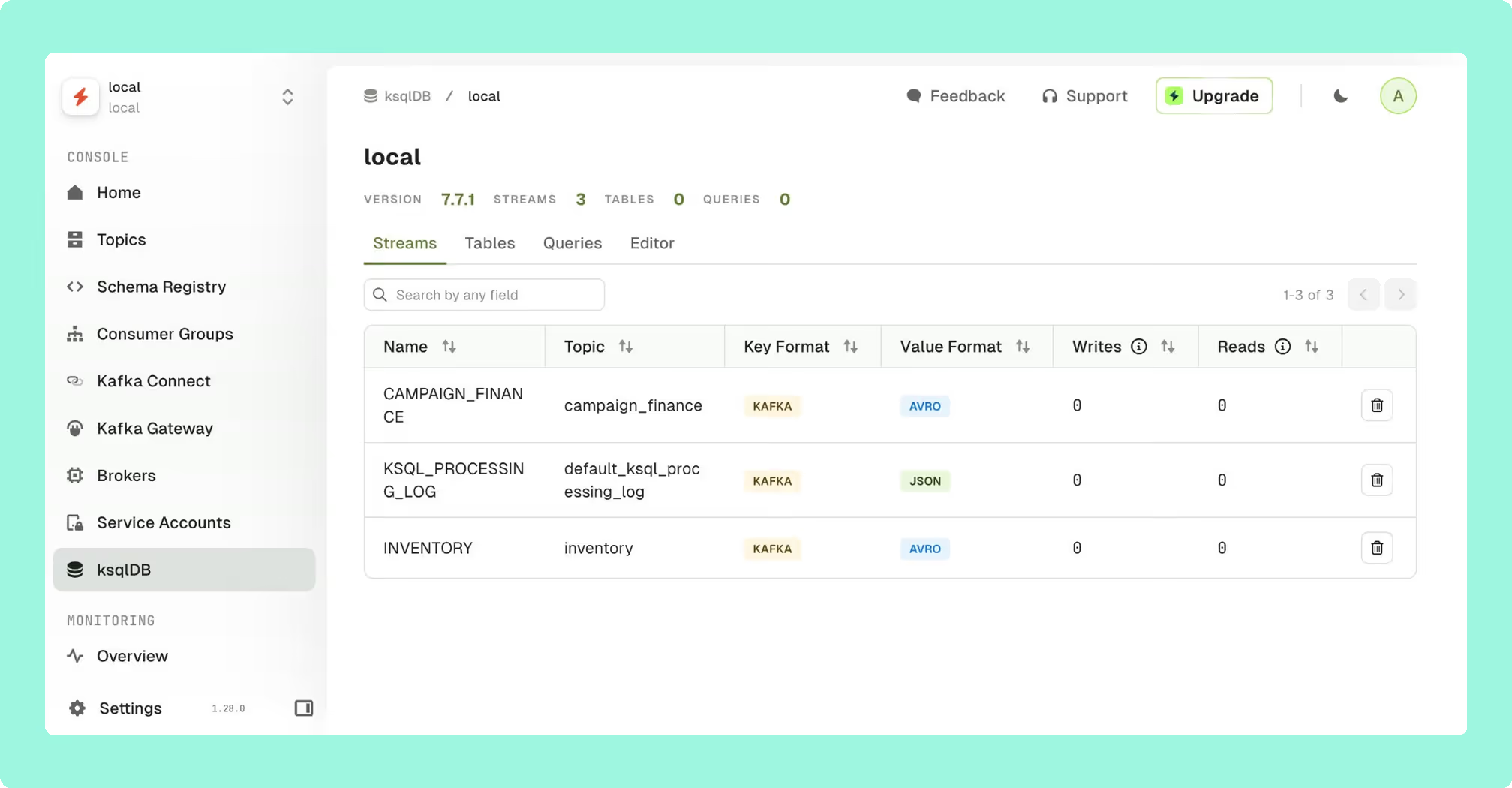
Conduktor is a commercial Kafka management and governance platform, sold as three separately licensed products: Console, a web interface over topics, schemas, connectors, consumer groups and access control; Gateway, a proxy that sits between clients and brokers; and a Schema Registry Proxy on its own Enterprise tier.
Gateway is the architectural fact that decides most evaluations. It enforces encryption, data masking, quota policy and multi-tenancy at the wire, so producers and consumers need no change to their code. Kafka is a binary protocol over TCP, and a component that speaks it can sit in the middle unnoticed.
- Assurance: SOC2 Type II certified in 2023.
- Audit: more than 70 event types, each carrying user identity, IP address, timestamp, topic and partition.
- Self-service: Topic as a Service hands topic creation to product teams inside policy guardrails.
- Footprint: PostgreSQL 13 or later for Console, plus 2 CPU and 3 GB of RAM, and a further 2 CPU and 4 GB for Gateway.
What is Lenses?
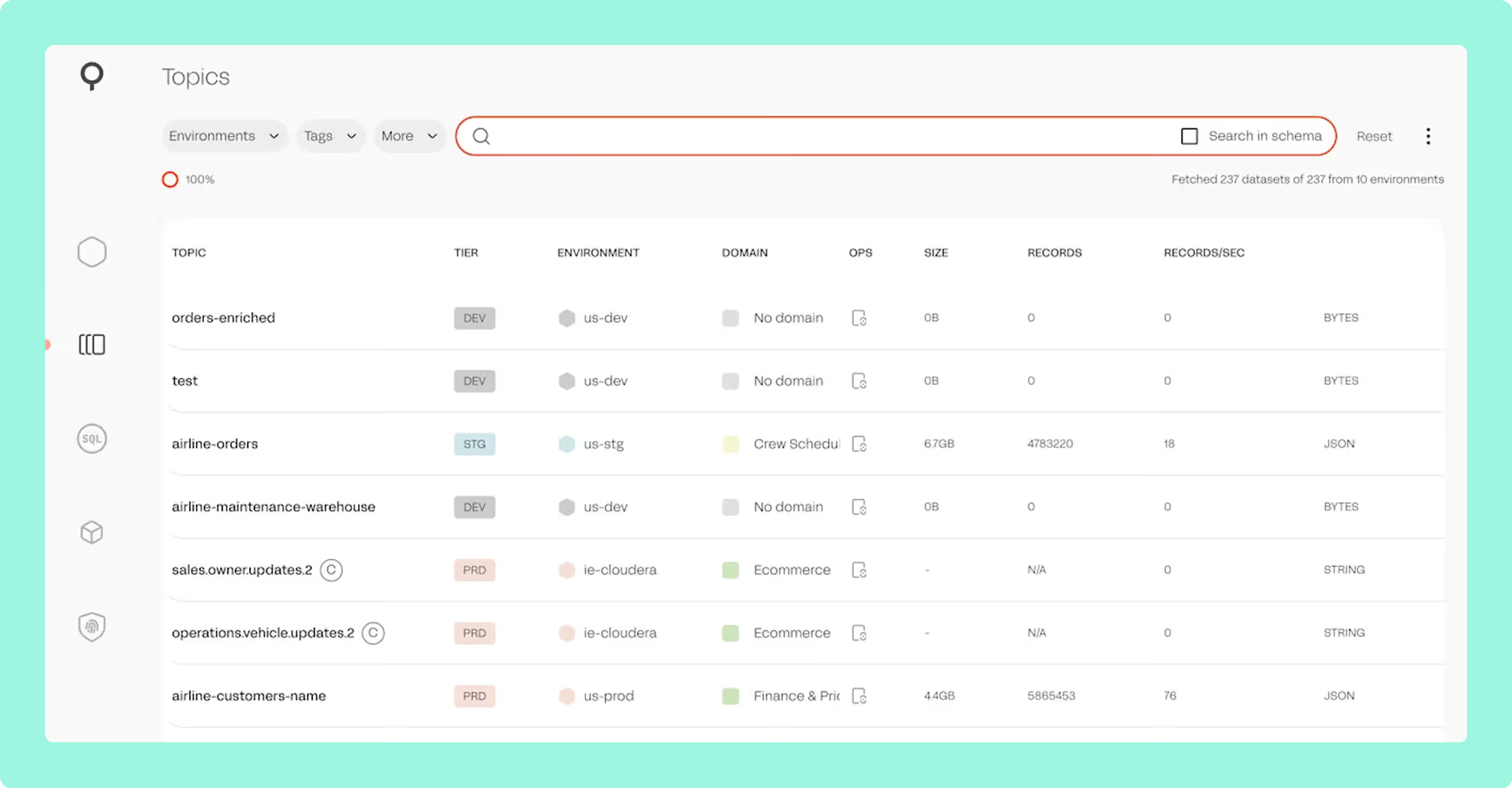
Lenses is a commercial Kafka governance and data exploration platform that sits on top of existing clusters, adding a SQL interface, topology and lineage visualisation, and a data catalogue. Architecturally it is the opposite of a proxy: it operates as an ordinary Kafka client and nothing in it sits in the data path, which is also why a KRaft cluster needs no modification. The deployment is a central Lenses HQ node with lightweight Agents running per cluster, and one Agent reaches one Kafka cluster.
SQL Studio is the differentiator, and it is what people who run Lenses talk about first: it replaces a search through millions of raw JSON, Avro or Protobuf payloads with a query, aimed at engineers and analysts who do not know Kafka. SQL Processors go further, giving Kubernetes-native stream processing defined in SQL and built on Kafka Streams. The product line splits into DevX, the UI, governance and SQL surface, and K2K, which is replication. Celonis acquired Lenses in early 2022, and 6.2.6 shipped on 19 August 2026.
What is the official 2026 pricing of Conduktor and Lenses?
Neither bill is one number, and the two are not metered on the same thing. Conduktor prices Console per seat: Team Edition is 1,200 US dollars per seat per year, or 125 US dollars per seat per month billed monthly, and the governance layer arrives at that published price rather than at a negotiation. Gateway Enterprise is licensed per cluster with a three-cluster minimum and is contact-only. Lenses prices DevX by capability, user count and cluster scope: Team starts at 4,000 US dollars a year, covers up to 15 users, and is scoped to a single cluster, with Multi-Kafka Enterprise custom priced past either limit.
Work both ends of the range. A team of five is five Conduktor seats at 6,000 a year against a Lenses Team price starting at 4,000, so the crossover sits between three and four engineers. Fifty seats is 60,000 a year at Conduktor list, and fifty users is well past the Lenses Team cap, so that side becomes a custom contract. The free tiers run the opposite way to the price tags: Console Community is free at 50 users and 3 clusters, while Lenses Community is free for up to 5 users with Basic Auth, no SSO and no RBAC. There is also a second Lenses meter, K2K Enterprise, from 1,000 US dollars a month with 5 clusters included and 200 a month per cluster after, paid on top of DevX.
Where does each one run out?
Both tools are marked out of 10 on the same five criteria, for a total out of 50, and every criterion counts once. Nothing sits behind a multiplier, so a total is the sum of its five marks and a reader can recompute it. The five are cost as teams grow, deployment footprint, support and maintenance, access control and audit, and multi-cluster reach, because those are the questions a Kafka interface is actually measured against after the first month: a second cluster, an access review with a date on it, an upgrade nobody owns, and a bill that moves when the team does. The widest gap between the two marks is on support and maintenance, where Conduktor marks 9 and Lenses marks 6. The marks come from the same matrix used on every comparison on this site, so a tool scores the same here as it does anywhere else, and the reason behind each mark is in the card below, under Why these scores.
 Rank 1
 Lenses
lenses.io
26 out of 50 Total
- Cost a year, 10 engineers
- 4,000 US dollars, DevX Team published, up to 15 users
- Free tier
- 5 users, Basic Auth only
- Needs to run
- Postgres for HQ, plus a database per Agent
- Cost as teams grow
- 4 out of 10
- Deployment footprint
- 2 out of 10
- Support and maintenance
- 6 out of 10
- Access control and audit
- 7 out of 10
- Multi-cluster reach
- 7 out of 10
Why these scores for Lenses
- Cost as teams grow 4 out of 10
- This page’s table gives the published entry price as DevX Team from 4,000 US dollars a year for up to 15 users on a single cluster, with Multi-Kafka Enterprise custom priced, and the free tier as 5 users on Basic Auth, no SSO and no RBAC. K2K is a second meter from 1,000 a month. The annual figure for ten engineers is 4,000 US dollars, the published DevX Team price, which covers up to 15 users on one cluster.
- Deployment footprint 2 out of 10
- The External dependencies row of this page’s table gives Postgres for HQ as its only supported store, plus one Agent and one Agent database for every Kafka cluster, on the Community edition too.
- Support and maintenance 6 out of 10
- On this page, Celonis acquired Lenses in early 2022 and 6.2.6 shipped on 19 August 2026, under a vendor contract, and the Lenses review records no high availability for HQ and slow bug fixes.
- Access control and audit 7 out of 10
- This page gives SSO, SAML and RBAC from Team, but data policies match on field name across every registered dataset with no escape even for an admin, so masking cannot vary by who is looking.
- Multi-cluster reach 7 out of 10
- The Multi-cluster reach row of this page’s table has one Agent reaching one Kafka cluster, and federated multi-Kafka is only at the custom-priced top tier.
Lenses’ costs sit in the control plane, which is wider than it first looks: HQ plus its Postgres, and then one Agent and one Agent database for every Kafka cluster. Postgres is the only supported store for HQ, and the Community edition carries the same dependency, standing up separate lenses_hq and lenses_agent databases before either component starts.
Masking: data policies match on field name across every registered dataset, with no escape even for an admin, so masking cannot vary by who is looking.
Permissions: 6.2.5 split UpdateTopicDetails into two actions, so custom roles granting the old one had to be re-granted by hand.
Portability: SQL Processors are proprietary and compiled, so anything built on them is a re-implementation if the team leaves.
Reach: one Agent reaches one Kafka cluster, so a four-cluster estate is five databases before anybody logs in.
 Rank 2
 Conduktor
conduktor.io
36 out of 50 Total
- Cost a year, 10 engineers
- 12,000 US dollars for 10 Team Edition seats at the published 1,200
- Free tier
- 50 users, 3 clusters
- Needs to run
- PostgreSQL 13 or later, not optional
- Cost as teams grow
- 5 out of 10
- Deployment footprint
- 3 out of 10
- Support and maintenance
- 9 out of 10
- Access control and audit
- 10 out of 10
- Multi-cluster reach
- 9 out of 10
Why these scores for Conduktor
- Cost as teams grow 5 out of 10
- This page’s table gives the published entry price as Console Team Edition at 1,200 US dollars per seat per year, and leaves Console Enterprise, Gateway Enterprise and the Schema Registry Proxy all contact-only. Community is free at 50 users and 3 clusters. The annual figure for ten engineers is 12,000 US dollars, ten seats at the published 1,200. Console Community is free at 50 users and 3 clusters, so ten engineers pay nothing until they want the governance this score is based on, which starts on Team Edition.
- Deployment footprint 3 out of 10
- This page’s table gives external dependencies as PostgreSQL 13 or later for Console and it is not optional, and Gateway sits in the data path and needs its own high-availability plan.
- Support and maintenance 9 out of 10
- This page has it SOC2 Type II certified in 2023, sold by a vendor under contract with support at the tier bought. Same value as every other Conduktor page.
- Access control and audit 10 out of 10
- This page gives more than 70 audited event types, each carrying user identity, IP address, timestamp, topic and partition, with Gateway enforcing encryption, masking and multi-tenancy at the wire.
- Multi-cluster reach 9 out of 10
- The Multi-cluster reach row of this page’s table has Console Team Edition listing unlimited clusters, with Gateway Enterprise licensed per cluster at a three-cluster minimum.
Conduktor’s costs are architectural, and Gateway carries most of them. A proxy adds a network hop that can slightly increase end-to-end latency, and it is a component in the data path that needs its own high-availability plan. Gateway Enterprise also carries a three-cluster minimum, so a team that wants wire-level policy on one cluster buys three.
Index: when Console’s internal index is stale or incomplete it queries the cluster directly, which a user sees as slow page loads.
Graphs: the monitoring graph averages brief spikes across wide time windows, so a short spike renders as zero until the range is narrowed.
Azure: Event Hubs is reachable over Kafka protocol compatibility, but Azure’s native Schema Registry is not integrated.
Tracing: no native distributed tracing, which is what stops it being a complete observability platform.
Compare Conduktor vs Kafbat UIConduktor vs Confluent Control CenterConduktor review
Which should you pick?
Conduktor scores 36 against Lenses’ 26 and is the pick for a team buying central policy control, at 1,200 US dollars per seat a year. Lenses is the pick where SQL access to topic data is the reason for buying, from 4,000 a year for fifteen users. Both need a database, so a team that wants neither a second datastore nor a per-seat bill should shortlist Kpow by Factor House, priced per cluster.
Pick Conduktor if:
- policy has to hold on every client with no way around it
- encryption, masking or multi-tenancy has to be enforced at the wire
- the estate is many clusters and one Console with one Postgres is the simpler shape
- the team is above three or four seats but well below fifty
Pick Lenses if:
- the people who need answers are not Kafka people
- SQL over topics replaces writing a consumer
- stream processing defined in SQL is part of the plan
- the team is between five and fifteen users on a single cluster
Gateway enforces at the wire, and a client cannot route past something it has to connect through, which is a different guarantee from a rule configured in a UI. On the other side, SQL Studio is the one axis where these two are genuinely not substitutes. Price where you expect to be in a year: a team of eight or ten inverts the arithmetic without a single feature changing hands. If the shortlist is wider than these two, the best Kafka management tools scores the paid consoles on the same criteria, and the tools for searching messages across Kafka topics takes the SQL Studio question on its own.
Kpow: no database of its own, licensed per cluster instead of per seat
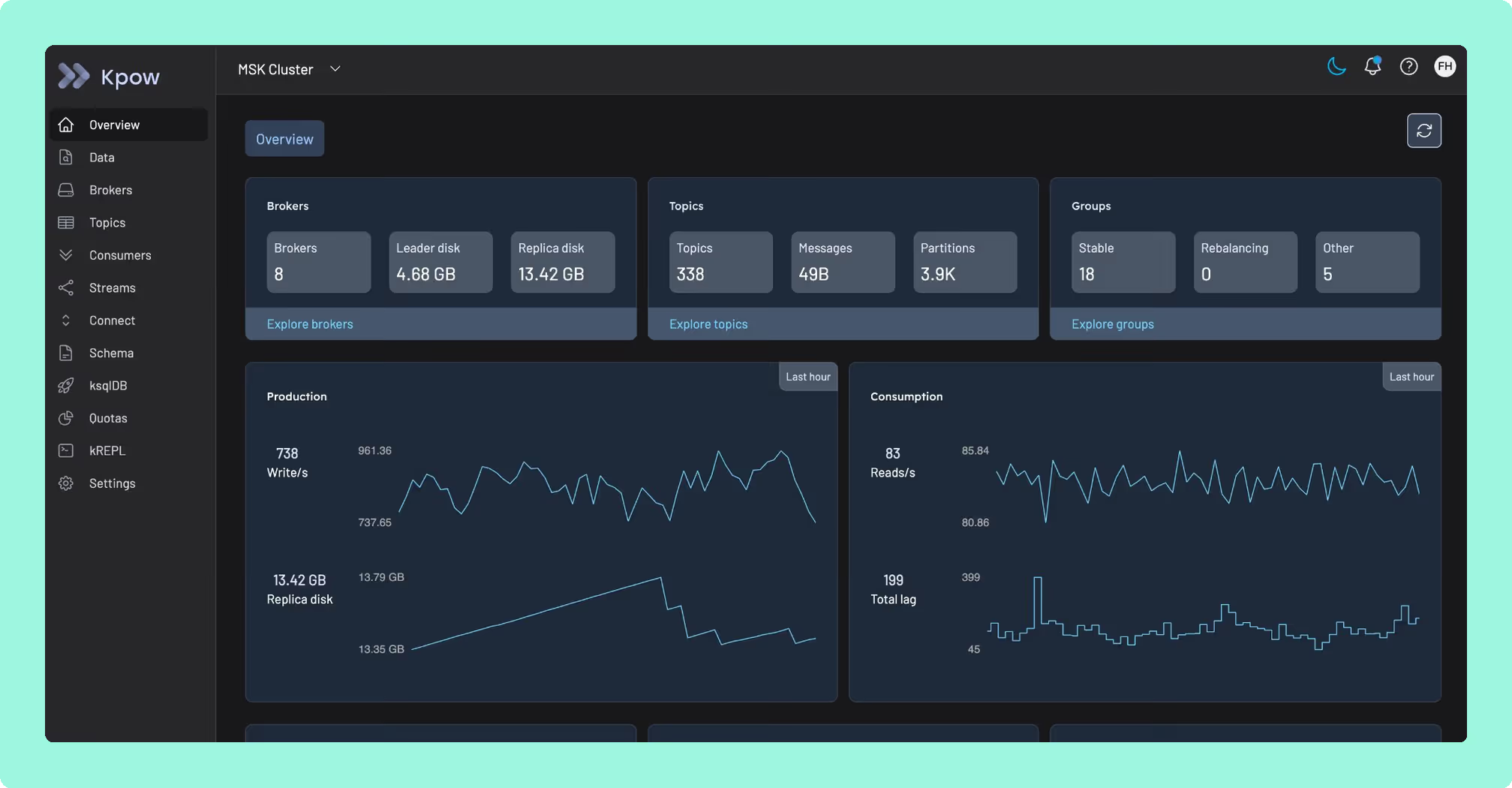
Conduktor and Lenses both bring a database with them before either team logs in. Console requires PostgreSQL 13 or later as a mandatory dependency, and Lenses needs Postgres for HQ plus a separate Agent and Agent database for every Kafka cluster it reaches, so a four-cluster deployment is HQ plus four Agents and their databases before anybody runs a query. Kpow by Factor House needs none of that: it is self-managed, vendor-agnostic tooling that runs against whatever Kafka you already have, as one stateless JVM container configured through environment variables with no external database. One instance manages up to 12 Kafka clusters, licensed per cluster at a published price, and it sits beside the cluster as an ordinary Kafka client rather than in the data path.
A tool that manages your clusters shouldn’t need a database of its own to do it. Start with Kpow on the cluster you already run and see what’s left to maintain.
How these tools were scored
Every option is scored from 0 to 10 on each criterion, from the evidence and sources this page cites, and the reason for each score is on its card. Each criterion counts once, for a total out of 50. The options are listed by total. Conduktor is listed last whatever its total; on its total of 36 it would place first.
Sources
- Apache Kafka protocol guide
- Apache Kafka documentation on authorization
- Apache Kafka documentation on basic operations