At a glance
Kadeck and Conduktor are scored here on the same five criteria, 50 points in all: Kadeck 29 out of 50, Conduktor 36 out of 50. Kadeck takes its best score on Multi-cluster reach (9 out of 10) and its lowest on Cost as teams grow (4 out of 10). Cost a year, 50 users: $19,200 on Enterprise. Conduktor takes its best score on Access control and audit (10 out of 10) and its lowest on Deployment footprint (3 out of 10). Cost a year, 50 seats: $60,000 on Team Edition. Conduktor holds the highest total on this page at 36 out of 50.
Conduktor vs Kadeck, compared
Kpow meets 5 of 7 requirements on this page. One row is not a yes or no question.
Key takeaway
Conduktor sells policy enforcement and Kadeck sells data exploration, so the two overlap on features and diverge on what governance means. Conduktor Console Team Edition is 1,200 US dollars per seat per year, with group-level RBAC, topic policies and masking included. Kadeck Enterprise is 32 US dollars per user per month with a ten-user minimum, so the floor is 3,840 a year below ten engineers, and roughly a third of Conduktor’s cost at fifty. Kpow by Factor House is licensed per cluster at a published price.
Kpow live demo
Test the trade-offs in a live Kafka UI
You have compared Conduktor vs Kadeck. Open a live Kpow environment to test the everyday workflows a shared Kafka platform needs.
Built for platform and data teams managing shared Kafka clusters.
Try the Kpow demoWhat is Conduktor?
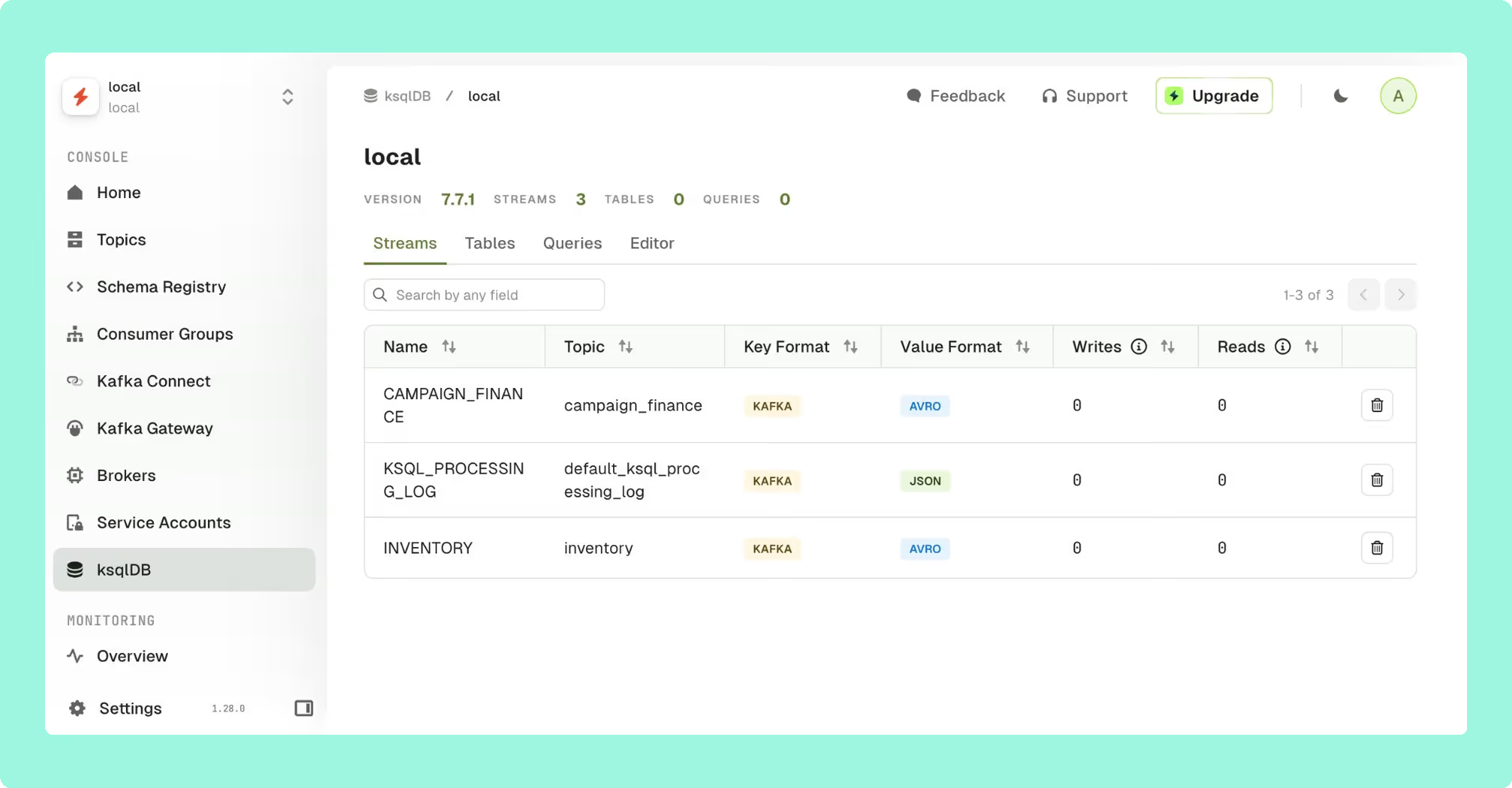
Conduktor is a Kafka management and governance platform, sold as three separately licensed products. Console is the web interface, a Kafka management console over topics, schemas, connectors, consumer groups and access control. Gateway is a proxy that sits between clients and brokers. A Schema Registry Proxy is the third, carrying its own tier.
Gateway is what makes this a different category of tool rather than a smarter dashboard. It enforces encryption, data masking, quota policy and multi-tenancy at the wire level, so producers and consumers need no change to their code, and the policy holds even on a cluster somebody else is running. The company retired its JavaFX desktop product at the end of 2025, and was SOC2 Type II certified in 2023.
What is Kadeck?
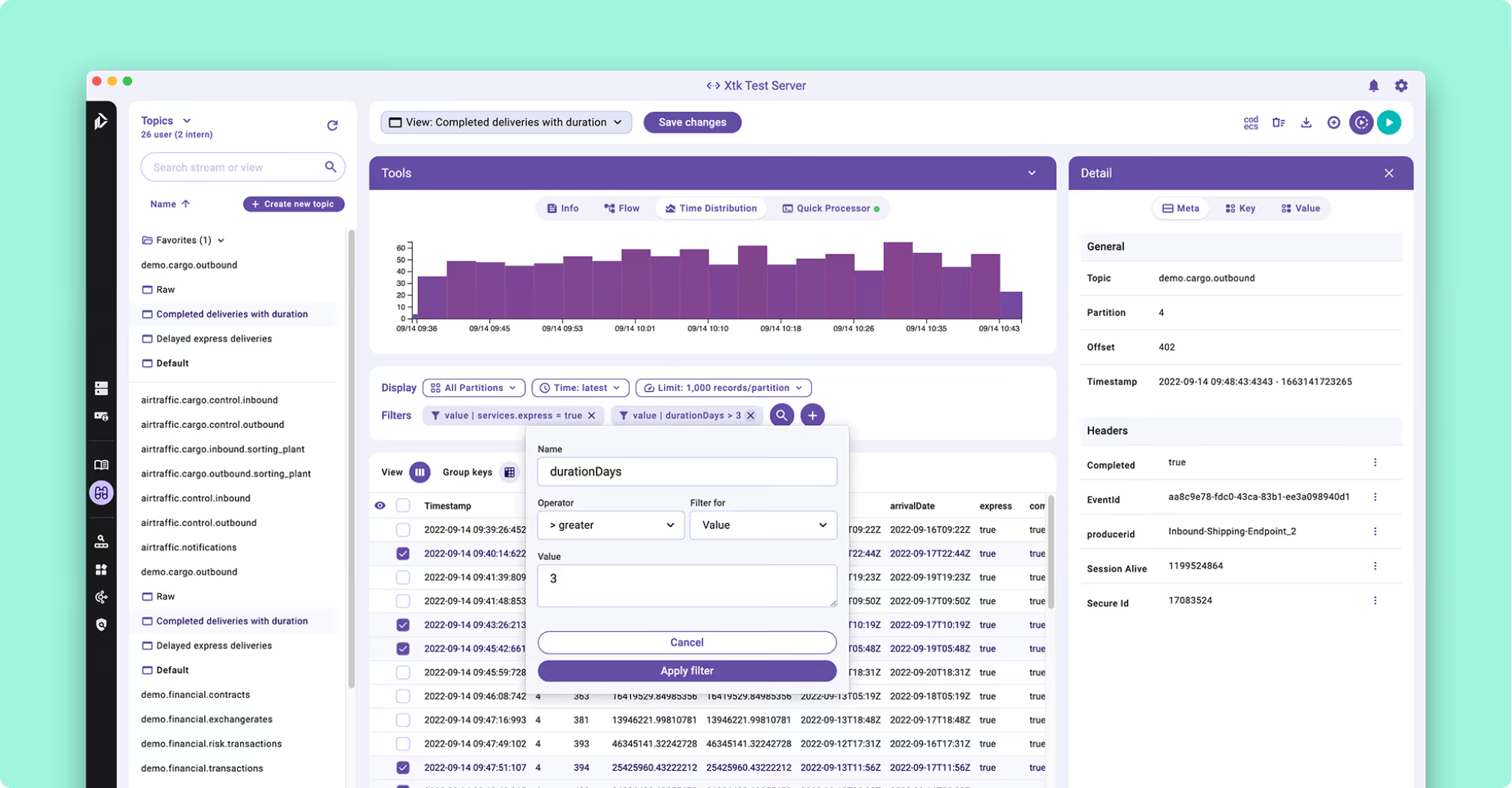
Kadeck is a commercially licensed Kafka management and data exploration tool from xeotek, a German vendor, and it is not open source. It comes as two product lines rather than two rungs of one ladder: a native desktop application for Linux, macOS and Windows, and a web and teams edition distributed as a Docker image. Apache Kafka, Redpanda and Amazon Kinesis are all supported as sources.
- Record view: Avro decoded through the Schema Registry into a columnar layout rather than raw bytes.
- Calculated fields: a JavaScript processor derives them from record values, with no streaming application behind it.
- Recovery: dead letter queues in Kafka are a documented workflow rather than a script written under pressure.
- Reach: managed clusters such as Amazon MSK, where CLI access is more cumbersome.
The vendor now frames it more broadly, as a portal for operations and business teams as well as engineers, with an AI Health Assistant added in the 5.x line. That widens who is expected to log in, which is a licensing question on a tool billed per user.
What is the official 2026 pricing of Conduktor and Kadeck?
Conduktor charges by the seat and Kadeck charges by the user, and those units do not behave the same way at the sizes a platform team buys at. Console Team Edition is 1,200 US dollars per seat per year, or 125 US dollars per seat per month billed monthly, so five engineers is 6,000 a year. Kadeck Enterprise is 32 US dollars per user per month with a ten-user minimum, so five engineers pay for ten and the floor is 3,840 a year. At fifty engineers the same two lines are 60,000 and 19,200.
Governance sits at a different rung on each ladder. Conduktor puts group-level RBAC, topic policies, unlimited audit logs and data masking in Team Edition, at the published price. Kadeck puts LDAP, OpenID Connect, data masking and audit logs in Enterprise only, and Professional at 19 US dollars per user per month does not close that gap, because Professional is the desktop line and carries no governance at all. RBAC for Kafka in both products is the tool’s own model, sitting above the cluster’s authorisation rules rather than replacing them. Conduktor publishes two of its five purchasable tiers; Kadeck publishes both of its paid tiers.
Where does each one run out?
Each tool here is marked out of 10 on five criteria, 50 points in all, and no criterion is weighted above another. Nothing sits behind a multiplier, so a total is the sum of its five marks and a reader can recompute it. The five are cost as teams grow, deployment footprint, support and maintenance, access control and audit, and multi-cluster reach, because those are the questions a Kafka interface is actually measured against after the first month: a second cluster, an access review with a date on it, an upgrade nobody owns, and a bill that moves when the team does. The widest gap between the two marks is on access control and audit, where Conduktor marks 10 and Kadeck marks 6. The marks come from the same matrix used on every comparison on this site, so a tool scores the same here as it does anywhere else, and the reason behind each mark is in the card below, under Why these scores.
Both run out in the same place first, and it belongs to neither vendor. Kafka does not index payloads, so a search across a large topic is a sequential partition scan in any tool that reads from the log. Past that, they run out in different directions. Conduktor Console requires PostgreSQL 13 or later, and it is not optional, so a monitoring tool arrives with a database, its backups and its upgrade path.
 Rank 1
 Kadeck
kadeck.com
29 out of 50 Total
- Cost a year, 50 users
- $19,200 on Enterprise
- Free tier
- Teams Free: 5 users, 1 cluster
- Runs on
- A Docker image, or a desktop installer
- Cost as teams grow
- 4 out of 10
- Deployment footprint
- 4 out of 10
- Support and maintenance
- 6 out of 10
- Access control and audit
- 6 out of 10
- Multi-cluster reach
- 9 out of 10
Why these scores for Kadeck
- Cost as teams grow 4 out of 10
- This page’s table gives $32 per user per month on Enterprise with a ten-user minimum, so fifty engineers is $19,200 a year and four people still pay $3,840; Kpow Enterprise is $18,000 for four clusters.
- Deployment footprint 4 out of 10
- On this page, the teams edition ships exclusively as a Docker image, with no RPM packages, no native server binaries and no Helm chart, and the documented Kubernetes path wants a persistent external database.
- Support and maintenance 6 out of 10
- This page has it commercially licensed from xeotek and sold per user, with an AI Health Assistant added in the 5.x line, and every container start makes an online licence validation call.
- Access control and audit 6 out of 10
- This page’s table puts LDAP, OpenID Connect, data masking and audit logs on Enterprise only, so Teams Free and Professional carry no governance at all.
- Multi-cluster reach 9 out of 10
- This page gives Apache Kafka, Redpanda and Amazon Kinesis as supported sources, with the free tier capped at one cluster.
Cost a year: Enterprise is $32 per user per month with a ten-user minimum, the vendor’s own published price, so fifty engineers is $19,200 a year and a team of four still pays $3,840. Kpow Enterprise is $4,500 per cluster a year for up to 100 users, so the same four clusters are $18,000, so the bill follows the clusters rather than the headcount.
The teams edition of Kadeck ships exclusively as a Docker image. There are no RPM packages, no native server binaries and no Helm chart, so a platform team that standardises on packaged deployment builds its own path to production.
Licence checks: every container start makes an online validation call, so air-gapped and per-pipeline deployments need challenge-response activation first.
Governance floor: the ten-user minimum is a floor rather than a rate, so a team of four that needs an audit log pays for ten.
Ladders: a desktop licence does not upgrade into Enterprise, so moving to a governed deployment is a repurchase.
Write path: no streaming of derived data back into a topic, and no Kafka Streams or ksqlDB integration.
 Rank 2
 Conduktor
conduktor.io
36 out of 50 Total
- Cost a year, 50 seats
- $60,000 on Team Edition
- Free tier
- Community: 50 users, 3 clusters
- Runs on
- PostgreSQL 13+, plus Gateway proxy
- Cost as teams grow
- 5 out of 10
- Deployment footprint
- 3 out of 10
- Support and maintenance
- 9 out of 10
- Access control and audit
- 10 out of 10
- Multi-cluster reach
- 9 out of 10
Why these scores for Conduktor
- Cost as teams grow 5 out of 10
- This page gives $1,200 per seat per year on Team Edition, so five engineers is $6,000 a year and fifty is $60,000, and only two of its five purchasable tiers are published; Kpow Enterprise is $18,000 for four clusters.
- Deployment footprint 3 out of 10
- On this page, PostgreSQL 13 or later is not optional, and Gateway Enterprise carries a three-cluster minimum, so wire-level policy on one cluster means buying three.
- Support and maintenance 9 out of 10
- This page has it SOC2 Type II certified in 2023, sold under contract, with support attached to the plan.
- Access control and audit 10 out of 10
- This page’s table puts group-level RBAC, topic policies, unlimited audit logs and data masking all in Team Edition at the published seat price, and the audit trail carries more than 70 event types.
- Multi-cluster reach 9 out of 10
- On this page, Gateway applies multi-tenancy to a cluster somebody else operates, and Console reaches clusters across distributions.
Cost a year: Console Team Edition is $1,200 per seat per year, the vendor’s own published price, so fifty engineers is $60,000 a year before Gateway, which is licensed separately per cluster with a three-cluster minimum and no published price. Kpow Enterprise is $4,500 per cluster a year for up to 100 users, so the same four clusters are $18,000, and that number does not move when the fifty-first engineer needs a login.
Latency: Gateway is a proxy in the data path, and a proxy adds a network hop that can slightly increase end-to-end latency.
Availability: Gateway sits in the data path as a potential single point of failure needing its own high-availability plan.
Gateway Community: a narrow-scope address translator. Interceptors, alias topics, Virtual Clusters, topic concentration and failover are all Enterprise.
Minimums: Gateway Enterprise carries a three-cluster minimum, so wire-level policy on one cluster means buying three.
Compare Conduktor vs Confluent Control CenterConduktor vs LensesConduktor review
Which should you pick?
Conduktor scores 36 against Kadeck’s 29 and is the pick for a team buying policy enforcement rather than data exploration. Kadeck is the better buy below ten engineers, where Conduktor’s per-seat bill is heaviest, and its dead-letter recovery has no Conduktor equivalent. Both meter people, so a team whose headcount is growing faster than its cluster count should shortlist Kpow by Factor House, which prices the cluster instead.
Pick Conduktor if:
- policy has to be enforced where applications cannot route around it
- field-level encryption or masking has to apply on the wire
- multi-tenancy is being applied to a cluster somebody else operates
- topic creation is being handed to product teams inside guardrails
Pick Kadeck if:
- the team is under ten people and needs an audit trail
- the problem is reading and repairing data rather than governing it
- dead-letter-queue recovery currently means a one-off script per incident
- individual developers want a Kafka UI on their own machine, with no container runtime
What the choice turns on is what governance means where you work. If it means policy on the wire that an application cannot bypass, Conduktor is built for it and Kadeck is not. If it means permissions and an audit trail inside the tool your engineers already have open, both do it, and Kadeck costs about a third as much. Kafka data masking tools sets the two masking models against the rest of the field, and the best Kafka management tools puts both price ladders next to everything else.
Kpow: a bill that doesn’t move with the team
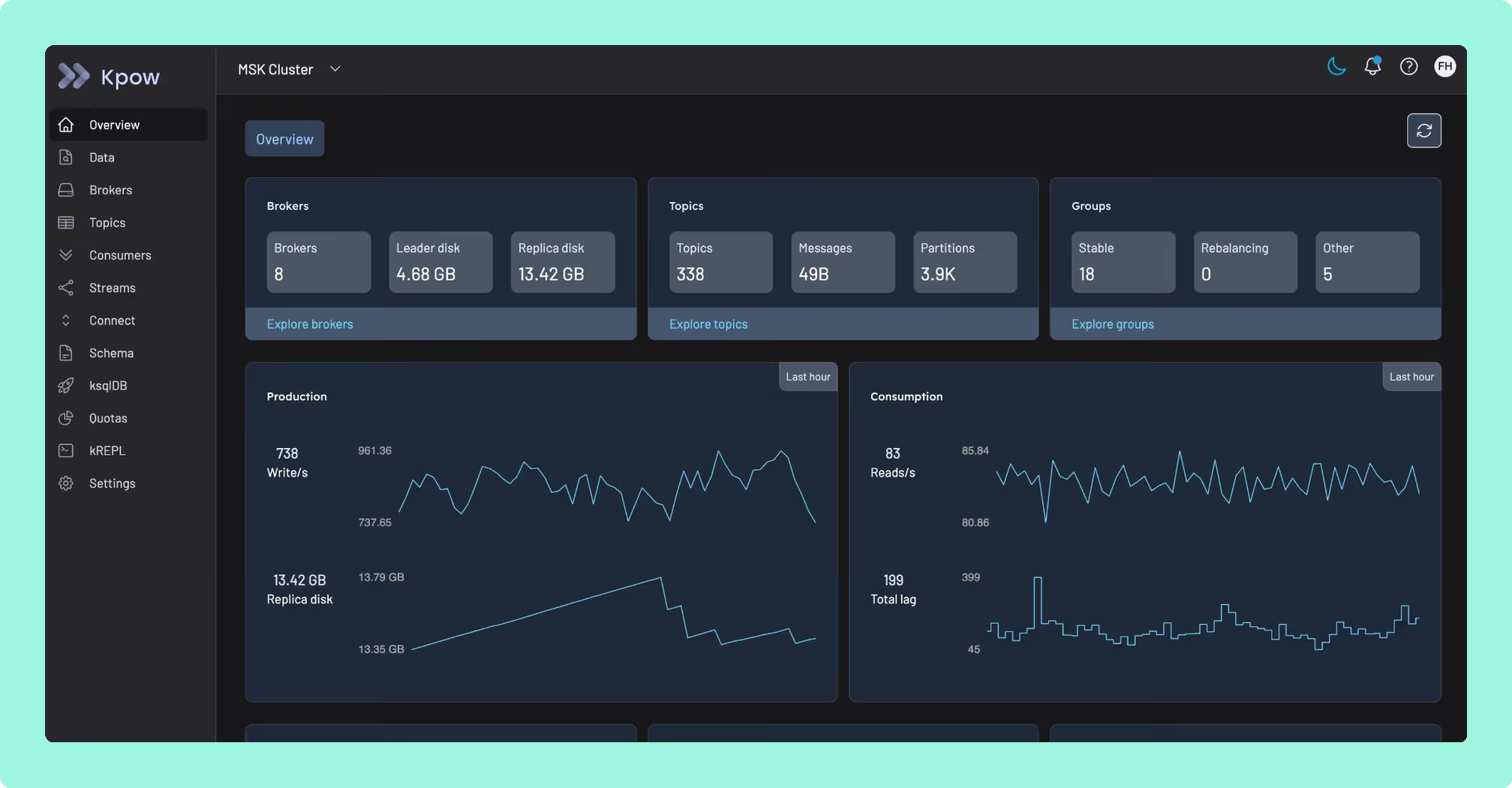
Both of these price per person, so the bill moves every time the team does, whichever ladder is cheaper. Conduktor Console Team Edition is 1,200 US dollars per seat per year, and Kadeck Enterprise is 32 US dollars per user per month with a ten-user minimum, so a team of four is already paying for ten. Kpow by Factor House is licensed per cluster instead, at a published price that does not move with headcount: one stateless JVM container, no external database, reaching up to 12 clusters from a single instance, with permissions and an audit trail on whatever cluster you already run rather than a proxy sitting on the wire.
A bill tied to the cluster stops moving the moment the team does. Kpow’s pricing is published in full before you talk to anybody.
How these tools were scored
Every option is scored from 0 to 10 on each criterion, from the evidence and sources this page cites, and the reason for each score is on its card. Each criterion counts once, for a total out of 50. The options are listed by total. Conduktor is listed last whatever its total; on its total of 36 it would place first.