At a glance
Kafdrop and Conduktor are scored here on the same five criteria, 50 points in all: Kafdrop 23 out of 50, Conduktor 36 out of 50. Kafdrop takes its best score on Cost as teams grow (10 out of 10) and its lowest on Access control and audit (0 out of 10). Cost a year, 10 engineers: 0 licence, about 11,520 US dollars to run, this page's estimate. Conduktor takes its best score on Access control and audit (10 out of 10) and its lowest on Deployment footprint (3 out of 10). Cost a year, 10 engineers: 12,000 US dollars of seats published, plus 2,880 this page's estimate. Conduktor holds the highest total on this page at 36 out of 50.
Conduktor vs Kafdrop, compared
Kpow meets 7 of 8 requirements on this page. One row is not a yes or no question.
Key takeaway
Kafdrop is free under Apache 2.0 with a single tier and no commercial edition, and it has no authentication and no access control, its README says so, and the feature request was closed as not planned in February 2026. Conduktor Console Community is free and self-hosted but caps at 3 clusters and 50 users, Team Edition is 1,200 US dollars per seat per year, and PostgreSQL 13 or later is not optional. Kpow by Factor House is licensed per cluster at a published price.
Kpow live demo
Test the trade-offs in a live Kafka UI
You have compared Conduktor vs Kafdrop. Open a live Kpow environment to test the everyday workflows a shared Kafka platform needs.
Built for platform and data teams managing shared Kafka clusters.
Try the Kpow demoWhat is Kafdrop?
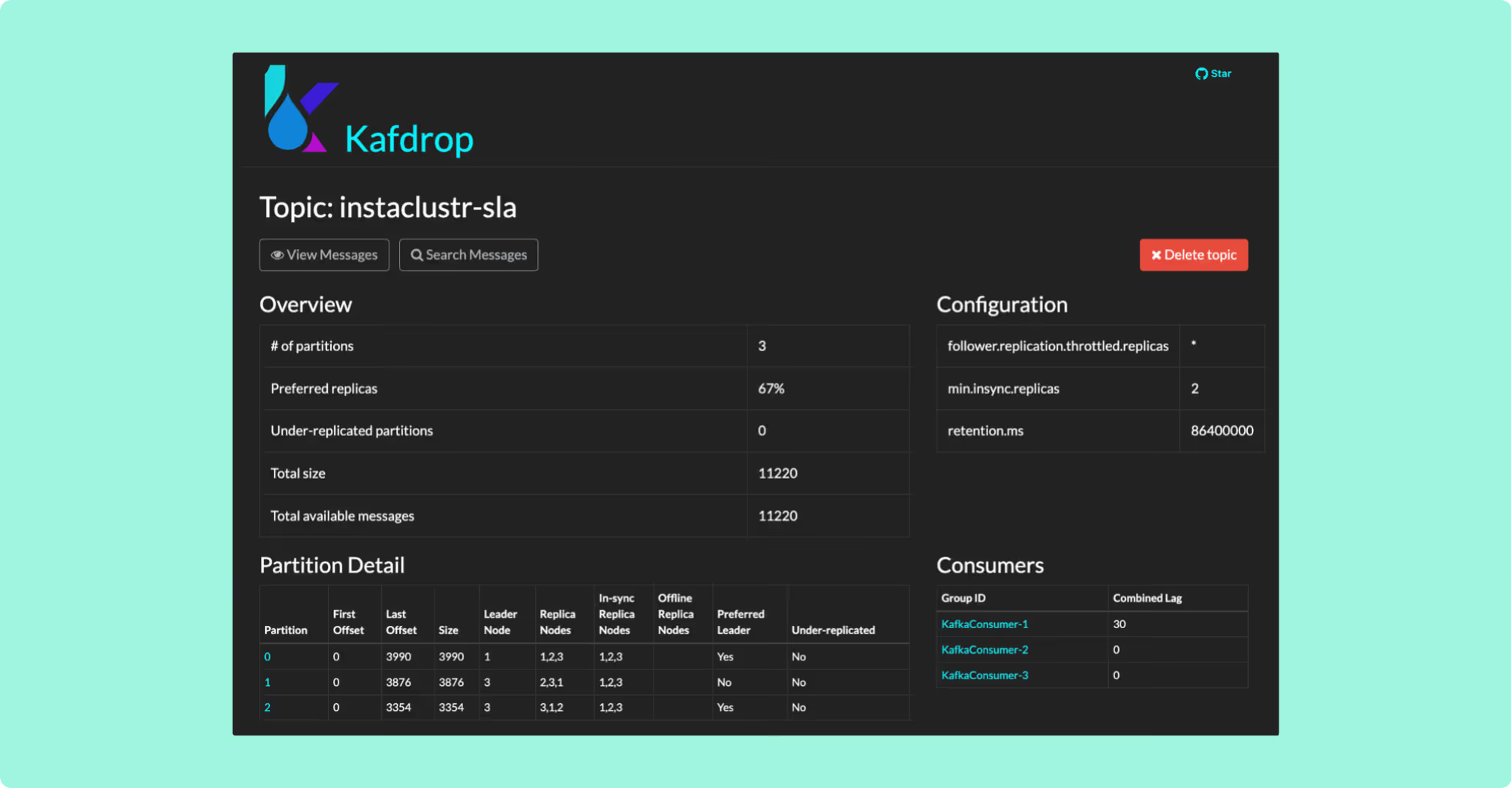
Kafdrop is an open-source Kafka web UI built on Spring Boot, licensed Apache 2.0, hosted at obsidiandynamics/kafdrop and maintained by the Obsidian Dynamics team. It runs as a stateless Java process against standard broker protocols with no backend datastore, which is what keeps setup minimal, and it is a Kafka UI that tutorials routinely stand up in a local Docker Compose environment. It needs Java 17 or newer and Kafka 0.11.0 or newer, serves on port 9000, and supports TLS and SASL to brokers.
- view brokers and topics
- browse messages in JSON, plain text, Avro and Protobuf
- view consumer groups with combined and per-partition lag
- create topics, view ACLs, and connect to Azure Event Hubs
The repository carries 6,154 stars, is not archived, and has 46 issues open, and commits have landed through August 2026 including a Spring Boot 4.1 upgrade. Tagged releases run to a different rhythm: the newest is 4.2.0 of July 2025, so this year’s feature work is in no published image.
What is Conduktor?
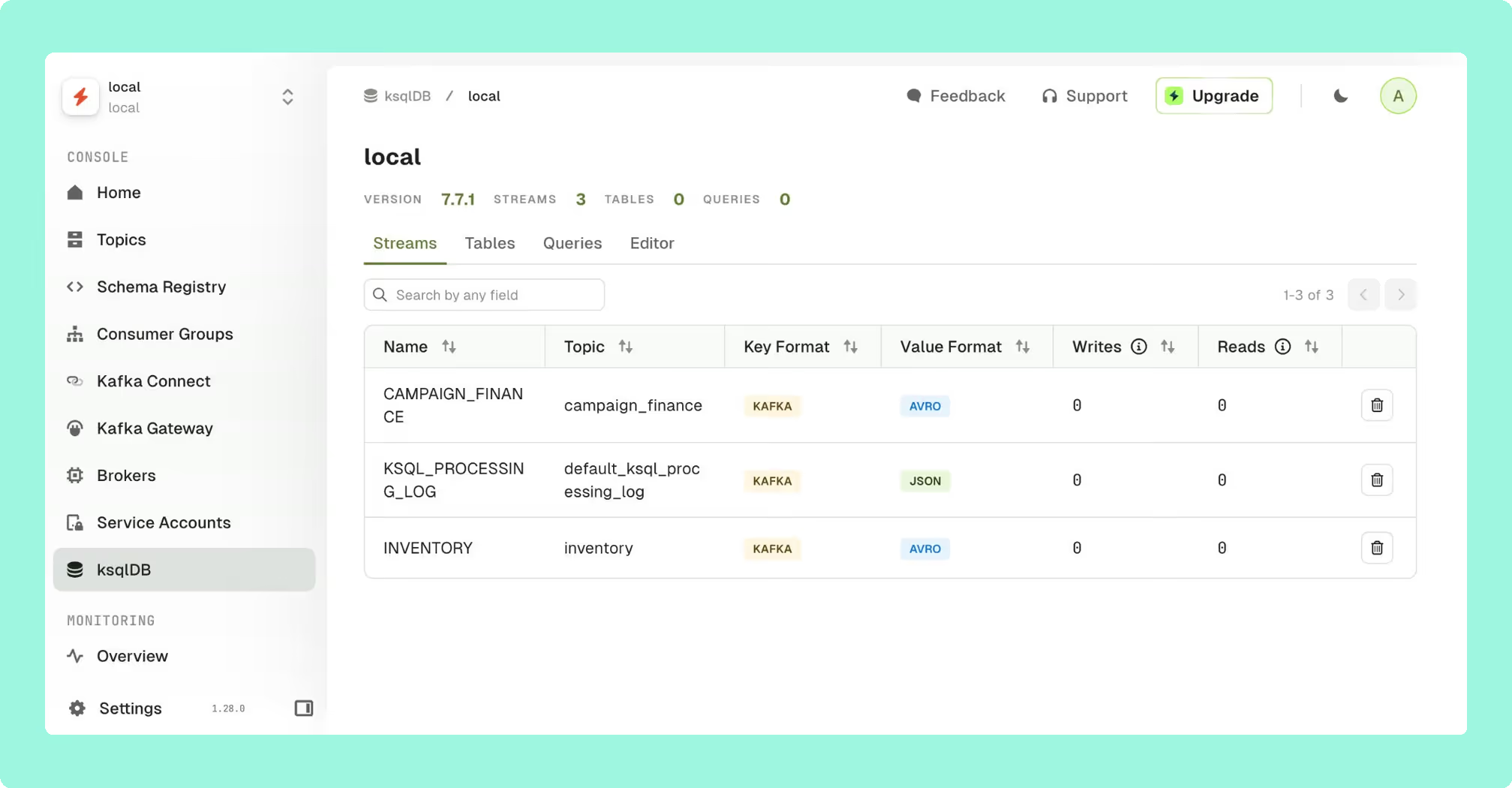
Conduktor is a commercial Kafka management and governance platform in two parts. Console is a React web interface over topics, schemas, connectors, consumer groups and access control across clusters. Gateway is a proxy between clients and brokers that enforces encryption, data masking, quota policy and multi-tenancy at the wire level, so producers and consumers need no change to their code. A Schema Registry Proxy carries its own Enterprise tier.
- Reach: MSK with IAM, Confluent Platform and Cloud, Redpanda, Aiven and Strimzi.
- Registries: Confluent-compatible and AWS Glue.
- Automation: a Terraform provider for GitOps workflows.
- Assurance: SOC2 Type II certified in 2023.
The company began with a JavaFX desktop application, moved to Console in 2023 and retired the desktop product at the end of 2025. The objections to Conduktor are commercial and architectural rather than functional.
What is the official 2026 pricing of Conduktor and Kafdrop?
These two are not priced on the same axis, so the comparison is not a discount. Kafdrop has no price at all, so the entire cost is operator time and there is nobody under contract when it stops. Console’s unit is the seat, so the cost is known in advance and moves with headcount rather than with the cluster.
For a team of five, Kafdrop is genuinely cheap: one container, minimal overhead, and five engineers who all hold cluster credentials anyway. Conduktor at five people fits inside Console Community, which is free, self-hosted, capped at 3 clusters and 50 users, and carries SSO by OIDC or LDAP. Community is also the default state of the container, since Console runs in it when no licence key is set, so the cost at that size is the PostgreSQL instance and the memory. At fifty people the two separate: fifty seats on Console Team Edition come to 60,000 US dollars a year and buy group-level RBAC, unlimited audit logs, topic policies and data masking. Fifty people on Kafdrop costs nothing, and buys no way to tell them apart.
Where does each one run out?
Both are scored out of 50, as five criteria marked out of 10, and each criterion carries the same weight as the others. Nothing sits behind a multiplier, so a total is the sum of its five marks and a reader can recompute it. The five are cost as teams grow, deployment footprint, support and maintenance, access control and audit, and multi-cluster reach, because those are the questions a Kafka interface is actually measured against after the first month: a second cluster, an access review with a date on it, an upgrade nobody owns, and a bill that moves when the team does. The widest gap between the two marks is on access control and audit, where Kafdrop marks 0 and Conduktor marks 10. The marks come from the same matrix used on every comparison on this site, so a tool scores the same here as it does anywhere else, and the reason behind each mark is in the card below, under Why these scores.
The dependency figures in the cards below were read on 24 September 2026 from each project’s published release artefact and matched against the NVD and GitHub advisory databases, so they move whenever a release or an advisory lands. Self-hosting is not the risk on this page. Both run in your own infrastructure. The question is who rebuilds the image when a dependency advisory lands.
Kafdrop
github.com/obsidiandynamics/kafdrop
23 out of 50 Total
- Cost a year, 10 engineers
- 0 licence, about 11,520 US dollars to run, this page's estimate
- Needs to run
- Java 17 or newer, no datastore
- Authentication
- None in the product
- Cost as teams grow
- 10 out of 10
- Deployment footprint
- 10 out of 10
- Support and maintenance
- 2 out of 10
- Access control and audit
- 0 out of 10
- Multi-cluster reach
- 1 out of 10
Why these scores for Kafdrop
- Cost as teams grow 10 out of 10
- This page’s table gives the pricing unit as free, Apache 2.0, a single tier, with no commercial edition and no support to buy, and adding an engineer makes no change to the bill. The annual figure for ten engineers is 0 in licence, and about 11,520 US dollars a year to run on this page’s own estimate, set out in the card.
- Deployment footprint 10 out of 10
- The External dependencies row of this page’s table gives none, a stateless Java process with no backend datastore, on Java 17 or newer, serving on port 9000.
- Support and maintenance 2 out of 10
- The Support row of this page’s table gives a GitHub tracker with 46 issues open and no channel beyond it, and the newest tagged release is 4.2.0 of July 2025 with three KRaft reports closed as not planned.
- Access control and audit 0 out of 10
- This page’s table gives authentication as none in the product, with an NGINX basic-auth workaround in the README, and the audit trail as none. Write operations are exposed to anybody who can reach port 9000.
- Multi-cluster reach 1 out of 10
- The Clusters per deployment row of this page’s table gives one, and there is no multi-cluster management.
Kafdrop has no authentication and no access control of any kind, and the README states it plainly, documenting an NGINX basic-auth workaround instead. The feature request was opened in January 2026 and closed as not planned in February. Kafka’s own ACLs govern what a principal may do on the broker, which is a different question from who may open a console pointed at it.
Write operations: exposed, so anybody who can reach port 9000 can delete a topic. The read-only toggle has sat in a pull request since November 2020.
KRaft: three reports of the topic view failing against a KRaft cluster were closed as not planned across 2025, and Kafka 4.0 supports KRaft only.
Reach: no multi-cluster management, no message search by key or value, no native MSK IAM, and deserialisation set per topic by hand.
Scale: 5,566 consumer groups took over 30 minutes to load, and the same view returned in under a minute with that enumeration disabled.
Staying patched: 4.3.0 shipped on 31 August 2026 bundling Tomcat 11.0.22, which had carried three critical advisories since 25 August, six days earlier. One of them, CVE-2026-65905, scores 9.8 and is an authentication bypass, and all three are still in the current release. Three releases have shipped in two years. Only 66 of its 118 bundled jars resolve to a Maven coordinate, so those counts are floors rather than totals.
Cost to run: the licence is 0, so what it costs is time and exposure. This page’s own estimate, not a vendor price: 8 engineer-hours a month at 120 US dollars an hour is 11,520 a year, covering the NGINX basic-auth reverse proxy the README points at, a separate deployment for every cluster because there is no multi-cluster management, and audit evidence collected by hand because there is no audit trail. Kpow’s published licence is 4,500 US dollars per cluster per year for up to 100 users, and it carries authentication, RBAC and an audit log in the product.
 Rank 2
 Conduktor
conduktor.io
36 out of 50 Total
- Cost a year, 10 engineers
- 12,000 US dollars of seats published, plus 2,880 this page's estimate
- Free tier
- 3 clusters, 50 users
- Needs to run
- PostgreSQL 13 or later, not optional
- Cost as teams grow
- 5 out of 10
- Deployment footprint
- 3 out of 10
- Support and maintenance
- 9 out of 10
- Access control and audit
- 10 out of 10
- Multi-cluster reach
- 9 out of 10
Why these scores for Conduktor
- Cost as teams grow 5 out of 10
- This page’s table gives the pricing unit as 1,200 US dollars per seat per year, or 125 per seat per month, and the free tier as Console Community at 3 clusters and 50 users, with three of the five purchasable tiers contact-only. The annual figure for ten engineers is 12,000 US dollars of seats at the published 1,200, plus about 2,880 US dollars of running cost on this page’s own estimate, 2 engineer-hours a month at 120 US dollars an hour, so about 14,880 US dollars. Console Community is free at 50 users and 3 clusters, so ten engineers pay nothing until they want the governance this score is based on, which starts on Team Edition.
- Deployment footprint 3 out of 10
- The External dependencies row of this page’s table gives PostgreSQL 13 or later for Console and it is not optional, with 2 CPU and 3 GB of RAM for Console and a further 2 CPU and 4 GB for Gateway.
- Support and maintenance 9 out of 10
- The Support row of this page’s table gives a vendor under contract, SOC2 Type II since 2023, with email support on Community and business-hours support on Team Edition.
- Access control and audit 10 out of 10
- The Authentication and Audit trail rows of this page’s table give SSO by OIDC or LDAP on every tier including the free one, group-level RBAC and data masking on Team Edition, SAML 2.0 on Enterprise, and more than 70 audited event types.
- Multi-cluster reach 9 out of 10
- The Clusters per deployment row of this page’s table gives 3 on Community and unlimited on Team Edition, with Gateway Enterprise licensed per cluster at a three-cluster minimum.
Conduktor’s limits are architectural before they are commercial. Console requires PostgreSQL 13 or later as a mandatory external dependency, so what looks like a container is a container plus a database somebody backs up and upgrades.
Latency: Gateway is a proxy in the data path, and a proxy adds a network hop that can slightly increase end-to-end latency.
Availability: Gateway stands in live traffic as a single point of failure with its own high-availability plan to write.
Pricing opacity: three of the five purchasable tiers are contact-only, and Gateway Enterprise carries a three-cluster minimum.
Free-tier ceiling: Console Community stops at 3 clusters and 50 users, which is why teams keep an open-source viewer for local and staging work.
There is also no native distributed tracing, and smaller edges surface in week two, such as Active Directory needing an LDAP search filter of (sAMAccountName={0}) to avoid an invalid user error.
Compare Conduktor vs Kafbat UIConduktor vs LensesConduktor review
Which should you pick?
Conduktor scores 36 against Kafdrop’s 23 and is the pick wherever access control matters, because Kafdrop has no authentication in the product and the request for it was closed as not planned in February 2026. Kafdrop suits a development cluster viewer and nothing more. Conduktor needs PostgreSQL and bills per seat, so for governance in one stateless container priced per cluster, shortlist Kpow by Factor House.
Pick Kafdrop if:
- what you need is a window onto one cluster rather than a console for governing it
- the job is local development, a dev cluster, or ad-hoc inspection of a topic
- a handful of people who already hold credentials are the whole audience
- nobody untrusted can reach port 9000
Pick Conduktor if:
- the question that brought you here is who is allowed to look
- an audit trail across more than 70 event types is a requirement
- topic policies and data masking have to be enforced rather than agreed
- SSO by OIDC or LDAP is needed at no licence cost
The reverse move is real. Teams already paying for Conduktor put a free viewer beside it for local and staging work, because Community does not reach a normal staging environment and nobody wants to spend seats on a laptop. Neither fits well if the shape is fifty people across several clusters on Kafka 4: Kafdrop’s KRaft position is three declined reports, Community stops at 3 clusters, and Team Edition’s unit is a seat, so the bill answers to headcount at exactly the moment the cluster count is what grew. If the shortlist is wider than these two, the best free Kafka UI tools ranks what a free tier actually reaches, and the best Kafka management tools scores the paid consoles on the same criteria.
Kpow: governance built in, priced by cluster instead of by seat
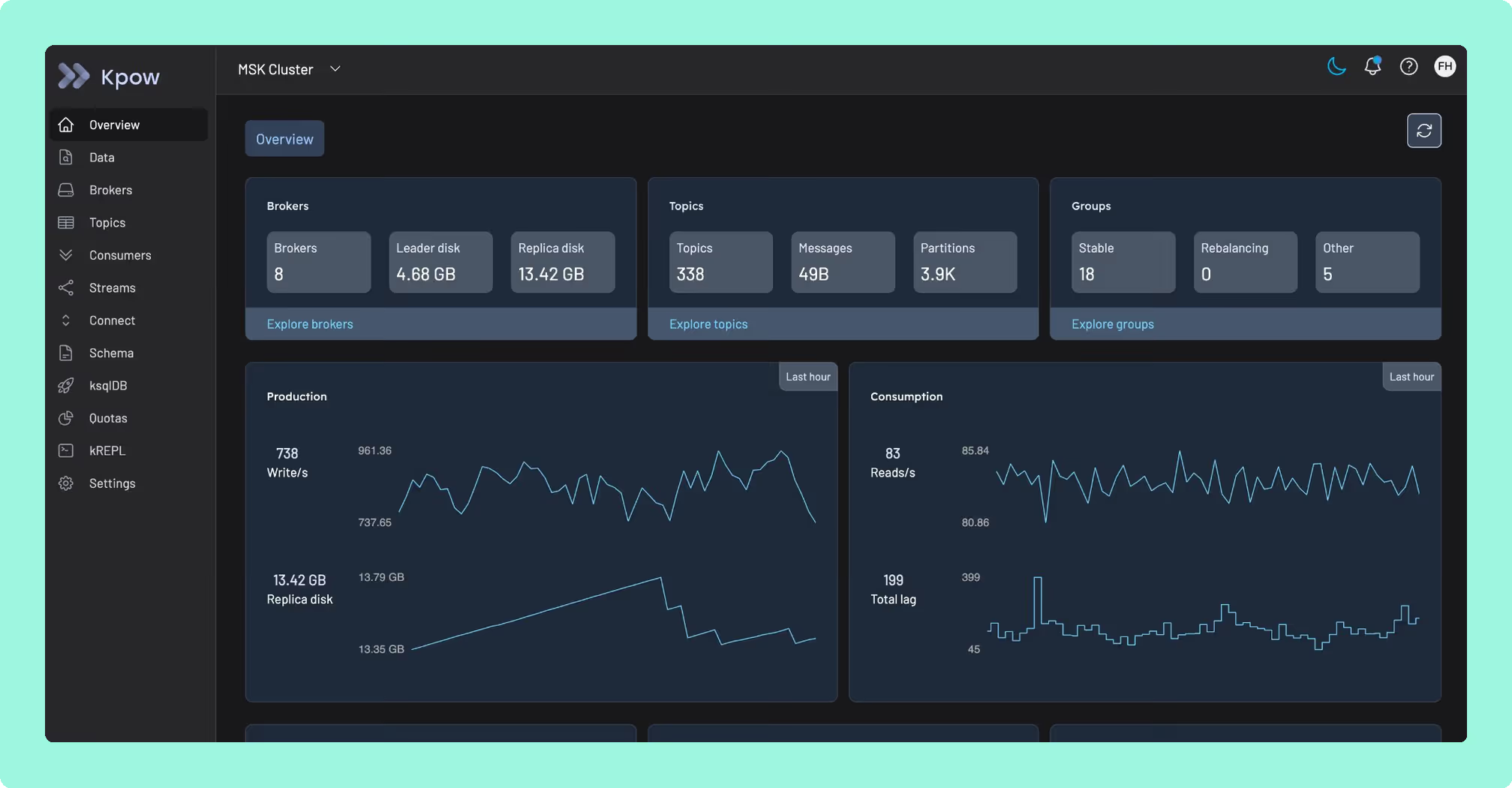
Kafdrop and Conduktor sit at opposite ends of the same gap. Kafdrop has no authentication and no access control at all, and its README says so, documenting an NGINX basic-auth workaround instead of building one in. Conduktor’s governance does exist, but the pieces that make it real, group-level RBAC, data masking and unlimited audit logs, only start on Team Edition, so all three arrive at 1,200 US dollars per seat per year. Kpow by Factor House builds LDAP, SAML and OpenID authentication, RBAC, masking policies and a full audit log into the product itself, applied at the console rather than the data path, and licenses the whole of it per cluster at a published price. One instance reaches up to 12 clusters as a single stateless JVM container configured through environment variables, with no external database, no sidecar and no persistent volume.
Governance shouldn’t be a workaround on one side or a seat-priced upgrade on the other. Point Kpow at the cluster and see what’s included from the start.
How these tools were scored
Every option is scored from 0 to 10 on each criterion, from the evidence and sources this page cites, and the reason for each score is on its card. Each criterion counts once, for a total out of 50. The options are listed by total. Conduktor is listed last whatever its total; on its total of 36 it would place first.