Confluent Control Center vs Redpanda Console
ComparisonsAt a glance
Redpanda Console and Confluent Control Center are scored here on the same five criteria, 50 points in all: Redpanda Console 29 out of 50, Confluent Control Center 20 out of 50. Redpanda Console takes its best score on Deployment footprint (8 out of 10) and its lowest on Multi-cluster reach (2 out of 10). Cost a year (modelled): $0 community licence, plus $8,640 in ops time. Confluent Control Center takes its best score on Access control and audit (7 out of 10) and its lowest on Cost as teams grow (2 out of 10). Cost a year (modelled): Licence not published, plus $2,880 in ops time.
Confluent Control Center vs Redpanda Console, compared
Kpow meets 5 of 6 requirements on this page. 2 rows are not a yes or no question.
Key takeaway
Control Center requires Confluent’s proprietary Telemetry Reporter on every broker and KRaft controller, so it does not run against Amazon MSK, Redpanda or Aiven, and for most teams the comparison ends there. Neither product publishes a price. Console’s free tier reaches the whole debugging surface and stops at governance: SSO, RBAC, debug bundles and Reassign Partitions all need a Redpanda Enterprise licence, and it also reaches only one cluster per deployment. Kpow by Factor House is licensed per cluster at a published price.
Kpow live demo
Test the trade-offs in a live Kafka UI
You have compared Confluent Control Center vs Redpanda Console. Open a live Kpow environment to test the everyday workflows a shared Kafka platform needs.
Built for platform and data teams managing shared Kafka clusters.
Try the Kpow demoWhat is Confluent Control Center?
Control Center is the web management and monitoring interface bundled with Confluent Platform, Confluent’s commercial Kafka distribution. It is closed-source, licensed at the enterprise tier, and not sold separately. One dashboard covers brokers, topics, consumer groups, Kafka Connect workers, Schema Registry, ksqlDB and Kafka Streams topologies.
It behaves as a component of a platform rather than as a product you point at a cluster. It requires Confluent’s proprietary Telemetry Reporter enabled on every broker and KRaft controller, exporting metrics over HTTP to Control Center’s own Prometheus endpoint, and Confluent’s guidance puts it on dedicated nodes because platform packages on the same host cause class-loading conflicts. Control Center cannot be installed on Amazon MSK, Redpanda or Aiven, and MSK’s native IAM authentication is not supported.
Confluent Control Center
confluent.io
20 out of 50 Total
- Cost a year (modelled)
- Licence not published, plus $2,880 in ops time
- Needs on the broker
- Telemetry Reporter on every broker and controller
- Dedicated nodes
- 4 cores, 8 GB, 200 GB to 100,000 replicas
- Cost as teams grow
- 2 out of 10
- Deployment footprint
- 2 out of 10
- Support and maintenance
- 6 out of 10
- Access control and audit
- 7 out of 10
- Multi-cluster reach
- 3 out of 10
Why these scores for Confluent Control Center
- Cost as teams grow 2 out of 10
- This page has it bundled inside a Confluent Platform enterprise licence and not sold on its own, with no published price, and the only free route is a single-broker developer licence outside production. Cost of ownership modelled at $2,880 a year in ops time on top of an unpublished platform licence (this page’s estimate, 2 engineer-hours a month at $120 an hour).
- Deployment footprint 2 out of 10
- This page gives dedicated nodes at 4 cores, 8 GB of RAM and 200 GB of preferably solid-state storage for clusters up to 100,000 replicas, assuming 15 days of retention, plus the Telemetry Reporter enabled on every broker and KRaft controller.
- Support and maintenance 6 out of 10
- On this page, the Enterprise tier covers quarterly patches for the current version only, and legacy to next generation is a migration with 7 to 15 days in parallel.
- Access control and audit 7 out of 10
- On this page, the licence gates the whole product, and SAML single sign-on is not supported for self-managed deployments.
- Multi-cluster reach 3 out of 10
- This page gives Confluent Platform only, because it needs Confluent’s proprietary Telemetry Reporter on every broker, so Amazon MSK, Redpanda and Aiven are out.
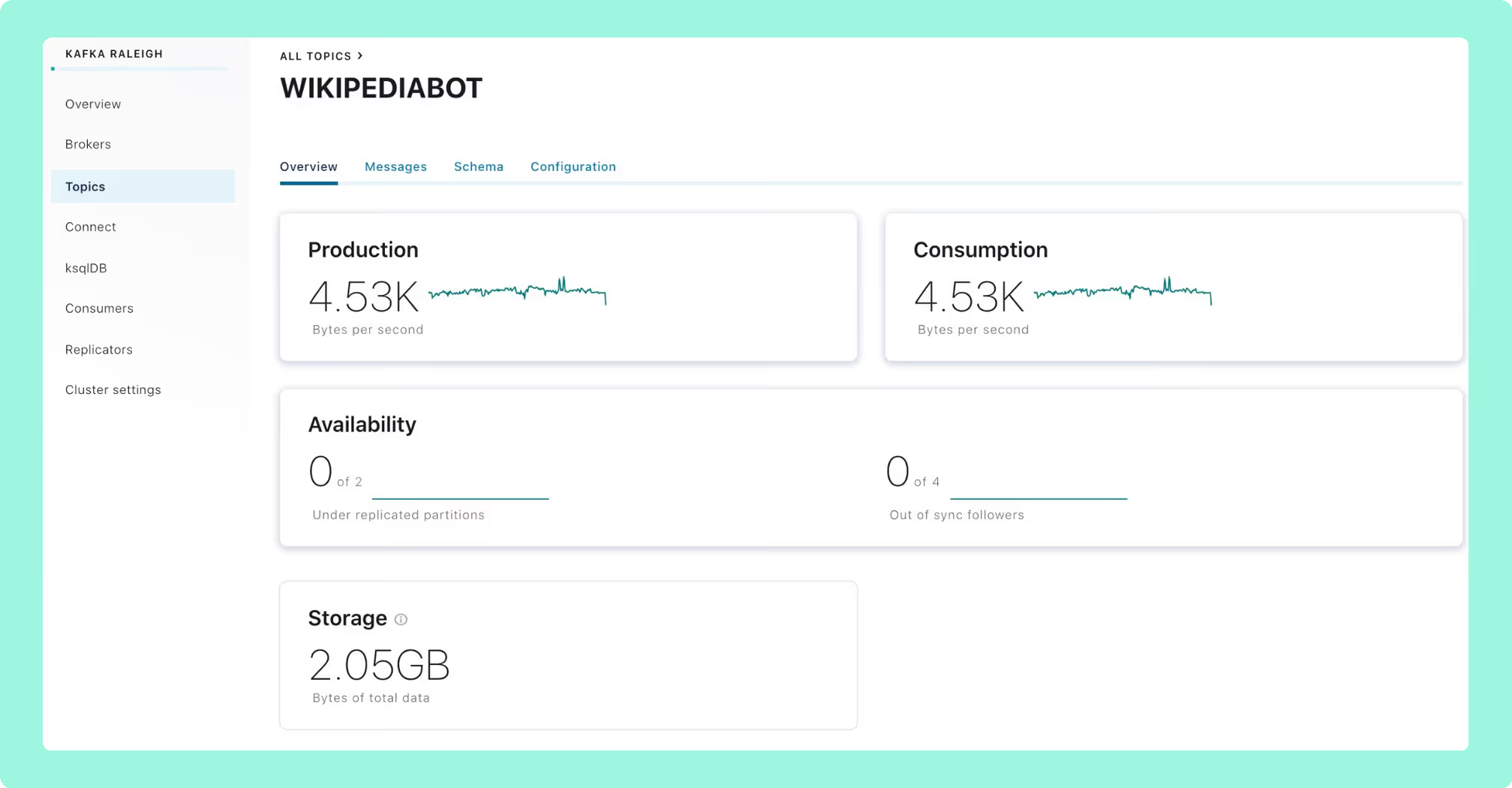
Unmatched: Kafka Streams topology visualisation, and native ksqlDB development integration.
Current line: 2.6.x, on a minimum of Java 17.
Next generation: Prometheus-based, GA with Confluent Platform 8.0 in May 2025, cutting startup from 15 to 50 minutes to roughly one and raising supported partition scale from 120,000 to 400,000.
Footprint: its own nodes, at 4 cores, 8 GB of RAM and 200 GB of preferably solid-state storage for clusters up to 100,000 replicas, assuming 15 days of retention.
Upgrades: legacy to next generation is a migration. Historical metrics do not carry across, and 7 to 15 days in parallel is the guidance.
Practical shape: keep it for ad-hoc debugging and route production alerting through Prometheus and Confluent’s own Grafana dashboards.
Cost of ownership (modelled): Confluent does not publish a price for Control Center, so there is no licence line to quote. What can be counted is the running cost: a dedicated node to size and patch, a reporter to keep on every broker, and a legacy to next generation migration run in parallel for 7 to 15 days. At 2 engineer-hours a month at $120 an hour that is $2,880 a year before the platform licence itself, against a published Kpow licence of $4,500 per cluster a year for up to 100 users.
Compare Kpow vs Confluent Control CenterAKHQ vs Confluent Control CenterConfluent Control Center review
What is Redpanda Console?
Redpanda Console is a web interface for inspecting and managing Kafka-compatible clusters, built in Go and React and distributed as a Docker image and a Helm chart. It began as Kowl, by CloudHut, and Redpanda acquired it in April 2022. The community edition ships under the Business Source License, which is source-available rather than open source: free for internal use, with commercial software-as-a-service use restricted until the licence converts. It runs against vanilla Apache Kafka, Amazon MSK and Confluent Platform as well as Redpanda, holds no cluster state, sits outside the data path and needs no database. v3.11.0 landed on 25 August 2026.
Where it bites is the other half of the job. It is a viewer and a browser rather than an operational platform: no built-in broker metrics, no alerting and no historical trend analysis, so production monitoring still needs a separate Prometheus and Grafana stack. And one deployment reaches one cluster.
 Rank 1
 Redpanda Console
redpanda.com
29 out of 50 Total
- Cost a year (modelled)
- $0 community licence, plus $8,640 in ops time
- What the licence gates
- SSO, RBAC, debug bundles, Reassign Partitions
- Latest release
- v3.11.0, 25 August 2026
- Cost as teams grow
- 6 out of 10
- Deployment footprint
- 8 out of 10
- Support and maintenance
- 7 out of 10
- Access control and audit
- 6 out of 10
- Multi-cluster reach
- 2 out of 10
Why these scores for Redpanda Console
- Cost as teams grow 6 out of 10
- This page gives a free community edition under the Business Source License, with a Redpanda Enterprise licence for the gated features and no price published for it. Cost of ownership modelled at $8,640 a year per cluster (this page’s estimate, 6 engineer-hours a month at $120 an hour) on a $0 community licence, with the governance licence unpriced.
- Deployment footprint 8 out of 10
- This page gives a Go binary as a Docker image or a Helm chart, with no database, plus an external Schema Registry for schemas.
- Support and maintenance 7 out of 10
- On this page, v3.11.0 landed on 25 August 2026, against hardcoded timeouts of 6 seconds for DescribeLogDirs and Metadata, 5 for DescribeConfigs and 35 for ListMessages, with no configuration key for any of them.
- Access control and audit 6 out of 10
- On this page, OIDC and OAuth single sign-on and role-based access control require a Redpanda Enterprise licence, so the free tier has no role-based access control and no single sign-on of any kind.
- Multi-cluster reach 2 out of 10
- This page gives Apache Kafka, Amazon MSK, Confluent Platform and Redpanda, but one cluster per deployment, and multi-cluster at the broker tier has not shipped.
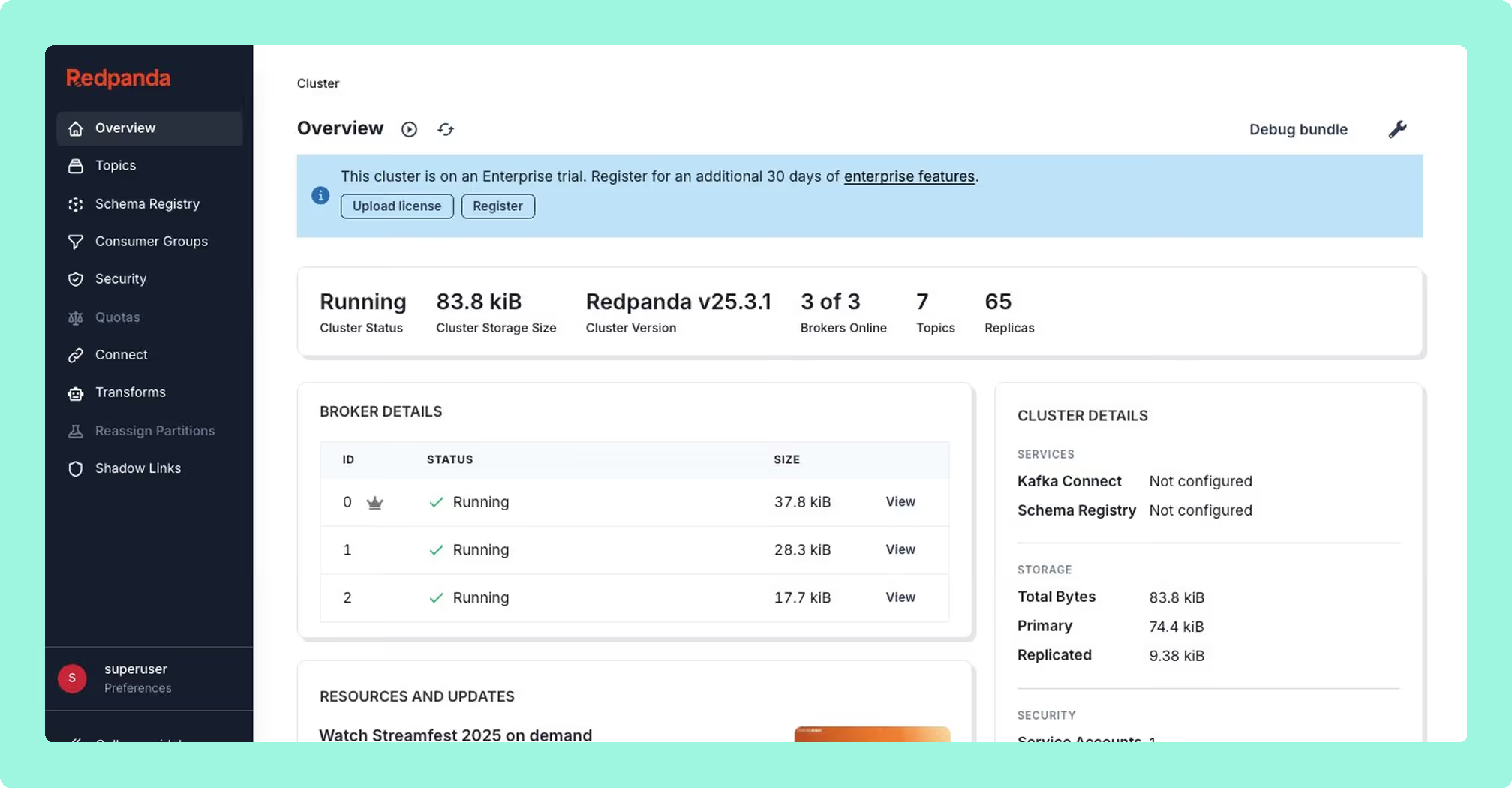
Deserialisation: Avro, Protobuf, JSON, XML, CBOR, MessagePack and binary hex, with Protobuf decoding from local descriptor maps and no registry involved.
Filtering: JavaScript filters over messages, and time-travel offset management.
Observer Mode: browses topic messages without joining a consumer group, so inspection triggers no rebalance and moves no committed offsets.
Timeouts: hardcoded at 6 seconds for DescribeLogDirs and Metadata, 5 for DescribeConfigs and 35 for ListMessages, with no configuration key for any of them.
MSK with IAM: those values are regularly exceeded, because the token exchange adds latency they never accounted for.
Access: no role-based access control and no single sign-on of any kind in the free tier.
Reach: multi-cluster at the broker tier has not shipped, requested in 2021 and again in 2022, so three environments means three deployments.
Cost of ownership (modelled): The community edition is $0 under the Business Source License, and Redpanda does not publish a price for the Enterprise licence that unlocks single sign-on and role-based access control. The counted cost is one deployment per cluster to run and keep current, which on this page’s estimate is 6 engineer-hours a month at $120 an hour, or $8,640 a year for a single cluster and the same again for each one after it. A published Kpow licence is $4,500 per cluster a year for up to 100 users, with up to 12 clusters from one instance.
Compare Kpow vs Redpanda ConsoleKafbat UI vs Redpanda ConsoleRedpanda Console review
What is the official 2026 pricing of Confluent Control Center and Redpanda Console?
Neither product publishes a price. Control Center is not priced or sold separately, so the unit is a Confluent Platform contract rather than a cluster or a seat, and the only free route to it is Confluent’s developer licence, which covers the commercial features indefinitely on a single-broker cluster outside production.
The asymmetry is not the price. It is who you buy from, and the two mirror each other. Control Center arrives inside a Confluent Platform licence, so the interface is not separable from the distribution. Console’s gated capabilities require a Redpanda Enterprise licence, which is Redpanda’s platform licence, so a team running vanilla Apache Kafka or Amazon MSK that wants access control inside its Kafka interface buys from a broker vendor whose broker it does not run. Neither gate is a broker ACL: Kafka’s own authorisation layer decides what a client may do, and what each vendor charges for is who may press which button. Neither bill answers to headcount, so the variables are how many clusters you run and whose distribution they are.
Where does each one run out?
Both tools are marked out of 10 on the same five criteria, for a total out of 50, and every criterion counts once. Nothing sits behind a multiplier, so a total is the sum of its five marks and a reader can recompute it. The five are cost as teams grow, deployment footprint, support and maintenance, access control and audit, and multi-cluster reach, because those are the questions a Kafka interface is actually measured against after the first month: a second cluster, an access review with a date on it, an upgrade nobody owns, and a bill that moves when the team does. The widest gap between the two marks is on deployment footprint, where Confluent Control Center marks 2 and Redpanda Console marks 8. The marks come from the same matrix used on every comparison on this site, so a tool scores the same here as it does anywhere else, and the reason behind each mark is in the card below, under Why these scores.
Control Center’s limits are commercial and architectural rather than a list of bugs. It does not leave Confluent Platform, and there is no supported route to a cluster the distribution does not own. SAML single sign-on is not supported for self-managed deployments either, so an organisation standardised on a SAML-only identity provider has no supported path.
Console’s limits are operational. It degrades badly rather than gracefully: one broker offline in a multi-node cluster fails every consumer group query with a shard error, which is exactly the moment observability is worth paying for.
Console also does not bundle a Schema Registry: its configuration requires an external registry URL, so schema browsing is a second service to deploy and operate.
Which should you pick?
Redpanda Console scores 29 against Control Center’s 20 and is the pick for any cluster Confluent’s reporter cannot be installed on, which is Amazon MSK, Redpanda and Aiven. Neither publishes a price, and Console’s SSO, RBAC and partition reassignment all need a Redpanda Enterprise licence. A team that wants a published per-cluster price with governance included should shortlist Kpow by Factor House, reaching up to 12 clusters.
Take Control Center if:
- you run Confluent Platform and are staying on it
- Kafka Streams topology visualisation is what your engineers open it for
- ksqlDB development integration is part of the work
Take Redpanda Console if:
- the cluster is Amazon MSK, Aiven, vanilla Apache Kafka or Redpanda
- the daily work is reading payloads rather than governing access
- Protobuf without a registry removes a step from incident work
Running Console alongside a paid Control Center adds nothing to the bill, and plenty of teams do exactly that. If you are re-examining a Confluent Platform licence, the honest question is not which interface is better: it is which of the two Confluent-only capabilities your engineers actually use, because everything else on that dashboard has an answer somewhere else you probably already run. Where two or more teams share a cluster, both answers get expensive in the same way, because both routes to governance run through a broker vendor’s platform licence. That question is scored directly on the tools that provide role-based access control for Kafka, and the wider interface field on the top Kafka UI tools compared for engineering teams.
Kpow: one licence that reaches every broker, not just its own vendor’s
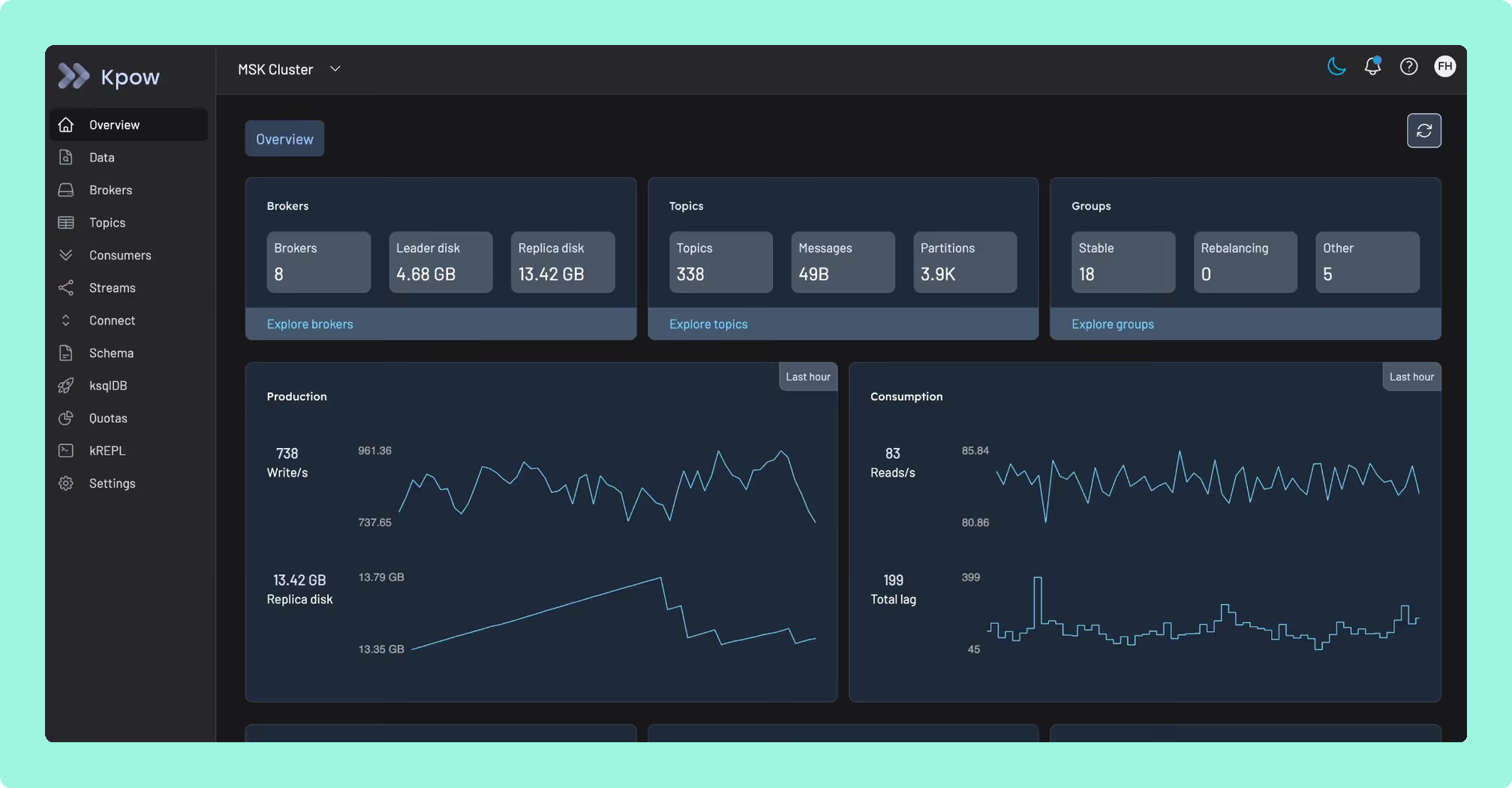
Control Center only ever answers to a Confluent Platform contract, and Redpanda Console’s governed features only ever answer to a Redpanda Enterprise licence, so a team running Amazon MSK or vanilla Apache Kafka ends up buying access from whichever broker vendor happens to own the interface, not the broker it actually runs. Kpow by Factor House does not care whose broker sits underneath it: licensed per cluster at a published price, it connects to self-managed Kafka, Amazon MSK, Confluent Cloud, Redpanda, Aiven and Instaclustr, with one instance reaching up to 12 clusters from a single stateless JVM container and no external database alongside it.
A licence that doesn’t care whose broker you run is the one that outlasts either vendor’s roadmap. Point Kpow at whichever of those clusters you actually run, and let the licence answer to the cluster instead of to either vendor.
How these tools were scored
Every option is scored from 0 to 10 on each criterion, from the evidence and sources this page cites, and the reason for each score is on its card. Each criterion counts once, for a total out of 50. The options are listed by total.
Sources
- Apache Kafka documentation on authorization
- Kafka consumer documentation on consumer groups and rebalancing
- Business Source License 1.1, canonical text