At a glance
Kadeck and CMAK are scored here on the same five criteria, 50 points in all: Kadeck 29 out of 50, CMAK 20 out of 50. Kadeck takes its best score on Multi-cluster reach (9 out of 10) and its lowest on Cost as teams grow (4 out of 10). Cost a year: $3,840 floor: Enterprise, 10 seats. CMAK takes its best score on Cost as teams grow (10 out of 10) and its lowest on Support and maintenance (1 out of 10). Cost a year: This page's estimate: $11,520 in operator time.
CMAK vs Kadeck, compared
Kpow meets 6 of 7 requirements on this page. One row is not a yes or no question.
Key takeaway
CMAK is free under Apache 2.0 and has shipped nothing since April 2022, and it requires a direct ZooKeeper connection that a Kafka 4.0 cluster does not have. Kadeck is commercial software from xeotek, billed per user per month: Teams Free covers five users and one cluster connection, and RBAC, masking and audit logs sit on Enterprise at 32 US dollars per user per month with a ten-user minimum, so a team of four pays for ten seats. Kpow by Factor House is licensed per cluster at a published price.
Kpow live demo
Test the trade-offs in a live Kafka UI
You have compared CMAK vs Kadeck. Open a live Kpow environment to test the everyday workflows a shared Kafka platform needs.
Built for platform and data teams managing shared Kafka clusters.
Try the Kpow demoWhat is CMAK?
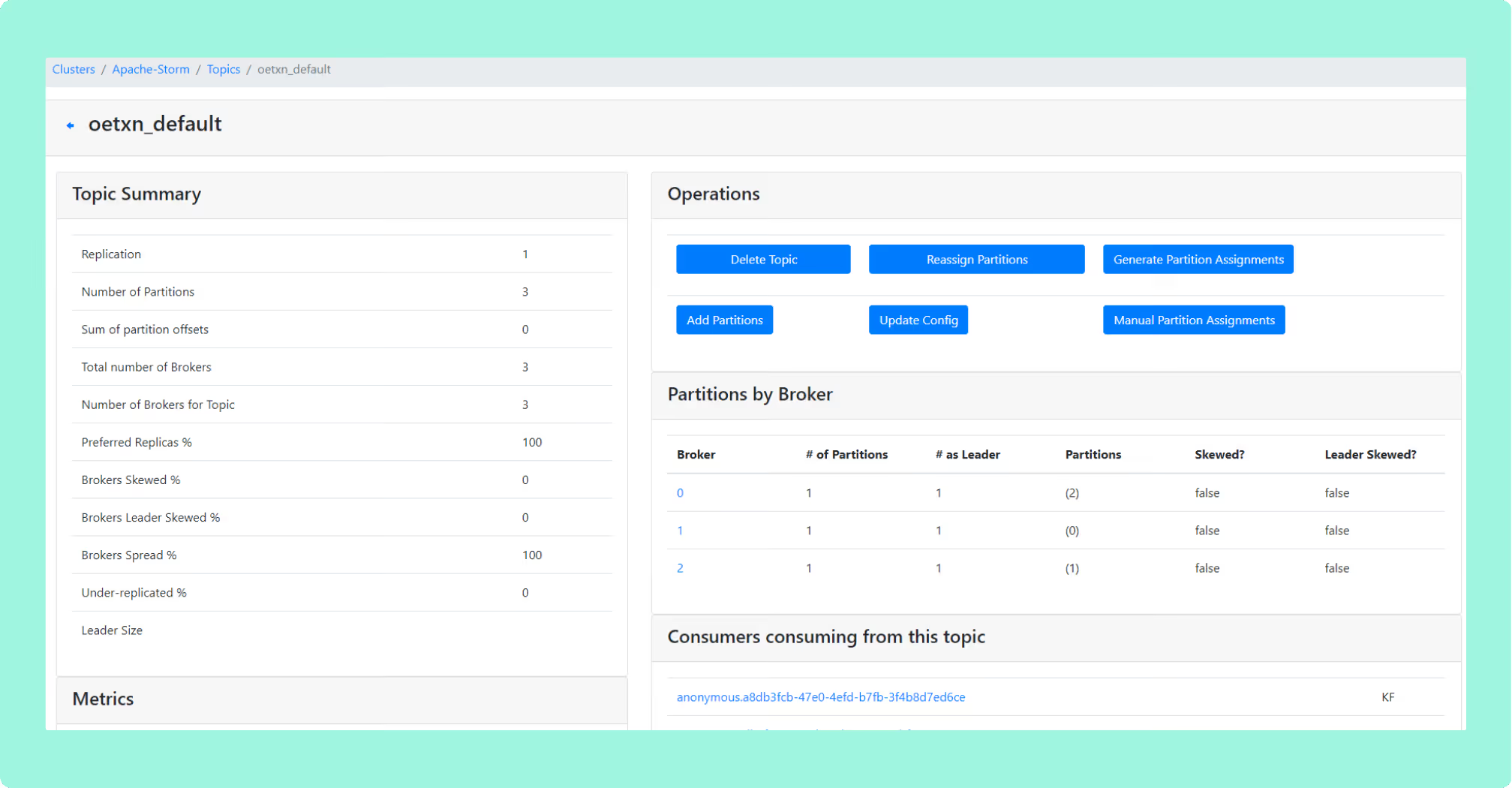
Cluster Manager for Apache Kafka, originally Kafka Manager, is a Scala application on the Play framework. It requires a direct connection to a ZooKeeper ensemble to work at all: the ensemble is where it reads the cluster from, not an optional integration alongside the broker APIs. Its scope is administrative rather than data-plane, and there is no commercial distribution, no hosted offering and no paid support tier.
- registering and monitoring clusters from a single multi-cluster view
- creating and modifying topics, and managing partitions
- partition reassignment and preferred-replica election
- optional JMX polling at broker and topic level
The last stable release, 3.0.0.6, was tagged on 29 April 2022. The last commit on master landed on 12 December 2022, and the last push of any kind was 2 August 2023. 522 issues stand open with nobody triaging them. The repository is public and it is not archived.
What is Kadeck?
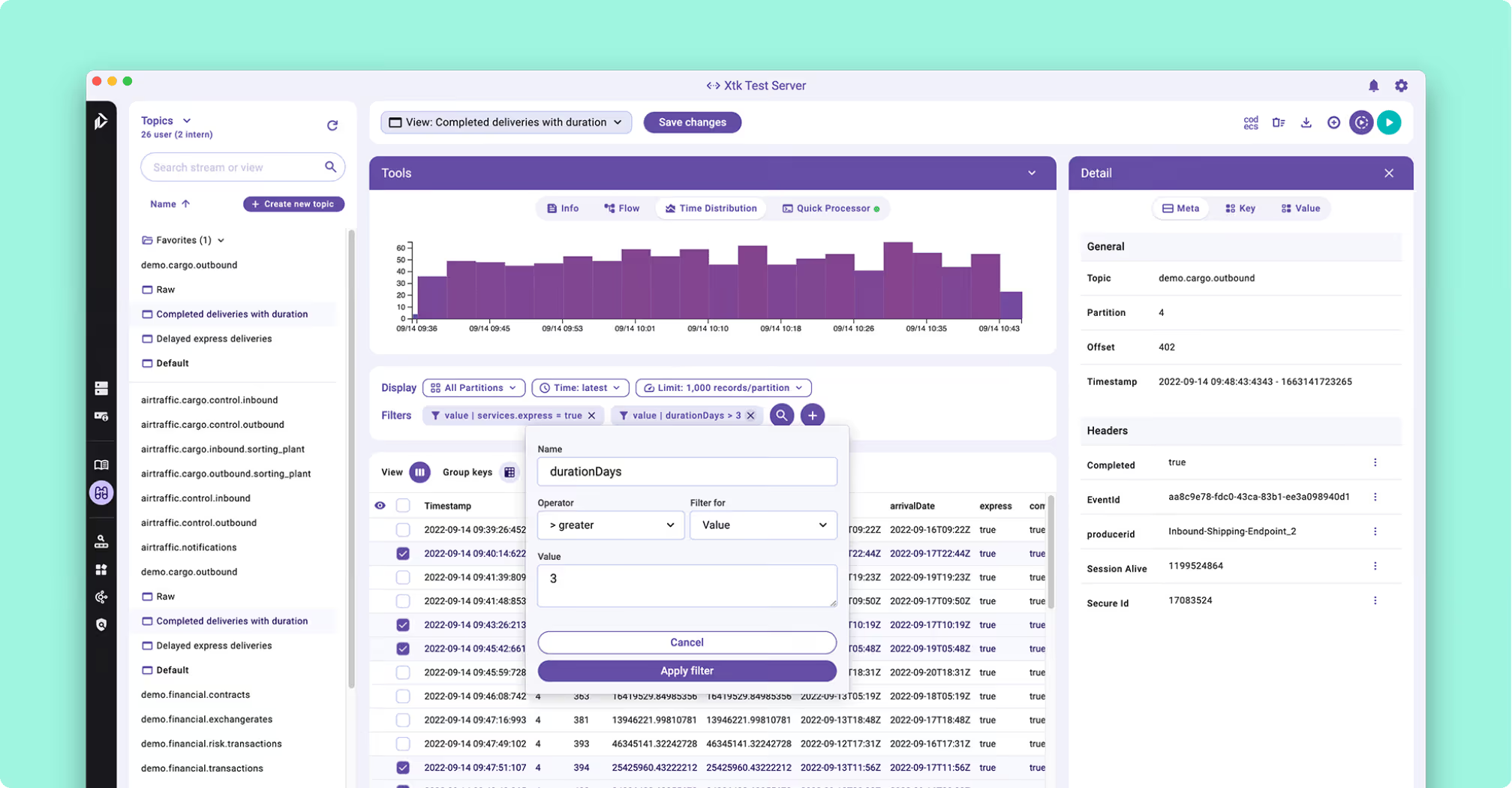
Kadeck is not open source. xeotek, its German vendor, ships it in two editions that are separate product lines rather than rungs of one ladder: a native desktop application for Linux, macOS and Windows, and a web and teams edition distributed as a Docker image, currently at version 7.0.4. Apache Kafka, Redpanda and Amazon Kinesis are supported as sources.
- Record view: Avro decoded through Confluent Schema Registry and presented in a columnar layout rather than as raw bytes.
- QuickProcessor: a JavaScript expression derives calculated fields from record values, with no streaming application behind it.
- Dead letter recovery: isolate failed records, transform inline, preview, re-ingest to the source topic, then purge.
- Teams edition: Kafka Connect management, ACL configuration, and role- and group-based access with LDAP and OpenID Connect.
What is the official 2026 pricing of CMAK and Kadeck?
CMAK costs nothing to license and there is no paid edition above it, so its cost is a dependency rather than a price. It is distributed as source needing an sbt and Scala build, with reported OpenJDK 17 compatibility problems on current toolchains. The Docker images that exist are community-maintained. The Kubernetes path was a third-party Helm chart whose last release was 2.2.2 in June 2023 and which is now archived and read-only. Long-running instances hang after 20 to 30 days from thread-pool exhaustion, a failure reported in 2018 and never addressed.
Kadeck’s ladder is per user per month and it is published. Teams Free covers five users and one cluster connection. Professional is 19 US dollars per user per month billed annually, or 25 billed monthly, with unlimited clusters and a one-user minimum. Enterprise is 32 US dollars per user per month with a ten-user minimum, so a team of four pays for ten seats and the entry price is 3,840 US dollars a year; a hundred engineers is 38,400. Floating licences are offered at 30 users or more, and they are still per user underneath. RBAC with LDAP and OpenID, data masking and audit logs all sit on Enterprise, and a desktop licence does not upgrade into it, because the two are separate product lines.
Where does each one run out?
The scoring is the same on both sides: five criteria, 10 points each, 50 in all, with every criterion counting once. Nothing sits behind a multiplier, so a total is the sum of its five marks and a reader can recompute it. The five are cost as teams grow, deployment footprint, support and maintenance, access control and audit, and multi-cluster reach, because those are the questions a Kafka interface is actually measured against after the first month: a second cluster, an access review with a date on it, an upgrade nobody owns, and a bill that moves when the team does. The widest gap between the two marks is on cost as teams grow, where CMAK marks 10 and Kadeck marks 4. The marks come from the same matrix used on every comparison on this site, so a tool scores the same here as it does anywhere else, and the reason behind each mark is in the card below, under Why these scores.
The dependency figures in the cards below were read on 24 September 2026 from each project’s published release artefact and matched against the NVD and GitHub advisory databases, so they move whenever a release or an advisory lands. Self-hosting is not the risk on this page. Both run in your own infrastructure. The question is who rebuilds the image when a dependency advisory lands.
 Rank 1
 Kadeck
kadeck.com
29 out of 50 Total
- Cost a year
- $3,840 floor: Enterprise, 10 seats
- Free tier
- 5 users, 1 cluster connection
- Governance floor
- Enterprise, 10-user minimum, $3,840/yr
- Cost as teams grow
- 4 out of 10
- Deployment footprint
- 4 out of 10
- Support and maintenance
- 6 out of 10
- Access control and audit
- 6 out of 10
- Multi-cluster reach
- 9 out of 10
Why these scores for Kadeck
- Cost as teams grow 4 out of 10
- The Pricing unit row of the compare figure gives per user per month, Enterprise at 32 US dollars with a ten-user minimum, so a team of four pays 3,840 US dollars a year, and Teams Free is five users on one cluster connection. The Enterprise floor is 3,840 US dollars a year.
- Deployment footprint 4 out of 10
- The Deployment row of the compare figure gives a Docker image for Teams with no RPM, no native server binary and no Helm chart, and a documented Kubernetes path that wants a persistent external database.
- Support and maintenance 6 out of 10
- The Support row of the compare figure gives a vendor under contract, offset by an online licence validation call on every container start, so air-gapped and CI deployments need challenge-response activation first.
- Access control and audit 6 out of 10
- The Access control row of the compare figure gives group-based access in the free tier, with RBAC through LDAP and OpenID, data masking and audit logs all held on Enterprise.
- Multi-cluster reach 9 out of 10
- The Which clusters it reaches row of the compare figure gives Apache Kafka, Redpanda and Amazon Kinesis with no ZooKeeper dependency, unlimited clusters from Professional, one connection on free.
Kadeck runs out at the edges of its free tier first, and that tier caps in three places at once: five users, one cluster connection, and one certificate at a time, so Dev, Test, Stage and Prod need a paid plan. It also caps how many records a single query returns.
Packaging: the teams edition ships only as a Docker image. No RPM, no native server binary and no Helm chart.
State: the documented Kubernetes path wants a persistent external database, so a read-oriented tool acquires backups of its own.
Licence checks: every container start makes an online validation call, so air-gapped and CI deployments need challenge-response activation first.
Write path: no streaming of transformed data back into a topic, and no Kafka Streams or ksqlDB integration.
What it costs a year: a published price, so no estimate is needed. Enterprise is 32 US dollars per user per month with a ten-user minimum, which is 3,840 US dollars a year for a team of four and 38,400 for a hundred engineers. Professional at 19 US dollars per user per month billed annually is 2,280 a year for ten people, and it does not carry RBAC, data masking or audit logs.
Compare Kpow vs KadeckKadeck vs Kafbat UIKadeck vs KafdropKadeck review
CMAK
github.com/yahoo/CMAK
20 out of 50 Total
- Cost a year
- This page's estimate: $11,520 in operator time
- Newest release
- 3.0.0.6, 29 April 2022
- Needs
- A reachable ZooKeeper ensemble
- Cost as teams grow
- 10 out of 10
- Deployment footprint
- 3 out of 10
- Support and maintenance
- 1 out of 10
- Access control and audit
- 2 out of 10
- Multi-cluster reach
- 4 out of 10
Why these scores for CMAK
- Cost as teams grow 10 out of 10
- The Pricing unit row of the compare figure gives free under Apache 2.0, one self-hosted tier, with no paid edition and no support to buy. This page’s modelled cost of ownership is 11,520 US dollars a year, at 8 engineer-hours a month and 120 US dollars an hour.
- Deployment footprint 3 out of 10
- The Deployment row of the compare figure gives an sbt and Scala build from source or a community Docker image, with the only Kubernetes chart archived and read-only since June 2023.
- Support and maintenance 1 out of 10
- The Support row of the compare figure gives none, with the last release in April 2022, the last commit in December 2022, and 522 open issues.
- Access control and audit 2 out of 10
- The Access control row of the compare figure gives LDAP basic auth and global feature flags, no per-topic granularity, no SAML, no OIDC and no audit log.
- Multi-cluster reach 4 out of 10
- It registers clusters from a single multi-cluster view, but compare row Which clusters it reaches limits that to ZooKeeper-based clusters.
CMAK has no KRaft support and a hard ZooKeeper dependency, and Kafka 4.0 operates entirely without ZooKeeper, so on a 4.0 cluster there is no ensemble left to connect to. The maintainer acknowledged this in 2022 and nothing has shipped since. MSK, Confluent Cloud, Aiven and Redpanda Cloud either lock down or no longer expose ZooKeeper endpoints, and on a cluster that does still run an ensemble, enabling ZooKeeper ACLs breaks the connection outright.
Data plane: no message browsing, no Schema Registry integration and no Kafka Connect management.
Freshness: reads come from an internal cache rather than live broker APIs, so a reassignment may appear not to have landed.
Access control: LDAP basic auth and coarse global feature flags, with no per-topic granularity, no SAML and no OIDC.
Audit: none.
Staying patched: the last release is from April 2022 and nothing has been committed since August 2023. It bundles ZooKeeper 3.5.7, carrying an authorization bypass that scores 9.1 and has been public since October 2023, 1,079 days. No release is coming to carry a fix. 109 of its 112 bundled jars resolve to a Maven coordinate, so its counts are floors rather than totals.
What it costs a year: nothing to license, so the bill is operator time. This page’s estimate, not a vendor price, at 8 engineer-hours a month and 120 US dollars an hour: 11,520 US dollars a year, for the sbt and Scala build on a JDK that fights it, the restart every 20 to 30 days after thread-pool exhaustion, the two archived community deployment paths and the 522 open issues with nobody to escalate to. A Kpow licence is published at 4,500 US dollars a cluster a year with 100 users included, so the free console is the dearer of the two once anybody has to keep it alive.
Compare Kpow vs CMAKCMAK vs Kafbat UICMAK vs KafdropCMAK review
Which should you pick?
Kadeck scores higher here, 29 against 20, and is the pick for a small team that can live with per-seat billing, because CMAK has shipped nothing since April 2022 and cannot reach a Kafka 4.0 cluster. Kadeck’s governance sits on Enterprise at a ten-user floor of 3,840 US dollars a year. Where governance should not be metered per person, shortlist Kpow by Factor House, priced per cluster.
Stay on CMAK if:
- the cluster is still on ZooKeeper
- the work is partition reassignment and preferred-replica election
- nobody on the team needs to read a message
Take Kadeck if:
- the work is data exploration and debugging rather than cluster administration
- decoding Avro without writing a consumer is routine
- dead letter queue recovery currently means a script per incident
- one or two engineers want a desktop tool with no container runtime
Neither answers the third case, and it is the common one. A platform team needs both halves at once, administration and data inspection, across more than one cluster, with per-topic access control and an audit trail behind it, and without a ten-seat floor under a team of four. CMAK cannot reach a modern cluster and never carried the governance. Kadeck carries the governance, on a tier priced above where most teams of that size sit. A shortlist that covers both halves at once starts with the best Kafka management tools, and where dead letter recovery is the actual driver, the comparison of the best tools to manage a dead letter queue in Kafka is the narrower list.
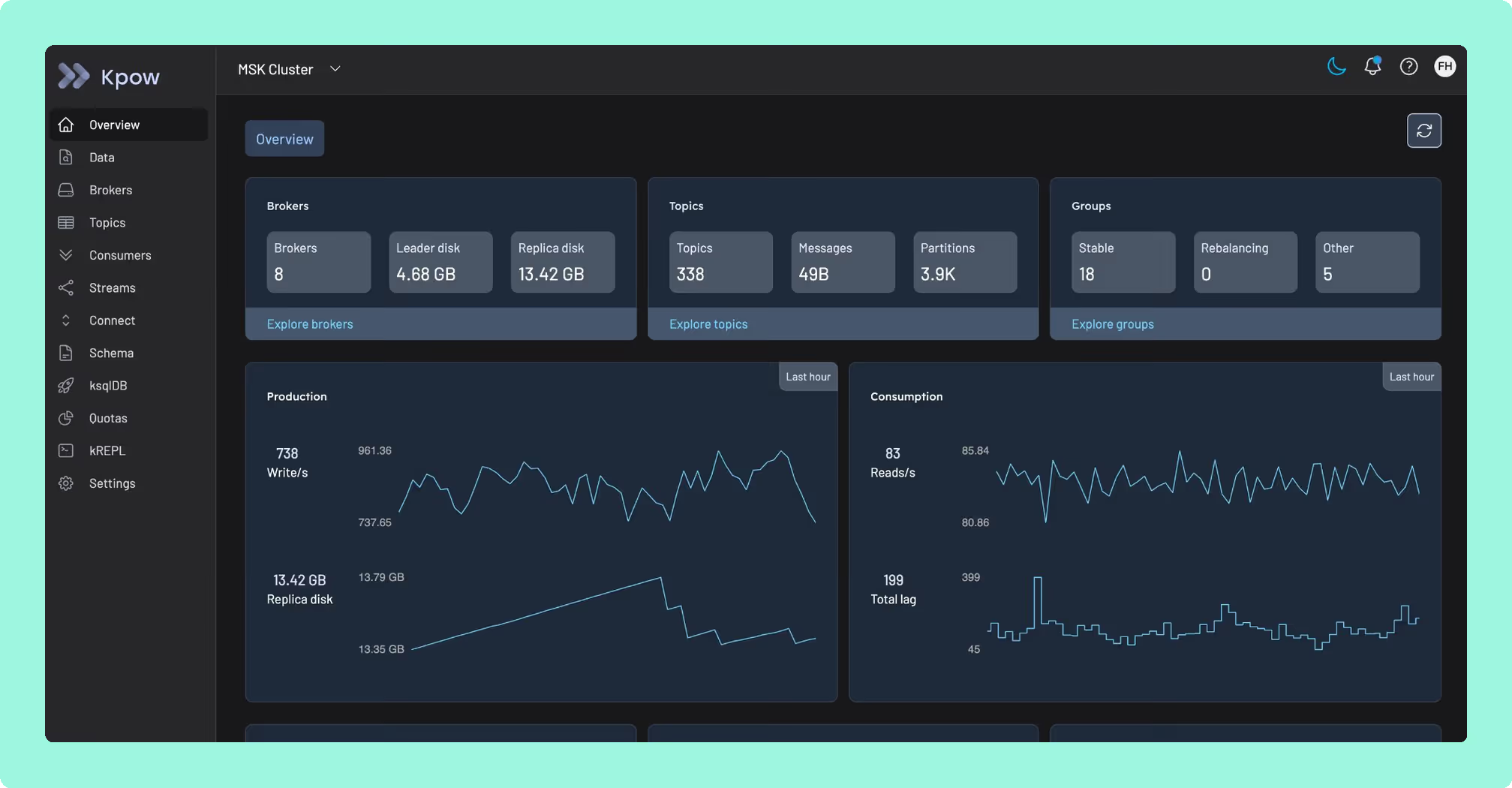
Kpow: no seat count and no ten-person floor
Neither of these prices governance the way a growing team actually grows. CMAK has none to price: no RBAC, no audit log, no SSO, at any size. Kadeck has it, but only on Enterprise, at 32 US dollars per user per month with a ten-user minimum, so a team of four is billed for ten seats before anyone reads a message. Kpow by Factor House is licensed per cluster rather than per person: one stateless JVM container with no external database, reaching up to 12 clusters from a single instance, at a published price that does not move when the team goes from five engineers to fifty.
A team that outgrows five people shouldn’t have to renegotiate its own tool. Kpow’s pricing is published for exactly that reason.
How these tools were scored
Every option is scored from 0 to 10 on each criterion, from the evidence and sources this page cites, and the reason for each score is on its card. Each criterion counts once, for a total out of 50. The options are listed by total.