At a glance
Lenses and CMAK are scored here on the same five criteria, 50 points in all: Lenses 26 out of 50, CMAK 20 out of 50. Lenses takes its best score on Access control and audit (7 out of 10) and its lowest on Deployment footprint (2 out of 10). Cost a year: $4,000 DevX Team, 15 users, plus infra. CMAK takes its best score on Cost as teams grow (10 out of 10) and its lowest on Support and maintenance (1 out of 10). Cost a year: This page's estimate: $11,520 in operator time.
CMAK vs Lenses, compared
Kpow meets 6 of 7 requirements on this page. One row is not a yes or no question.
Key takeaway
CMAK requires a direct ZooKeeper connection, and Kafka 4.0 runs KRaft only, so a cutover ends it the day it lands; its last release was April 2022, and both community deployment paths are archived. Lenses connects as an ordinary Kafka client, so KRaft is a non-event for it, but it is a control plane: PostgreSQL behind HQ, one Agent per cluster, and a database behind every Agent, with DevX Team starting at 4,000 US dollars a year. Kpow by Factor House is one stateless container, licensed per cluster.
Kpow live demo
Test the trade-offs in a live Kafka UI
You have compared CMAK vs Lenses. Open a live Kpow environment to test the everyday workflows a shared Kafka platform needs.
Built for platform and data teams managing shared Kafka clusters.
Try the Kpow demoWhat is CMAK?
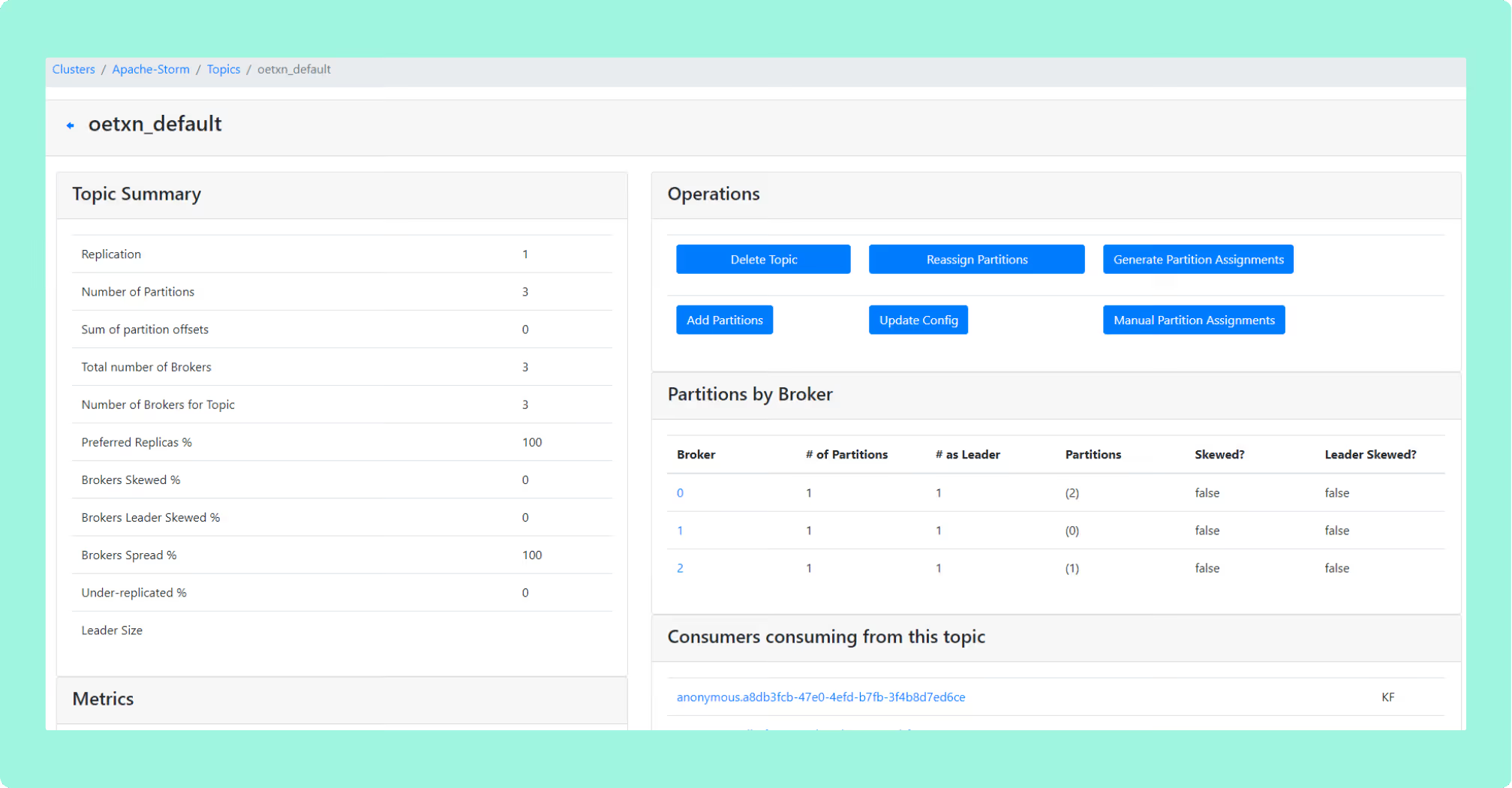
CMAK is Cluster Manager for Apache Kafka, originally Kafka Manager, built at Yahoo and released under Apache 2.0. It is written in Scala on the Play framework, and its scope is administrative rather than data-plane. It sits with the other free Kafka UI tools rather than in the free tier of a commercial one: no commercial distribution, no hosted offering and no paid support tier.
- registering and monitoring clusters from a single view
- creating and modifying topics, and managing partitions
- partition reassignment and preferred-replica election
- optional JMX polling at broker and topic level
Everything else follows from one architectural fact: it requires a direct connection to a ZooKeeper ensemble to function at all. The last stable release, 3.0.0.6, was tagged 29 April 2022, and the last commit on master is December 2022. The repository is public and not archived, and it carries 11,925 stars and 2,476 forks.
What is Lenses?
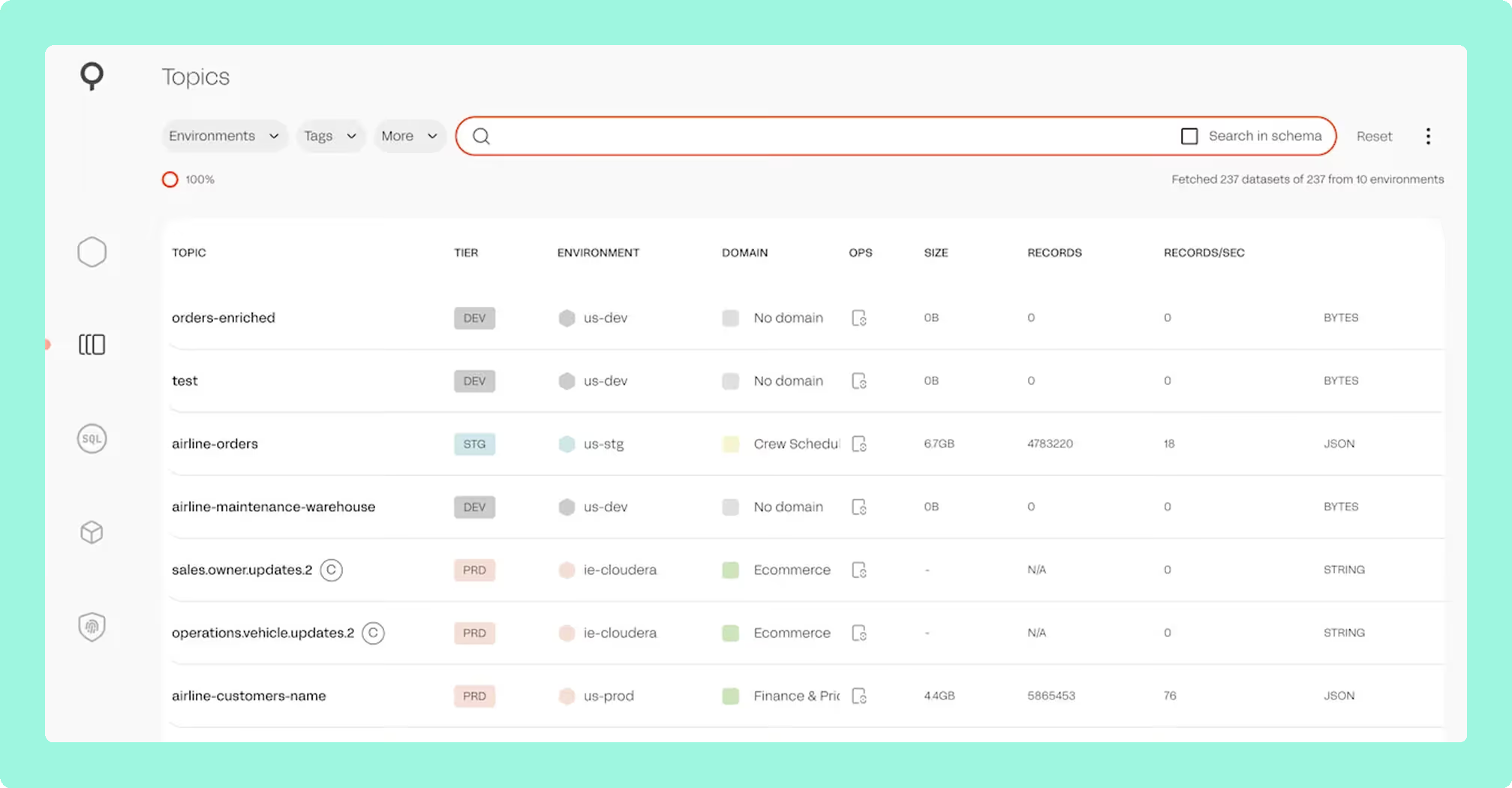
Lenses is a commercial Kafka governance and data exploration platform that sits on top of clusters somebody else runs. It operates as a Kafka client and does not sit in the data path. The architecture is a central Lenses HQ node with lightweight Agents deployed one per cluster, and because an Agent connects as an ordinary Kafka client, a KRaft cluster needs no modification to be reached. Celonis acquired Lenses in early 2022, and 6.2.6 was released on 19 August 2026.
- SQL Studio: lets a reader query a Kafka topic without writing consumer code, over JSON, Avro or Protobuf.
- Topology and lineage: one picture across producers, topics, connectors and consumers on several clusters.
- SQL Processors: Kubernetes-native stream processing built on Kafka Streams, with rules defined in SQL.
- Data catalogue: registered datasets grouped for search.
What is the official 2026 pricing of CMAK and Lenses?
CMAK costs nothing to license and there is no tier above it, so the whole cost is operator time: somebody builds it from Scala source, keeps a ZooKeeper ensemble reachable, and answers for it when it stops. There is no SLA to escalate to, because 522 issues stand open with no maintainer triaging them.
Lenses publishes two ladders, and a team can end up on both. DevX covers the UI, the governance surface and SQL, tiered by capability and user count: Community is free for up to 5 users on basic authentication, with no SSO and no role-based access; Team starts at 4,000 US dollars a year for up to 15 users and adds SSO, SAML, RBAC and team support; Multi-Kafka Enterprise is custom priced. K2K, the replication product, is metered separately, with Community capping a replication job at 5 topic partitions and Enterprise starting at 1,000 US dollars a month with 5 clusters included and further clusters at 200 US dollars a month. The change a CMAK operator is making is from a bill of zero to a bill attached to headcount and cluster count at the same time.
Where does each one run out?
Each tool here is marked out of 10 on five criteria, 50 points in all, and no criterion is weighted above another. Nothing sits behind a multiplier, so a total is the sum of its five marks and a reader can recompute it. The five are cost as teams grow, deployment footprint, support and maintenance, access control and audit, and multi-cluster reach, because those are the questions a Kafka interface is actually measured against after the first month: a second cluster, an access review with a date on it, an upgrade nobody owns, and a bill that moves when the team does. The widest gap between the two marks is on cost as teams grow, where CMAK marks 10 and Lenses marks 4. The marks come from the same matrix used on every comparison on this site, so a tool scores the same here as it does anywhere else, and the reason behind each mark is in the card below, under Why these scores.
The dependency figures in the cards below were read on 24 September 2026 from each project’s published release artefact and matched against the NVD and GitHub advisory databases, so they move whenever a release or an advisory lands. Self-hosting is not the risk on this page. Both run in your own infrastructure. The question is who rebuilds the image when a dependency advisory lands.
 Rank 1
 Lenses
lenses.io
26 out of 50 Total
- Cost a year
- $4,000 DevX Team, 15 users, plus infra
- Needs
- PostgreSQL for HQ, a database per Agent
- Kafka 4.0
- Connects as an ordinary Kafka client
- Cost as teams grow
- 4 out of 10
- Deployment footprint
- 2 out of 10
- Support and maintenance
- 6 out of 10
- Access control and audit
- 7 out of 10
- Multi-cluster reach
- 7 out of 10
Why these scores for Lenses
- Cost as teams grow 4 out of 10
- DevX is tiered by capability and user count from 4,000 US dollars a year for 15 users, with K2K replication metered separately from 1,000 US dollars a month. DevX Team is 4,000 US dollars a year published, and this page’s modelled infrastructure cost adds 2,880 on a four-cluster deployment.
- Deployment footprint 2 out of 10
- It needs PostgreSQL for HQ as the only supported storage option plus a database per Agent, and the Community edition carries the same dependency.
- Support and maintenance 6 out of 10
- A vendor supports it by tier with team support from Team, offset by HQ running a single replica whose default update strategy replaces the pod.
- Access control and audit 7 out of 10
- SSO, SAML and role-based access from Team, but data policies match on field name across every registered dataset and are global, so masking cannot vary by role.
- Multi-cluster reach 7 out of 10
- Each Kafka cluster adds another Agent and another Agent database, with federated multi-Kafka only at the custom-priced Enterprise rung.
What Lenses costs is what its control plane asks a platform team to keep alive. HQ requires PostgreSQL and it is the only supported storage option. Each Agent needs its own database as well, with the embedded H2 route documented for evaluation only, and one Agent reaches one Kafka cluster, so a four-cluster topology is HQ plus a database plus four Agents plus four more databases.
Availability: HQ runs a single replica, with no value exposed to change it and a default update strategy that replaces the pod rather than rolling it.
Portability: SQL Processors are proprietary and compiled in Kubernetes, so a team that leaves takes its SQL and not the engine.
Permissions: 6.2.5 split UpdateTopicDetails into two actions, so custom RBAC for Kafka roles need re-granting by hand.
Masking: data policies match on field name across every registered dataset and are global, so masking cannot vary by role.
What it costs a year: a published price with infrastructure under it. DevX Team starts at 4,000 US dollars a year for up to 15 users, Multi-Kafka Enterprise is custom priced, and K2K replication is metered separately from 1,000 US dollars a month. On top of the licence sit PostgreSQL for HQ and a database for every Agent, which this page’s estimate, not a vendor price, puts at 2 engineer-hours a month and 120 US dollars an hour, or 2,880 US dollars a year on a four-cluster deployment.
Compare Kpow vs Lenses.ioKafbat UI vs LensesKafdrop vs Lenses.ioLenses review
CMAK
github.com/yahoo/CMAK
20 out of 50 Total
- Cost a year
- This page's estimate: $11,520 in operator time
- Needs
- ZooKeeper ensemble and an in-house Scala build
- Kafka 4.0
- Cannot connect
- Cost as teams grow
- 10 out of 10
- Deployment footprint
- 3 out of 10
- Support and maintenance
- 1 out of 10
- Access control and audit
- 2 out of 10
- Multi-cluster reach
- 4 out of 10
Why these scores for CMAK
- Cost as teams grow 10 out of 10
- It is free under Apache 2.0, with no paid tier, no hosted offering and nothing to buy. This page’s modelled cost of ownership is 11,520 US dollars a year, at 8 engineer-hours a month and 120 US dollars an hour.
- Deployment footprint 3 out of 10
- Running it needs a reachable ZooKeeper ensemble and a Scala build produced in-house, with both community deployment paths archived and read-only.
- Support and maintenance 1 out of 10
- There is no support, 522 issues open with nobody triaging them, and long-running instances hanging after 20 to 30 days.
- Access control and audit 2 out of 10
- LDAP basic auth and global feature flags, with no per-topic granularity, no SAML, no OIDC and no audit log.
- Multi-cluster reach 4 out of 10
- Adding a Kafka cluster means registering it in the same instance at no cost, but only a cluster that still runs a ZooKeeper ensemble.
CMAK cannot connect to a Kafka 4.0 cluster at all. It requires a direct ZooKeeper connection and Kafka 4.0 runs KRaft only. The maintainer acknowledged this in 2022 and nothing has shipped since. MSK, Confluent Cloud, Aiven and Redpanda Cloud either lock down or no longer expose ZooKeeper endpoints, and both community deployment paths are archived and read-only.
Data plane: no message browsing, no Schema Registry integration and no Kafka Connect management.
Access control: LDAP basic auth and global feature flags, with no per-topic granularity, no SAML, no OIDC and no audit log.
Freshness: reads come from an internal cache and the broker view refreshes on a 30-second default.
Longevity: long-running instances hang after 20 to 30 days on a thread-pool exhaustion error reported in 2018.
Credentials also pass unencrypted unless SSL is configured by hand, which is awkward inside any Kafka security architecture that has to be evidenced.
Staying patched: the last release is from April 2022 and nothing has been committed since August 2023. It bundles ZooKeeper 3.5.7, carrying an authorization bypass that scores 9.1 and has been public since October 2023, 1,079 days. No release is coming to carry a fix. 109 of its 112 bundled jars resolve to a Maven coordinate, so its counts are floors rather than totals.
What it costs a year: nothing to license, so the bill is operator time. This page’s estimate, not a vendor price, at 8 engineer-hours a month and 120 US dollars an hour: 11,520 US dollars a year, for the sbt and Scala build on a JDK that fights it, the restart every 20 to 30 days after thread-pool exhaustion, the two archived community deployment paths and the 522 open issues with nobody to escalate to. A Kpow licence is published at 4,500 US dollars a cluster a year with 100 users included, so the free console is the dearer of the two once anybody has to keep it alive.
Compare Kpow vs CMAKCMAK vs ConduktorCMAK vs Kafbat UICMAK review
Which should you pick?
Lenses scores 26 against CMAK’s 20 and is the pick wherever a KRaft cutover is coming, because it connects as an ordinary Kafka client and CMAK cannot address such a cluster at all. Lenses costs 4,000 US dollars a year at Team and runs a control plane with PostgreSQL behind HQ and every agent. For one stateless container priced per cluster, shortlist Kpow by Factor House.
Keep CMAK if:
- the cluster is still on ZooKeeper with no migration scheduled
- the people using it already hold cluster credentials
- the daily work is partition reassignment and preferred-replica election
Take Lenses if:
- the people who need the data are not the people who run the cluster
- topology and lineage across several clusters is the actual project
- SSO, SAML and role-based access are a procurement requirement
Replacing a working Kafka UI for its own sake is not a project, and CMAK’s case closes on a date rather than fading: the day the cluster moves to KRaft. Removing it then is cheap, because it holds no cluster state of its own. On the other side, what the money buys is a vendor and a data-access layer, and the counterweight belongs in the same breath: SQL Processors are the part you cannot take with you. Neither sits where a shortlist of the best Kafka management tools would put it, because the shortlist ranks features and the trade here is operator time. Where reaching several clusters from one place is the requirement, the comparison of the best tools to manage multiple Kafka clusters from one place is the list to start from.
Kpow: nothing else to keep alive
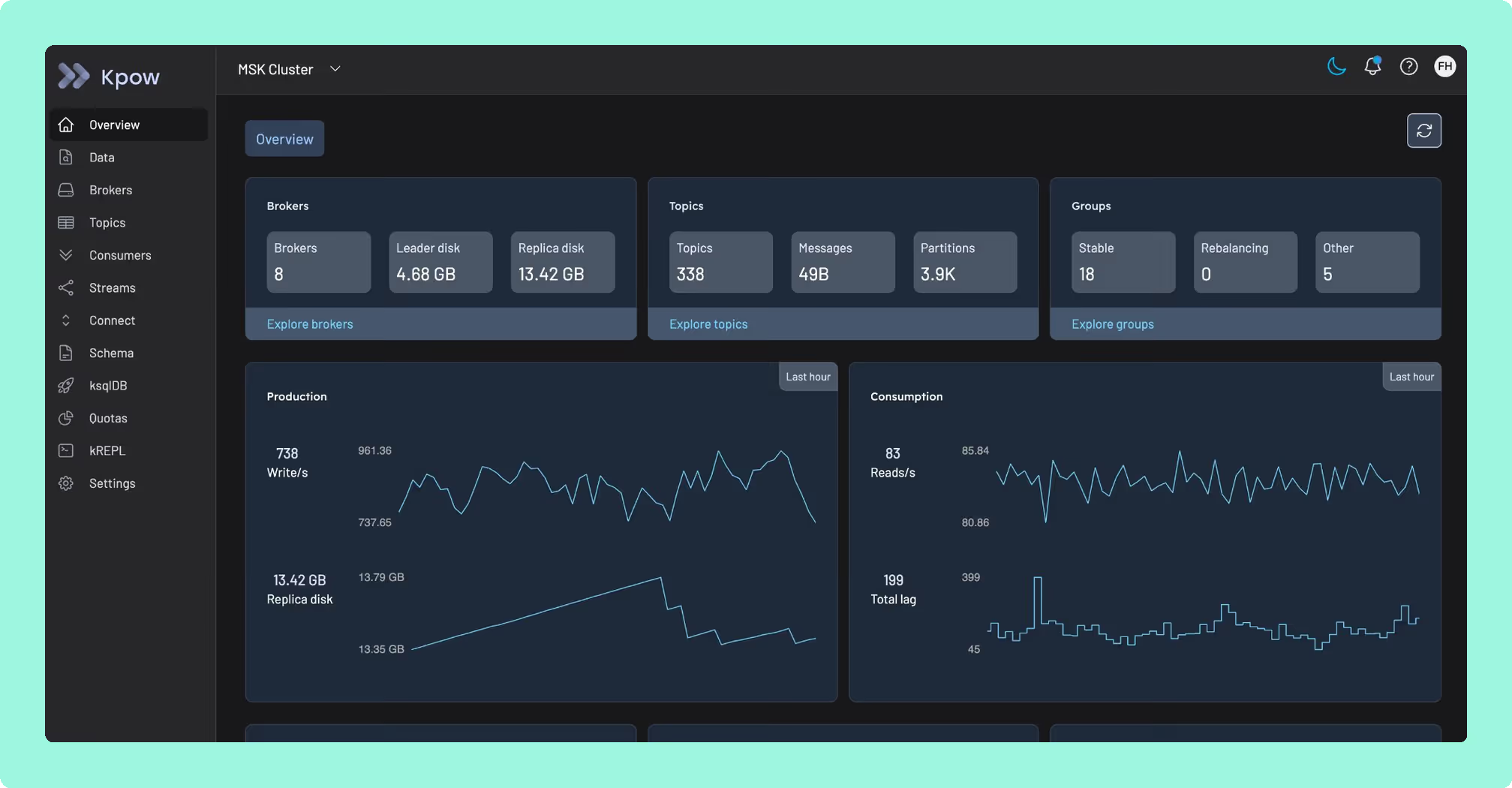
Both of these hand a platform team a second system to run before the first one does anything. CMAK needs a reachable ZooKeeper ensemble and a Scala build produced in-house, and Lenses needs PostgreSQL behind HQ as its only supported storage option plus a database behind every Agent, so a four-cluster deployment is HQ, four Agents and five databases before any topology renders. Kpow by Factor House is a single stateless JVM container configured entirely through environment variables, with no external database, sidecar or persistent volume: it keeps its own telemetry in internal Kafka topics on the cluster it is watching, and reaches up to 12 clusters from that one instance. It is licensed per cluster at a published price.
A tool you have to keep alive is a second job. Kpow’s product page has the full specification and the published price for the one that doesn’t need it.
How these tools were scored
Every option is scored from 0 to 10 on each criterion, from the evidence and sources this page cites, and the reason for each score is on its card. Each criterion counts once, for a total out of 50. The options are listed by total.