At a glance
Redpanda Console and Conduktor are scored here on the same five criteria, 50 points in all: Redpanda Console 29 out of 50, Conduktor 36 out of 50. Redpanda Console takes its best score on Deployment footprint (8 out of 10) and its lowest on Multi-cluster reach (2 out of 10). Cost a year, 10 engineers: 0 licence, about 8,640 US dollars to run, this page's estimate. Conduktor takes its best score on Access control and audit (10 out of 10) and its lowest on Deployment footprint (3 out of 10). Cost a year, 10 engineers: 12,000 US dollars of seats published, plus 2,880 this page's estimate. Conduktor holds the highest total on this page at 36 out of 50.
Conduktor vs Redpanda Console, compared
Kpow meets 6 of 7 requirements on this page. One row is not a yes or no question.
Key takeaway
Conduktor Console Team Edition costs 1,200 US dollars per seat per year. Redpanda Console is free under the Business Source License, with its enterprise licence priced on request. Console’s RBAC and SSO sit behind that Redpanda Enterprise licence, so a team on vanilla Apache Kafka buys a broker vendor’s licence just for access control, and it has no broker-tier multi-cluster, so three environments means three deployments. Kpow by Factor House is licensed per cluster at a published price.
Kpow live demo
Test the trade-offs in a live Kafka UI
You have compared Conduktor vs Redpanda Console. Open a live Kpow environment to test the everyday workflows a shared Kafka platform needs.
Built for platform and data teams managing shared Kafka clusters.
Try the Kpow demoWhat is Conduktor?
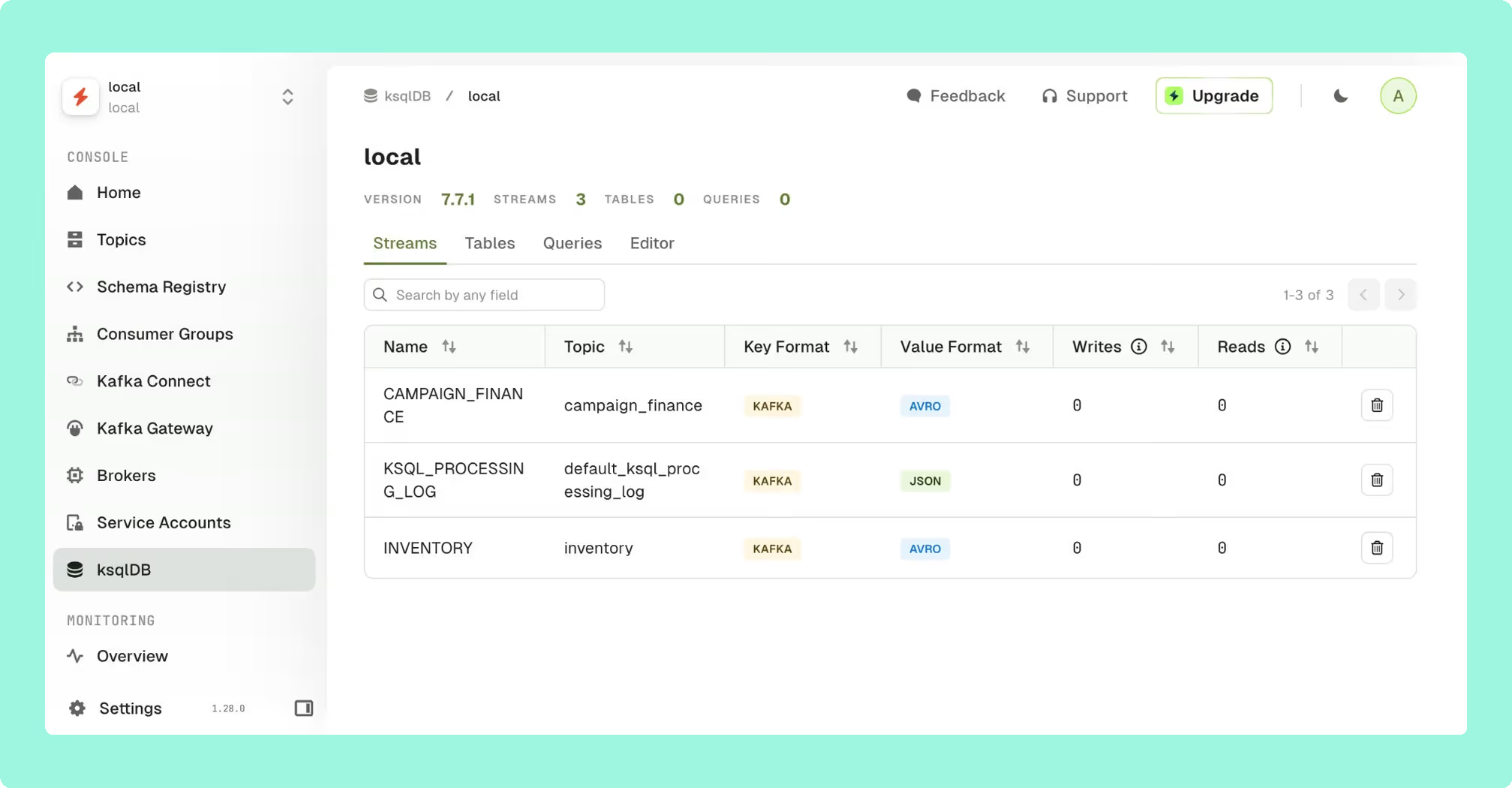
Conduktor is a commercial Kafka management and governance platform, sold as three separately licensed products. Console is a React web interface over topics, schemas, connectors, consumer groups and access control across clusters. Gateway is a proxy between clients and brokers that enforces encryption, data masking, quota policy and multi-tenancy at the wire level. A Schema Registry Proxy is the third, with its own Enterprise tier.
Gateway is what makes this a different category of product rather than a smarter viewer: field-level encryption without touching a client, virtual topic filtering server-side with no stream processor behind it, and a backend cluster failover applications never notice. It is also a thing to deploy, keep available and pay for. The company achieved SOC2 Type II certification in 2023. Console and Gateway are both Kafka only, and the JavaFX desktop product was retired at the end of 2025, so a solo developer who wants a local look now runs Docker.
What is Redpanda Console?
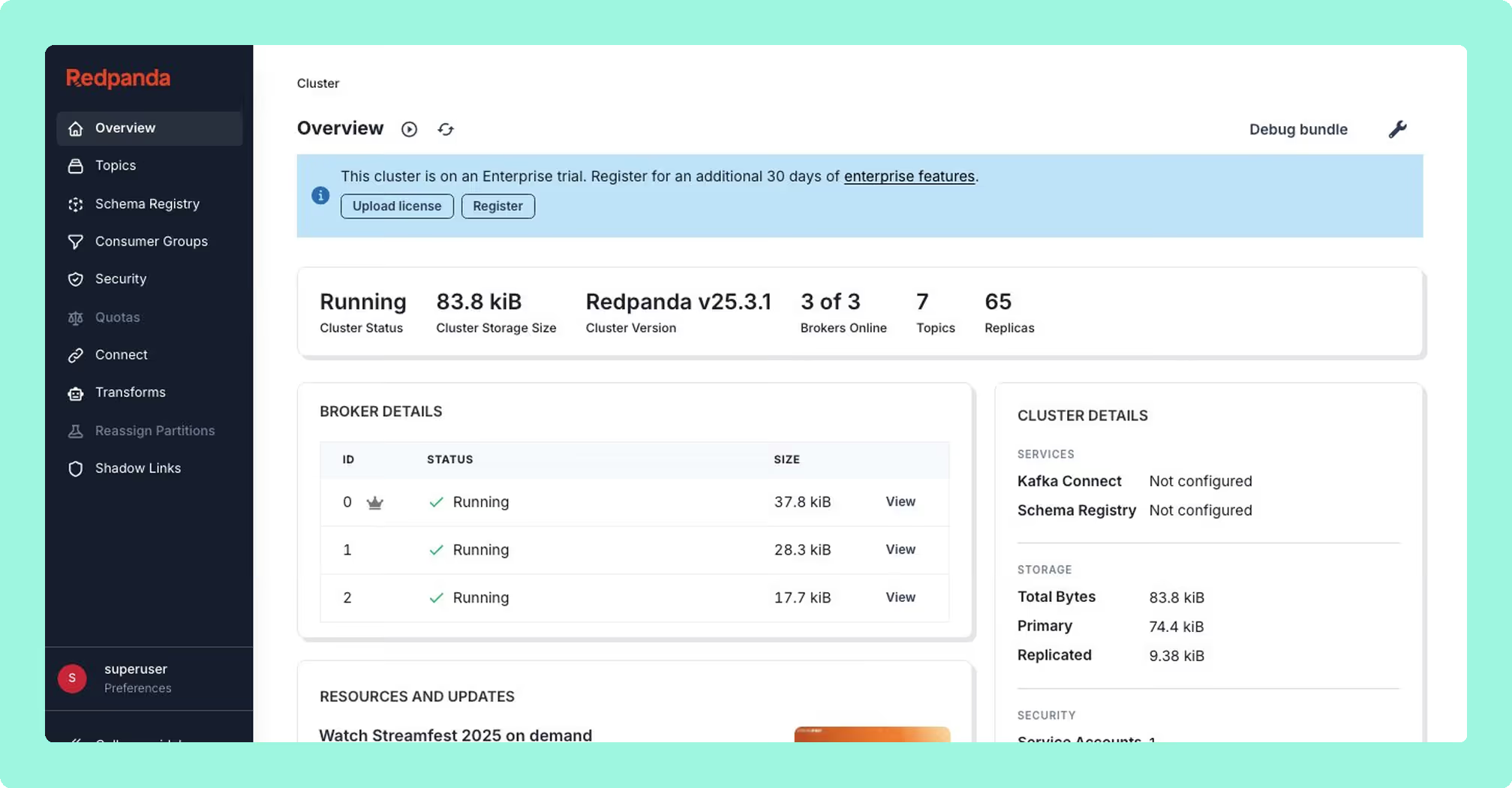
Redpanda Console is a source-available web UI for Kafka-compatible clusters, built in Go and React and shipped as a Docker image and a Helm chart. It began as Kowl, by CloudHut, and Redpanda acquired it in April 2022. It serves Redpanda clusters, where it integrates with the Redpanda admin API, and it serves vanilla Apache Kafka, Amazon MSK and Confluent Platform as well. Version 3.11.0 shipped on 25 August 2026.
- Deserialisation: Avro, Protobuf, JSON, XML, CBOR, MessagePack and binary hex, with Protobuf decoding from local descriptor maps and no registry.
- Filtering: JavaScript message filters, and time-travel offset management.
- Observer Mode: streams and browses topic messages without joining a consumer group, so inspection triggers no rebalance.
- Connect: one instance manages connectors across several Kafka Connect clusters.
What is the official 2026 pricing of Conduktor and Redpanda Console?
Conduktor’s Console Community is free and self-hosted, capped at 50 users and 3 clusters, carrying Insights, full Kafka operations, the advanced data explorer, API and CLI access, and SSO by OIDC or LDAP at no cost. Team Edition is 1,200 US dollars per seat per year, or 125 US dollars per seat per month billed monthly, and it is where group-level RBAC, topic policies, unlimited audit logs, data masking and chargeback Insights start. Console Enterprise is contact only, and Gateway is licensed separately per cluster with a three-cluster minimum.
Redpanda Console is free under the Business Source License, and four capabilities sit outside it: authentication for Console including OIDC and OAuth 2.0 SSO, authorization meaning RBAC, debug bundle generation, and Reassign Partitions. The gate is a Redpanda Enterprise licence, which is the broker vendor’s platform licence, and no price for it is published. What is gated is not broker authorization: Kafka’s own ACLs still decide what a client may do, and Console’s RBAC decides who may press which button. So a team on vanilla Apache Kafka or Amazon MSK that wants the second buys an enterprise licence from a broker vendor whose broker it does not run.
Where does each one run out?
The scoring is the same on both sides: five criteria, 10 points each, 50 in all, with every criterion counting once. Nothing sits behind a multiplier, so a total is the sum of its five marks and a reader can recompute it. The five are cost as teams grow, deployment footprint, support and maintenance, access control and audit, and multi-cluster reach, because those are the questions a Kafka interface is actually measured against after the first month: a second cluster, an access review with a date on it, an upgrade nobody owns, and a bill that moves when the team does. The widest gap between the two marks is on multi-cluster reach, where Conduktor marks 9 and Redpanda Console marks 2. The marks come from the same matrix used on every comparison on this site, so a tool scores the same here as it does anywhere else, and the reason behind each mark is in the card below, under Why these scores.
 Rank 1
 Redpanda Console
redpanda.com
29 out of 50 Total
- Cost a year, 10 engineers
- 0 licence, about 8,640 US dollars to run, this page's estimate
- Governance licence
- Redpanda Enterprise, no published price
- Clusters per deployment
- One
- Cost as teams grow
- 6 out of 10
- Deployment footprint
- 8 out of 10
- Support and maintenance
- 7 out of 10
- Access control and audit
- 6 out of 10
- Multi-cluster reach
- 2 out of 10
Why these scores for Redpanda Console
- Cost as teams grow 6 out of 10
- This page’s table gives the pricing unit as free software with no seat count and no change to the bill for another engineer, and no published price for the enterprise licence the gated features need. The annual figure for ten engineers is 0 in licence, and about 8,640 US dollars a year to run on this page’s own estimate, set out in the card, before any Redpanda Enterprise licence.
- Deployment footprint 8 out of 10
- The External dependencies row of this page’s table gives none, because it holds no state of its own and ships as a Docker image and a Helm chart.
- Support and maintenance 7 out of 10
- On this page, version 3.11.0 shipped on 25 August 2026 under Redpanda, and where enterprise features are enabled and no valid licence is found, Console restricts the whole interface rather than the gated feature.
- Access control and audit 6 out of 10
- The Free tier row of this page’s table gives everything except Console authentication, authorization, debug bundle generation and Reassign Partitions, all of which need a Redpanda Enterprise licence from the broker vendor.
- Multi-cluster reach 2 out of 10
- The Clusters per deployment row of this page’s table gives one, so dev, staging and production means three instances, against two multi-cluster requests, one closed in 2021 and one open since 2022.
Redpanda Console runs out at scale and on bad days. There is no broker-tier multi-cluster: one request was opened on 1 September 2021 and closed, a second was opened on 22 April 2022 and is still open, so dev, staging and production means three deployments to run and upgrade.
Timeouts: 6 seconds for DescribeLogDirs and Metadata, 5 for DescribeConfigs and 35 for ListMessages, all hardcoded with no configuration key.
MSK with IAM: calls take 4.9 and 5.7 seconds against those limits, because the STS token exchange adds latency the values never accounted for.
Degradation: one broker offline in a multi-node cluster fails every consumer group query with a shard error.
Licence lapse: where enterprise features are enabled and no valid licence is found, Console restricts the whole interface rather than the gated feature.
There is also no way to produce a message from the UI, no built-in broker metrics, no alerting and no historical trends, so production monitoring needs a separate Prometheus and Grafana stack beside it.
Cost to run: Console is free under the Business Source License, so the licence is 0, and the Redpanda Enterprise licence its RBAC and SSO need carries no published price at all. This page’s own estimate of the rest, not a vendor price: 6 engineer-hours a month at 120 US dollars an hour is 8,640 a year, covering three deployments for dev, staging and production because there is no broker-tier multi-cluster, and the separate Prometheus and Grafana stack that production monitoring needs beside it. Kpow’s published licence is 4,500 US dollars per cluster per year for up to 100 users, with RBAC and SSO in the product and no broker vendor to license.
Compare Kpow vs Redpanda ConsoleKafbat UI vs Redpanda ConsoleRedpanda Console review
 Rank 2
 Conduktor
conduktor.io
36 out of 50 Total
- Cost a year, 10 engineers
- 12,000 US dollars of seats published, plus 2,880 this page's estimate
- Free tier
- 50 users, 3 clusters
- Needs to run
- PostgreSQL 13 or later, not optional
- Cost as teams grow
- 5 out of 10
- Deployment footprint
- 3 out of 10
- Support and maintenance
- 9 out of 10
- Access control and audit
- 10 out of 10
- Multi-cluster reach
- 9 out of 10
Why these scores for Conduktor
- Cost as teams grow 5 out of 10
- This page’s table gives the published price as Team Edition at 1,200 US dollars per seat per year, or 125 per seat per month, so the bill tracks the number of people with a login, and the free tier as 50 users and 3 clusters. The annual figure for ten engineers is 12,000 US dollars of seats at the published 1,200, plus about 2,880 US dollars of running cost on this page’s own estimate, 2 engineer-hours a month at 120 US dollars an hour, so about 14,880 US dollars. Console Community is free at 50 users and 3 clusters, so ten engineers pay nothing until they want the governance this score is based on, which starts on Team Edition.
- Deployment footprint 3 out of 10
- The External dependencies row of this page’s table gives PostgreSQL 13 or later for Console and it is not optional, with 2 CPU and 3 GB for Console plus 2 CPU and 4 GB for Gateway, which also sits in the data path.
- Support and maintenance 9 out of 10
- This page gives SOC2 Type II certification in 2023, with the governance licence sold by the tool vendor on the same contract as the interface.
- Access control and audit 10 out of 10
- The Free tier and Who sells the governance licence rows of this page’s table give SSO by OIDC or LDAP at no cost, with group-level RBAC, topic policies, unlimited audit logs and data masking from Team Edition.
- Multi-cluster reach 9 out of 10
- The Clusters per deployment row of this page’s table gives several from one Console, and three of them on the free tier.
Conduktor’s costs are architectural before they are financial. Console requires PostgreSQL 13 or later and it is not optional, so a Kafka UI acquires a database with its own backups, upgrade path and restore drill. Minimum resources are 2 CPU and 3 GB of RAM for Console, plus 2 CPU and 4 GB for Gateway.
Latency: Gateway is a proxy in the data path, and a proxy adds a network hop that can slightly increase end-to-end latency.
Availability: Gateway sits in the data path as a single point of failure with its own high-availability plan to write.
Azure: Event Hubs is reachable over Kafka protocol compatibility, but Azure’s native Schema Registry is not integrated.
Pricing: three of the five purchasable tiers are contact only, so a purchase cannot be sized without a conversation.
Compare Conduktor vs Kafbat UIConduktor vs Confluent Control CenterConduktor review
Which should you pick?
Conduktor scores 36 against Redpanda Console’s 29 and is the pick where RBAC and SSO are requirements, because Console puts both behind a Redpanda Enterprise licence bought from the broker vendor. Console is free under the Business Source License and reaches one cluster per deployment. A team on vanilla Apache Kafka that wants access control without either bill should shortlist Kpow by Factor House, published per cluster.
Pick Conduktor if:
- a regulator or a customer contract makes the audit trail non-negotiable
- encryption or masking has to be enforced below the application
- topic creation is being handed to product teams inside policy guardrails
- one deployment has to cover several environments
Pick Redpanda Console if:
- the job is debugging rather than delegation
- the people using it already hold cluster credentials
- you run Redpanda and want the interface aligned to that distribution
- the Protobuf and time-travel workflow is what you open a UI to do
For five engineers the arithmetic is easy either way: Team Edition is a small and predictable purchase, and Redpanda Console is free unless RBAC is required. For fifty, most of whom should never touch a broker, the units diverge: one becomes a budget line that grows with headcount, and the other a negotiation with a broker vendor over a number nobody can look up first. Redpanda Console holds no state of its own and adds nothing to the data path, so removing it later changes nothing on the brokers. If the shortlist is wider than these two, the best free Kafka UI tools ranks what a free tier actually reaches, and the tools to manage several Kafka clusters from one place takes the three-environments problem on its own.
Kpow: governance you don’t need another vendor’s licence to get
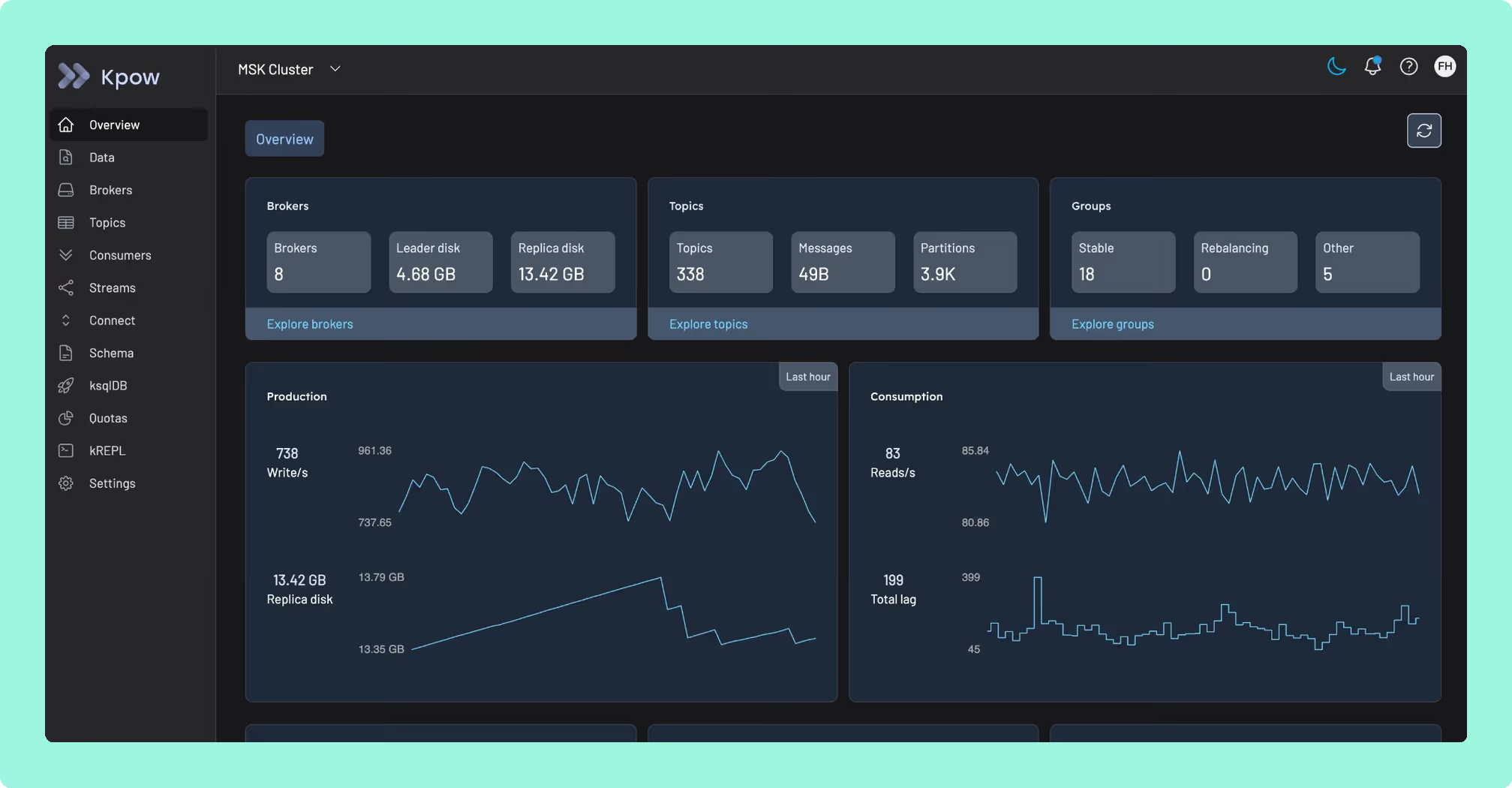
Conduktor and Redpanda Console both hide the real cost of governance behind something other than the tool itself. Conduktor bills per seat, so the audit trail and RBAC arrive at 1,200 US dollars per seat per year and move with headcount. Redpanda Console’s RBAC and SSO sit behind a Redpanda Enterprise licence instead, so a team running vanilla Apache Kafka has to buy a broker vendor’s platform contract just to get access control, at a price that is a negotiation rather than a number. Kpow by Factor House is licensed per cluster at a published price, so adding an engineer changes nothing and there is no broker vendor to negotiate with. It is vendor-agnostic tooling that runs against whatever cluster you already have, in one stateless JVM container with no external database.
Governance shouldn’t cost a seat on one side or a phone call to a different vendor on the other. Point Kpow at that cluster and see a price that answers to neither.
How these tools were scored
Every option is scored from 0 to 10 on each criterion, from the evidence and sources this page cites, and the reason for each score is on its card. Each criterion counts once, for a total out of 50. The options are listed by total. Conduktor is listed last whatever its total; on its total of 36 it would place first.
Sources
- Apache Kafka documentation on the consumer position
- Apache Kafka documentation on authorization