At a glance
Kadeck and Lenses are scored here on the same five criteria, 50 points in all: Kadeck 29 out of 50, Lenses 26 out of 50. Kadeck takes its best score on Multi-cluster reach (9 out of 10) and its lowest on Cost as teams grow (4 out of 10). Licence: Per user per month, subscription. Lenses takes its best score on Access control and audit (7 out of 10) and its lowest on Deployment footprint (2 out of 10). Licence: Capability tiers, 15-user cap on Team.
Kadeck vs Lenses, compared
Kpow meets 6 of 7 requirements on this page. One row is not a yes or no question.
Key takeaway
Kadeck and Lenses are both commercially licensed tools on top of a Kafka cluster somebody else runs. Lenses reaches topic data through SQL, Kadeck through a filterable record browser. Kadeck Enterprise costs 32 US dollars per user per month with a ten-user minimum; Lenses DevX Team starts at 4,000 a year for fifteen users. Kadeck stays per seat at any size, while Lenses moves to negotiated pricing past fifteen, and needs Postgres for HQ plus an Agent database per cluster, where Kadeck Teams is one Docker image. Kpow by Factor House is licensed per cluster at a published price.
Kpow live demo
Test the trade-offs in a live Kafka UI
You have compared Kadeck vs Lenses. Open a live Kpow environment to test the everyday workflows a shared Kafka platform needs.
Built for platform and data teams managing shared Kafka clusters.
Try the Kpow demoWhat is Lenses?
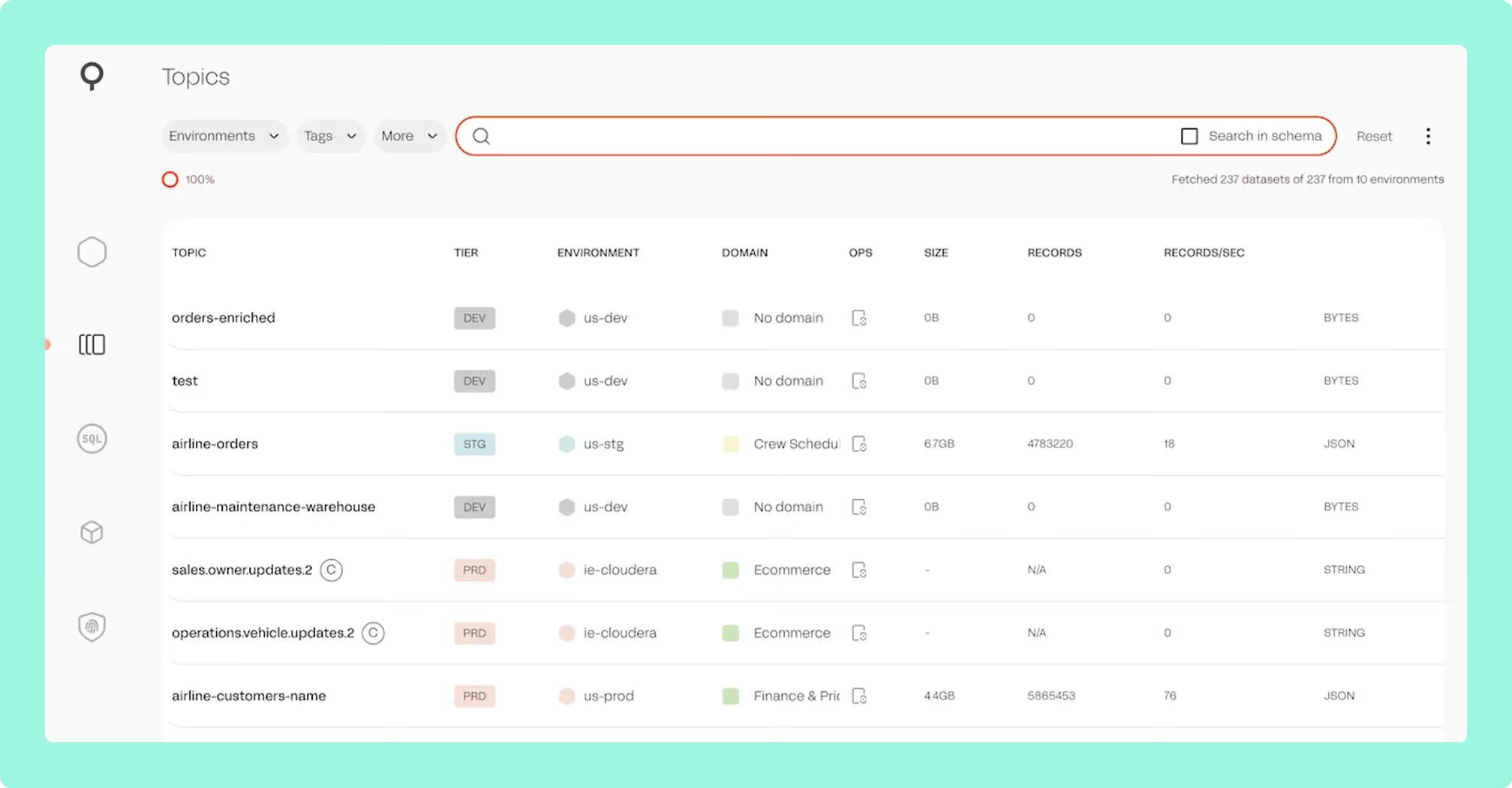
Lenses is a commercial Kafka governance and data exploration platform that sits on top of existing clusters. It is a Kafka client rather than a proxy, so it does not sit in the data path, and KRaft clusters need no modification because the Agent connects as an ordinary client. The architecture is a central Lenses HQ node with lightweight Agents deployed per cluster, and one Agent reaches one Kafka cluster. Celonis acquired Lenses in early 2022, and 6.2.6 shipped on 19 August 2026.
- SQL Studio: queries a topic in SQL rather than in consumer code, which puts topic data in reach of an analyst.
- SQL Processors: Kubernetes-native stream processing defined in SQL on top of Kafka Streams.
- Topology and lineage: one picture across producers, topics, connectors and consumers.
- Two ladders: DevX for the UI, governance and SQL surface, and K2K for replication.
What is Kadeck?
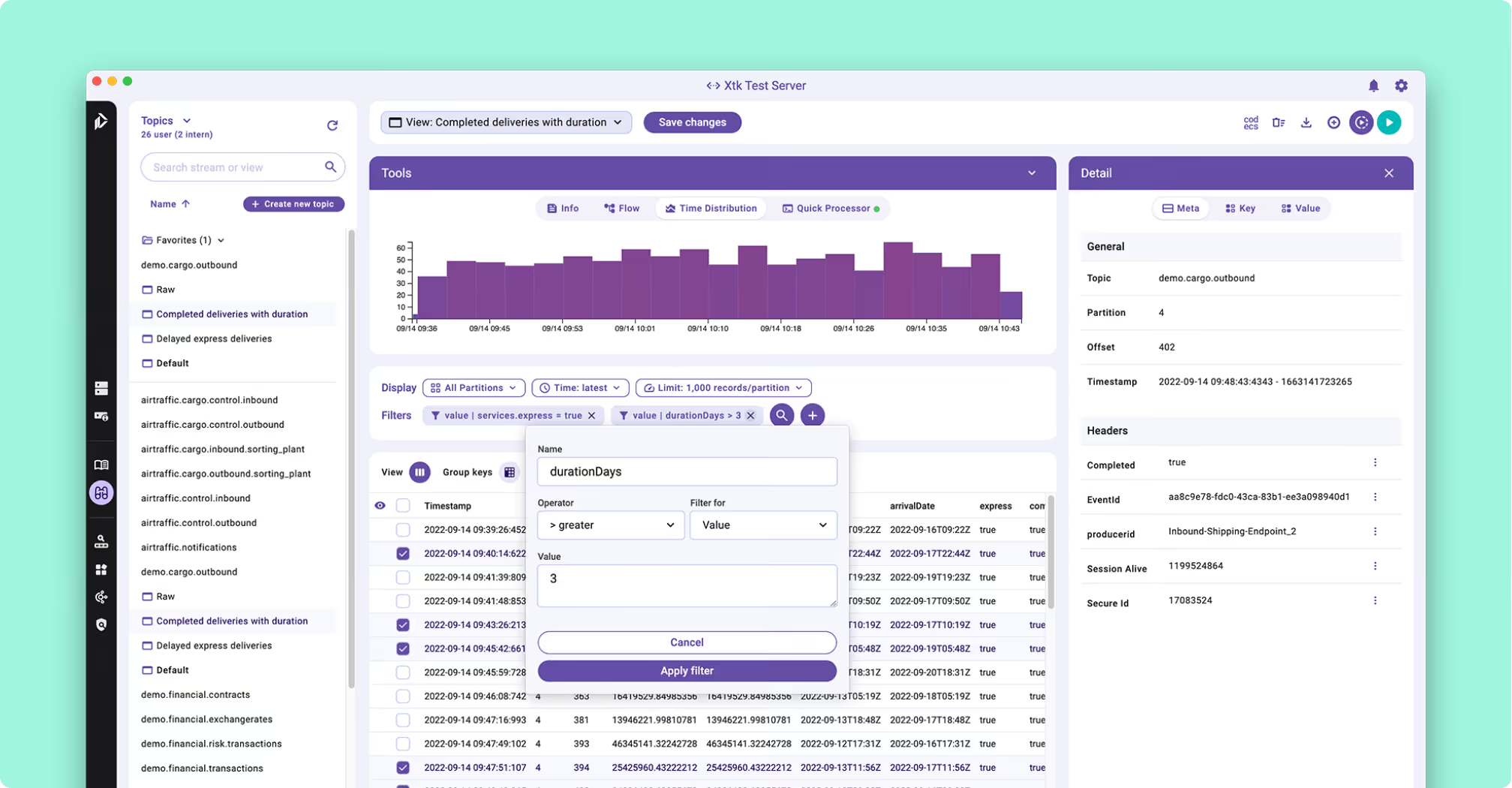
Kadeck is a commercially licensed Kafka management and data exploration tool from Xeotek. It is not open source, and it supports Apache Kafka, Redpanda and Amazon Kinesis. The fact that shapes everything downstream is not a feature: it ships as two separate product lines rather than as two rungs of one ladder. Kadeck Desktop is a native application for Windows, macOS on both Intel and Apple Silicon, and Linux, so an individual engineer needs no container runtime. Kadeck Teams is the web product, distributed exclusively as a Docker image.
- Record view: Avro decoded through a Schema Registry and presented in a columnar layout rather than as raw bytes.
- QuickProcessor: a JavaScript expression derives calculated fields, with no streaming application behind it.
- Dead-letter recovery: isolate, transform inline, preview, re-ingest, then purge what has been processed.
- Metadata layer: schema fields documented without modifying the Schema Registry or bumping a version.
What is the official 2026 pricing of Kadeck and Lenses?
Kadeck’s Enterprise floor and Lenses’ DevX Team floor land within 160 US dollars a year of each other, and on neither side is that the headline tier. Kadeck’s RBAC with LDAP and OpenID Connect, its data masking and its audit logs are Enterprise-only, at 32 US dollars per user per month with a ten-user minimum, so the entry cost is 3,840 US dollars a year at any team size below ten. Lenses puts SSO, SAML and RBAC at DevX Team, from 4,000 US dollars a year for up to fifteen users. Two products whose headline tiers look an order of magnitude apart converge the moment access control becomes a requirement.
After that they diverge. For a team of fifty, Kadeck stays arithmetic at 19,200 US dollars a year, while fifty users is past the Lenses Team cap of fifteen and the deal becomes a Multi-Kafka Enterprise contract priced by negotiation. Two smaller things move the total. Kadeck Professional at 19 US dollars per user per month is the Desktop line, and a desktop licence is not upgradeable into Enterprise. Lenses carries a second meter, because exactly-once replication, offset replication or schema migration puts a team on the K2K ladder on top of DevX, from 1,000 US dollars a month with five clusters included and 200 a month per cluster after.
Where does each one run out?
Both are scored out of 50, as five criteria marked out of 10, and each criterion carries the same weight as the others. Nothing sits behind a multiplier, so a total is the sum of its five marks and a reader can recompute it. The five are cost as teams grow, deployment footprint, support and maintenance, access control and audit, and multi-cluster reach, because those are the questions a Kafka interface is actually measured against after the first month: a second cluster, an access review with a date on it, an upgrade nobody owns, and a bill that moves when the team does. The widest gap between the two marks is on deployment footprint, where Lenses marks 2 and Kadeck marks 4. The marks come from the same matrix used on every comparison on this site, so a tool scores the same here as it does anywhere else, and the reason behind each mark is in the card below, under Why these scores.
 Rank 1
 Kadeck
kadeck.com
29 out of 50 Total
- Licence
- Per user per month, subscription
- Cost a year, ten people
- $6,720 all in
- Governed tier
- $32 a user a month, 10 minimum
- Cost as teams grow
- 4 out of 10
- Deployment footprint
- 4 out of 10
- Support and maintenance
- 6 out of 10
- Access control and audit
- 6 out of 10
- Multi-cluster reach
- 9 out of 10
Why these scores for Kadeck
- Cost as teams grow 4 out of 10
- The compare figure prices it per user per month on two separate product lines, with RBAC, masking and audit logs Enterprise-only at 32 US dollars a user and a ten-user minimum, so 3,840 US dollars a year below ten people.
- Deployment footprint 4 out of 10
- The compare figure gives one Docker image for Teams with an external database on the documented Kubernetes path, and an online licence validation at every container start.
- Support and maintenance 6 out of 10
- On this page, support comes from a vendor under the licence already being paid per seat, and the container validates that licence online on every start.
- Access control and audit 6 out of 10
- The compare figure has RBAC with LDAP and OpenID Connect, masking and audit logs on Enterprise only, and Teams Free carries none of them.
- Multi-cluster reach 9 out of 10
- This page gives one cluster connection on the free tier and unlimited on the paid tiers, across Apache Kafka, Redpanda and Amazon Kinesis.
Kadeck’s Teams edition ships as a Docker image and nothing else, and the documented production Kubernetes path wants a persistent external database.
Licence checks: every container start triggers an online validation, so air-gapped sites need offline activation and CI deployments need challenge-response activation.
Free tier: one cluster connection, so covering Dev, Test, Stage and Prod is a paid plan on its own.
Write path: read-oriented, with no streaming of derived data back into a topic and no Kafka Streams or ksqlDB integration.
Export: CSV respects the column filters applied in the record table and JSON does not.
Cost a year: Enterprise is 32 US dollars per user per month with a ten-user minimum, so ten people are 3,840 US dollars a year in licence and fifty are 19,200. Two engineer-hours a month at 120 US dollars an hour is 2,880 US dollars a year, the same rate used on both sides of this page. Here those hours go on the Docker image, the external database the Kubernetes path wants and licence activation, which puts ten people at 6,720 US dollars a year all in. The licence rates are the vendor’s published prices from this page; the operator time is a Factor House estimate.
 Rank 2
 Lenses
lenses.io
26 out of 50 Total
- Licence
- Capability tiers, 15-user cap on Team
- Cost a year, ten people
- $6,880 all in on one cluster
- What has to be deployed
- HQ on Postgres, agent and DB per cluster
- Cost as teams grow
- 4 out of 10
- Deployment footprint
- 2 out of 10
- Support and maintenance
- 6 out of 10
- Access control and audit
- 7 out of 10
- Multi-cluster reach
- 7 out of 10
Why these scores for Lenses
- Cost as teams grow 4 out of 10
- The compare figure gives DevX Team from 4,000 US dollars a year for up to fifteen users on a single cluster, Community capped at five, a team of sixteen custom priced, and replication adding the K2K ladder from 1,000 US dollars a month.
- Deployment footprint 2 out of 10
- The compare figure gives a central HQ node with PostgreSQL as its only supported store, plus one Agent and one Agent database per Kafka cluster, and the Community edition carries the same dependency.
- Support and maintenance 6 out of 10
- This page gives a commercial vendor under contract, Celonis-owned since early 2022, with 6.2.6 shipped on 19 August 2026.
- Access control and audit 7 out of 10
- The compare figure has SSO, SAML and RBAC arriving at DevX Team, docked because masking is global by field name across every registered dataset, with no way to escape a policy even as an admin.
- Multi-cluster reach 7 out of 10
- The compare figure has one Agent reaching one Kafka cluster, so a four-cluster estate is HQ plus four Agents plus their databases.
Lenses’ control plane is wider than it first looks: HQ plus its Postgres, plus one Agent and one Agent database per Kafka cluster, and the Community edition carries the same dependency. Its own Helm quickstart creates lenses_hq and lenses_agent before either component starts.
Masking: data policies match on field name across every registered dataset and are global, with no way to escape a policy even as an admin.
Portability: SQL Processors are proprietary and compiled, so anything built on them is re-implementation if the team leaves.
Permissions: 6.2.5 split UpdateTopicDetails into two actions, so custom roles granting the old one needed re-granting by hand.
Weight: a server-side JVM backend runs alongside the web interface, which is heavy for an engineer who only wants to look at a local topic.
Cost a year: DevX Team starts at 4,000 US dollars a year for up to fifteen users on a single cluster, so ten people on one cluster are 4,000 in licence and a second cluster is a second licence. Two engineer-hours a month at 120 US dollars an hour is 2,880 US dollars a year, the same rate used on both sides of this page. Here those hours go on HQ, its Postgres and an Agent and Agent database for every cluster, which puts ten people on one cluster at 6,880 US dollars a year all in, still the 160 dollars apart from Kadeck that this page names at the licence floor. Replication on the K2K ladder is a second meter from 1,000 US dollars a month. The licence rates are published; the operator time is a Factor House estimate.
Compare Kpow vs Lenses.ioKafbat UI vs LensesLenses.io review
Which should you pick?
Kadeck scores 29 against Lenses’ 26 and is the pick for a team that wants one Docker image rather than a control plane, because Lenses needs Postgres behind HQ and a database behind every per-cluster agent. Lenses is the pick where SQL access to topic data is the reason for buying. Both meter users, so where the bill should track clusters, shortlist Kpow by Factor House at a published price.
Pick Kadeck if:
- the tool is for one engineer with one laptop and one cluster today
- a native installer with no container runtime and no database is what is wanted
- the work is recovering from failures rather than reporting on them
Pick Lenses if:
- people who will not write consumer code need to answer their own questions
- SQL over a topic is the capability being bought
- stream processing defined in SQL is part of the plan
That last pair is the one axis on which these two are genuinely not substitutes: a record browser with filters is a debugging surface for the person holding the incident, and SQL is a self-service surface for everybody else. If access control has become somebody’s requirement, count the whole cost rather than the tier. Both floors sit within 160 US dollars a year of each other, and what differs is what happens next: Kadeck bills every seat forever behind a ten-seat minimum, while Lenses covers fifteen users flat and then moves to a negotiated contract. Two commercial tools are a narrow shortlist for that decision: the Kafka management tools compared on price and governance is the wider field, and the Kafka SSO tools compared covers the SAML and OpenID Connect requirement that put both of these on a paid tier.
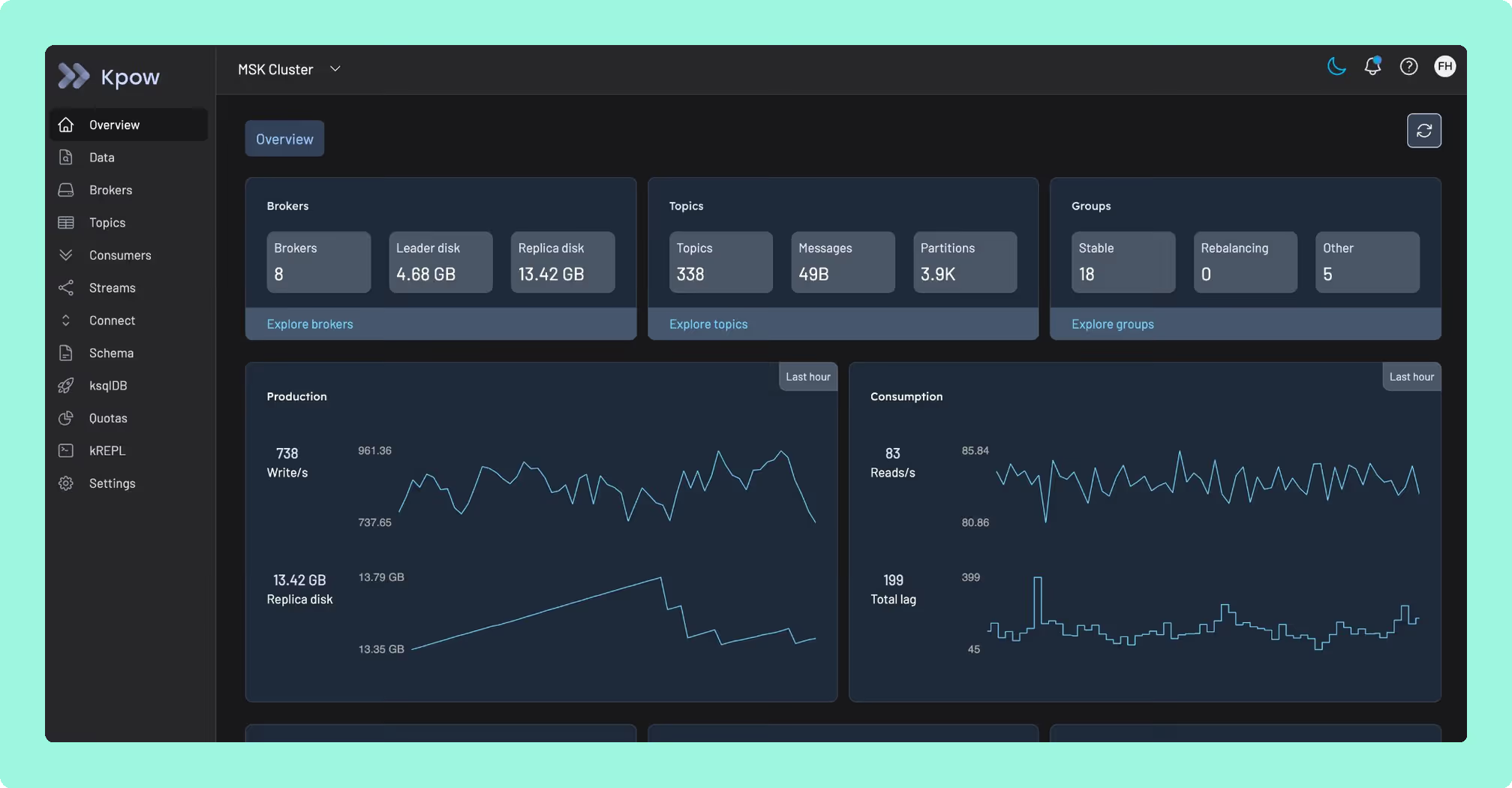
Kpow: no seat count to negotiate, no control plane to run
Kadeck stays per seat at any size behind a ten-seat Enterprise floor, and Lenses covers users flat only up to fifteen before the deal becomes a Multi-Kafka Enterprise contract priced by negotiation, so both roads eventually turn into a headcount conversation. Both also cost infrastructure before they cost people: Kadeck’s Teams edition wants a persistent external database, and Lenses needs a central HQ node on PostgreSQL plus a separate Agent and Agent database for every cluster it reaches. Kpow by Factor House avoids both: licensed per cluster at a published price, adding an engineer never moves what you pay, and there is no external database, no sidecar and no persistent volume behind it, just a single stateless JVM container, configured through environment variables, reaching up to 12 clusters from one instance.
No seat count to negotiate and no control plane to keep alive is the whole saving. Check the number before a headcount conversation becomes a contract negotiation. It is published in full on Kpow’s product page.
How these tools were scored
Every option is scored from 0 to 10 on each criterion, from the evidence and sources this page cites, and the reason for each score is on its card. Each criterion counts once, for a total out of 50. The options are listed by total.
Sources
- Apache Kafka documentation on authorization
- Apache Kafka documentation on basic operations
- Apache Avro documentation