Best Kafka management tools for pharma and life sciences companies
ComparisonsThe best Kafka management tool for a pharma or life sciences company is the one that lets engineers run research, manufacturing and supply data flows on Kafka while keeping the controls a regulated company is asked for: it runs inside the company’s own environment and stays out of the data path, names the person behind every action and data query, holds changes for a second person and grants production access for one task before removing it, signs people in through the company’s directory, reaches on-prem and cloud clusters from one deployment, and searches message content across topics. Kpow, Kafbat UI, AKHQ, Lenses, Confluent Control Center and Conduktor each cover part of that. Scored on the six weighted criteria explained below the rankings, Kpow ranks first with 107 out of 120, ahead of Kafbat UI at 78, Conduktor at 74, and AKHQ and Lenses at 69 each.
Tools compared
| Rank | Tool | Total (out of 120) | Out of the data path | Audit trail per person | Production access on request | Directory and Kafka sign-in | On-prem and cloud together | Inspecting topic data | Cost a year (modelled) |
|---|---|---|---|---|---|---|---|---|---|
| 1 | Kpow | 107 | One container, state in your Kafka, not a proxy | Every action with the IdP user, data queries included | Time-boxed temporary policies via API, staged approvals, masking per resource | SAML, OIDC, LDAP; Kerberos, SCRAM or mTLS to brokers | Any distribution, 12 clusters per instance | kJQ search across topics, on the server | $20,880 |
| 2 | Kafbat UI | 78 | One stateless container | Optional, reads at level ALL, no view | Per-resource RBAC, no approvals, masking for all viewers | OAuth2, OIDC, LDAP; no SAML | Confluent Cloud broke in v1.4.x and v1.5.0 | Message browsing | $11,520 |
| 3 | AKHQ | 69 | One stateless container | Opt-in, no reads, no view | Regex groups, UI-only if JWT secret unset | LDAP, OIDC; no SAML | Named connections | Topic data browsing | $16,320 |
| 4 | Lenses | 69 | HQ on PostgreSQL, agent and database per cluster | In-product audit log from Team tier | Strict global masking, no approvals | SSO incl. Entra ID and Okta | Any Kafka API, agent per cluster | SQL over topics | $2,880 plus quoted licence |
| 5 | Confluent Control Center | 43 | Dedicated host, broker reporter JAR | Broker principal, not always the person | Confluent RBAC, no DENY, no approvals | OIDC on self-managed | Confluent Platform only | Topics > Messages view | $2,880 plus quoted subscription |
| 6 | Conduktor | 74 | Console on PostgreSQL; Gateway proxy in the data path | 70+ event types with user, in the UI | Per-viewer masking, cross-team access requests | LDAP, OIDC | Confluent Cloud, Aiven, MSK, Cloudera | Browse and filter | $122,880; $212,880 with Gateway Core and Protect |
No tool meets every column, and none of them makes a Kafka platform compliant with 21 CFR Part 11 or EU GMP Annex 11 on its own. Regulated companies commonly pair a management tool for people with broker ACLs or an authorizer for services, inside a quality system that covers validation and record retention.
The tools, ranked for pharma and life sciences companies
 Rank 1
 Kpow
107 out of 120 Total
Try Kpow in the live demo No signup needed.
- Cost a year
- $18,000 licence for 4 clusters plus $2,880 operator time, so $20,880 (modelled)
- Audit
- Every action and data query, with the person from the directory
- Deployment
- One container or JAR, no external database
- Out of the data path ×3 weight, this criterion counts 3 times toward the total
- 9 out of 10
- Audit trail per person ×3 weight, this criterion counts 3 times toward the total
- 9 out of 10
- Production access on request ×3 weight, this criterion counts 3 times toward the total
- 9 out of 10
- Directory and Kafka sign-in
- 9 out of 10
- On-prem and cloud together
- 8 out of 10
- Inspecting topic data
- 9 out of 10
Why these scores for Kpow
- Out of the data path 9 out of 10
- It is one container or JAR whose state lives in Kafka topics on your own cluster, and it connects as an ordinary Kafka client, so nothing sits between your applications and the brokers.
- Audit trail per person 9 out of 10
- Every action is recorded with the user from the identity provider and the policy that allowed it, including data inspect queries, with a seven-day view in the product, the record written to an audit topic on your own cluster, and webhooks that send it to a SIEM for long-term retention.
- Production access on request 9 out of 10
- Temporary policies grant time-boxed access that an admin or a change system calling the Kpow API can create, staged mutations hold any action for approval, and data policies mask fields in inspection, though masking is per resource rather than per viewer.
- Directory and Kafka sign-in 9 out of 10
- People sign in with SAML, OpenID or LDAP through Jetty JAAS, and Kpow connects to brokers with any SASL mechanism, GSSAPI by default, or SSL.
- On-prem and cloud together 8 out of 10
- One deployment manages self-managed Apache Kafka, Confluent Platform, Confluent Cloud and MSK together, capped at 12 clusters per instance before you run another. Its documentation asks for it to run close to its clusters and does not officially support multi-region installations.
- Inspecting topic data 9 out of 10
- Data inspect searches across multiple topics with kJQ filters, which its documentation says scan tens of thousands of messages a second from a topic, and streaming search keeps a query running until it reaches its result or scan limit; Lenses’ SQL scores higher.
For a pharma or life sciences company. Kpow runs inside the company’s own environment, beside the brokers, as one container with no external database, which keeps the list of components to qualify short. People sign in through the company’s directory with LDAP or SAML, and RBAC allows, denies or stages each action per resource. Staged mutations hold a change until an administrator approves it, temporary policies grant a role extra actions on a named resource for a fixed time, and the Kpow API lets a change system create them. The audit log records each action and each data query with the person who took it, and webhooks send that record to the system where the company keeps its long-term records.
Where it falls short. Kpow is not a validated system out of the box and does not make a Kafka platform compliant with 21 CFR Part 11 or Annex 11; it supplies access control, approval and audit mechanisms that the company validates within its own quality system. Section 11.10(e) asks that audit trail documentation be retained at least as long as the records it covers, while Kpow’s in-app audit view covers seven days and its own topics default to one week of retention, so the long-term record has to be sent by webhook to a SIEM or archive that the company controls. Kpow’s documentation describes no electronic signatures, so an approval of a staged change is an audit log entry and not a Part 11 signature. Kpow governs people working through Kpow, while services still authenticate to the brokers with their own principals, so broker ACLs or an authorizer remain the control for applications. Its masking is set per resource, not per viewer. RBAC, masking, tenants, temporary policies, staged mutations and the audit log are Enterprise features; Community Edition is free for 3 clusters and 10 users. One instance manages up to 12 clusters, and its documentation asks for it to run close to the clusters it manages, so a company with clusters in several regions runs an instance in each.
Cost a year. $20,880 on this page’s model of a company running 4 clusters (development, test, pre-production and production) for 100 engineers. Kpow Enterprise is published at $4,500 per cluster per year with 100 users included, so the licence is $18,000, and the model adds 2 engineer-hours a month at $120 an hour, $2,880, to run one container and keep it current. Factor House prices Kpow per cluster, not per seat. Kpow is also sold on AWS Marketplace as Kpow for Apache Kafka (Annual).
 Rank 2
 Kafbat UI
78 out of 120 Total
- Cost a year
- $0 licence, about $11,520 in operator time (modelled)
- Sign-in
- OAuth2, OIDC, LDAP or Active Directory; no SAML
- Deployment
- One stateless container
- Out of the data path ×3 weight, this criterion counts 3 times toward the total
- 9 out of 10
- Audit trail per person ×3 weight, this criterion counts 3 times toward the total
- 6 out of 10
- Production access on request ×3 weight, this criterion counts 3 times toward the total
- 4 out of 10
- Directory and Kafka sign-in
- 7 out of 10
- On-prem and cloud together
- 6 out of 10
- Inspecting topic data
- 8 out of 10
Why these scores for Kafbat UI
- Out of the data path 9 out of 10
- It is one stateless container with no database and no proxy, the same pass as Kpow.
- Audit trail per person 6 out of 10
- Its audit log names the logged-in user and records reads when the level is set to ALL, but it writes to a topic or the console with no view in the product, so reading the trail is something you build.
- Production access on request 4 out of 10
- RBAC grants actions per resource and a cluster can be set read-only, but there is no approval step, no time-boxed grant, and its masking applies the same way to every viewer.
- Directory and Kafka sign-in 7 out of 10
- It supports OAuth2 and OIDC, including Microsoft Entra ID, and LDAP or Active Directory, and its documentation does not list SAML.
- On-prem and cloud together 6 out of 10
- It covers self-managed Kafka, MSK and other managed services, but Confluent Cloud connectivity broke in v1.4.x and v1.5.0.
- Inspecting topic data 8 out of 10
- Message browsing and inspection are core features of the open-source UI.
For a pharma or life sciences company. Kafbat UI is the maintained open-source fork of the original kafka-ui, Apache 2.0, with free RBAC, server-side remove, replace and mask policies, and an optional audit log that can record reads. It stays out of the data path the same way Kpow does, runs as one container inside the company’s network, and for a research team on one set of clusters it covers day-to-day message inspection and topic work at no licence cost.
Where it falls short. There is no approval before a change runs and no way to grant production access for one task and have it expire, so controlled change has to be enforced by procedure outside the tool. Its audit trail lands in a Kafka topic or the console, so showing a reviewer who changed a topic means building a consumer and a report first. Its last release, v1.5.0, shipped in April 2026. There is no SLA, and paid help is a professional services engagement from the maintainers, quoted rather than listed.
Cost a year. $11,520 on this page’s estimate, with no licence fee. Running, securing and upgrading it is 6 engineer-hours a month at $120 an hour, $8,640, and a company that signs people in with SAML also runs a proxy such as oauth2-proxy in front of it, 2 hours a month, $2,880.
 Rank 3
 AKHQ
69 out of 120 Total
- Cost a year
- $0 licence, about $16,320 in operator time and review (modelled)
- Sign-in
- LDAP, OIDC, header auth; no SAML
- Deployment
- One stateless container
- Out of the data path ×3 weight, this criterion counts 3 times toward the total
- 9 out of 10
- Audit trail per person ×3 weight, this criterion counts 3 times toward the total
- 4 out of 10
- Production access on request ×3 weight, this criterion counts 3 times toward the total
- 3 out of 10
- Directory and Kafka sign-in
- 6 out of 10
- On-prem and cloud together
- 7 out of 10
- Inspecting topic data
- 8 out of 10
Why these scores for AKHQ
- Out of the data path 9 out of 10
- It is one stateless container with no database and no proxy, the same pass as Kpow.
- Audit trail per person 4 out of 10
- Audit events are opt-in to a Kafka topic, reads are not recorded, and there is no view for the trail.
- Production access on request 3 out of 10
- Groups bind actions to resources by regex, but there is no approval step or time-boxed grant, masking is global, and without the JWT signing secret the restriction is in the UI only.
- Directory and Kafka sign-in 6 out of 10
- It supports LDAP, OIDC and header authentication from a proxy, does not list SAML, and ships with security disabled until you enable it.
- On-prem and cloud together 7 out of 10
- Each cluster is a named connection, with Confluent Cloud and MSK IAM examples in its documentation.
- Inspecting topic data 8 out of 10
- Topic data browsing is a core AKHQ feature.
For a pharma or life sciences company. AKHQ is free under Apache 2.0 and configured in YAML that fits a GitOps review, which suits a team that already puts configuration changes through version control. Its roles combine resource types and cluster patterns, it browses topic data well, and it runs as one container inside the company’s network. Its latest release, 0.28.0, shipped in August 2026.
Where it falls short. Its documentation warns that if the JWT signing secret is not set, the API will not enforce the group role, so a misconfiguration turns access control into a UI restriction. Audit is opt-in and reads are not in it, and there is no view for the trail. There is no approval step or expiring grant.
Cost a year. $16,320 on this page’s estimate, with no licence fee. Running, securing and upgrading it is 6 engineer-hours a month at $120 an hour, $8,640; a company that signs people in with SAML runs oauth2-proxy in front of it, 2 hours a month, $2,880; and the model adds one access review a year, 40 hours or $4,800, because of the JWT secret behaviour above.
Compare Kpow vs AKHQAKHQ review
 Rank 4
 Lenses
lenses.io
69 out of 120 Total
- Cost a year
- $2,880 operator time, plus a licence quoted above 15 users (modelled)
- Search
- SQL over topics in SQL Studio
- Deployment
- HQ on PostgreSQL, an agent and database per cluster
- Out of the data path ×3 weight, this criterion counts 3 times toward the total
- 4 out of 10
- Audit trail per person ×3 weight, this criterion counts 3 times toward the total
- 7 out of 10
- Production access on request ×3 weight, this criterion counts 3 times toward the total
- 4 out of 10
- Directory and Kafka sign-in
- 7 out of 10
- On-prem and cloud together
- 7 out of 10
- Inspecting topic data
- 10 out of 10
Why these scores for Lenses
- Out of the data path 4 out of 10
- It runs a central HQ on PostgreSQL plus an agent and an agent database beside every cluster, and HQ has no high-availability option.
- Audit trail per person 7 out of 10
- Audit logs can be read in the product, with no need to build a consumer first.
- Production access on request 4 out of 10
- Its masking is the strictest view-time model, global with no escape even for admins, but no approval step or time-boxed grant is described.
- Directory and Kafka sign-in 7 out of 10
- SSO spans Okta, Keycloak, OneLogin, Google and Entra ID, with basic authentication only on Community.
- On-prem and cloud together 7 out of 10
- It connects to any provider exposing a Kafka-compatible API, one agent per cluster.
- Inspecting topic data 10 out of 10
- SQL over topics is the centre of the product and the strongest query model on this page, ahead of Kpow’s kJQ.
For a pharma or life sciences company. Lenses brings vendor-backed RBAC, SSO, in-product audit logs and SQL Studio for querying topics, which is the reason to choose it if scientists and analysts need SQL over Kafka. Its data policies redact by field name across Kafka topics, Postgres tables and Elasticsearch indices, and its masking cannot be lifted even for admins.
Where it falls short. Every cluster adds an agent and an agent database to deploy, patch and bring under the company’s qualification and change procedures, beside an HQ that is a single node every cluster depends on. Its policies apply to Lenses interfaces only, and no approval step or expiring grant is described.
Cost a year. $2,880 of operator time on this page’s estimate, 2 hours a month at $120 an hour, plus a licence that is not published. The published Team Edition is $4,000 a year for up to 15 users on one cluster, so 100 engineers across 4 clusters is Multi-Kafka Enterprise at a custom quote.
 Rank 5
 Confluent Control Center
confluent.io
43 out of 120 Total
- Cost a year
- $2,880 operator time, plus a Confluent Platform subscription that is quoted (modelled)
- Sign-in
- OIDC on self-managed; no SAML
- Scope
- Confluent Platform clusters only
- Out of the data path ×3 weight, this criterion counts 3 times toward the total
- 4 out of 10
- Audit trail per person ×3 weight, this criterion counts 3 times toward the total
- 4 out of 10
- Production access on request ×3 weight, this criterion counts 3 times toward the total
- 2 out of 10
- Directory and Kafka sign-in
- 5 out of 10
- On-prem and cloud together
- 2 out of 10
- Inspecting topic data
- 6 out of 10
Why these scores for Confluent Control Center
- Out of the data path 4 out of 10
- It is not a proxy, but it needs a dedicated host of 4 cores, 8 GB and 200 GB and the Confluent Metrics Reporter on each broker.
- Audit trail per person 4 out of 10
- Confluent Server’s audit logs record authorization decisions for the connection’s principal, which is not always the person behind a tool.
- Production access on request 2 out of 10
- Access runs through Confluent RBAC role bindings, which have no DENY rules, and no approval step, time-boxed grant or masking is described.
- Directory and Kafka sign-in 5 out of 10
- OIDC is the only single sign-on protocol on self-managed deployments, with users and groups from LDAP or OIDC through Confluent RBAC.
- On-prem and cloud together 2 out of 10
- It documents Confluent Platform clusters only, and cannot monitor MSK, Redpanda or Aiven.
- Inspecting topic data 6 out of 10
- Its Topics > Messages view browses topic data, and its review records a rendering bug for compound, nested Avro keys in that view and a Safari authentication failure when browsing messages.
For a pharma or life sciences company. Control Center is the natural console on a topology that is Confluent Platform and nothing else, with Confluent RBAC extending the same bindings to Connect, ksqlDB and Schema Registry, and a company that already holds a Confluent Platform subscription has it under that contract.
Where it falls short. It does not reach clusters outside Confluent Platform, so a company that also runs Amazon MSK, Confluent Cloud or plain Apache Kafka needs a second tool. It offers no approval step, expiring grant or masking, and the audit record names the connection’s principal rather than always the person.
Cost a year. $2,880 of engineering time on this page’s estimate, 2 hours a month at $120 an hour, on top of a Confluent Platform subscription that Confluent quotes rather than publishes, so the total cannot be compared with the others here.
Compare Kpow vs Confluent Control CenterConfluent Control Center review
 Rank 6
 Conduktor
conduktor.io
74 out of 120 Total
- Cost a year
- 100 seats at $1,200 plus $2,880 operator time, so $122,880; Gateway Core adds $60,000 and Gateway Protect, which carries encryption and masking, a further $30,000 (modelled)
- Sign-in
- LDAP, OIDC; no SAML described
- Deployment
- Console on PostgreSQL 13+; data-level controls through Gateway, a proxy
- Out of the data path ×3 weight, this criterion counts 3 times toward the total
- 3 out of 10
- Audit trail per person ×3 weight, this criterion counts 3 times toward the total
- 8 out of 10
- Production access on request ×3 weight, this criterion counts 3 times toward the total
- 6 out of 10
- Directory and Kafka sign-in
- 7 out of 10
- On-prem and cloud together
- 8 out of 10
- Inspecting topic data
- 8 out of 10
Why these scores for Conduktor
- Out of the data path 3 out of 10
- Console needs PostgreSQL 13 or later, and its encryption, data-level masking and Virtual Clusters only work when client traffic goes through Gateway, a proxy in the data path that Conduktor sizes at around 20 to 30 MB/s of sustained throughput per instance, with at least three instances in production.
- Audit trail per person 8 out of 10
- Console logs produce, consume and admin requests across more than 70 event types with user, IP and timestamp, browsable in the UI and exported as CloudEvents.
- Production access on request 6 out of 10
- Masking can exempt users or groups, which beats every other tool here on who sees unmasked data, and cross-team access requests are approved by the owning team, but no expiring grant is described and topic creation that passes policy is a direct API call.
- Directory and Kafka sign-in 7 out of 10
- Its SSO configuration covers LDAP and OIDC, with guides for Okta, Entra ID and Keycloak, and does not describe SAML.
- On-prem and cloud together 8 out of 10
- Its cluster configuration covers Confluent Cloud, Aiven, Amazon MSK and Cloudera, and Console works across clusters.
- Inspecting topic data 8 out of 10
- Console browses and filters topic data.
For a pharma or life sciences company. Conduktor pairs Console, a web UI, with Gateway, a Kafka protocol proxy. Conduktor’s Gateway documentation describes it as “a Kafka-compliant middle layer between clients and Kafka clusters” and says it can “mask sensitive data at the proxy layer”, and that is where field encryption, masking of the data itself, policy enforcement on client traffic and Virtual Clusters are applied. Console alone connects to clusters directly, keeps a detailed audit log in its UI, and masks in its UI with exemptions per user or group. The full picture is in the Conduktor review.
Where it falls short. The data-level controls a pharma company would buy Conduktor for need every producer and consumer to connect through Gateway, which puts a vendor’s proxy in front of every research, manufacturing and supply message, and adds a tier the company has to size, run for high availability and bring under its own qualification and change procedures. Kai Waehner’s Kafka Proxy Demystified notes that a proxy adds an extra network hop, which “can slightly increase end-to-end latency”. Console also needs its own PostgreSQL, and per-seat pricing grows with every engineer who needs access.
Cost a year. $122,880 on this page’s model of 100 engineers. Conduktor’s published Team Edition price is $1,200 a seat a year, $120,000, and the model adds 2 engineer-hours a month at $120 an hour, $2,880. On AWS Marketplace, Conduktor Enterprise lists Gateway Core, which carries Virtual Clusters and policy enforcement, at $60,000 a year and Gateway Protect, the add-on for encryption and masking, at a further $30,000, so the data-level controls take the total to $212,880. Conduktor prices Gateway per cluster with a 3-cluster minimum, and the listing does not say how many clusters that figure covers.
Compare Conduktor review
What pharma and life sciences companies need from a Kafka management tool
This page is about companies that discover, develop, manufacture and supply medicines and other life sciences products: pharmaceutical and biotechnology companies, and the research, manufacturing and quality teams inside them. Organisations that deliver, pay for or coordinate care are covered in best Kafka management tools for healthcare organisations, and companies that build connected medical devices and health software in best Kafka management tools for health technology and medical device companies. Plant-floor Kafka in general, without the pharmaceutical rules, is covered in best Kafka management tools for manufacturers, and the regulation-by-regulation view for banks, payments and insurance is in best Kafka governance tools for financial services.
Two public texts set out most of what these companies are asked for when a computer system touches regulated records. In the United States, FDA 21 CFR 11.10 lists the controls for closed systems that create, modify, maintain or transmit electronic records. They include “limiting system access to authorized individuals”, the “use of authority checks to ensure that only authorized individuals can use the system, electronically sign a record, access the operation or computer system input or output device, alter a record, or perform the operation at hand”, and the “use of secure, computer-generated, time-stamped audit trails to independently record the date and time of operator entries and actions that create, modify, or delete electronic records.” The same paragraph says that audit trail documentation “shall be retained for a period at least as long as that required for the subject electronic records and shall be available for agency review and copying.”
In the European Union, EudraLex Volume 4, Annex 11: Computerised Systems applies to “all forms of computerised systems used as part of a GMP regulated activities” and opens with the principle that “the application should be validated; IT infrastructure should be qualified.” Its clause on audit trails says they “need to be available and convertible to a generally intelligible form and regularly reviewed”, its clause on change says “any changes to a computerised system including system configurations should only be made in a controlled manner in accordance with a defined procedure”, and its security clauses ask for controls “to restrict access to computerised system to authorised persons” and say that the “creation, change, and cancellation of access authorisations should be recorded.”
Neither text names Kafka or any tool, and whether a given Kafka cluster falls under them is the company’s own determination. FDA’s guidance on the scope and application of Part 11 says the agency interprets that scope narrowly, around records that predicate rules require a company to keep, and recommends basing the decision to apply audit trails on those rules and on “a justified and documented risk assessment”. Where a company decides that a cluster carrying batch, laboratory or quality data is in scope, or simply applies the same discipline to every production system, the management tool people use on that cluster becomes part of the answer. When engineers work through a shared tool, the brokers only see that tool’s service account, so the tool’s own log is the only place that can name the person who changed a topic’s configuration, reset a consumer group or read a production message.
A management tool for this work should therefore add as few components as possible to the list the company has to qualify, keep no copy of the data outside the company’s clusters, sign people in as named individuals from the company’s directory, check each action against that person’s role, hold changes for approval, and record all of it with a time and a name in a form the company can retain and review. It also has to reach the clusters wherever they run, because published accounts of Kafka in this industry describe on-premises data centers and more than one cloud in the same architecture.
Each of the six criteria this page scores comes from those needs, and for each one the regulators’ own guidance on data integrity says something specific that general lists of Kafka tools leave out. Three documents carry most of it: FDA’s Data Integrity and Compliance With Drug CGMP: Questions and Answers, the UK MHRA’s GXP data integrity guidance and definitions, and the PIC/S guidance on good practices for data management and integrity (PI 041-1) that GMP inspectorates use.
Out of the data path. Clause 4.3 of Annex 11 asks for an up-to-date inventory of the relevant systems and, for critical systems, a description of “the physical and logical arrangements, data flows and interfaces with other systems or processes”. A management tool that connects to the brokers as an ordinary Kafka client is one more interface in that description. A proxy that producers and consumers connect through changes the data flow of every application on the cluster, so the descriptions of the systems that publish batch, laboratory or quality events change with it, and each of those systems then depends on the proxy being up. Where the tool runs matters as well. Clause 3.1 says that when third parties are used to provide, maintain or retain a computerised system or related service, “or for data processing”, formal agreements must set out their responsibilities, and the MHRA guidance asks a company using cloud or software-as-a-service providers to understand the ownership, retrieval, retention and security of the data and the physical location where it is held. A hosted console that reads topic data processes that data on someone else’s infrastructure, while a tool installed in the company’s own environment leaves its vendor as a software supplier, which clause 3.2 still asks the company to assess for competence and reliability. Conduktor sits on the other side of this line by design. Conduktor Console connects to clusters directly, keeps a detailed audit log and masks data in its own UI, but it needs an external PostgreSQL database, and Conduktor’s encryption, masking of the data itself, policy enforcement on client traffic and Virtual Cluster multi-tenancy run through Conduktor Gateway, which Conduktor’s documentation describes as a Kafka proxy between client applications and brokers. Gateway can enforce policy on applications, which Kpow does not attempt. Kpow keeps its snapshots, metrics and audit log in topics on the company’s own cluster, needs no external database, and keeps Kafka data in the company’s environment unless the company connects one of its optional AI features to a hosted model provider rather than a model server of its own.
Audit trail per person. FDA’s questions and answers are direct about shared accounts: when login credentials are shared, “a unique individual cannot be identified through the login and the system would not conform to the CGMP requirements in parts 211 and 212.” The same answer accepts shared, read-only accounts for viewing data, but not for actions such as a second person’s review, which have to be attributable to a specific individual. A Kafka tool that reaches the brokers under one service account is, from the brokers’ side, a shared login for every change made through it, so only the tool’s own record can attribute each change to a person. The guidance defines an audit trail as a record “that allows for reconstruction of the course of events relating to the creation, modification, or deletion of an electronic record”, and says that the people who review a record under CGMP review its audit trail with it. Review is where a trail that only lands in a topic falls short. The MHRA guidance accepts audit trail review as a list of the relevant data or as exception reporting, a validated search that picks out predetermined abnormal actions, and both need the trail in a readable, searchable form; Kafbat UI and AKHQ write their audit events to a Kafka topic or the console with no view in the product, so either form of review starts with building a consumer. The MHRA guidance also says users should not be able to amend or switch off the audit trail, and that where a system administrator does, a record of that action should be kept. Kpow’s audit log is itself a Kafka topic, so a Kafka administrator with rights on __oprtr_audit_log could shorten its retention or delete it. Sending the record by webhook, with the verbosity set to ALL so that data inspect queries go with the mutations, to a system those administrators do not control keeps a copy out of their reach.
Production access on request. The FDA guidance asks companies to restrict the ability to alter data or settings “by technical means where possible”, and says the system administrator role “should be assigned to personnel independent from those responsible for the record content.” The MHRA guidance adds that administrator rights should not go to people with a direct interest in the data, and PI 041-1 that administrator access should not be used for routine operations. On a shared Kafka cluster the platform team holds the administrator rights and the research, manufacturing and quality teams own the record content, so the useful control lets each side do its job without the other’s rights. In Kpow’s RBAC any action that no policy allows is denied, so running the cluster does not by itself grant reading a team’s topics; reads of production data are granted for one task and expire, and changes are staged for approval. Staging is also how the second person’s review that FDA wants attributable is recorded, because in Kpow the approver of a staged mutation must hold the permission for that action, and the request and the decision both land in the audit log. Annex 11 clause 9 asks for the reason for a change or deletion of GMP-relevant data to be documented. Where requests go through a change system, the reason sits in the change record that asked for the staged change or the temporary policy, which a reviewer matches to the audit entry by user and time. Conduktor’s cross-team access requests are approved by the team that owns the data, which suits this division of roles, though no expiring grant is described.
Directory and Kafka sign-in. The MHRA guidance says companies must be able to demonstrate the access levels granted to individual staff and keep historical information about user access levels, with a record kept outside the system where the system does not capture it. PI 041-1 expects a system to list the users with actual access and their roles for periodic user review, and to list successful and unsuccessful login attempts. When a tool hands sign-in to the company’s directory through LDAP, SAML or OpenID Connect, password rules, revocation and the login record are the directory’s, and in Kpow the role policies are a YAML file that the company can keep under version control, so the history of who could do what is the history of the directory groups and of that file. A tool with local accounts has to produce each of those lists itself. The same MHRA paragraph says that where a system supports individual user access, that function must be used, and “this may require the purchase of additional licences.” That bears on cost, because a per-seat licence grows with every scientist, analyst and engineer who needs a named account, while Kpow Enterprise is priced per cluster with 100 users included.
On-prem and cloud together. FDA’s questions and answers say the extent of validation should be commensurate with the risk the automated system poses, and that when the same system serves both CGMP and non-CGMP functions, the potential for the non-CGMP functions to affect CGMP operations should be assessed and mitigated. That is the position of a management tool that spans manufacturing clusters in a site data center and research or commercial analytics clusters in a cloud account, the kind of topology Bayer’s DataHub describes. With one deployment the policies sit in one file and one audit log, and a Kpow tenant can include or exclude whole Kafka clusters, schema registries and Connect clusters as well as topics, so people who work only on non-GMP workloads do not see the GMP clusters at all. Kpow’s documented limits still apply: one instance manages up to 12 clusters and is meant to run close to them, so a company with GMP clusters at several manufacturing sites runs an instance per site or region, each from the same container image and the same kind of configuration file.
Inspecting topic data. Annex 11 clause 13 says that all incidents, not only system failures and data errors, should be reported and assessed, and that the root cause of a critical incident should be identified and form the basis of corrective and preventive actions. When a batch record, a laboratory result or a document does not arrive where it was sent, the root cause question is whether the message reached Kafka, what it contained and which consumer failed to process it, and the topic is where that is answered. Without a tool for it, teams build their own: Pickles, a Kpow customer in online auctions, built a custom microservice to read a topic and confirm delivery, and found it could not build one for every case. Clause 5 asks systems that exchange data electronically to include built-in checks for the correct and secure entry and processing of data. On Kafka those checks are mostly a schema registry and the consumers’ own validation, and searching a topic is how a team sees what a producer actually wrote. Kpow’s search runs on the server, the query itself goes into the audit log, and fields such as participant identifiers can be masked in the results. Lenses’ SQL over topics is the stronger query model for scientists and analysts who think in SQL, and it scores higher here for that reason.
How pharma and life sciences companies use Kafka
No pharma or life sciences company is named as a Kpow customer on this page, so it carries no customer cards. The page ranks the tools against the industry’s published requirements, set out above, and against public accounts of how companies in the industry run Kafka.
Kai Waehner’s overview of Apache Kafka and event streaming in pharma and life sciences lists use cases across research and development, manufacturing and quality assurance, supply chain, and sales and marketing, and names the challenges he sees in the industry, among them data silos, cloud, on-premises and hybrid deployment, regulatory affairs and security. He describes Kafka in this industry as middleware that has to integrate mainframes, batch systems and old ERP systems with modern analytics platforms, with “Python, Java, .NET and some proprietary tools in one single workflow”.
Two companies recur in his accounts. Recursion Pharmaceuticals presented its drug discovery platform at Kafka Summit, and Waehner summarises the change as a move from drug discovery in a “manual and slow, not scalable, bursty” batch mode to an automated real-time mode built on Kafka Streams. Bayer, in his post on legacy modernization and hybrid multi-cloud with Kafka, built a “Kafka-based cross-data center DataHub” as “a bi-directional streaming replication and integration architecture between on-premises data centers and multiple cloud providers”, in a journey that started on AWS before some project teams worked on GCP. Waehner notes that this scenario comes from Monsanto, which Bayer acquired, so it describes a hybrid architecture at a life sciences group and is not an account of GMP manufacturing records. Bayer engineers also presented a session at Kafka Summit Europe 2021, Bayer Document Stream Pipelines, whose abstract says Bayer selected Apache Kafka as the primary layer for document streams that include clinical trials, patents, reports and literature, and that the platform handles errors in a way that “allows efficient debugging while not blocking the pipeline”.
These accounts are the reason the rubric scores hybrid reach and message inspection beside the three regulatory criteria: the clusters sit in more than one place, many teams with different tools share them, and someone has to find the document or event that failed.
How pharma and life sciences companies run their Kafka with Kpow
The workflows below are built from documented Kpow features, each linked to the Factor House docs, and matched to the requirements above; they do not describe a named customer’s deployment. Kpow supplies the mechanisms, and the company’s own quality system decides how they are validated and used.
Install it inside the company’s network. Kpow runs as one Docker container or Java JAR, or on Kubernetes with the Helm charts, on the company’s own infrastructure. It connects to the brokers as an ordinary Kafka client with the same cluster security settings as any other client, and it needs no external database, because its snapshots, metrics and audit log live in topics on the company’s own clusters. Applications keep talking to the brokers directly, so the tool adds one component to the company’s system inventory and none to the path the data takes.
Put on-prem and cloud clusters in one view. One instance connects to self-managed Apache Kafka, Confluent Platform, Confluent Cloud and Amazon MSK together, up to 12 clusters, so clusters in a site data center and in a cloud account sit side by side under the same roles and the same audit log. Its system requirements ask for it to be installed in reasonably close proximity to the Kafka resources it manages, so a company with clusters in several regions runs an instance in each.
Sign people in as named individuals. People sign in with LDAP against a directory such as Active Directory, or with SAML through Microsoft Entra ID or another identity provider, and their directory groups map to roles. Joiners, movers and leavers are then handled in the directory the company already controls, and every later audit record carries a person’s name and not a shared account.
Check each action against the person’s role. RBAC sets Allow, Deny or Stage per action and resource, with Deny winning where policies overlap, so production can stay read-only for everyone outside the team that operates it. Where research, manufacturing and commercial teams share a cluster, a tenant scopes each one to its own topics, consumer groups and connectors.
Hold changes for a second person. With staged mutations, a role can be set to Stage on actions such as creating a topic, resetting a consumer group’s offsets or deleting a topic, so the request waits in Kpow until an administrator who holds that permission approves or denies it, and the full history lands in the audit log. That gives the company’s change procedure a technical control on the cluster itself. Factor House’s public London workshop publishes a role design along these lines, in which an editor role inspects topics and produces data while creating topics, modifying connectors and updating schemas are staged for review; on a GMP cluster a company would usually stage or deny producing as well.
Grant production access for one task. An engineer who needs to inspect a production topic raises a request in the company’s change or service management system. Once it is approved, that system calls the Kpow API to create a temporary policy that grants inspect access on the named topics for an hour or two. The policy expires on its own, is capped at seven days by default, and is persisted to the audit log, so the grant of access is itself on record.
Keep the record of who did what. The audit log records each action, data inspect queries included, with the user from the company’s directory, whether the action was authorised and the policy that allowed it. Kpow shows the last seven days in the product and writes the record to the __oprtr_audit_log topic on the company’s own cluster, where Kpow’s topics default to one week of retention. For the record a quality or compliance team keeps for years, webhooks send mutations, data inspect queries or both as JSON, each event with a timestamp, the user, their roles and the event type, to any endpoint the company chooses, such as its SIEM or archive, where the company’s own retention rules apply. That copy is also what makes the exception reporting described in the MHRA guidance practical, because a search in the receiving system for every topic deletion, offset reset or production read on a GMP cluster gives the reviewer a short list instead of the whole log.
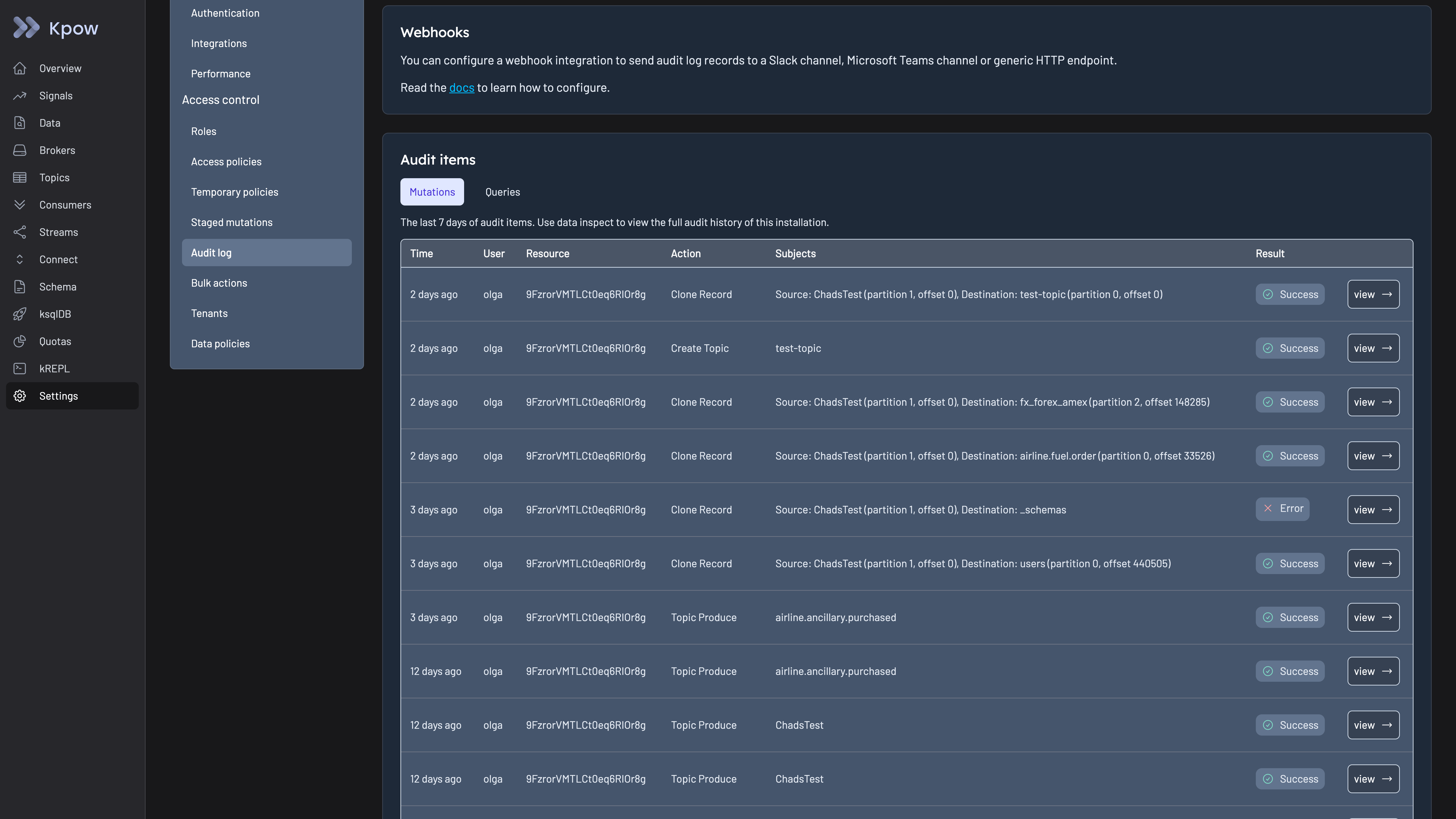
The Kpow audit log, showing the last seven days of changes with the time, the user and the result of each. The topics in this installation carry demo data; a pharma company’s own changes are recorded the same way.
Find the message that failed. When a pipeline stalls on one document, batch event or instrument reading, an engineer opens data inspect, selects the topics the message passes through, sets a time window, and filters by key, value or header with kJQ. The search runs on the server, so nobody writes a throwaway consumer against production, and the query itself lands in the audit log. The schema view shows the structure each payload should have.
Mask fields people should not see. Data policies redact chosen fields, such as participant or patient identifiers, in Data Inspect and ksqlDB results on the server, so an engineer tracing a fault sees the structure and status of a message without those values.
Govern Flink jobs the same way. Companies that run Apache Flink beside Kafka can put the same directory sign-in and Allow, Deny or Stage policies over their Flink jobs with Flex.
Keep the controls Kpow does not supply. Kpow does not win on every point. It is not validated or qualified for a company in advance, and that work stays with the company’s quality system. Its audit log is kept for seven days in the product and one week by default on its topic, so the long-term record depends on the webhook and on the system that receives it. It has no electronic signatures, so an approval of a staged change is an audit record and not a Part 11 signature. It governs people working through Kpow, not services connecting to brokers, so broker ACLs or an authorizer remain the control for applications: ACLs decide what an application’s principal can do at the broker, and Kpow’s roles decide what a person can do through Kpow. Every governance feature on this page is Enterprise; Community Edition is free for 3 clusters and 10 users but holds none of them.
To see these screens before installing anything, the live Kpow demo needs no signup and shows data inspect with kJQ, consumer groups, topic management and the audit log topic on two MSK clusters. A reader can check the rubric against the product there by running a kJQ search across topics, following a consumer group’s lag, and then opening the __oprtr_audit_log topic on MSK Secondary to see what the audit trail records. The demo has no SSO and no data policies configured, so sign-in and masking are the two things to test in the company’s own environment. To run the workflows against the company’s own clusters, install Kpow from its container image or JAR; tenants, RBAC, temporary policies, staged mutations, masking and the audit log are Kpow Enterprise features, and Community Edition is free for 3 clusters and 10 users.
Kpow live demo
Read the audit trail the way a quality or IT compliance reviewer would
The live Kpow demo needs no signup. Browse topics and consumer groups on two clusters, search messages with kJQ, then read the audit trail on the __oprtr_audit_log topic of the MSK Secondary cluster.
For platform and IT quality teams running Kafka under research, manufacturing and supply systems.
Try the Kpow demoFAQ
What is the best Kafka management tool for a pharma or life sciences company?
On this page’s rubric, Kpow: it runs as one container with no external database and nothing in the data path, records every action and data query with the person from the company’s directory, holds changes for a second person’s approval, grants time-boxed production access through its API, manages on-prem and cloud clusters from one deployment, and searches message content across topics with kJQ. Kafbat UI is the strongest free option, but it has no approval step, no expiring access grants and no view of its audit trail. For a small team that only needs to browse, search and manage topics, Kpow Community Edition is free for 3 clusters and 10 users, without the governance features scored here.
Is there a 21 CFR Part 11 compliant Kafka management tool?
No tool is Part 11 compliant on its own. The controls in 21 CFR 11.10 are written for the persons who use systems to create, modify, maintain or transmit electronic records, and they begin with validation of those systems, which only the regulated company can do for its own use. A Kafka management tool is one of the mechanisms a company uses to meet some of them, through its sign-in, its authority checks, its approval step and its audit log. Kpow supplies those mechanisms from inside the company’s own environment. It does not supply electronic signatures, and it does not retain its audit log for the life of the records, so that record has to be sent to a system the company controls.
Does 21 CFR Part 11 apply to Kafka?
Part 11 does not name Kafka or any technology. FDA’s guidance on the scope and application of Part 11 says the agency interprets the scope narrowly, around records that predicate rules require to be maintained or submitted, and recommends that companies determine and document which of their records are Part 11 records. Whether a Kafka topic carrying batch, laboratory or quality data is one of them is the company’s own determination. Many platform teams apply the same access, change and audit discipline to every production cluster so that the answer does not depend on which topics a cluster happens to carry.
What does EU GMP Annex 11 ask of a tool like this?
Annex 11 applies to computerised systems used as part of GMP regulated activities. For a tool that people use to operate such a system, the relevant clauses are the principle that the application should be validated and IT infrastructure qualified, clause 9 on audit trails that are available, intelligible and regularly reviewed, clause 10 on changes made only in a controlled manner, and clause 12 on restricting access to authorised persons and recording the creation, change and cancellation of access authorisations. In Kpow these map to directory sign-in, RBAC, staged mutations, temporary policies and the audit log, and the validation itself remains the company’s work.
Can engineers share one account in a Kafka UI at a GMP site?
Only for viewing data. FDA’s questions and answers on data integrity accept shared, read-only accounts that cannot modify data or settings for viewing data, but say that shared login credentials do not conform to the CGMP requirements for actions to be attributable to a specific individual, and the MHRA’s GXP data integrity guidance says that where a system supports individual user access, that function must be used. A Kafka UI in which people create topics, reset offsets, produce messages or approve changes therefore needs named accounts, ideally from the company’s directory, and its own audit log, because the brokers see only the tool’s service account.
How long does Kpow keep its audit log?
The audit log view in the product covers the last seven days, and the record is written to the __oprtr_audit_log topic on the company’s own cluster, where Kpow’s topics default to one week of retention. For anything longer, webhooks send each mutation, each data inspect query or both to an endpoint the company chooses, such as a SIEM, and the company’s retention rules apply there. A company that needs the record for as long as its regulated records should treat the webhook as a required part of the installation.
Is a Kafka proxy a problem in a regulated pharma environment?
A proxy is a deliberate choice with real uses, such as enforcing policy on applications. In a regulated environment it is also one more component in the data path that has to be sized, run for high availability, qualified and kept under change control, and Kai Waehner notes that the extra network hop can slightly increase end-to-end latency. A management tool that connects as an ordinary Kafka client avoids that, because producers and consumers never pass through it.
Can Kpow manage on-premises and cloud Kafka clusters together?
Yes. One Kpow instance connects to self-managed Apache Kafka, Confluent Platform, Confluent Cloud and Amazon MSK together, up to 12 clusters, with one set of roles and one audit log across them. Its documentation asks for it to run close to the clusters it manages, so a company with clusters in a site data center and in a distant cloud region runs an instance in each. Best tools to manage multiple Kafka clusters from one place compares the options in detail.
Do pharma companies need a different Kafka tool from healthcare organisations?
The tool can be the same, but the priorities differ. The healthcare organisations page weights the record of who read patient data most heavily, under the HIPAA Security Rule. This page gives the same weight to controlled change and authorised access, because Part 11 and Annex 11 are about the integrity of records and systems as well as who looked at them, and it scores on-prem and cloud reach because published pharma architectures span both.
How these tools were scored
Six criteria, each taken from FDA 21 CFR Part 11, EU GMP Annex 11 or published accounts of Kafka in pharma and life sciences, score every option from 0 to 10. They are listed here in order of weight; the weights add up to 12, so the total is out of 120.
1. Out of the data path. A management tool that runs in the company’s own environment, connects as an ordinary Kafka client and keeps no data outside the company’s clusters adds nothing between the company’s applications and the brokers, and adds the fewest components to the systems a regulated company has to qualify and keep under change control. Scored lower: tools that need an external database, and tools whose controls work only when application traffic passes through a vendor’s proxy. A self-hosted container with no external database and no proxy scores 9, a tool with a database of its own 6, one with several databases or a component on the brokers 4, and one that needs both a database and a proxy for its controls 3; 10 is kept for an option with nothing to deploy at all. This criterion is scored the same way on every Factor House page that uses it, and only its weight changes with the reader.
2. Audit trail per person. When people work through a shared tool, the broker only sees the tool’s service account, so only the tool’s own log can name the person. A regulated company needs that log to record changes and data reads against a named person with a time, and to be readable without building a consumer first. How long each tool keeps the record is not scored here, and each card says where the long-term record has to live. Kafka audit logging tools compares the layers in detail.
3. Production access on request. Can a change such as creating a topic or resetting offsets be held for a second person’s approval? Can an engineer be given read access to a production topic for a task, approved and time-boxed, without a standing grant? And is sensitive data masked for the people who do get in? The wider set of controls over deletes and offset resets is compared in Kafka destructive operations tools, and masking in best Kafka data masking tools.
4. Directory and Kafka sign-in. People should sign in as named individuals through the company’s directory, whether that is LDAP directly or SAML and OIDC in front of Active Directory or Entra ID, with directory groups mapped to roles. On the cluster side the tool has to connect the way the company’s clusters already authenticate clients, whether that is SASL, Kerberos or mutual TLS. Kafka SSO tools covers the protocol detail.
5. On-prem and cloud together. Where a company runs clusters in its own data centers beside one or more clouds, as Bayer’s published DataHub does, one deployment of the tool should reach all of them under the same roles; the general comparison is best tools to manage multiple Kafka clusters from one place.
6. Inspecting topic data. Finding one failed document, batch event or reading means filtering messages by key, value or header across several topics, on the server, without writing a consumer against production. SQL over topics scores highest, filtered search across topics next, and browsing or filtering one topic at a time a point lower. Best Kafka message search tools covers search in detail.
Electronic signatures, validation documentation and record retention are not scored, because none of the six tools was found to supply them for Kafka operations and they remain the regulated company’s responsibility. The cost figures model a company running 4 clusters (development, test, pre-production and production) for 100 engineers at $120 an engineer-hour, the same model as the banks and government agencies pages, and each card prints its own assumptions. The general listicle view, without the pharma weighting, is in best Kafka management tools.
Every option is scored from 0 to 10 on each criterion, from the evidence and sources this page cites, and the reason for each score is on its card. The criteria are weighted: Out of the data path counts three times, Audit trail per person counts three times, Production access on request counts three times, Directory and Kafka sign-in counts once, On-prem and cloud together counts once and Inspecting topic data counts once, for a total out of 120. Out of the data path counts three times because EU GMP Annex 11 asks for the application to be validated and the IT infrastructure to be qualified, so a database of the tool's own or a vendor's proxy between applications and brokers is one more component to qualify, change-control and explain to an inspector. The per-person audit trail counts three times because 21 CFR 11.10(e) asks for secure, computer-generated, time-stamped audit trails of operator entries and actions, and when people work through a shared tool only the tool's own log can name the person. Production access on request also counts three times, because 21 CFR 11.10(d) and (g) limit system access to authorised individuals and require authority checks, and Annex 11 says changes to a computerised system should only be made in a controlled manner, which is what an approval step and an expiring grant provide. Directory sign-in, on-prem and cloud together, and inspecting topic data count once each. This page is published by Factor House, which makes Kpow. Every option is scored on the same rubric and the same sources: Kpow's per-criterion scores are set the same way as every other option's and are not adjusted, and the weights apply to every option alike. Kpow ranks first on its total of 107 out of 120. The other options follow by total. Conduktor is listed last whatever its total; on its total of 74 it would place third.
Related reading
- Kafka: the complete guide
- Best Kafka audit logging tools
- Kafka destructive operations tools
- Best Kafka management tools for healthcare organisations
- Best Kafka management tools for health technology and medical device companies
- Best Kafka management tools for manufacturers
- Best Kafka governance tools for financial services