
AKHQ: Review, pricing, and best alternatives in 2026
Table of contents


Key takeaways
- AKHQ is the most complete free Kafka UI available, covering multi-cluster management, Schema Registry, Kafka Connect, consumer group monitoring, ACL management, and LDAP/OIDC authentication in a single self-hosted tool.
- Memory behaviour under high-throughput message tailing or large consumer group counts is a documented operational risk, with multiple out-of-memory reports at heap sizes up to 14 GB and no published fix.
- The authentication layer is more mature than most free alternatives, but reaching fine-grained multi-cluster RBAC required Michelin to contribute code directly to the project; audit logging is absent throughout.
- Reddit practitioners consistently frame AKHQ as a starting point for small teams, with a recurring pattern of switching to commercial tooling once teams feel pain around auditability, self-service workflows, or scale.
- AKHQ has no data masking, no JMX metrics visualisation, no alerting, and no partition or replica management from the UI, making it unsuitable for regulated environments or operators who need those capabilities.
- For teams that need enterprise RBAC, data masking, audit logging, or commercially backed support, Kpow is worth evaluating as an alternative.
What is AKHQ?
AKHQ (formerly KafkaHQ) is an open-source Kafka management UI maintained by Ludovic Dehon (tchiotludo) under the Apache 2.0 licence. The project is hosted at https://github.com/tchiotludo/akhq. It is self-hosted, JVM-based, and built on Micronaut.
A single AKHQ deployment connects to one or more Kafka clusters and exposes topic browsing, live message tailing, message production, consumer group monitoring, Schema Registry management, Kafka Connect management, ACL management, and role-based access control with LDAP and OIDC integration. AWS MSK IAM authentication is also supported.
AKHQ has no commercial edition, no hosted SaaS version, and no paid support tier. All functionality is available in the open-source release. Enterprise users including Michelin and La Redoute have contributed features directly to the project.
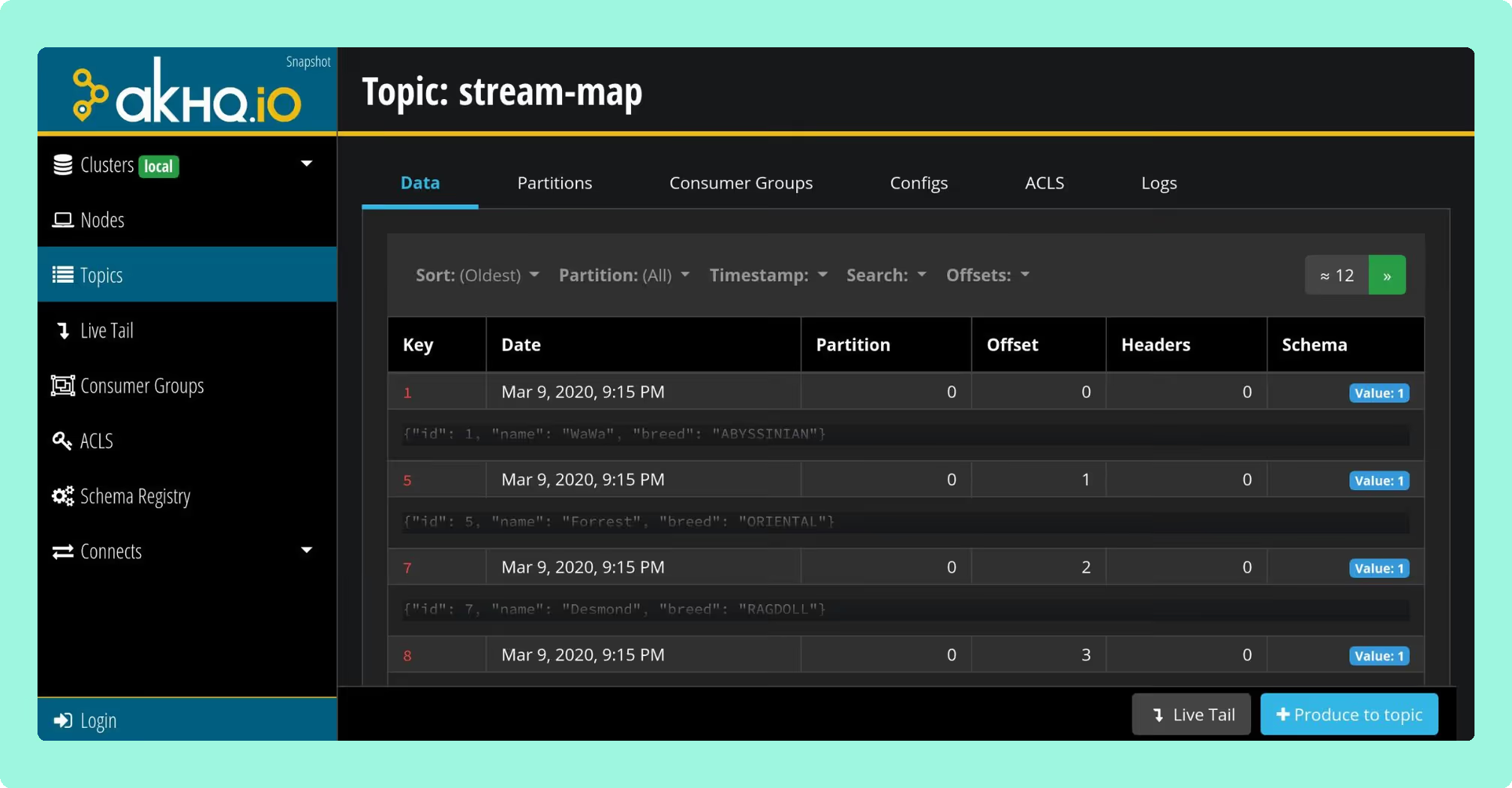
AKHQ review
Functionalities
AKHQ covers a broad surface area for a free tool. Named reviewers credit it with multi-cluster management, message browsing, live tailing, Schema Registry, Kafka Connect, ACL management, and RBAC in a single deployment. [German Osin, Medium / Towards Data Science, 2 Sep 2021]
The functional ceiling appears in a consistent set of areas. AKHQ does not support dynamic topic configuration, partition increase, replica change, Kafka Streams topology visualisation, or JMX metrics visualisation. [German Osin, same source; Zeenia Gupta, Platformatory blog, 5 Sep 2024] Protobuf support is partial: the schema registry integration is limited to the deserialiser side, and at least one user reports complete deserialization failure when using Protobuf with Apicurio Registry even when the descriptor-file flow works. [Zeenia Gupta, Platformatory blog, 5 Sep 2024; GitHub issue #1185] A related Avro bug causes AKHQ to fall back to raw message output when it cannot match a schema ID, leaving messages unparsed in the UI. [GitHub issue #1918, 2024]
ksqlDB integration is listed in AKHQ's configuration options but is effectively non-functional against Confluent Cloud endpoints. Configuring a Confluent ksqlDB endpoint produces a null pointer exception on the HTTP client (Cannot invoke io.vertx.core.http.HttpClientRequest.response(...) because request is null). [sbourell, GitHub issue #1954, 24 Sep 2024] A separate discussion thread reports that ksqlDB does not appear in the menus at all despite correct configuration. [GitHub Discussion #1486]
There is also a production workflow friction point: the message production dialog closes after each message, requiring the operator to reopen it and refill all fields when producing multiple messages in sequence. [xarx00, GitHub Discussion #805, Sep 2021]
Data masking is absent. For any team handling PII or operating under HIPAA, PCI-DSS, or GDPR requirements, this is a hard compliance gap.
AKHQ also has no built-in support for dead-letter queue (DLT) retry patterns or inline message payload correction. These capabilities require separate tooling, and the gap has driven some teams toward purpose-built event-streaming platforms that handle error recovery alongside broker management. [r/apachekafka, GitHub: i_built_a_spring_boot_starter_for_kafka_message, 2025]
Deployment and operations
Docker Compose and Helm installation are two of the most consistently praised aspects of AKHQ. Getting a full local stack including Kafka, Schema Registry, Kafka Connect, and AKHQ running requires a single docker compose pull followed by docker compose up, giving access to everything at localhost:8080. [AKHQ docs, akhq.io/docs/] Connections, users, groups, and schema registry links are defined in YAML and deployed via Helm, making the configuration GitOps-friendly. [Factor House, same URL above, 2026] Community feedback echoes this: one practitioner on r/apachekafka described it as "open source, can be installed on prem using their docker image, and it's very lightweight." [Drazul_, r/apachekafka, 2025]
AKHQ 0.24.0 has been successfully deployed on Red Hat OpenShift 4 using Helm with Kafka 3.3.1; Rogerio Santos at Red Hat describes it as "an excellent complement to AMQ streams." [Rogerio Santos, Red Hat Developer, 26 Jul 2023]
The operational risk is memory. A documented memory pattern on AWS ECS at 4 GB RAM shows "an ascending stair shape" with little or no deallocation between scans. [arnaud-ly, GitHub issue #1141, 5 Jul 2022] High-throughput topic tailing triggers a Direct buffer memory out-of-memory error even at 14 GB heap, which points to a missing backpressure mechanism rather than a simple heap sizing problem. [MichalPopielski, GitHub issue #1206, 13 Sep 2022] Neither issue has a published resolution. For clusters with many consumer groups, the AKHQ documentation itself recommends enabling HIDE_EMPTY and setting skip-consumer-groups: true as a workaround to keep startup responsive. [AKHQ docs, referenced in GitHub issue #271]
Security scan failures have also been reported against the official Docker image at version 0.24.0, related to vulnerabilities in bundled Java libraries. [GitHub issue #1771]
Access control and security
AKHQ supports LDAP, OIDC, HTTP basic authentication, and external role and attribute claim mapping. MSK IAM support was contributed and merged. [Zeenia Gupta, Platformatory blog, 5 Sep 2024; GitHub issue #810] This is a broader authentication story than most free Kafka UIs offer, and it is one of the primary reasons practitioners choose AKHQ over Kafdrop.
The limits become apparent under enterprise conditions. Michelin built their own resource-level RBAC layer on top of AKHQ because the default authorisation mechanisms were not granular enough for multi-cluster, multi-team use. Their contribution modified "all AKHQ features and authorization mechanisms (LDAP, OIDC, external claims)" and introduced an AKHQSecured annotation for fine-grained control. [Alexis Souquiere, Michelin engineering blog, 5 Mar 2024] An internal survey at Michelin in 2023 "revealed widespread dissatisfaction" with small issues that accumulated over time, and the team considered building an alternative before choosing to contribute instead. [Alexis Souquiere, same source]
Active auth bugs affect current releases. An Okta OIDC redirect loop sends authenticated users back to /ui/login when they click a topic linked to a restricted consumer group, affecting AKHQ 0.25.1. [ndemyanchuk-booking, GitHub issue #2131, 25 Mar 2025] A separate regression sends users to the login page despite a 200 OK on the initial login request. [GitHub issue #2055] LDAPS configuration also carries documented friction. [GitHub issues #887, #1041]
Audit logging is absent. Teams evaluating AKHQ alongside commercial alternatives will find that "AKHQ and Kafbat have basic RBAC but neither provides self-service workflows, team ownership models, audit logging, or the enterprise API that multi-team organisations need." [Factor House, same URL above, 2026] Without audit logs, there is no record of who reset a consumer offset, modified a broker configuration, or produced a message - a meaningful constraint for any team operating under change-management or compliance requirements.
User interface
The UI is functional and covers its stated scope, but it is consistently described as less polished and less responsive than Conduktor or modern Kafbat. The structural complaints are recurring: search filters reset when navigating between views, and content reloads from the server rather than from a cached client-side state, which creates a sluggish experience when switching between topics or schemas. [xarx00, GitHub Discussion #805, Sep 2021] The maintainer acknowledged performance and navigation debt in the same thread, noting that schema registry caching would be a prerequisite for any direct topic-to-schema navigation improvement.
German Osin's characterisation from 2021 remains consistent with more recent accounts: AKHQ "is not the most convenient" and users "will definitely need to allocate some time" to learn it. [German Osin, Medium / Towards Data Science, 2 Sep 2021] Comparison reviewers describe Kafbat's UI as "more modern" than AKHQ's. [Factor House, 2026] The Reddit community surfaces the same friction directly: one engineer summarised it as "you get what you pay for... since you pay nothing, you get a clunky UI/UX. It does its job, but leaves more to be desired (especially after you use Conduktor)." [roastedsun, r/apachekafka, 2025] A platform architect put it in practical terms: "if it's a startup and you just want visibility and basic management I'd try Kafka UI or AKHQ first. If you're feeling pain around 'who changed what' and 'how do we let devs self-serve without blowing stuff up' then look harder at Conduktor or Lenses." [TellersTech, r/apachekafka, 2025]
On the positive side, a practitioner walkthrough from March 2026 frames AKHQ as "a control tower for the entire Kafka ecosystem," removing the need to SSH into servers and run kafka shell scripts. [Naveen Mittal, Medium, 7 Mar 2026] Thoughtworks placed AKHQ in "Trial" status on their Technology Radar in 2022, citing topic browsing, Avro and Protobuf deserialization, and consumer group visibility as useful capabilities for teams working to understand data flows. [Thoughtworks Technology Radar, 29 Mar 2022] Day-to-day debugging tasks - message scanning, data discovery, and consumer group inspection - receive the most consistent praise from practitioners, and some larger engineering organisations run AKHQ alongside a commercial tool as a lightweight secondary viewer. [arcanumoid, r/apachekafka, 2025; r/apachekafka, urn8f3 thread, 2022]
Ecosystem
Schema Registry and Kafka Connect are well-supported and among the most cited reasons to choose AKHQ over lighter tools like Kafdrop. MSK IAM was added through a community contribution. Multi-cluster support is documented in production: Michelin uses AKHQ across on-premise factory clusters and cloud deployments to supervise topics, consumer groups, and connectors. [Alexis Souquiere, Michelin engineering blog, 5 Mar 2024] Rogerio Santos at Red Hat singles out multi-cluster support as a key advantage: "One of the features of AKHQ is its support for configuring multiple clusters, making it a convenient central GUI for managing multiple Kafka clusters." [Red Hat Developer, 26 Jul 2023]
The ksqlDB gap is the notable exception. The integration exists in configuration and was listed as a 0.24.0 feature contributed by 30+ contributors, but it does not function reliably against Confluent Cloud endpoints, and at least two community threads report it being absent from the UI despite correct configuration. [sbourell, GitHub issue #1954, 2024; GitHub Discussion #1486; akhq.io LinkedIn post on the 0.24.0 release]
Customer support
AKHQ has no commercial support tier, no SLA, and no enterprise offering. The project is functionally a single-maintainer effort led by Ludovic Dehon, with major feature contributions from a small set of enterprise users. La Redoute's distributed OSPO experience building an open-source Kafka product is documented; Michelin is a recognised core contributor. [La Redoute engineering blog, summarised via search result; Alexis Souquiere, Michelin engineering blog, 5 Mar 2024]
Open issues can wait months for a response. The memory leak reported in issue #1141 dates to July 2022 with no published fix or maintainer comment. The Confluent ksqlDB issue #1954 was labelled "wait for reply" with no visible maintainer response in the thread. Documentation covers the happy path well but is thin on production tuning guidance and auth edge cases, with HTTPS Schema Registry configuration appearing as a recurring community discussion topic. [GitHub Discussion #575]
Best for
AKHQ suits individual engineers and small platform teams that need real authentication (LDAP/OIDC), Schema Registry and Connect management, MSK IAM support, and multi-cluster visibility in one self-hosted tool at zero licensing cost. It is a credible production choice for OpenShift shops running AMQ Streams, and for teams who want GitOps-friendly YAML configuration and a mature Helm chart. Engineers replacing ad hoc CLI workflows - SSH sessions and kafka shell scripts - will find AKHQ a meaningful step forward. Some larger organisations also run it as a lightweight secondary viewer alongside a commercial platform, using it for quick message browsing while relying on the commercial tool for access control and governance.
It stops being a sufficient fit when teams grow beyond roughly five engineers sharing a cluster, when compliance requirements mandate data masking or audit logging, when operators need JMX metrics or alerting built into the UI, or when the cluster runs Confluent ksqlDB. Teams handling PII or operating in regulated industries should treat the absence of data masking as a hard constraint rather than a roadmap item. The operational overhead of maintaining a web-based server has also pushed some engineers toward desktop-native Kafka clients that require no Docker daemon to run; tools like KafkIO and Swifka have emerged to serve that preference. [r/apachekafka, rkquik thread, 2025; r/apachekafka, rash5y thread, 2025]
AKHQ pricing
AKHQ is free and open-source under the Apache 2.0 licence. There is no paid edition, no hosted SaaS option, and no commercial support offering.
Pricing tiers
Free trial
No trial period applies. The full project is available at https://github.com/tchiotludo/akhq with no feature restrictions or registration requirements.
AKHQ competitors and alternatives
AKHQ competes with a range of self-hosted and commercial Kafka management tools, from lightweight topic browsers like Kafdrop to full governance platforms like Kpow. The right fit depends on how much operational maturity, compliance capability, and support you need beyond what the open-source tier provides.
For a broader comparison across all major Kafka UI tools, see the Factor House Kafka UI tools comparison.
Frequently asked questions about AKHQ
How much does AKHQ cost, and is there a free tier?
AKHQ is fully free under the Apache 2.0 licence. There is no paid tier, no SaaS option, and no commercial support offering. All features are available in the open-source release with no restrictions or registration required.
When is AKHQ a better choice than the alternatives?
AKHQ is the strongest free option when you need LDAP/OIDC authentication, Schema Registry and Connect management, MSK IAM support, and multi-cluster visibility in one self-hosted tool. It has a more mature auth story than Kafdrop and broader ecosystem coverage than Redpanda Console's open-source tier.
When are the alternatives a better choice than AKHQ?
Consider a commercial alternative when you need data masking, audit logging, JMX metrics, alerting, or working ksqlDB integration. AKHQ's single-maintainer governance model and documented out-of-memory behaviour under high-throughput tailing also make alternatives worth evaluating for large-scale or regulated deployments.
Is AKHQ actively maintained?
Active, but with a single primary maintainer. Ludovic Dehon leads development, with contributions from enterprise users including Michelin and La Redoute. Some issues sit without a maintainer response for months. There is no commercial entity behind the project and no SLA.