
Lenses.io: Review, pricing, and best alternatives in 2026
Table of contents


Lenses.io is a commercial Kafka management platform that sits on top of your existing Kafka clusters, adding a SQL querying interface, topology visualisation, and a data catalog for multi-cluster environments. This review draws on practitioner feedback collected through mid-2026 to give you an honest picture of where the product delivers value and where it falls short.
Key takeaways
- Lenses.io's SQL Studio is its standout feature, giving non-Kafka-savvy team members a familiar interface for inspecting and troubleshooting topics without writing consumer code.
- Multi-cluster topology and cross-cluster data lineage are genuine differentiators for organisations running several Kafka deployments across clouds or regions.
- Deployment complexity, upgrade friction, and the absence of a high-availability option for the Lenses HQ control plane are recurring concerns in practitioner reviews through 2025-2026.
- The community edition caps at two clusters and five users with basic authentication only; SSO, RBAC, and SAML all require the Team tier at a minimum of $4,000/year.
- Lenses was acquired by Celonis in early 2022, leading to uncertainty about future development. The product has continued as a standalone offering and has received some version updates since then.
- If your primary need is operational observability, audit logging, or data masking across Kafka clusters, Kpow by Factor House is worth evaluating alongside Lenses.io.
What is Lenses.io?
Lenses.io is a Kafka governance and data exploration platform. It connects to one or more Kafka clusters and surfaces topic data, schema information, consumer group state, and Kafka Connect configuration through a browser-based UI. Its primary differentiator is SQL Studio, a proprietary SQL interface that lets engineers and analysts query Kafka topics using familiar syntax without writing Kafka consumer code.
The platform also provides a topology view that maps data lineage across topics, connectors, and applications (including externally registered Flink jobs). A data catalog groups topics by logical domain and supports schema registry integration.
Lenses operates as a Kafka client; it does not sit in the data path and does not act as a proxy. The current architecture consists of a central Lenses HQ node and lightweight agents deployed per cluster. KRaft clusters are supported without modification, since the agent connects as a standard Kafka client.
Within the Kafka tooling ecosystem, practitioners draw a distinction between lightweight desktop clients designed for quick topic inspection and enterprise control planes that add governance, RBAC, and audit workflows. Lenses.io sits firmly in the latter category: its value becomes most apparent once multiple teams are sharing a cluster infrastructure and need guardrails around access, configuration changes, and data visibility.
The product is available in three tiers: a free community edition, a Team edition, and an Enterprise edition.
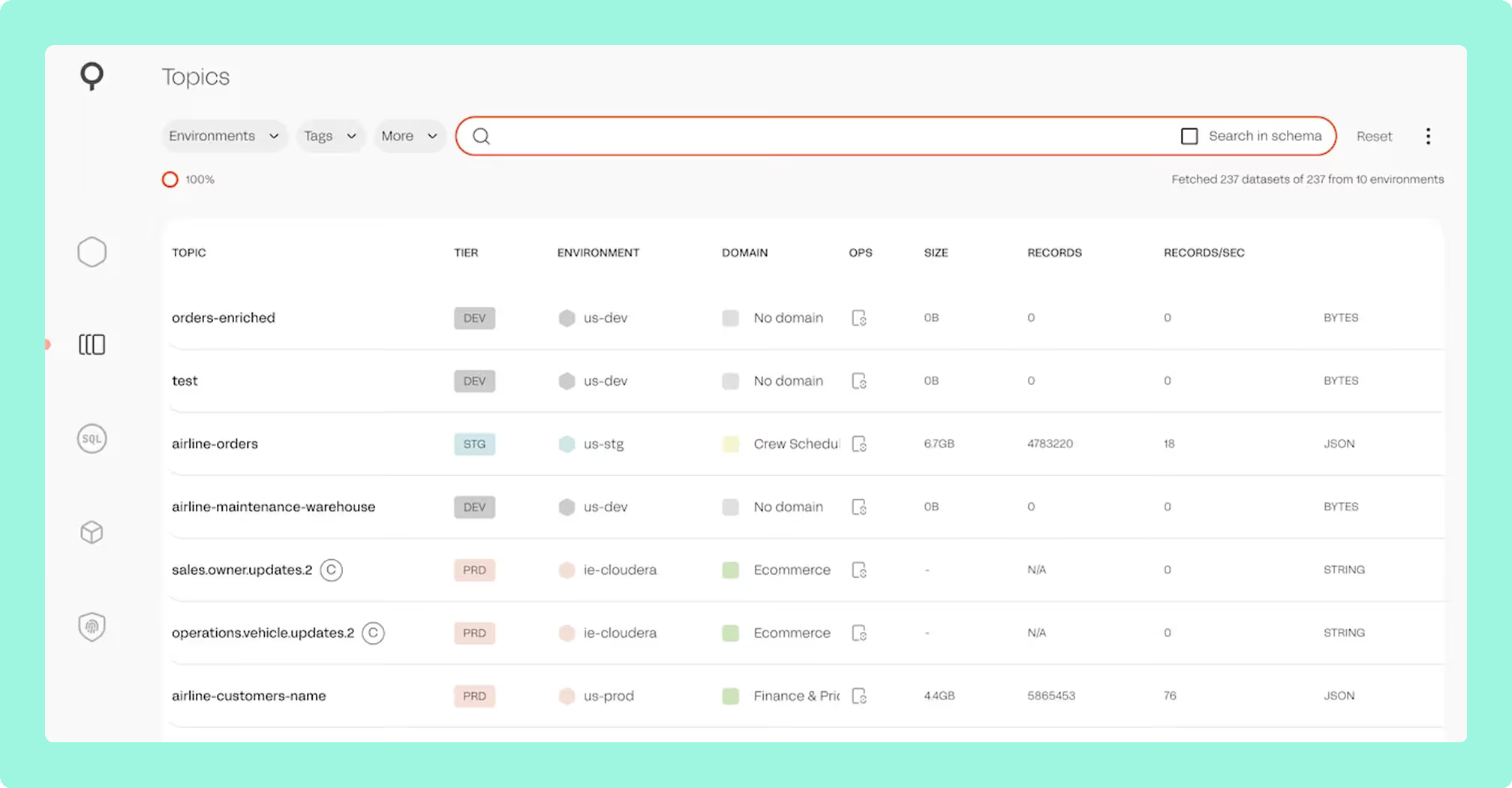
Lenses.io review
Functionalities
The SQL Studio is consistently the most praised aspect of Lenses.io in practitioner reviews. Juan Luis d. on G2 (November 2025) described it as "providing a straightforward way to troubleshoot problem cases and check topic metrics," with the broader UI characterised as "accessible for both experienced individuals as well as those who are not very familiar with Kafka development." Community discussion on r/apachekafka echoes this: engineers highlight that SQL Studio lowers the barrier for team members who are not comfortable with Kafka's internal mechanics, replacing the need to search through millions of raw JSON, Avro, or Protobuf payloads with familiar query syntax.
The topology and lineage view is the second most cited strength. In multi-cluster environments where teams need a single pane of glass across producers, topics, connectors, and consumers, the topology view reduces the operational overhead of maintaining that picture manually.
Lenses.io also provides SQL Processors, Kubernetes-native stream processing engines built on Kafka Streams. These allow teams to define stateful and stateless processing rules in SQL, compiled and executed within a Kubernetes cluster, without maintaining a dedicated Flink or Spark infrastructure. For straightforward transformation and filtering tasks, this can be a practical option. However, the proprietary nature of SQL Processors is a meaningful consideration. Jose Manuel C. on G2 (November 2025) wrote: "Some of Lenses' functionalities that are not open-source create a vendor lock-in, with SQL Processors being the most clear example... the tradeoff doesn't pay off in the long run." Teams considering SQL Processors as a core part of their architecture should weigh portability before committing.
The limitations are equally consistent across reviews. The ACL management interface has not advanced meaningfully across major releases: one unnamed G2 reviewer from the retail sector noted that version 6 "introduced a new interface, but the same issues remain: the ACLs listing is still too basic." Bug resolution is perceived as slow, with Juan Luis d. noting "ongoing bugs within Lenses that remain unresolved, highlighting a potential lack of responsiveness in bug fixes." One practitioner on r/apachekafka put it more directly: "I often felt like a QA for Lenses developers as a customer and it was exhausting."
Schema Registry integration exists but was described by Berta m. on G2 (November 2025) as "not entirely optimal" in terms of schema inference accuracy.
Deployment and operations
Lenses.io supports Helm-based Kubernetes deployment, which is the recommended path. In practice, practitioners have encountered meaningful friction here.
The platform runs a server-side JVM backend alongside its web interface, which makes it a relatively resource-intensive deployment. This comes up frequently in community discussions: developers who only need to inspect local topics during development find the Docker and JVM overhead excessive compared to lighter alternatives. Starting with version 5, the community edition also restricts connections to single-node clusters, which has frustrated users attempting to test multi-broker SSL-enabled environments locally. Several have reported rolling back to version 4.3 to retain multi-broker support in their trial setups.
Upgrades to Lenses 6 HQ triggered Liquibase database migration errors in at least one documented case on the community forum (ask.lenses.io, November 2025), where a column-rename operation failed depending on the source version and database backend. A separate reported issue involved Traefik ingress login loops caused by the default secureSessionCookies: true setting, which breaks non-HTTPS environments; the workaround requires adding lensesHq.http.secureSessionCookies: false to values.yaml.
A third operational issue affects teams connecting Lenses to Amazon MSK: the default broker metrics refresh interval (approximately 5 seconds) generates an unexpectedly high volume of JMX requests against MSK's OpenMetrics/Prometheus-backed JMX exporter. The recommended workaround is to set the interval to 30 seconds or higher (ask.lenses.io, April-May 2026).
Lenses HQ does not support high availability in the current architecture. Multiple G2 reviewers in 2025 identified this as a gap, particularly in production environments where the control plane itself needs to be resilient. The community edition further limits deployment to two clusters with five users and basic authentication only; a Helm chart for community edition was still a feature request as recently as May 2025.
Access control and security
SSO (Okta, Keycloak, OneLogin, Google, Azure/Entra ID) and RBAC are available but gated to the Team tier at $4,000/year minimum. The community edition provides only username/password authentication.
LDAP integration has had documented instability across recent releases. A connection-reset bug was fixed in v5.5.14 (December 2024). Version 5.5.6 (August 2024) introduced a breaking behaviour change: new LDAP users are no longer automatically created unless they belong to a mapped group, which silently broke access for teams relying on the previous behaviour.
Azure Entra ID SAML integration has a documented limitation: Azure exposes only Group UUIDs (not group names) via SAML, requiring administrators to use UUID strings as group identifiers within Lenses. Google SSO requires custom attribute mapping because Google does not expose user groups or organisation units to SAML applications by default.
The read-only account use case, a common requirement for giving stakeholders visibility without change permissions, was an unanswered question on the community forum as of August 2025, which suggests RBAC granularity for viewer-only roles is either not well-documented or not straightforward to configure in v6.
It is worth noting that identity provider support has historically been a point of friction with Lenses. The team behind Kowl (now Redpanda Console) cited Lenses' lack of support for their preferred identity provider and group configurations as one of the motivating reasons they built their own tool.
User interface
The general UI receives consistently positive marks in practitioner reviews. Descriptions include "simple and effective" (unnamed reviewer, retail sector, G2, November 2025), "user friendly, easy to use" (unnamed reviewer, apparel sector, G2, November 2025), and praise for the ease with which non-engineers can interact with topic configurations.
The version 6 redesign refreshed the visual style but did not resolve the underlying capability gaps that existed in v5. The ACL management views remain limited, and the deployment experience was still described as "complicated" by reviewers writing after the v6 release. Documentation quality is also cited as a persistent concern, with multiple reviewers in 2025 describing it as "insufficient and unclear."
Ecosystem
Lenses operates as a Kafka client and integrates with Schema Registry, Kafka Connect, and the Topology view can include externally registered Flink jobs for monitoring (though Flink is not natively managed through the platform). KRaft clusters are supported; the only known limitation is a minor display bug where the controller count is not shown correctly on KRaft clusters (confirmed by a Lenses team member on ask.lenses.io, July 2025).
The open-source Stream Reactor connector library extends Lenses with a range of sinks and sources. Active GitHub issues from late 2025 through early 2026 show a maintenance backlog for the S3 connector (ByteArrayConverter envelope restoration failures, ConnectionClosedException on S3 Source), an MQTT source SchemaParseException triggered by topic names containing hyphens, and Azure Data Lake Gen2 connector header errors.
Teams connecting to MSK Serverless with IAM authentication should note a documented access-denied issue: Lenses 6 Agent requires kafka-cluster:* IAM actions, not the broader kafka:* scope. A well-documented workaround exists on the community forum.
Celonis acquisition and product continuity
Celonis acquired Lenses.io in early 2022. At the time, the acquisition generated significant uncertainty within the Kafka community, with several engineers on r/dataengineering and r/apachekafka speculating that Celonis had bought the company primarily for its core technology and planned to discontinue the standalone product.
Lenses.io continues to operate as a standalone commercial product, and the cadence of version releases (including 5.3, 5.4, and the version 6 UI redesign) indicates that Celonis has maintained some active development. For teams evaluating the product, the acquisition risk appears lower than it did in 2022 and 2023, though Celonis has not publicly committed to a long-term standalone roadmap in specific terms.
Customer support
Community edition users rely on the public forum (ask.lenses.io) and documentation. The forum is actively monitored by a small number of Lenses team members, and response quality for technical issues is generally fair. Enterprise support SLAs are available at the Team and Enterprise tiers.
Independent review coverage is thin. Gartner Peer Insights has two ratings as of mid-2026, giving Lenses a 3.7/5 overall with a 50% willingness to recommend. TrustRadius and PeerSpot had insufficient or no reviews to report an aggregate score at the time of this research. Roadmap clarity and documentation quality were the most frequently cited support-related concerns in 2025 G2 reviews.
Best for
Lenses.io is a good fit for teams where the primary use case is giving business analysts or less Kafka-savvy engineers self-service access to Kafka topic data through a familiar SQL interface, without requiring them to write consumer code or understand Kafka internals. It is also well-suited to organisations running multiple Kafka clusters across regions or cloud accounts who need unified topology visibility and cross-cluster querying.
It is worth evaluating carefully if your organisation is small or budget-constrained (the step from the community edition to the Team tier is significant), if high availability for the control plane is a hard requirement, or if you are building on Kafka primarily for operational observability and governance rather than SQL-based data exploration.
Lenses.io pricing
Lenses.io uses a tiered model with a free community edition and two paid tiers. Pricing details are based on the Lenses pricing page and community forum sources.
Pricing tiers
The jump from Community to Team is steep for smaller teams. SSO and any form of role-based access control require the paid Team tier, which starts at $4,000/year. The community edition's two-cluster ceiling also limits its usefulness for anything beyond a single development or staging environment.
Self-hosting context
One recurring theme in community discussion is the financial case for self-hosting Kafka on Kubernetes with an operator like Strimzi, combined with a commercial management plane. Engineers on r/apachekafka have noted that managed Kafka pricing can change significantly with billing model updates: one example cited a partition-based fee change that would have increased monthly costs from $30 to $1,200 for a single team. Against that backdrop, the predictability of a fixed annual licence for Lenses (or an alternative like Kpow) can be attractive, even at the Team tier price point.
Free trial
A time-limited trial of the Team or Enterprise edition is not available from the Lenses website.
Lenses.io competitors and alternatives
Lenses.io occupies a specific niche: SQL-based self-service access and multi-cluster topology for teams investing in a DataOps model. Depending on your actual requirements, other tools may be a better fit. The table below covers the most relevant alternatives across open-source and commercial options.
For a more detailed comparison of Kafka UI tooling, see our guide to Kafka UI tools in 2026.
Frequently asked questions about Lenses.io
How much does Lenses.io cost, and is there a free tier?
The community edition is free and supports 2 clusters and 5 users with basic authentication only. From version 5, the community edition is also restricted to single-node clusters. SSO and RBAC require the Team tier, which starts at $4,000/year. Enterprise pricing is available on request.
When is Lenses.io a better choice than the alternatives?
Lenses.io is strongest when your team needs SQL-based self-service access to Kafka topics for non-engineering stakeholders, or when you need unified topology visibility and cross-cluster querying across multiple Kafka deployments. No comparable OSS tool provides an equivalent SQL Studio experience.
When are the alternatives a better choice than Lenses.io?
If your primary need is operational governance (audit logging, data masking, gateway-level policy enforcement), Conduktor's proxy architecture is better suited. For teams whose main requirement is comprehensive RBAC, audit logging, and stateless deployment without an external database dependency, Kpow is worth evaluating. For small teams or single-cluster deployments, the community edition's limits and the $4,000/year jump to SSO make the cost-to-value ratio difficult to justify against open-source alternatives.
Does Lenses.io support KRaft?
Yes. Lenses connects to Kafka clusters as a standard client, so KRaft clusters work without modification. There is a minor known display issue where the controller count is not shown correctly on KRaft clusters, confirmed by the Lenses team in July 2025.
Is there high availability for the Lenses control plane?
Not in the current architecture. Lenses HQ is a single-node deployment. Multiple practitioner reviews from 2025 identified the absence of native HA as a gap for production control-plane resilience. Manual workarounds are possible but are not a supported configuration.
Is Lenses.io still actively developed following the Celonis acquisition?
Yes. Celonis acquired Lenses.io in early 2022, which initially prompted concern in the community about product continuity. The product has continued as a standalone offering since then, with version updates including a full v6 UI redesign and ongoing connector and feature development. Community forum support from Lenses team members has remained active.