
Kafbat UI: Review, pricing, and best alternatives in 2026
Table of contents


Key takeaways
- Kafbat is a free, open-source Kafka UI forked from the abandoned Provectus kafka-ui project in early 2024, maintained by community volunteers with no commercial backing and no SLA.
- The tool covers the core Kafka visibility surface well: multi-cluster management, Avro/Protobuf/JSON deserialization, Schema Registry, Kafka Connect, and CEL-based message filtering.
- Regression bugs across minor version upgrades have repeatedly broken Confluent Cloud connectivity and Schema Registry serde auto-selection; many users on v1.3.0 choose to stay there rather than upgrade.
- RBAC is available but shallow: configuration is error-prone and fails silently, with no team namespacing, no per-role data masking override, and no approval workflows.
- For teams that need enterprise-grade access controls, reliable support, and a commercial SLA, Kpow from Factor House is worth evaluating alongside Kafbat.
What is Kafbat?
Kafbat is a web-based UI for Apache Kafka clusters. It is the active continuation of the Provectus kafka-ui project, which paused development in late 2023 and left a critical remote code execution vulnerability unpatched for approximately six months. In early 2024, core contributors led by Roman Zabaluev (GitHub: Haarolean) and germanosin forked the project to kafbat/kafka-ui and released v1.0.0 in March 2024.
The project operates under a GitHub Sponsors model. There is no commercial backer, no paid tier, and no SLA. Development velocity is determined by volunteer contributor interest and the priorities of the core maintainers.
The fork was well received across developer communities. On r/apachekafka, users expressed relief that the project was continuing and verified that their existing configurations carried over: "Looks like a fork, at least I tried it as is, and it is compatible with my old deployment" (Low-Iron6962, r/apachekafka, March 2024). The maintainer confirmed backward compatibility was a deliberate goal for the initial release.
At its core, Kafbat supports multi-cluster management, topic browsing, message inspection with Avro/Protobuf/JSON Schema deserialization, consumer group lag monitoring, Schema Registry integration, Kafka Connect management, and ACL administration. Version 1.3.0 (July 2025) added GCP IAM authentication and MCP (Model Context Protocol) support. Version 1.5.0 introduced live consumer lag updates.
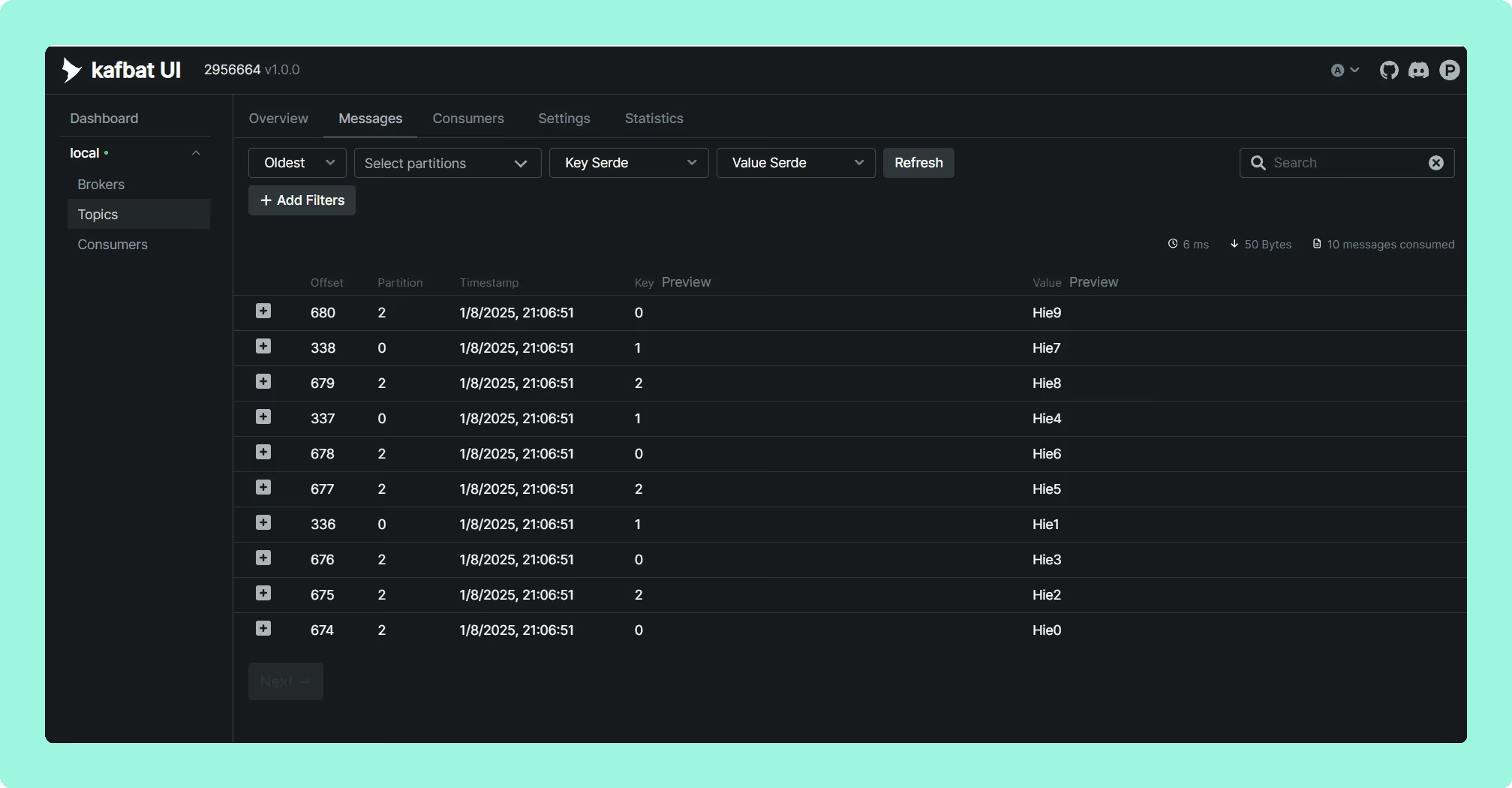
Kafbat review
Functionalities
Kafbat's core visibility features are solid for a free tool. Topic browsing, message inspection, and Schema Registry deserialization work reliably in stable releases. The move from Groovy-based scripting to CEL (Common Expression Language) filters is consistently praised: it removes the Groovy-based RCE risk while giving users a more expressive and readable filter syntax.
That said, the functionality surface has recurring rough edges. Consumer lag accuracy is unreliable when transactional producers are in use: end-of-transaction marker messages are counted in the lag calculation, causing persistently elevated readings that do not reflect actual consumer progress (krumft, GitHub Issue #1039, April 2025). Filtering behaviour under high message volumes has been described as "unstable and unpredictable" (Rajan Gaul, Product Hunt, approximately February 2026). CEL filters are not persisted between sessions, requiring users to re-enter them on every login (GitHub Issue #1401, October 2025).
There is no message replay capability from the UI, and no ability to add brokers, increase partitions, rebalance, or change replica counts from the interface (Zeenia Gupta, Platformatory, September 2024). These are open feature requests rather than bugs, but they matter for teams that need operational tooling, not just observational tooling.
This scope is broadly understood by community users. One r/apachekafka developer summarised it well: "Kafka UI is great if what you want is a simple CLI replacement... browse topics, consumer groups/lag, tweak configs, peek messages, and mess with Schema Registry without everyone needing 8 terminal tabs. Conduktor / Lenses are more 'we want guardrails + governance + workflows' than 'give me a UI'" (TellersTech, r/apachekafka, approximately 2025). Kafbat is a strong observational console; it is not a change-management platform.
Deployment and operations
Docker deployment is fast: the project is launchable with a single command and accessible at localhost:8080 (Vorrawut Judasri, Medium, October 2024). A Helm chart is actively maintained for Kubernetes deployments, with quick-start documentation available. Some users bypass Docker entirely by downloading the JAR and running it directly from the terminal, which avoids the 4 GB RAM minimum the default Docker configuration recommends (vernochan, r/apachekafka, approximately 2025).
The main operational pain point is dynamic cluster configuration in Kubernetes. Users who attempt to add clusters through the UI in a Kubernetes deployment consistently receive 400 Bad Request validation errors. Static YAML configuration works; dynamic configuration does not. Documentation on how to deploy with dynamic config via Helm is described by multiple users as absent or insufficient (RaWqqq8, GitHub Issue #1637, January 2026).
Other operational issues to be aware of:
- Spring Boot 3.4.4 reports unbound properties when cluster config is injected via environment variables, blocking AWS Secrets Manager and similar cloud-native secret patterns (Heniland, GitHub Issue #1045, April 2025).
- AWS IAM authentication via STS temporary tokens requires manual JAAS config injection through environment variables, and credential rotation is not documented for this pattern (r/apachekafka, approximately 2025).
- The Helm chart cannot mix
yamlApplicationConfigwith an existing secret, has noextraDeploysupport, and does not expose deployment strategy configuration (Helm chart issues #43, #57, #47). - The default Docker configuration recommends 4 GB RAM minimum, which can catch teams running smaller instances.
Access control and security
Kafbat supports YAML-based RBAC, OAuth2 (Google, GitHub, Azure AD), LDAP/Active Directory, and basic auth. Active Directory support was added in v1.1.0 in response to demand carried over from the Provectus project. Community users cite this as a meaningful differentiator among free tools: "Unlike most free UIs, it comes with Active Directory integration for security which is a big plus for us" (Hopeful-Programmer25, r/apachekafka, approximately 2025). Data masking is available with REMOVE, REPLACE, and MASK policies. Audit logging ships as a built-in feature, writing events to a Kafka topic.
In practice, RBAC configuration is error-prone. The most common failure mode is a mismatch between the OAuth token attribute used for subject matching and the email or username format in the RBAC YAML, causing silent permission failures where users cannot see any clusters at all. The project's own FAQ directs users to enable trace logging on io.kafbat.ui.service.rbac.extractor to diagnose the problem (kafbat RBAC FAQ; GitHub Discussion #290, April 2024).
The security record warrants scrutiny for compliance-sensitive teams. CVE-2025-49127 (CVSS 10.0) was introduced in kafbat's own v1.0.0: the application accepted user-provided JMX endpoints without validation, and a 30-second scheduler automatically connected to them, allowing any unauthenticated user to trigger unsafe Java deserialization and execute arbitrary code. It was patched in v1.1.0 (SecureLayer7, July 2025). This follows CVE-2023-52251, an RCE inherited from Provectus that took approximately six months to be patched under the original maintainers.
Further gaps: there is no per-role data masking override (feature requested but not yet implemented; GitHub Issue #1311, September 2025), no team namespacing, no approval workflows, and no policy enforcement layer. The audit log feature is documented but inaccessible to users under RBAC due to a confirmed access denial bug that also generates continuous error spam in the server console (povigg, GitHub Discussion #587, October 2024).
User interface
Kafbat's UI is consistently described as the most modern and visually clean among open-source Kafka UIs, and onboarding is fast for engineers already familiar with Kafka (multiple comparison sources, including Conduktor and Platformatory; Vorrawut Judasri, Medium, October 2024).
The main UX pain points are:
- Filters reset on every session, requiring manual re-entry (GitHub Issue #1401).
- No consumer groups or lag visibility in the Topics list; users must navigate away to find lag context (GitHub Issue #1405).
- The Produce Message sidebar does not retain its "Keep Contents" state between uses (GitHub Issue #1535, November 2025).
- With Kafka 4.x in KRaft mode, the UI shows inconsistent partition leaders on every page refresh because it queries brokers rather than the KRaft quorum controller; at least one user reported nearly aborting a production migration based on the false impression of leadership instability (elielfg, GitHub Issue #1513, November 2025).
- There are no time-series graphs for consumer lag or message throughput; this has been an open feature request since early in the project (GitHub Issue #233).
Ecosystem
Kafbat covers the standard Confluent ecosystem: Schema Registry with Avro, Protobuf, and JSON Schema deserialization, Kafka Connect with connector and task management, and basic ksqlDB. Custom SerDe plugins are available, including an AWS Glue integration. GCP IAM authentication and MCP support were added in v1.3.0 (Release Discussion #1212, Haarolean, July 2025).
Cloud-managed Kafka compatibility is mixed. GCP Managed Kafka with SASL authentication works reliably, and Kafbat is the recommended replacement for the legacy Provectus image in that environment: multiple r/apachekafka users confirmed successful connections after switching container images (r/apachekafka, approximately late 2024 to early 2025). Confluent Cloud is a different story: connectivity broke in v1.4.x and v1.5.0 due to a metrics refactor that introduced three unhandled failure modes, leaving the cluster in a permanent INITIALIZING state. v1.3.0 works with the same configuration (miehar, GitHub Issue #1852, May 2026). Schema Registry OAuth2 authentication is not supported, blocking use with services such as Google Managed Schema Registry (GitHub Issue #1575, December 2025). Multiple Schema Registries per cluster are not supported (GitHub Discussion #569, October 2024). Flink integration is not available.
Customer support
Kafbat's primary maintainer, Roman Zabaluev, is actively responsive on GitHub: triage typically happens within days, and there is at least one documented case of an Azure AD RBAC misconfiguration being diagnosed and resolved within 24 hours of the report (GitHub Discussion #290, April 2024). The GitHub Sponsors program offers priority bug handling for sponsors as a formal support incentive.
There is no commercial support tier, no SLA, and no dedicated support queue. Several issues remain open without resolution for months. The audit log RBAC discussion was closed without a confirmed fix for the user who reported it (GitHub Discussion #587, October 2024). For teams that cannot absorb an unresolved incident in production, the absence of an escalation path is a meaningful operational risk.
Best for
Kafbat is well suited to solo engineers and small teams of up to roughly five engineers who need cluster visibility for development or staging environments, are comfortable managing open-source tooling, and are running self-managed Kafka clusters rather than cloud-managed services. It is a practical starting point where budget is the primary constraint and the team can absorb configuration and maintenance overhead.
It is not a strong fit for teams where several engineers share a production cluster and need RBAC at team or namespace granularity, organisations with compliance requirements that depend on a clean server-side audit trail, teams using Confluent Cloud on v1.4.x or later, or any organisation that requires a commercial support channel or SLA.
Kafbat pricing
Kafbat is free and open-source under the Apache 2.0 licence. There is no paid tier and no enterprise edition.
Pricing tiers
Free trial
There is nothing to trial: the full application is freely available. Deployment takes a few minutes via Docker or Kubernetes, with no registration required.
Kafbat competitors and alternatives
The open-source Kafka UI market includes a handful of actively maintained tools, from lightweight read-only viewers to fuller operational consoles. Commercial options offer stronger access controls, vendor support, and broader ecosystem integrations at the cost of licensing fees.
One trend shaping adoption in 2024 and 2025: Conduktor's decision to restrict its community edition - reducing the number of allowed servers and users - pushed a portion of its user base toward fully open-source alternatives. On r/apachekafka, one developer noted "v1.43 ruined it by reducing the number of servers and users allowed" (Sure-Consideration33, r/apachekafka, approximately 2025). Kafbat and AKHQ have been the primary beneficiaries of that migration, though AKHQ has its own ceiling: "We used AKHQ, it's a nice tool but you hit limitation quite quickly." (Senior-Act-3761, r/apachekafka, approximately 2025). Teams caught between free tools that run out of headroom and commercial tools with restrictive licensing are the core audience Kafbat is currently serving.
For a broader side-by-side comparison, see Top Kafka UI tools in 2026: a practical comparison for engineering teams.
Frequently asked questions about Kafbat
How much does Kafbat cost, and is there a free tier?
Kafbat is fully free and open-source under Apache 2.0. There is no paid tier. The full application is self-hosted and takes minutes to deploy via Docker or Kubernetes, with no account or registration required.
When is Kafbat a better choice than the alternatives?
Kafbat suits small teams and dev environments where budget is the primary constraint and the team can absorb configuration overhead. If you are self-managing Kafka, need basic cluster visibility, and do not require an SLA or enterprise controls, Kafbat is a reasonable starting point.
When are the alternatives a better choice than Kafbat?
When you need team-level RBAC, a reliable audit trail, Confluent Cloud stability, or a commercial support channel. Kafbat has documented gaps in all four areas, and two critical unauthenticated RCEs (both CVSS 10.0) have been disclosed in the project's history.
Is Kafbat secure?
Kafbat has had two CVSS 10.0 vulnerabilities disclosed: one inherited from Provectus, and CVE-2025-49127, which the kafbat team introduced in v1.0.0 and patched in v1.1.0. Running v1.1.0 or later and restricting network access to the UI are the minimum mitigations for production deployments.