
Defense in depth: unifying RBAC and data policies for transparent governance

Table of contents



Overview
Throughout this series, we have explored how to shape data for foundational visibility, accelerate investigations with AI, and integrate workflows to repair broken pipelines. However, granting developers the power to inspect and modify production data introduces significant risk.
Balancing engineering velocity with regulatory compliance is a major enterprise challenge. Giving application teams access to production topics often exposes Personally Identifiable Information (PII) or sensitive financial records. This article explores the friction inherent in generic security models and demonstrates how Kpow unifies access control and payload redaction to safely empower developers.
This is Part 4 of the Kafka Data Management with Kpow: Unlocking Engineering Productivity series. You can read the full strategy in the main series article and access the associated posts below:
- Part 1: Foundational Kafka Data Inspection: Shaping Payloads and Optimizing Visibility
- Part 2: Accelerating Incident Response: Advanced Filters, Streaming Search, and AI-Powered Queries
- Part 3: Triage, Repair, and Replay: Integrated Kafka Remediation Workflows
- Part 4: Defense in Depth: Unifying RBAC and Data Policies for Transparent Governance (This article)
About Factor House
Factor House is a leader in real-time data tooling, empowering engineers with innovative solutions for Apache Kafka® and Apache Flink®.
Our flagship product, Kpow for Apache Kafka, is the market-leading enterprise solution for Kafka management and monitoring.
Start your free 30-day trial or explore our live multi-cluster demo environment to see Kpow in action.
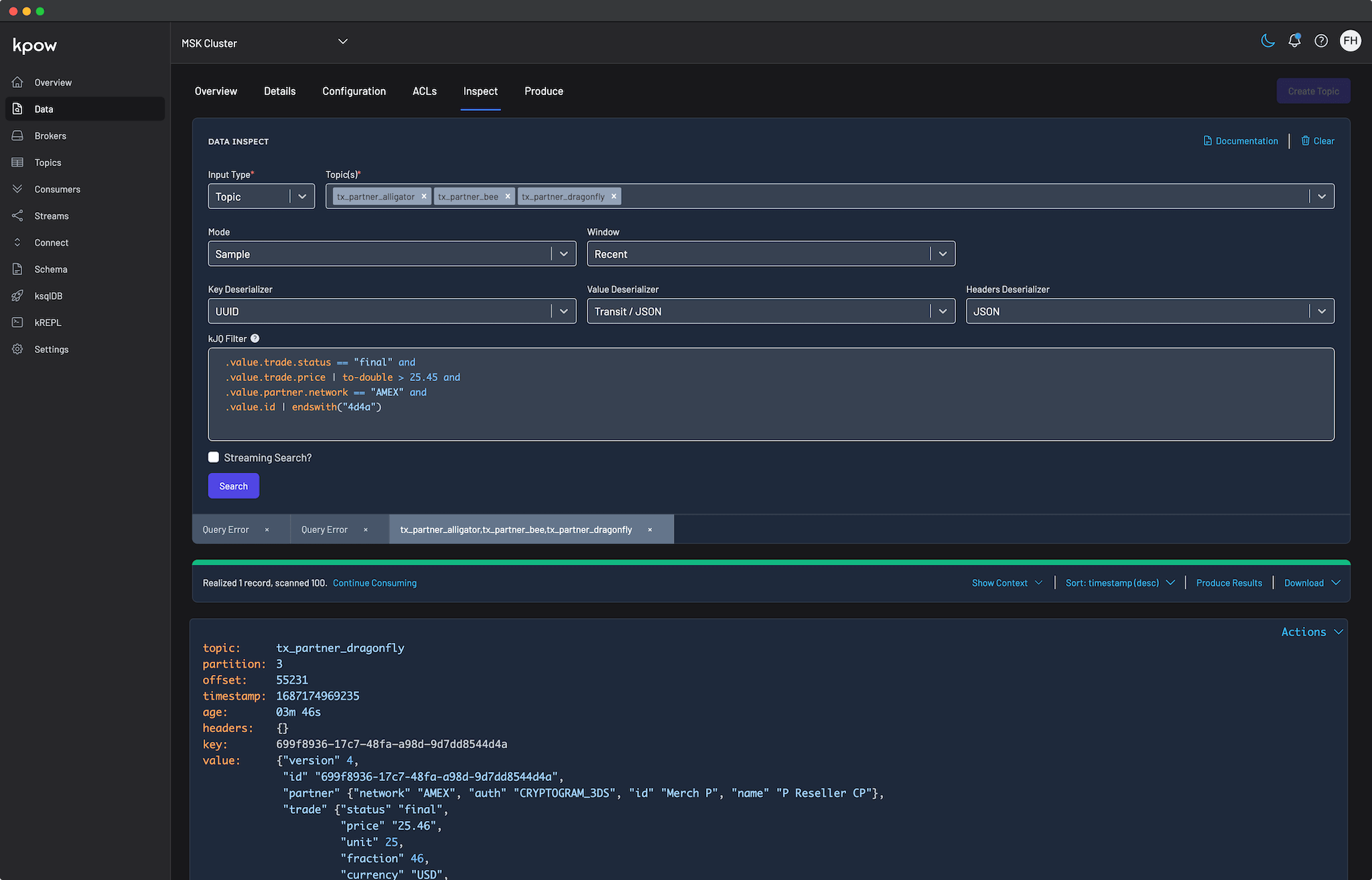
Problem: Compliance Risk in Production Environments
As organizations scale their streaming infrastructure, developers inevitably need to debug production issues. A failed transaction or a stalled consumer requires application teams to look at the exact data causing the problem.
This creates a severe "Compliance Gap". Production topics contain sensitive data. Regulatory constraints (such as GDPR, HIPAA, or SOC2) strictly prohibit exposing unmasked PII, financial records, or secure tokens to broad engineering teams. Organizations must find a way to let developers fix their applications without violating these critical privacy laws.
Limitations of Manual Access Control
To mitigate compliance risks, platform administrators typically enforce a total lockdown. They block all direct access to production Kafka clusters for anyone outside of a small group of trusted infrastructure engineers.
While this solves the security problem, it creates a massive operational bottleneck. Developers are forced into disconnected, manual ticketing processes. When an incident occurs, an application engineer must submit a ticket and wait for a platform engineer to manually execute CLI scripts, extract the relevant records, sanitize the logs by hand, and return the safe data. This bureaucratic process destroys developer velocity and wastes valuable platform engineering time.
Unified Declarative Governance with Kpow
Kpow eliminates this operational bottleneck by introducing transparent governance. By utilizing a "Defense in Depth" approach, Kpow secures both administrative actions and data payloads using a shared, declarative YAML resource taxonomy.
Tier 1: Action-Level Control with Granular RBAC
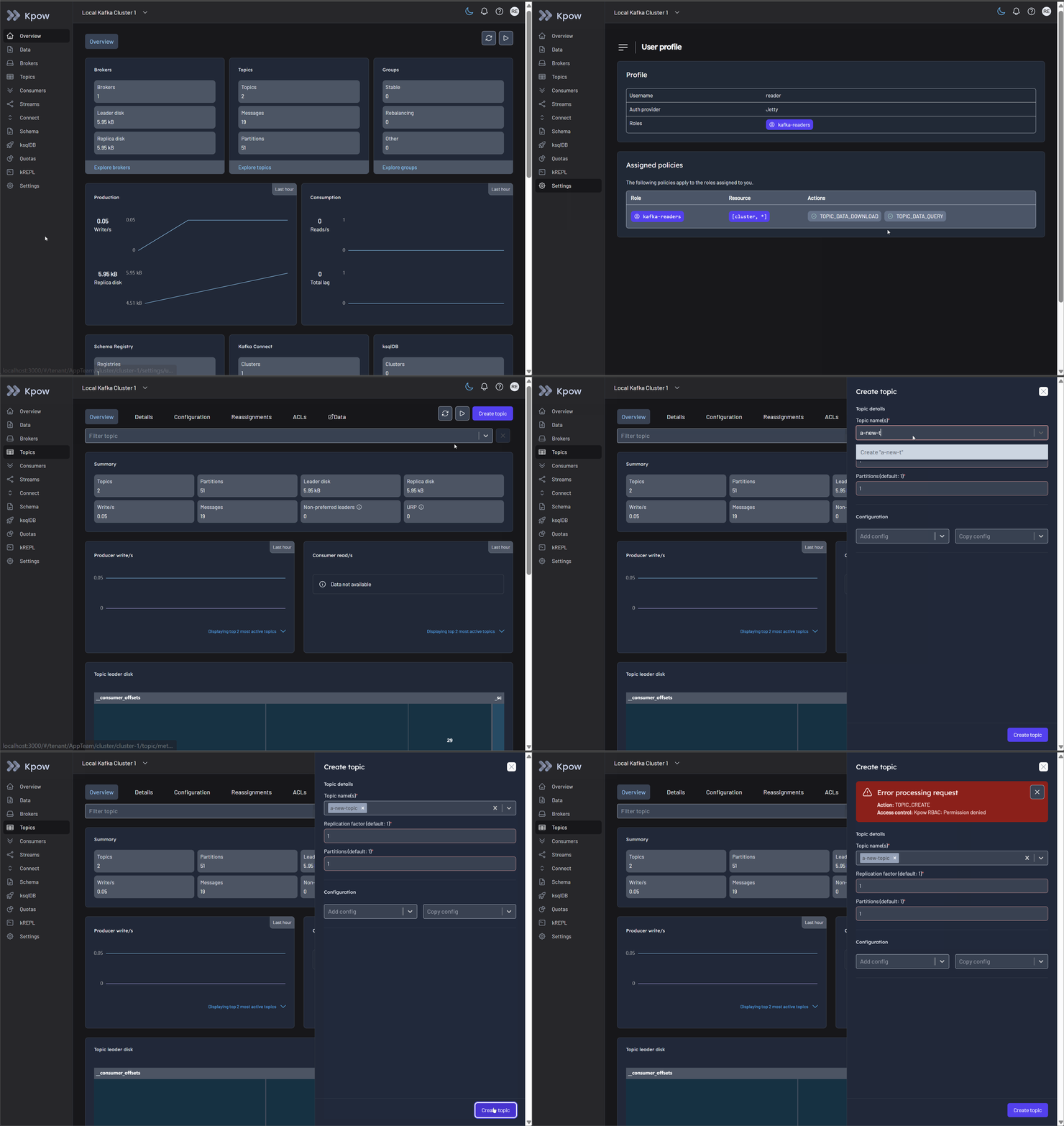
The first layer of defense controls what actions a user can perform. Kpow provides highly granular Role Based Access Control (RBAC), allowing administrators to map Identity Provider roles to precise permissions.
Platform administrators can safely grant a TOPIC_INSPECT action to application teams (such as a kafka-readers role) so they can view data. Simultaneously, administrators can enforce an implicit deny or explicit Stage effect on sensitive mutations like TOPIC_CREATE or TOPIC_PRODUCE. If a user with read-only access attempts to execute an unauthorized infrastructure change, Kpow actively prevents the action and logs the attempt.
Tier 2: Payload-Level Control with Data Policies
Action-level access is necessary but insufficient on its own. If a developer is permitted to inspect a topic, they still cannot be allowed to see raw financial data. Kpow solves this by layering Data Policies directly on top of inspection rules.
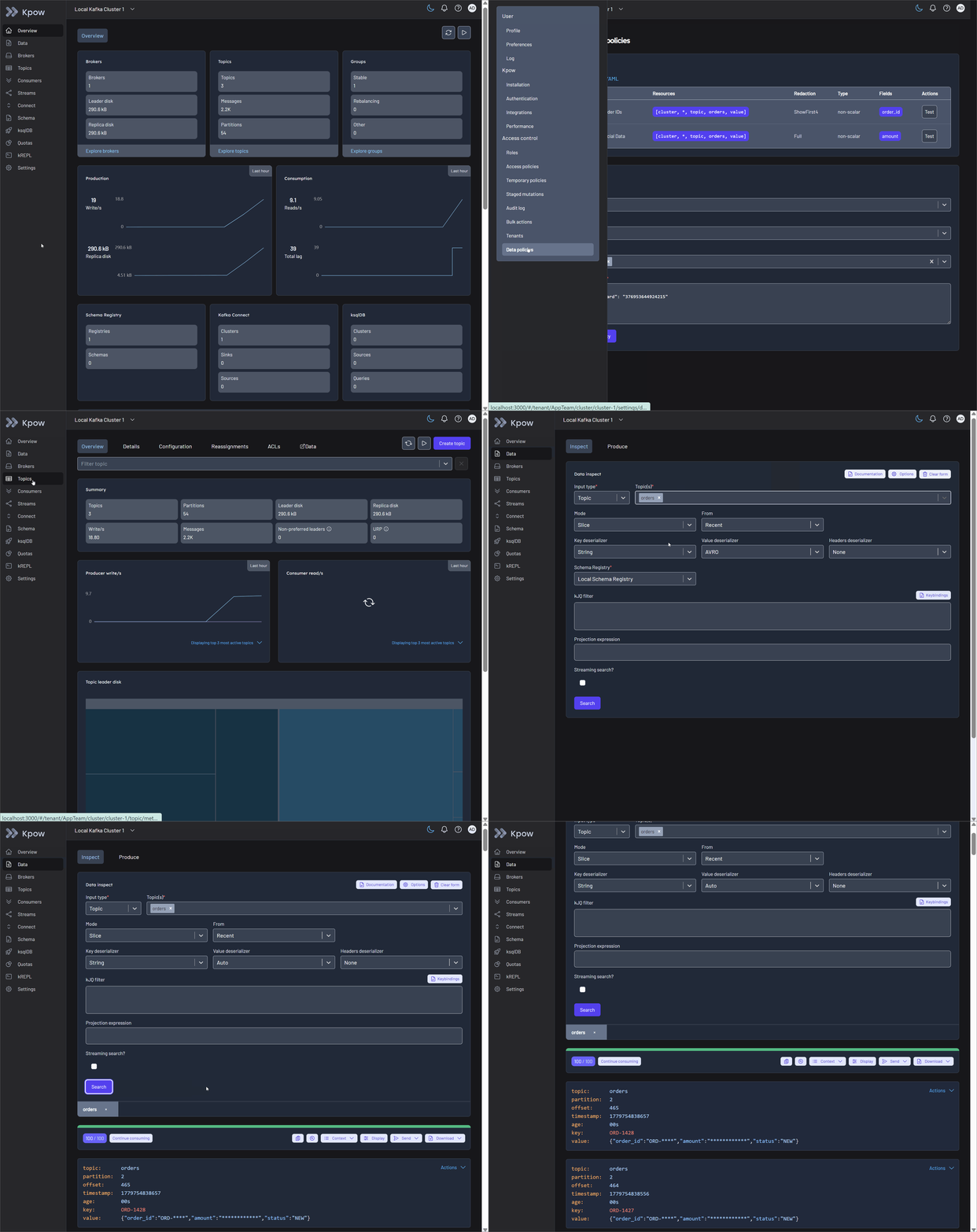
Data Policies apply nested redaction to specific fields automatically. For example, consider an orders topic containing a sensitive order_id and a financial amount. Administrators can define a policy that applies a ShowFirst4 redaction to the order_id and a Full redaction to the amount field.
When an authorized developer inspects the topic to debug a stalled order, Kpow automatically renders the masked record. The developer can verify the operational status of the payload without ever exposing the restricted values.
Ensuring Fail-Safe Protection
To guarantee regulatory compliance, Kpow builds fail-safe mechanics into its transparent governance model. If a schema evolves and a previously simple string field becomes a complex nested object, Kpow utilizes a conservative fallback mechanism. Rather than risking exposure by failing to apply a partial redaction, the system automatically defaults to a Full redaction for that field.
Furthermore, Kpow intentionally disables String SerDes options in the UI when Data Policies are active. This architectural choice prevents users from bypassing JSON or Avro deserialization to read the raw, unmasked bytes directly from the topic.
Conclusion
Combining granular RBAC with automated Data Policies completely breaks the disconnected ticketing bottleneck. Platform administrators no longer need to act as manual data extractors. By mathematically guaranteeing data security at both the action and payload levels, platform teams can finally offer safe, self-service debugging in production environments.
This concludes our four-part series on enterprise Kafka data management. By closing the Visibility, Velocity, Remediation, and Compliance gaps, organizations can eliminate operational friction. Unifying data inspection, AI-powered search, pipeline repair, and transparent governance ultimately transforms Kafka from a complex infrastructure burden into an engine that unlocks true engineering productivity.
Next steps
Explore Kpow in your own environment with a free 30-day trial.
If you need assistance managing your Kafka environment, reach out to our engineering support team at support@factorhouse.io.