
Kadeck: Review, pricing, and best alternatives in 2026
Table of contents


Key takeaways
- Kadeck is a commercial Kafka management tool from xeotek, available as a native desktop application and a Docker-based web/teams edition supporting Apache Kafka, Redpanda, and Amazon Kinesis.
- Reddit practitioners consistently recommend it for local development, topic inspection, and debugging — especially on managed clusters like Amazon MSK.
- The JavaScript QuickProcessor enables lightweight payload transformation and Dead Letter Queue recovery workflows without writing a full streaming application.
- The free tier caps message display at 100 records and limits cluster connections to one; teams managing separate Dev, Test, Stage, and Prod clusters will hit that ceiling quickly.
- The web edition runs exclusively in Docker with an online license check on every container start; teams in air-gapped environments need a separate offline activation process before deployment.
- For teams evaluating commercially supported alternatives with advanced RBAC and enterprise deployment options, Kpow from Factor House is worth examining alongside Kadeck.
What is Kadeck?
Kadeck is a Kafka management and data exploration tool built by xeotek, a German software vendor. It comes in two editions: a desktop application for Linux, macOS, and Windows, and a web/teams edition distributed as a Docker image. Both connect to Apache Kafka clusters and provide a graphical interface for browsing topics, inspecting message payloads, managing consumer groups, and working with ACLs and Schema Registry configurations. Redpanda and Amazon Kinesis are supported alongside Apache Kafka.
The product is commercially licensed and is not open source. [Emil Koutanov, DZone, March 2020] Registration on the xeotek website is required before using the web edition in any substantive capacity.
Kadeck was originally started in 2019 as a solo project by its founder, Benjamin Buick. Buick has noted in Reddit discussions that "hardly any of my original code is left and the team has grown considerably" since then. [Benjamin Buick, r/apachekafka] The tool has maintained an active presence in the Apache Kafka subreddit, where Buick has directly engaged with practitioners to promote and clarify the product's capabilities.
Kadeck review
Functionalities
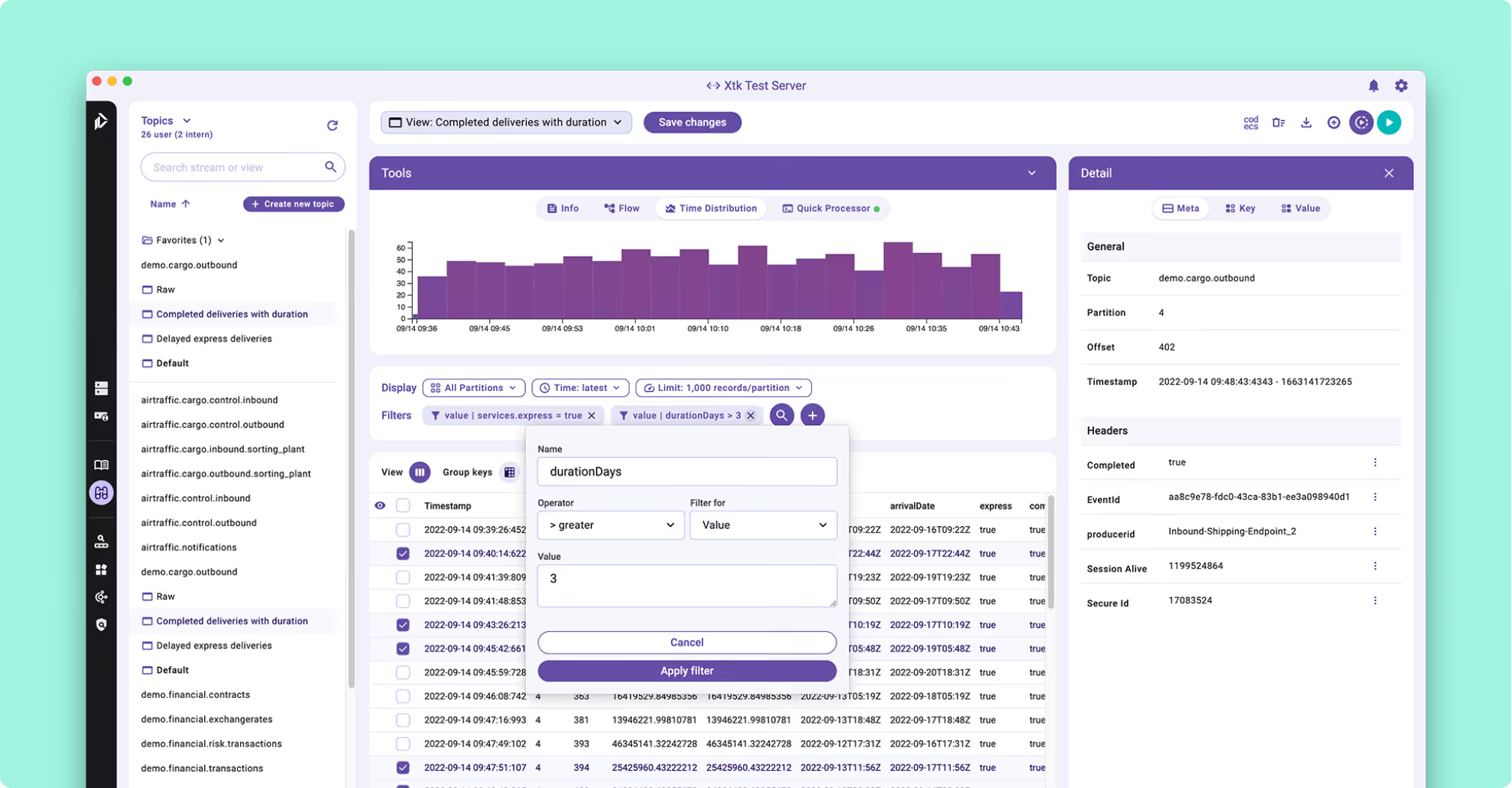
Kadeck's core strength is data exploration. It decodes Avro payloads via Confluent Schema Registry and presents structured records in a columnar layout, which is a practical improvement over reading raw bytes at the command line. A JavaScript-based Quick Processor lets users derive calculated fields from record values without writing a full streaming application. [Markus Günther, personal blog, mguenther.net, January 2021]
Reddit practitioners echo this assessment. In a thread on Kafka troubleshooting, user usualdev described their workflow as: "To check messages, topics and config I use Kadeck. There is another tool called Kafka Tool to check topics and messages as well. Both of these are cross platform." [usualdev, r/apachekafka] In a thread about Kafka tools for AWS managed Kafka, user lite-beer-1620 noted: "The Kadeck GUI management & monitoring tools for Kafka and MKS are also really good (and free)." [lite-beer-1620, r/aws]
Dead Letter Queue reprocessing. One well-documented use case is recovering malformed payloads from a Dead Letter Queue (DLQ) topic. Buick described the workflow in detail on Reddit: consumer applications write unprocessable records to a designated DLQ topic with an error attribute attached; developers then use Kadeck's Data Browser to isolate the failed records; the JavaScript QuickProcessor applies inline payload transformations; corrected records are previewed and re-ingested into the original source topic; and Kadeck's "Delete up to here" command purges the processed DLQ entries to prevent duplicate processing. [Benjamin Buick, r/apachekafka] This is a practical alternative to writing a one-off consumer-producer script for each recovery incident, though it requires a paid plan to inspect more than 100 records per query.
Schema documentation. Kadeck includes an external metadata layer that lets teams document schema fields without modifying the Schema Registry or bumping a schema version. Buick described the capability in a thread on updating field documentation: "We have just recently added topic documentation capabilities to Kadeck." [Benjamin Buick, r/apachekafka] This is useful for multi-team environments where consistent topic naming and field-level context need to be maintained outside the contract enforcement layer.
AI-assisted tuning. Kadeck 5.x introduced an AI Health Assistant for monitoring and cluster optimization. Independent practitioner assessment of this feature is limited: the most substantial commentary is a single Reddit reply describing it as "a game-changer for Kafka monitoring." [Mariobmf, r/apachekafka] No independent technical review of the feature has been located.
Several functional limits are documented by independent practitioners. The free tier displays only 100 records per query. [Anonymous G2 reviewer, g2.com, estimated 2022-2024] The export function is inconsistent between formats: CSV exports respect the column filters applied in the record table, but JSON exports do not, which means the two formats carry different data from the same view. [Markus Günther, ibid.] There is no mechanism to stream derived or transformed data back into a Kafka topic — Kadeck is read-oriented. Kafka Streams and ksqlDB are not integrated, a limitation Günther described as worth noting for teams with processing-oriented workflows. [Markus Günther, ibid.]
There is also no built-in deduplication filter to restrict the view to the newest record per key. [Markus Günther, ibid.]
Deployment and operations
The web and teams edition ships exclusively as a Docker image. There are no RPM packages, native binaries, or Helm charts for server deployment. [Guy Shilo, idata.co.il, September 2020] For production Kubernetes deployments, xeotek's own documentation recommends using a persistent external database.
Every container start triggers an online license validation call. For environments without outbound internet access, xeotek provides an offline activation path through the admin settings panel. [Guy Shilo, ibid.] Automated or ephemeral deployments — for example, spinning up Kadeck in a CI/CD pipeline — require handling a challenge-response license activation via xeotek's Public API before the container becomes usable.
The desktop edition does not require Docker. It installs natively on Debian/Ubuntu, macOS, and Windows and requires a Java runtime. An independent installation guide published in March 2024 did not report significant issues with the process. [kifarunix.com, March 2024] Apple Silicon and ARM support were added for both editions in 2024.
Using the teams edition requires registering on the xeotek website to receive a team ID and secret key before the application is fully functional. [Guy Shilo, ibid.]
Scale and query performance
Because Apache Kafka does not natively index message payloads, searching for specific records requires sequential partition scans. For topics in the hundreds of gigabytes, this scanning pattern can cause significant performance issues in any desktop-class GUI tool.
A data engineer on r/dataengineering described the limitation directly: their team had Kadeck set up by the cluster hosting team, but found it unusable for large-scale ad-hoc queries, eventually routing high-volume topic data to a parallelized layer instead. [Efxod, r/dataengineering] This is not a Kadeck-specific problem — sequential partition scanning will degrade any UI-based tool at sufficient scale — but it is worth accounting for when evaluating Kadeck for production debugging scenarios involving high-throughput topics.
For large-scale analytical queries, the practical path is to bypass GUI visualizers entirely and use parallelized engines such as PySpark, Databricks, or external data lakes rather than expect any desktop-oriented tool to handle the load.
Access control and security
Kadeck Teams includes role- and group-based access control with LDAP and OpenID Connect integration. The free tier of the teams edition includes password policies and basic audit logs, alongside namespace support for topics, ACLs, and consumer groups. [Capterra listing content, capterra.com]
One Capterra reviewer described the group management as working well for separating project teams, noting that it prevented users from accessing data outside their scope. [Anonymous Product Owner, Capterra, September 2021] No independent practitioner feedback on SSO reliability, RBAC granularity, or the completeness of audit logs was found in any source reviewed during research.
Connection limits and certificate management
The free tier of the teams edition is limited to a single active cluster connection. Multi-broker clusters are supported within that single connection, but connecting to multiple clusters — for example, separate Dev, Test, Stage, and Prod environments — requires a paid plan.
This surfaced directly in a Reddit thread on Kafka visualizers. User Jalebibabyded described looking for an open-source alternative because "we have multiple brokers from which the data needs to be fetched and Kadeck freemium is a limiting there." Buick clarified in the same thread: "We removed the broker restriction a while ago. Kadeck now supports clusters with multiple brokers even in the free version. However, the number of cluster connections is limited to one cluster (connection)." Jalebibabyded confirmed that was the sticking point: "Yes, that was the problem. Because I was looking at connecting to multiple clusters." [Jalebibabyded and Benjamin Buick, r/dataengineering]
Certificate management carries a similar constraint. In a recent thread on Kafka UI tools, user Quirky-Design3856 noted: "Me using Kadeck, though free version only offer one cert at a time, its UX is perfect." [Quirky-Design3856, r/apachekafka] For teams running multiple TLS-secured clusters with separate certificate authorities, this means either purchasing a commercial license or manually rotating credentials on each connection.
User interface
The UI receives consistent praise from the available review sample. Reviewers describe it as clean, modern, and a meaningful step up from CLI-based Kafka tooling. [David W., Solution Architect (IT Services), Capterra, August 2021; Christine U., SAP Consultant (Insurance), Capterra, August 2021; anonymous G2 reviewer, g2.com] One reviewer noted minor usability problems in earlier versions that the support team addressed quickly. [David W., ibid.] Another described it as making working with data from multiple sources straightforward, and cited the team features as time-saving in day-to-day work. [Christine U., ibid.]
Reddit commentary reinforces the UX narrative. The phrase "its UX is perfect" from Quirky-Design3856 — even in the context of raising a limitation — reflects the general tone of practitioner commentary on the interface. [Quirky-Design3856, r/apachekafka]
No independent practitioner assessments of the Kadeck 4.x or 5.x UI redesign were found within the last 36 months. All available feedback dates from 2021 or earlier.
Ecosystem
Kadeck supports Confluent Schema Registry for Avro payload decoding. Protocol Buffer support via Schema Registry was added in release 3.2.3. [Xeotek release notes, support.xeotek.com] Kafka Connect management and ACL configuration are included. Amazon Kinesis is listed as a supported data source alongside Apache Kafka and Redpanda.
Apache Pulsar is not supported, noted explicitly as a gap by at least one reviewer. [David W., Solution Architect, Capterra, August 2021] No independent practitioner feedback on ksqlDB, Apache Flink, Confluent Cloud, Amazon MSK, Aiven, or AWS Glue Schema Registry was found in any source reviewed.
Kadeck appears in the Confluent Community's reference list of third-party GUI tools for Apache Kafka but receives no user discussion in that thread. [Confluent Community forum, forum.confluent.io]
Customer support
All three Capterra reviewers mentioned support in positive terms. One described receiving answers within minutes to questions that extended beyond Kadeck's direct scope into general Kafka troubleshooting, and encouraged the team to "keep it up." [Anonymous Product Owner, Capterra, September 2021] Another noted the support team reacted quickly. [David W., Capterra, August 2021] xeotek has documented conducting structured sessions with users to gather product feedback, and states that critical input from those sessions was incorporated into the Kadeck 4.0 redesign. [Xeotek blog, Kadeck.com]
The confidence limit here is the review sample itself: three reviews, all from 2021, all 5-star. No complaints about support quality appear in any source reviewed, but no commentary on enterprise tier support, SLA differences, or documentation quality was found either.
Best for
Kadeck suits small-to-medium development and QA teams that want a polished graphical interface for data exploration, debugging, and lightweight governance without writing custom scripts or living in the CLI. The desktop edition is a reasonable choice for individual developers on macOS, Windows, or Linux who need a native Kafka browser without a Docker dependency. The teams edition suits environments where a Docker deployment model is already established and group-based access control at the namespace level is sufficient.
Reddit community feedback broadly confirms this positioning: practitioners reach for Kadeck when they want a clean, accessible interface for inspecting topics and debugging consumer behaviour, particularly on managed clusters like Amazon MSK where CLI access is more cumbersome.
It is a less natural fit for teams requiring an open-source-licensed tool, for air-gapped environments that want a simpler deployment model without online license activation, for any workflow that requires streaming derived data back into Kafka topics, for teams managing multiple clusters on the free tier, or for production debugging scenarios where you need to inspect more than 100 records without a paid plan.
Kadeck pricing
The following describes what is confirmed in independent and vendor sources.
Pricing tiers
Kadeck Teams has a free tier: up to five users, with message display capped at 100 records per query. The free tier includes password policies, basic audit logs, namespace support, and group-based access control. Beyond five users, or for teams that need to remove the 100-record display cap, commercial paid tiers apply. Paid tier pricing is user-based, starting at $25 USD per user per month for Professional, and $32 USD per user per month on their flagship Enterprise plan. For a team of 100 engineers, the flagship plan would cost $3,200 USD per month, equivalent to $38,400 per year.
Free trial
A free tier is available for the teams edition within the five-user and 100-record limits described above. Registration on the xeotek website is required to obtain a team ID and access credentials before using the tool.
Kadeck competitors and alternatives
The Kafka management tooling market includes a mix of open-source projects and commercial products. Open-source options typically carry strong community familiarity but require self-managed deployment and tend to offer limited access control out of the box. Commercial tools trade some flexibility for stronger governance features, vendor support, and defined roadmaps.
Reddit discussions reflect this trade-off clearly. In a thread on UI tools for AWS-managed Kafka, developer JohnPreston72 noted a preference for commercial tooling once open-source options are outgrown: "I tried and used nearly all the open source ones. Winner for me was AKHQ before trying Conduktor. I now use Conduktor for work and well worth the money." In the same thread, armanduco_ expressed satisfaction with AKHQ for lighter requirements: "In my company we use AKHQ, it's simple but enough to retrieve some important information." [JohnPreston72 and armanduco_, r/apachekafka]
For a broader comparison of Kafka management tools, see [our Kafka management tools guide] [placeholder — link to be added].
Frequently asked questions about Kadeck
How much does Kadeck cost, and is there a free tier?
Kadeck Teams has a free tier covering up to 5 users and 100 records displayed per query. It includes password policies, audit logs, and group access controls. Paid tier pricing is user-based, starting at $25 USD per user per month for Professional, and $32 USD per user per month on their flagship Enterprise plan. For a team of 100 engineers, the flagship plan would cost $3,200 USD per month, equivalent to $38,400 per year.
When is Kadeck a better choice than the alternatives?
Kadeck is worth considering if you want a native desktop client on macOS, Windows, or Linux without a Docker dependency, or if a small team needs a clean visual Kafka browser and basic group-based access control within the five-user free tier limit. Reddit practitioners particularly rate it for local development and debugging on managed Kafka clusters.
When are the alternatives a better choice than Kadeck?
If you need open-source licensing, a deployment model without an online license check, stream processing or write-back capability, Apache Pulsar support, multiple simultaneous cluster connections without a paid plan, or the ability to inspect more than 100 records per query without upgrading, other options are worth evaluating first.
Is Kadeck actively maintained?
xeotek released Apple Silicon and ARM support for both editions in 2024 and has documented a 5.x release including an AI Health Assistant. Independent practitioner discussion is sparse compared to tools like AKHQ or Kafbat, and the most recent located independent reviews date from 2021. Buick remains personally active in the Apache Kafka subreddit, where he has engaged directly with user questions and promoted new features.