
Confluent Control Center: Review, pricing, and best alternatives in 2026
Table of contents


Key takeaways
- Confluent Control Center is built exclusively for Confluent Platform. It cannot monitor Amazon MSK, Redpanda, or Aiven clusters, and requires the proprietary Confluent Metrics Reporter JAR installed on each broker.
- The next-generation Control Center, released with Confluent Platform 8.0 in May 2025, reduced startup time from up to 50 minutes to approximately one minute, but upgrading from the legacy version is a full migration that discards all historical metrics.
- Pricing is the most frequently cited complaint across practitioner reviews; Control Center, multi-tenancy support, and encryption each carry costs beyond the base Confluent Platform licence.
- IBM's acquisition of Confluent, completed in March 2026, is actively prompting installed-base customers to evaluate alternatives, citing concerns about future pricing pressure and roadmap direction.
- At large cluster scale, the legacy interceptor-based telemetry architecture creates measurable overhead: Control Center adds approximately 50 internal topics to broker metadata and can become unresponsive when the number of consumer groups is high. Many enterprise teams bypass it for production alerting, using Prometheus with Grafana instead.
- For teams that need Kafka tooling across distributions, or that cannot accept Confluent's pricing and ecosystem constraints, alternatives such as Kpow offer broader distribution support with more predictable per-cluster pricing.
What is Confluent Control Center?
Confluent Control Center is a web-based management and monitoring interface bundled with Confluent Platform, Confluent's commercial Kafka distribution. It provides a single dashboard for monitoring brokers, topics, consumer groups, Kafka Connect workers, Schema Registry, ksqlDB, and Kafka Streams topologies across Confluent-managed clusters.
Two generations of Control Center are currently in active deployment. The legacy version, shipped with Confluent Platform 7.x and earlier, has been widely deployed since Confluent's earliest commercial releases. The next-generation Control Center, released as generally available with Confluent Platform 8.0 in May 2025, replaces the internal Kafka Streams-based metrics pipeline with a Prometheus-based architecture and delivers substantially faster startup and improved partition scale limits.
Control Center is closed-source and requires an enterprise Confluent Platform licence. It is not available as a standalone product.
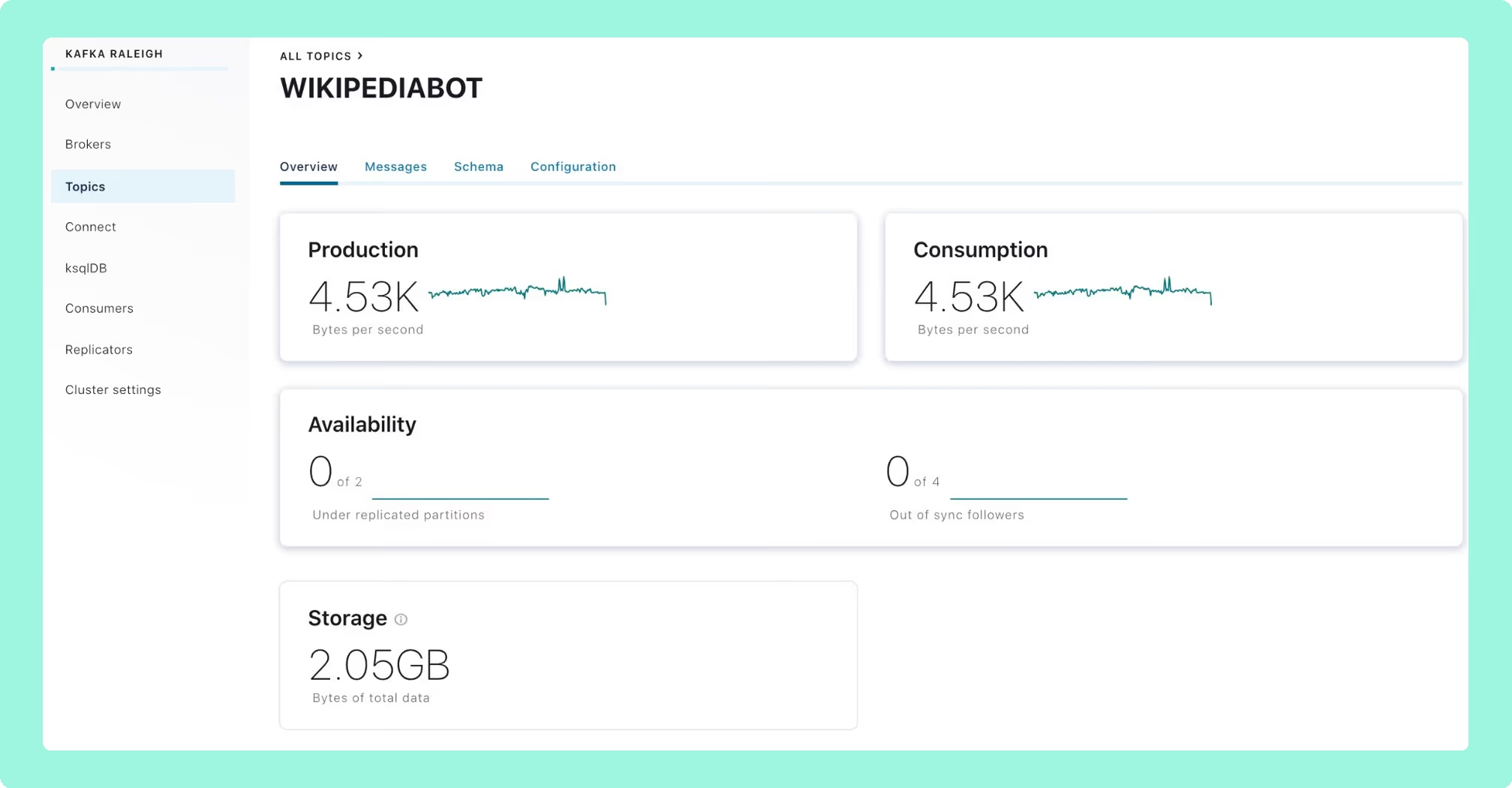
Confluent Control Center review
Functionalities
Control Center offers comprehensive monitoring within the Confluent ecosystem. Practitioners describe it as providing "a panoramic view into all the elements in Confluent Platform: brokers, consumers, Connect workers, ksqlDB objects." [Ben, Confluent Community Forum, February 2021] The monitoring module has been described as "impressive" by at least one named enterprise reviewer. [Ahmed Emad, Territory Sales Leader at Sumerge, PeerSpot, January 2024]
The specific functional differentiators that justify Control Center over open-source alternatives are Kafka Streams topology visualisation and native ksqlDB development integration. No open-source Kafka UI provides a comparable native view of these Confluent-specific components.
Consumer lag monitoring has documented boundaries. Consumers using the assign() method rather than subscribe() are not tracked, and Metrics API lag values do not update during a rebalance. [Confluent documentation] A UI rendering bug also affects compound, nested Avro keys in the Topics > Messages view; because Control Center has no public issue tracker, there is no way for users to monitor for a fix. [Ben, Confluent Community Forum, February 2021]
Deployment and operations
The legacy Control Center has a well-documented reputation for slow startup and high resource consumption. Confluent's own engineering blog acknowledged startup times of 15 to 50 minutes after a restart, and described customer ABANCA's experience of service restarts as "tedious." [Philip Wang and Surabhi Singh, Confluent Engineering Blog, May 2025] The next-generation release reduces startup to approximately one minute, increases partition scale support from 120,000 to 400,000, narrows metrics freshness to two to three minutes, and eliminates the requirement for a separate Kafka cluster to store metrics. [Philip Wang and Surabhi Singh, Confluent Engineering Blog, May 2025]
The upgrade path from legacy to next-gen is a full migration, not a standard upgrade. Historical metrics do not carry over, and Confluent recommends running both versions in parallel for 7 to 15 days. Starting with CP 8.0, Confluent Monitoring Interceptors are also removed; teams that embedded interceptors for producer and consumer tracing will need to reconfigure for the Prometheus-based architecture. [Confluent documentation; Confluent release notes]
Interceptor overhead at scale. In the legacy architecture, Control Center relies on client-side interceptors to collect producer and consumer telemetry. A practitioner on r/apachekafka warned that deploying Control Center with interceptors "will add like 50 topics to your kafka brokers." [xkillac4, r/apachekafka] At high consumer group counts, this metadata burden can become structurally unworkable. One platform engineer on the same thread described the scale failure directly: "Interceptors destroy CCC with the number of consumers/consumer groups we have." [lord_pirax, r/apachekafka] The same engineer noted that restarts without wiping state or changing the application ID were unreliable on their cluster. These are cluster-size-dependent conditions; the same engineer explicitly noted that "for people without crazy clusters: CCC will probably work fine."
A documented practitioner response to this overhead is to decouple monitoring from Control Center entirely. On the same thread, an engineer stated: "I use Prometheus with the Confluent provided Grafana dashboards for all production deployments even when the Confluent Control Center is present." [aerialbyte, r/apachekafka] This pattern of treating Control Center as an ad-hoc debugging tool while routing production alerting through external Prometheus pipelines is reported across multiple community discussions.
Several operational issues in the legacy version remain unresolved. A user running version 7.5.0 reported continuous RAM growth until all available memory was exhausted, with no vendor response. [NhatDuy11, Confluent Community Forum, November 2024] Control Center 7.6.0 on Confluent for Kubernetes was separately reported to stop after a few hours with RackId doesn't exist for process errors; the GitHub issue remained open with no assigned owner. [Mohamed Aziz Tousli, GitHub issue #305, confluentinc/confluent-kubernetes-examples, June 2024] A recurring pattern involves Kafka Streams entering a rebalancing loop on startup, leaving the UI on a "Loading data" spinner for 20 to 30 minutes. Confluent's own mitigation recommends dedicated hardware at the level of an m4.2xl instance with 6 GB JVM heap and 8 stream threads, meaning Control Center can require compute comparable to the brokers themselves. [Elizabeth Bennett (Stitch Fix) and Xavier Léauté (Confluent), Google Groups, April 2017 — older source, flagged; deployment-sizing guidance confirmed in current Confluent documentation]
Horizontal Pod Autoscaling is not supported for Control Center pods in Kubernetes, and the cp-helm-charts repository was archived in February 2024, narrowing the supported Kubernetes deployment path to Confluent for Kubernetes (CFK). [Confluent documentation; GitHub, confluentinc/cp-helm-charts]
GitOps and configuration drift. A related operational concern for teams managing Control Center via CFK or Helm is configuration drift. Any cluster changes made through the Control Center UI — connector configurations, topic settings — are applied directly to the cluster state rather than through the declarative Git-managed manifest. One DevOps engineer noted the specific friction: "Only problem I have is not being able to easy persist my connector configs or being able to mount them as configmaps." [r/devops] Teams running strict GitOps pipelines need to treat Control Center as a read-only observability surface in production, or accept that UI-driven changes will diverge from the declared state.
Access control and security
RBAC in Control Center covers the expected enterprise use cases, with audit logging available for authentication and authorisation events across Confluent-managed clusters. [Confluent documentation]
The most consequential security limitation for many organisations is that SAML SSO is not supported for self-managed, on-premises Control Center deployments. OIDC is the only supported SSO protocol for Confluent Platform; SAML is available only on Confluent Cloud. [Confluent documentation] Teams with a SAML-only identity provider have no supported path for SSO on self-managed deployments.
Initial RBAC setup requires the SystemAdmin role for the first role bindings, and in RBAC-enabled environments you cannot send only metrics to Control Center: full management must be enabled, which is an all-or-nothing constraint. [Confluent documentation] A scale limit of 10,000 rules per cluster adds friction for fine-grained access management at larger deployments. [Anonymous tech manager at a 1,001-5,000 employee tech services company, PeerSpot, August 2024] Principals who are Kafka super.user but have no RBAC role assignment cannot view or assign roles through the UI; the CLI must be used as a workaround. [Confluent documentation]
ACL configuration is a recurring pain point in community discussions. One engineer running Control Center in production described the experience as: "ACLs wise, was a pain, as for most of the confluent components, where ACLs are not really well documented." [r/devops, Gathering opinions on Kafka management tools] This documentation gap is particularly notable given that RBAC is one of the headline enterprise features Confluent uses to justify the licence cost.
User interface
Practitioners who use Control Center within the full Confluent Platform describe it as feature-rich and appropriate for day-to-day operations. One named reviewer called it "more than just an ordinary topic checking tool," while a named solutions architect offered a less favourable view: "From the control center perspective, there is a lot of room for improvement in the visualization." [German Osin, Towards Data Science, September 2021; Ravi Bhati, Solutions Architect at a 10,000+ employee tech services company, PeerSpot, October 2021]
The production versus ad-hoc distinction is a consistent thread in community feedback. One platform engineer summarised the trade-off concisely: Control Center is "great for debugging" but "sadly not really reliable/stable/performant" as a continuous production observability tool. [lord_pirax, r/apachekafka] This matches the pattern of enterprise teams who keep Control Center available for incident investigation while routing routine alerting to Prometheus. A separate report from a practitioner running a local or dockerised instance described the experience as buggy, with errors not surfacing correctly, plugin integration issues, and no historical data available. [Accomplished-Map-984, r/apachekafka]
The next-generation UI has received positive feedback. A known WebKit issue in Safari causes authentication failures when browsing topic messages; the documented workaround is Chrome or Firefox. [Confluent documentation] In the legacy version, the "Initialising" spinner can persist for 20 to 30 minutes after a restart, which is most disruptive during incidents. [Google Groups, April 2017; pattern confirmed in current Confluent troubleshooting documentation]
Ecosystem
Control Center integrates natively with Kafka Connect, Schema Registry, ksqlDB, and Kafka Streams. Schema Registry integration in particular receives positive mention: one software architect credited it with "significantly enhancing our organisation's data quality assurance." [Gustavo Barbosa dos Santos, Software Architect at C&A Brasil, PeerSpot, January 2024]
The hard boundary is distribution compatibility. Control Center requires the Confluent Metrics Reporter JAR installed in broker classpaths to function fully. This prerequisite cannot be satisfied on Amazon MSK, Redpanda, or Aiven, and MSK's native IAM authentication is not supported. The result is that Control Center is not viable for any team outside a pure Confluent Platform deployment. [Factor House, March 2026; Hayato Shimizu, AxonOps Blog, December 2025]
IBM's acquisition of Confluent, completed in March 2026, has introduced meaningful uncertainty about pricing and roadmap direction. One VP Engineering at an unnamed fintech company stated: "We started evaluating alternatives the day the acquisition was announced. Not to leave Confluent, but to understand our options." [Stéphane Derosiaux, Medium, December 2025]
Customer support
Enterprise tier users generally describe Confluent support as responsive. Below that tier, most issues are handled through documentation and community forums. "We continuously face issues, such as Kafka being down and slow responses from the support team," noted one SDE II at Nutanix. [Mayank Aggarwal, PeerSpot, February 2025]
A recurring pattern across practitioner reviews is that the complexity of getting Control Center to work correctly requires deep engagement with Confluent professional services, and results have not always matched the investment: one reviewer described "many problems and limitations during implementation despite professional services." [IT Security and Risk Management Associate at an IT services company, Gartner Peer Insights, January 2025 — anonymous, flagged; included for pattern]
Because Control Center is closed-source, there is no public issue tracker. A GitHub issue raised in September 2024 proposing that the README be updated to state clearly that an enterprise licence is required remained open with no vendor response, pointing to a recurring source of user confusion. [Mark Sallee, GitHub issue #105, confluentinc/control-center-images, September 2024] The Platinum support tier is not available; the maximum is Enterprise, with quarterly patch updates for the current version only. [Confluent documentation]
Pricing is the most consistently cited complaint across practitioner platforms. Multiple named reviewers describe multi-year contracts as "very costly" and rate pricing at 5 to 6 out of 10. "High fees while not offering features that match those of other tools" and "hundreds of configurations that application teams must understand" are both flagged as operational burdens. [PavanManepalli, Wells Fargo, PeerSpot, September 2025; RameshJogula, PeerSpot, April 2024; Praveeen Manvi, PeerSpot, March 2024; Clara Riva, PeerSpot, November 2023] Community feedback reinforces this: one engineer, asked why their team uses Control Center, replied simply: "we pay for it so might as well use it." [r/devops, Gathering opinions on Kafka management tools] For teams running open-source Kafka rather than full Confluent Platform, the licensing cost of Control Center is rarely justified by features that modern open-source alternatives do not cover. [r/apachekafka community consensus]
Best for
Control Center is a well-matched tool for organisations running Confluent Platform on-premises or on their own infrastructure, with the full stack in place: Kafka Streams, ksqlDB, Kafka Connect, and Schema Registry. If Kafka Streams topology visualisation or native ksqlDB tooling integrated with your monitoring UI is a hard requirement, there is currently no open-source alternative that provides an equivalent view.
It suits large enterprise deployments where the Confluent ecosystem is already established and where in-house Kafka operations are not the preferred model. [Mayank Aggarwal, Nutanix, PeerSpot, February 2025] Community experience also suggests it is effective as an ad-hoc debugging and incident investigation tool, even for teams who have moved routine alerting elsewhere.
It is a weaker fit for teams on MSK, Redpanda, or Aiven (where it simply cannot function), for organisations that require SAML SSO for self-managed tooling, for cost-sensitive or smaller environments, and for teams running mixed-distribution environments or actively managing vendor lock-in risk in the wake of the IBM acquisition. Teams operating at high consumer group counts should evaluate the interceptor overhead against their broker capacity before committing to the legacy architecture.
Confluent Control Center pricing
Confluent Control Center is not priced or sold separately. It is bundled with Confluent Platform under an enterprise licence. Pricing is not published and requires direct engagement with Confluent's sales team.
Pricing tiers
Confluent Platform is sold under an enterprise licence. Features including Control Center, multi-tenancy support, and encryption carry costs beyond the base tier, meaning the all-in cost of a production Control Center deployment is higher than the licence headline suggests. Multiple named practitioners rate pricing at 5 to 6 out of 10 and describe multi-year contracts as "very costly." [RameshJogula, PeerSpot, April 2024; Clara Riva, PeerSpot, November 2023; Praveeen Manvi, PeerSpot, March 2024] Additional charges for scaling have also been noted: "They charge a lot for scaling, which makes it expensive." [Mayank Aggarwal, Nutanix, PeerSpot, February 2025]
The Enterprise licence includes quarterly patch updates for the current version only. The Platinum support tier is not available for Control Center. [Confluent documentation]
Free trial
A time-limited evaluation of Confluent Platform may be available through Confluent's website.
Confluent Control Center competitors and alternatives
For teams evaluating Kafka management tooling in 2026, the competitive landscape ranges from lightweight open-source options to commercial platforms designed for multi-distribution or multi-technology environments. The most important filtering decision is which Kafka distribution you run: if you are outside Confluent Platform, Control Center is not in the running.
For a broader comparison of Kafka management tools in 2026, see Top Kafka UI tools in 2026: a practical comparison for engineering teams.
Frequently asked questions about Confluent Control Center
How much does Confluent Control Center cost, and is there a free tier?
Control Center is bundled with Confluent Platform under an enterprise licence. Pricing is not published. Named practitioners rate it 5-6 out of 10, describing multi-year contracts as very costly. Additional charges apply for Control Center, multi-tenancy, and encryption beyond the base licence.
When is Confluent Control Center a better choice than the alternatives?
If you run Confluent Platform on-premises with Kafka Streams and ksqlDB, Control Center provides native topology visualisation and ksqlDB tooling that no open-source alternative matches. The next-gen release (CP 8.0, May 2025) also resolves longstanding startup time and partition scaling complaints. It is also well-regarded as an ad-hoc debugging and investigation console even by teams who use external tools for production alerting.
When are the alternatives a better choice than Confluent Control Center?
If you run Amazon MSK, Redpanda, or Aiven, Control Center is not viable. Teams that need SAML SSO for self-managed deployments, have cost constraints, operate at high consumer group counts where interceptor overhead becomes a concern, or are managing mixed-distribution environments will find broader support and more predictable pricing elsewhere.
Does Confluent Control Center work with Amazon MSK?
No. MSK's native IAM authentication is not supported, and the Confluent Metrics Reporter JAR (required for full Control Center functionality) cannot be installed on MSK broker classpaths. Control Center is not a viable option for MSK deployments.
What changed in the next-generation Control Center released with CP 8.0?
CP 8.0 (May 2025) cut startup from 15-50 minutes to ~1 minute, raised partition support from 120,000 to 400,000, and improved metrics freshness to 2-3 minutes. The new release also removes the legacy interceptor-based telemetry architecture in favour of Prometheus, which eliminates the interceptor overhead that affected large-scale deployments. Upgrading from the legacy version is a full migration; historical metrics do not carry over.